eBook - ePub
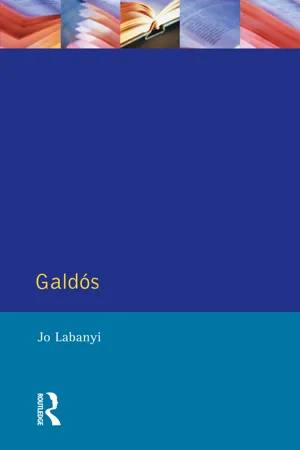
Galdos
About this book
Benito Perez Galdos has been described as 'the greatest Spanish novelist since Cervantes.' His work constitutes a major contribution to the nineteenth-century novel, rivalling that of Dickens of Balzac and making him an essential candidate for any course on the fiction of the period.
Jo Labanyi's study is supported by a wide-rangting introduction, a section of contemporary comment, headnotes to each piece and helpful appendix material.
Information
Part One
Contemporary Documents
1 | Some Observations on the Contemporary Novel in Spain* |
Written in 1870, the year of publication of Galdós’s first novel, this article is his earliest statement of literary priorities. Given that Galdós’s novels prior to Doña Perfecta (1876) were, with the exception of The Shadow, historical, it is interesting that here he comes out in favour of the novel of contemporary life. Despite the hostility shown to French culture, the influence of Balzac, whose work he had first encountered in 1867, probably lies behind his stress on the importance of observation. Galdós’s isolation of Cervantes as a model here is deceptive: what he will take from Cervantes is not observation but his fascination with obsession and ironic self-reflexivity. Galdós’s mention of the vitality of popular fiction is worth noting, since much of his own work draws on popular melodrama. His laments about the lack of a reading public in Spain are echoed by contemporaries, and show a keen awareness of the role of the public, and of modes of production such as serialization, in shaping literary trends; much of his life was taken up with devising schemes for selling his novels. Most noticeable is Galdós’s sensitivity to the changing shape of the Spanish class structure, and his interest in relations between the various classes. His rejection of regionalism for a novel of the urban middle classes and the world of commerce stands as a manifesto for his own future work. Feminist critics will note his awareness that the family is the key to bourgeois ideology, and that the domestic ideal is under threat from its internal contradictions.
I
The great mistake made by most of our novelists is to have brought in extraneous elements dictated by fashion or convention, while completely neglecting those which present-day Spanish society offers them in such abundance. That is why we have no novel to speak of; the majority of those works which, claiming to be novels, feed the insatiable curiosity of an over-frivolous public are destined to enjoy a brief life thanks only to the superficial reading of a few thousand people, who turn to these books simply for momentary distraction or passing pleasure. There can surely be no country or period in history which has seen a more lamentable or less successful attempt to create a novel of its own than that of Spanish writers in recent years. […]
People who like to find explanations for such things have claimed that we Spaniards have little capacity for observation and thus lack the main virtue needed to create the modern novel. […] It is true enough that we Spaniards are incorrigible idealists, who prefer to imagine rather than observe. It is also plain that there is no one less practical in a whole range of activities than the Spaniard, even though in days gone by we managed to create such a stir in the world. Men of letters are by no means exempt from this particular disposition of our national character. However it is, I think, undeniable that this tendency is more an accidental product of the special conditions of our age than something innate and truly characteristic. If we examine the quality of observation in our earlier writers, we can see that Cervantes, the greatest genius our country has produced, was so richly endowed with it there can surely be no writer in ancient or modern times to match, let alone better, him. Turning to another branch of the arts, what was Velázquez if not the greatest of observers, the painter with the keenest eye and greatest skill in capturing nature? The capacity for observation does exist among us; it must be the terrible degeneration afflicting us nowadays that cloaks and stifles it. We need to look for the causes of the parlous state of our literature, the poverty of our novel, in the external conditions affecting us, in our social make-up, perhaps in the weakening of our national spirit, or in the continual crises that have assailed us without respite. The novel is a true son of peace: unlike heroic or jingoistic literature, it can prosper only in quiet times, and in our day and age there are few pens which are not thrown into some political battle or other. The only thing expected of the greatest talents of our day is that they produce magnificent diatribes.
We also have to take into account the lamentable state of literature as a profession. The dominant mood among our impoverished men of letters is one of dismal gloom. Asking them to produce serious, honest works of purely literary interest is like asking for the moon. They are far too busy rushing from one newspaper to the next to gain a livelihood, which mostly eludes them; the crowning reward for their labours, the goal of all their endeavours, is to see themselves installed in an office, that pantheon of Spanish glory. […]
In the meantime, despite what people say, reading is popular and we Spaniards read all kinds of things: politics, literature, poetry, art, science, and above all fiction. But those readers, those Spaniards who like to buy a novel, who devour it from cover to cover and genuinely appreciate its craftsmanship, are catered for by a special market. For the demands of this particular public determine the kind of novel produced. They want something tailored to suit their tastes, they sample what is available and put in their orders made to measure; and the customer must needs be satisfied. This explains why, instead of a national novel based on observation, we are saddled with a conventional, bland variety churned out to order, a plague imported from France which has spread with the dizzying speed of all contagious diseases. The public said: T want pale, shifty villains, angelic dressmakers, harlots with haloes, fatally flawed duchesses, romantic hunchbacks, scenes of adultery, extremes of love and hate’, and that is what it has been given. Satisfying its tastes was easy enough, for such contraptions are turned out with amazing ease by anyone who has read a couple of novels by Dumas and Soulié.1 The writer does not take the trouble to write anything better, because he knows he will not be rewarded for it; and I think we need look no further for the reason why we have no novel in Spain today. The one literary genre which our unfortunate writers have cultivated with some success, and which manages to support a few small publishing firms, is this novel of sentiment and action. Reading this kind of literature has had a profound effect on the youth of today, shaping our upbringing and possibly marking us for life. […]
II
This novel of sentiment and action aimed purely at the distraction and entertainment of a certain type of reader has achieved what it set out to achieve, namely to flood Spain with a disastrous plague in the form of the proliferation of printed matter that has made the modern publishing industry. Part works, a brilliant invention from an economic point of view, are the scourge of serious art. They represent the extension of journalism to all forms of literary expression, and confirm a current tendency to adopt in all things the English principle of making a little go a long way, which that nation is so good at applying universally. First and foremost, these part works substantially increase the opportunities for publicity. Split up in this fashion, a book enters every home page by page, and is accessible to those of even the most modest means. Yet it would not be fair to put all the blame on this system; that is not where the main problem lies. Because it is such an excellent distribution system, serialization has broadcast works of little worth; but it could just as easily disseminate things of merit, giving them a mass circulation with the speed and accessibility of newspapers. […]
There have also been attempts here in Spain to create the upper-class salon novel, but this is a breed which adapts to new conditions with difficulty. In general these attempts have little value, being scarcely more than pale, botched imitations of the French genre of boudoir literature. The blame for this lies in the French way of life which our aristocrats have adopted, thereby losing all their own distinguishing features. […] The aristocracy in Spain today takes no risks, makes no show of passion; it is no longer devoted to bullfighting, no longer a model of hypocrisy. It is a class perfectly at ease with the spirit of modernity, which helps rather than hinders the progress of civilization, co-existing quietly and peacefully in the midst of a civilization it neither dominates nor leads, content with its role, contributing to the collective life of the nation as far as its power and influence permit, mixing with the rest of us during the day before withdrawing at night into the sanctuary of its salons, which anyway are accessible nowadays to all manner of mortals. Moreover, lovers of the picturesque and idiosyncratic will find this aristocracy rather ordinary: the adoption of French rituals for all their ceremonies, the constant use of the French language and rules of etiquette, their love of, or rather mania for, elegant voyages, has completed this levelling process, making them akin to the nobility everywhere. All of this has made the salon novel, based essentially on notions of elegance and sport, an exotic, short-lived bloom in Spain. It is also true that the circle of our high society is very reduced in numbers; the rest of us have little interest in what those worthy people get up to in their enchanted retreats. […] Being the most complex, the most varied of all the literary genres, the novel needs a wider canvas than that offered by a single class, especially one that is now so unremarkable. The novel becomes stifled in the perfumed air of the salon, needing the wide open spaces in which society as a whole breathes and moves.
The only kind of novel to have produced results in recent years is that of the popular classes, doubtless thanks to our picaresque tradition, whose characters and style are still engraved on our national mind. It is of course easier to portray the common people, as they are more colourful, their personality more sharply defined, their customs more idiosyncratic, their speech more able to give life and variety to the novelist’s style. It is more difficult to depict the urban lower classes, because they have already suffered the influence of the middle classes, particularly in the big cities. The new elements which political reforms have introduced into society, the rapid divulgation of certain ideas to even the lowest classes, the ease with which a passive and vividly imaginative populace like ours assimilates certain customs, all make the task of portraying them harder and more complicated. We know little about the common people of today’s Madrid: they are studied only superficially, and there can be no doubt anyone wanting to depict them faithfully and graphically would encounter all kinds of problems, and would need to undertake first-hand research of an extremely tiresome kind. It would be a mistake to think they are to be found in the works of Mesonero Romanos. […] Everything nowadays is new, and the society Mesonero described today seems almost as remote as the fables of antiquity, or the gallery of rogues, social climbers, fools, constables, gamblers, impoverished squires and other members of the underworld immortalized by Quevedo.2
As far as descriptions of country life go, Fernán Caballero and Pereda have produced inimitable but minor works. The former has portrayed the worthy rural populace of Andalusia with immense style and simplicity. […] Pereda is a highly skilful artist: his Escenas montañesas are tiny masterpieces destined for immortality. It is only a shame they are so localized and he cannot apply his talents to a broader canvas. The bucolic realism and strange poetry with which he endows his endearing yokels cannot completely satisfy the literary aspirations of today. They are too narrow, expressing only one aspect of our populace. […]
III
It is the middle class, so neglected by our novelists, which is our model, our inexhaustible source. The social order nowadays is built on the middle class: through its initiative and intelligence it has taken on the sovereign role in all nations; it is there that nineteenth-century man is to be found, with all his virtues and vices, his noble, insatiable aspirations, his passion for reforms, his frantic activity. The modern novel of manners must be the expression of the good and evil at this class’s centre, of the constant upheavals that give it form, of its efforts to attain goals and solve problems that concern us all, of its search for the causes and remedies to those ills threatening family life. To lend form to all these things must be the chief aspiration of contemporary literature.
There are those who claim that the middle class in Spain has not produced the necessary personalities or distinguishing features to sustain the production of this novel of manners. They say our current society lacks the vitality to serve as model for a great theatre like that of the seventeenth century, and is not sufficiently original to produce a literary age to match that of the modern English novel. This is not true. In addition to the artistic possibilities offered by the constants of the human heart and everyday events, today’s society, epitomized by the middle classes, can also, as it appears to our modern eyes, offer striking examples of originality, style and form.
It is enough to take a close look at the world around us to appreciate this truth. The middle class is the one which determines political orientations. It is the class which administers, which debates, which provides the world’s great innovators and libertines, its ambitious geniuses and pretentious fools. The middle class dominates the world of commerce, a major manifestation of modernity; it is the middle class which holds the key to economic interests, which have such a powerful hold on society today, and are responsible for so many dramas and such strange reversals of human relations. In public life, the determining characteristics of the middle class are extremely marked since it is at the centre of politics and trade; and these, although fundamental agents of progress, are responsible for two great social defects, namely unbridled ambition and positivism. At the same time, what a vast canvas this class offers on a domestic level, constantly preoccupied as it is with the organization of the family! What is most striking is the problem of religion, which causes such upheavals in families and creates disturbing contradictions since, while in some cases the collapse of beliefs loosens or breaks the moral and civil ties that bind the family, in others fanaticism and piety produce precisely the same effect. One can also observe with alarm the harm done by adultery, that vice which above all others disrupts the family unit, it being hard to know whether this problem is best remedied by a religious solution, an ethical one, or simply by civil reform. We know it is not for the novelist to intervene directly in such serious matters, but it is his mission to reflect this underlying confusion, this unending struggle of principles and events which goes to make up the marvellous drama that is contemporary life. […]
Editor’s notes
1. It is not clear whether this is a reference to Alexandre Dumas père, author of popular historical novels such as The Three Musketeers (1844) and The Count of Monte Christo (1846); or to Alexandre Dumas fils, whose sentimental romances included The Lady of the Camelias (1848). Melchior Frédéric Soulié was a popular writer of serialized fiction in the 1830s and 1840s, noted for his anticlericalism and sympathy for the lower classes.
2. Francisco Quevedo’s prose works El buscón (1626) and Los sueños (1627) are known for their mordant social satire.
* Originally the introduction to his review column ‘Noticias literarias’, 1870, Revista de España 15.57: 162–93. Reproduced in Galdós, 1972, Easayos de crítica literaria, ed. L. Bonet, Peninsula, Barcelona, pp. 115–32.
2 | Present-day Society as Material for the Novel* |
This text is Galdós’s speech on being elected to membership of the Spanish Royal Academy in 1897, towards the end of his career. As in his ...
Table of contents
- Cover
- Half Title
- Title Page
- Copyright Page
- Table of Contents
- General Editor’s Preface
- Acknowledgements
- Introduction
- Chronology
- Part One: Contemporary Documents
- Part Two: Critical Readings
- Glossary
- Notes on Authors
- Bibliography
- Index
Trusted by 375,005 students
Access to over 1.5 million titles for a fair monthly price.
Study more efficiently using our study tools.
Frequently asked questions
Yes, you can cancel anytime from the Subscription tab in your account settings on the Perlego website. Your subscription will stay active until the end of your current billing period. Learn how to cancel your subscription
No, books cannot be downloaded as external files, such as PDFs, for use outside of Perlego. However, you can download books within the Perlego app for offline reading on mobile or tablet. Learn how to download books offline
Perlego offers two plans: Essential and Complete
- Essential is ideal for learners and professionals who enjoy exploring a wide range of subjects. Access the Essential Library with 800,000+ trusted titles and best-sellers across business, personal growth, and the humanities. Includes unlimited reading time and Standard Read Aloud voice.
- Complete: Perfect for advanced learners and researchers needing full, unrestricted access. Unlock 1.5M+ books across hundreds of subjects, including academic and specialized titles. The Complete Plan also includes advanced features like Premium Read Aloud and Research Assistant.
We are an online textbook subscription service, where you can get access to an entire online library for less than the price of a single book per month. With over 1.5 million books across 990+ topics, we’ve got you covered! Learn about our mission
Look out for the read-aloud symbol on your next book to see if you can listen to it. The read-aloud tool reads text aloud for you, highlighting the text as it is being read. You can pause it, speed it up and slow it down. Learn more about Read Aloud
Yes! You can use the Perlego app on both iOS and Android devices to read anytime, anywhere — even offline. Perfect for commutes or when you’re on the go.
Please note we cannot support devices running on iOS 13 and Android 7 or earlier. Learn more about using the app
Please note we cannot support devices running on iOS 13 and Android 7 or earlier. Learn more about using the app
Yes, you can access Galdos by Jo Labanyi in PDF and/or ePUB format, as well as other popular books in Literature & European Literary Criticism. We have over 1.5 million books available in our catalogue for you to explore.