Concern with stress and coping has a long history in biomedical, psychological and sociological research. The inadequacy of simplistic models linking stressful life events and adverse physical and psychological outcomes was pointed out in the early 1980s in a series of seminal papers and books. The issues and theoretical models discussed in this work shaped much of the subsequent research on this topic and are reflected in the papers in this volume. The shift has been away from identifying associations between risks and outcomes to a focus on factors and processes that contribute to diversity in response to risks.
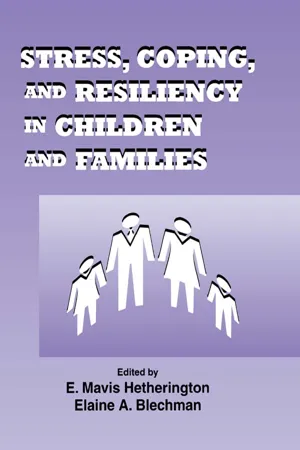
Based on the Family Research Consortium's fifth summer institute, this volume focuses on stress and adaptability in families and family members. The papers explore not only how a variety of stresses influence family functioning but also how family process moderates and mediates the contribution of individual and environmental risk and protective factors to personal adjustment. They reveal the complexity of current theoretical models, research strategies and analytic approaches to the study of risk, resiliency and vulnerability along with the central role risk, family process and adaptability play in both normal development and childhood psychopathology.
eBook - ePub
Stress, Coping, and Resiliency in Children and Families
- 256 pages
- English
- ePUB (mobile friendly)
- Available on iOS & Android
eBook - ePub
Stress, Coping, and Resiliency in Children and Families
About this book
Information
Publisher
Psychology PressYear
2014Print ISBN
9781138983052
9780805817102
Edition
1eBook ISBN
9781317780137
1

Thinking About Risk and Resilience in Families
For some children, the risks of developing serious psychological disorders are high, whereas for others the likelihood of being given a clinical diagnosis is remote. However, risks and stressors are not always followed by the consequences we expect. Some children at high risk with highly stressful environments may adapt very well, whereas others considered to be at low risk develop debilitating psychological disorders. Are researchers simply making errors in prediction, or are there lawful principles to explain both positive and negative outcomes that defy the odds? Interest in this question has been stimulated by the conceptual and empirical work on risk and resilience by Rutter and Garmezy, with important contributions from Masten, Sameroff, Seifer, Sroufe, Egeland, Rolf, Achenbach, and Cicchetti, and an increasing number of risk researchers. Together, they have given new impetus to an already active research and clinical literature on stress and coping (Garmezy & Rutter, 1983), created the new and exciting field of developmental psychopathology (Rolf, Masten, Cicchetti, Nuechterlein, & Weintraub, 1990), and provided a solid conceptual and empirical foundation for preventive intervention programs and prevention science (Coie et al., 1993).
Concepts associated with the study of risk, resilience, vulnerability, protection, and buffering now appear frequently in discussions of mental health and disorders (cf. Mrazek & Haggerty, 1994). As is usually the case when complex ideas are assimilated by a wider audience, variability and vagueness pervade the language of risk, with different theorists, researchers, clinicians, and policymakers using the same terms in very different ways. Contributing additional confusion to the discourse is the fact that risk concepts, originally developed for the study of individual adaptation, have increasingly been extended to the analysis of family adaptation. The central task in this chapter, using Garmezy, and especially Rutter, as guides, is to attempt to clarify the definitions of risk, resilience, and other related concepts and to explore their implications for family research and preventive intervention. In the course of this effort at clarification, a number of issues are addressed:
1. We show how concepts of risk, vulnerability, protection, buffering, and resilience originated, and how they lead inevitably to a new theoretical and methodological paradigm—a dynamic, process-oriented view of psychopathology rather than the static, categorical picture presented by the traditional psychiatric nosology (e.g., American Psychiatric Association, 1994).
2. We emphasize the fact that distinctions among concepts from the risk and resilience literature are often blurred and we attempt to provide definitions emphasizing their differences.
3. We explore the problems that arise when risk models created to explain individual psychopathology are applied to families.
4. We argue that, from the point of view of family researchers, the elegant examples Rutter and Garmezy use to illustrate risk, buffering, and resilience effects are deceptively simple. It is necessary to develop more complex models of multiple risks and multiple vulnerabilities, buffers, or sources of resilience as they interact and unfold over time.
5. Finally, we show how risk models provide important new conceptual underpinnings to the planning and evaluation of preventive interventions designed to reduce the incidence and severity of psychological distress and to promote and enhance the development of competence.
Although risk studies are now examining psychopathology all along the individual and family lifespan, many points in this chapter are made with examples from our own research and from other investigators focused on adaptation and dysfunction during the early phases of the family developmental cycle.
RISK RESEARCH AND PSYCHOPATHOLOGY
Origins of the Concept of Risk
The concept and measurement of risk originated in the fields of commerce and insurance. Centuries ago, merchants faced with frequent disasters in shipping their goods across the seas wanted to estimate the risk of losing their cargo in order to insure themselves against potential loss. Gradually, individual bargaining and haggling about the odds of disaster and the cost of protection gave rise to an insurance industry, which relies on actuarial data concerning mortality and other natural catastrophes that affect sailors and their ships.
Risk studies also have a long history in the field of epidemiology, which focuses on documenting the health and disease patterns in human populations and the factors influencing, or at least associated with, these patterns (Kleinbaum, Kupper, & Morgenstern, 1982). What epidemiologists want to know is who gets sick, who does not, and why (Gruenberg, 1980). Answering the “why” question places us squarely in the business of understanding risk. Early epidemiological studies focused on risks associated with mortality and physical illness, with the most famous examples arising from the discovery of the fact that people living in particular locations were more likely to contract cholera, yellow fever, and typhoid.
More recently, researchers have seen rapid growth in the epidemiology of mental health and mental illness (e.g., Costello & Angold, 1993). In one example, Kellam, Brown, Rubin, and Ensminger (1983) demonstrated in a large longitudinal population study of the children of Woodlawn that those who had been described by teachers and peers as having difficulty in their academic and social adaptation to first grade were at risk for developing social and psychiatric disorders 10 years later during adolescence. Although few very large studies attempt to discover the incidence and prevalence of mental health risks and outcomes in an entire population (e.g., Rutter, 1989), most researchers choose to study individuals already identified as being at high risk for one or more specific disorders.
In one of the first applications of the “high risk” strategy, Mednick and Schulsinger (1968) sought to identify individual and family stressors that increase the likelihood of a child developing schizophrenia (see also Goldstein, 1990). Subsequent investigations focused on other subgroups at high risk for pathological outcomes including mood disorders (Radke-Yarrow & Zahn-Waxler, 1990), aggression (Patterson & Dishion, 1988; Richters & Cichetti, 1993), hyperactivity (Lambert, 1988), impaired intellectual development (Sameroff, Seifer, Baldwin, & Baldwin, 1993), and a variety of psychological and academic problems (Baldwin, Cole, & Baldwin, 1982; Sameroff, Seifer, & Zax, 1982).
It should be noted that the meaning and measurement of risk has shifted in significant ways from its beginnings in business and public health epidemiology to its current applications in the field of mental health. The field began with simple dichotomous definitions of risk: Ships returned safely to port or they did not; people developed typhoid or they did not. Risk was measured in terms of the probability of a negative, categorically defined outcome occurring in a specified population. As risk analysis was extended to the understanding of mental illness, the definition of what constitutes an “outcome” was broadened considerably. Beyond the presence or absence of a disease, investigators were also concerned with the duration of the disorder and the number or severity of symptoms regardless of the presence of a disorder. For example, studies now commonly assess the correlation between a risk factor, such as marital conflict, and the level of aggressive behavior shown by the child (e.g., Fincham, Grych, & Osborne, 1994).
A second shift in risk research has been the move from studying epidemiologically defined population samples to selecting samples of convenience with large variations in mental health status or symptom picture. Because these studies rarely provide both continuous (e.g., aggressive behavior) and categorical measures of dysfunction (e.g., Oppositional Defiant Disorder), and rarely involve epidemiologically defined samples from specified populations, it is not known whether this broadening of the concept affects the pattern of findings obtained from risk–outcome research.
From its beginnings, the study of risk has not been limited to descriptions of the chance that illness or mental disorders will occur in large populations. Epidemiologists are often motivated by the hope that their data will be used in the planning of actions to reduce both the risks and their consequences. That is, there is a close connection between the epidemiology of risk and the public health ideal of prevention. Understanding more about the risk can help researchers to make decisions and take actions that will promote good health outcomes or minimize the incidence, prevalence, and severity of disease or disorder. This point is revisited at the end of the chapter.
CAUSAL MODELS AND RISK MODELS OF PSYCHOPATHOLOGY
In our view, risk analysis challenges traditional causal models of mental illness and provides a new theoretical and research paradigm for understanding psychopathology.
Causal Models. For most of this century, mental health researchers and clinicians have assumed that psychological disorders can be classified meaningfully in an array of discrete categories (e.g., schizophrenia, depression, antisocial personality disorder), and that a set of specific causes can be identified for each disorder. There are three problems associated with applying causal models to mental health. First, philosophers and scientists have a great deal of difficulty agreeing on the logical and empirical ground rules for establishing causal relationships. Furthermore, traditional definitions of causality do not always fit newer systemic conceptions of how mental health problems arise. Causal models are usually thought of as linear—from cause to effect—but family systems views, for example, assume that causality operates in a dynamic process that is circular (Steinglass, 1987) or transactional (Sameroff & Chandler, 1975). For example, in Patterson and Dishion’s (1988) account of “coercive cycles” in families, a parent’s ineffective responses to low levels of a child’s aggression reinforce the child’s negative behavior, which makes it more difficult for the parent to respond effectively, which, in turn, results in escalations in aggressive behavior. In this view, the parent’s behavior is not the cause of the child’s aggression, but one element in a reciprocal transactional process.
A second problem with applying traditional causal models to the etiology of mental illness as defined by mutually exclusive diagnostic categories is that many diagnoses show extensive overlap or comorbidity. For example, as Hinshaw (1992b) pointed out, children who are diagnosed as having Attention Deficit Hyperactivity Disorder also tend to exhibit features of conduct disorder and are frequently diagnosed with learning disabilities. Beyond accounting for the emergence of each of these problems, researchers must also be able to account for the fact that some children show all three, some combine these problems in pairs, and others suffer from a single disorder or difficulty.
A third problem with causal models of the etiology of specific psychiatric disorders is created by the fact that research designs often make it difficult to distinguish between simple correlations (A predicts B) and causal relationships (A causes B). Compounding this problem is the fact that mental health researchers have persisted in making a simple but fatal mistake in drawing causal conclusions from their empirical studies. Until recently, these studies almost always began with participants diagnosed in a category of mental illness or psychological disorder, or displaying a range from low to high levels of the problematic behavior in question. Investigators attempted to identify the antecedents or causes of the disorder or the behavior, but causality can never be established by reasoning backward from its presumed effects. Even if A causes B, our observation of B does not prove that A was the cause; another variable, C, may also cause B.
Three common research designs, each increasingly sophisticated, have failed to avoid the causal inference trap. First, through analysis of a single case, or through collecting a sample of patients with the same diagnosis, clinicians attempted to understand the forces that might have created a specific disorder. For example, it was observed that in the families of patients diagnosed as schizophrenic, there was a high incidence of parental psychopathology and very distressed parent-child relationships (e.g., Sullivan, 1962). It is easy to see now that without a control group, the meaning of this observation is ambiguous. It is not known whether the incidence of pathology in the patients’ parents is higher than it is in a group of parents whose children have never received the diagnosis. This point seems obvious until we realize how often “backward reasoning” from single cases or samples is accepted as an adequate causal explanation of psychopathology.
To address the flaws of single case and single sample studies, researchers use concurrent or retrospective follow-back designs; in epidemiology these are called case-control studies. Two samples are chosen, roughly comparable in demographic characteristics. One sample contains individuals diagnosed as having the disorder, and the other is comprised of individuals described as normal, or at least not disordered. The goal of study is the search for premorbid differences between the two samples. It has been found, for example, that there is a higher incidence of schizophrenia in the biological parents of schizophrenic patients than in parents of controls (Gottesman, McGuffin, & Farmer, 1987). The question is: What can be concluded from such a finding? This chapter is not concerned with the issue of whether the causes of schizophrenia are genetic, environmental, or both. Regardless of one’s position on the heredity–environment issue, neither concurrent nor retrospective research studies can be used to establish causal relationships between antecedents and outcomes. If researchers assess the parents and children at the same point in time, we cannot determine whether the parents’ pathology presents a risk for their children’s development or whether the children’s pathology puts their parents’ emotional equilibrium at risk.
Even with good data about parents’ diagnostic status from prior records, retrospective studies beginning with samples of diagnosed individuals provide a distorted estimate of risk. Suppose all of the schizophrenic children were found to have at least one schizophrenic parent (decidedly not the case). Researchers would still not be able to conclude that parental pathology was a risk factor for the development of schizophrenia. If the study had started prospectively with parents, researchers would find that most schizophrenic parents do not have schizophrenic children. In logic, the fact that A (schizophrenic children) implies B (schizophrenic parents) does not mean that B implies A. Although concurrent and retrospective research designs can be useful in generating hypotheses about antecedents of psychopathology, these hypotheses must be tested in prospective studies that start with an identified risk and follow the subjects forward over time. As will be seen, adopting the prospective risk approach changes the nature of the questions that are asked about psychopathology and alters the conception of psychopathology itself.
Risk Models. A number of risk studies, including adoption studies (Kety, Wender, Jacobsen, & Ingraham, 1994), have used a prospective longitudinal approach, with the outcomes of schizophrenia and antisocial behavior receiving the most attention.1 In general, this research shows that severe pathology in the parents, or dysfunction...
Table of contents
- Cover
- Half Title
- Title Page
- Copyright Page
- Table of Contents
- Introduction and Overview
- 1 Thinking About Risk and Resilience in Families
- 2 Stress, Parenting, and Adolescent Psychopathology in Nondivorced and Stepfamilies: A Within-Family Perspective
- 3 Divorce and Boys’ Adjustment Problems: Two Paths With a Single Model
- 4 Family Support, Coping, and Competence
- 5 Risk and Resiliency in Nonclinical Young Children: The Georgia Longitudinal Study
- 6 The Timing of Childbearing, Family Structure, and the Role Responsibilities of Aging Black Women
- 7 Family Wages, Family Processes, and Youth Competence in Rural Married African American Families
- 8 Attention—The Shuttle Between Emotion and Cognition: Risk, Resiliency, and Physiological Bases
- Author Index
- Subject Index
Trusted by 375,005 students
Access to over 1.5 million titles for a fair monthly price.
Study more efficiently using our study tools.
Frequently asked questions
Yes, you can cancel anytime from the Subscription tab in your account settings on the Perlego website. Your subscription will stay active until the end of your current billing period. Learn how to cancel your subscription
No, books cannot be downloaded as external files, such as PDFs, for use outside of Perlego. However, you can download books within the Perlego app for offline reading on mobile or tablet. Learn how to download books offline
Perlego offers two plans: Essential and Complete
- Essential is ideal for learners and professionals who enjoy exploring a wide range of subjects. Access the Essential Library with 800,000+ trusted titles and best-sellers across business, personal growth, and the humanities. Includes unlimited reading time and Standard Read Aloud voice.
- Complete: Perfect for advanced learners and researchers needing full, unrestricted access. Unlock 1.5M+ books across hundreds of subjects, including academic and specialized titles. The Complete Plan also includes advanced features like Premium Read Aloud and Research Assistant.
We are an online textbook subscription service, where you can get access to an entire online library for less than the price of a single book per month. With over 1.5 million books across 990+ topics, we’ve got you covered! Learn about our mission
Look out for the read-aloud symbol on your next book to see if you can listen to it. The read-aloud tool reads text aloud for you, highlighting the text as it is being read. You can pause it, speed it up and slow it down. Learn more about Read Aloud
Yes! You can use the Perlego app on both iOS and Android devices to read anytime, anywhere — even offline. Perfect for commutes or when you’re on the go.
Please note we cannot support devices running on iOS 13 and Android 7 or earlier. Learn more about using the app
Please note we cannot support devices running on iOS 13 and Android 7 or earlier. Learn more about using the app
Yes, you can access Stress, Coping, and Resiliency in Children and Families by E. Mavis Hetherington,Elaine A. Blechman in PDF and/or ePUB format, as well as other popular books in Psychology & History & Theory in Psychology. We have over 1.5 million books available in our catalogue for you to explore.