eBook - ePub
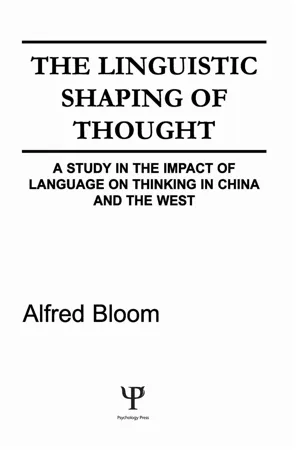
The Linguistic Shaping of Thought
A Study in the Impact of Language on Thinking in China and the West
- 128 pages
- English
- ePUB (mobile friendly)
- Available on iOS & Android
eBook - ePub
The Linguistic Shaping of Thought
A Study in the Impact of Language on Thinking in China and the West
About this book
First published in 1981. Using his fourteen years of interaction with the Chinese language and its speakers the author has noted certain important differences between the Chinese mode of speaking and thinking and that of speakers of English. This study looks at the impact of these differences looking at how they increase the sensitivity to what Chinese speakers mean; how they heighten awareness of the biases implicit in the way English speakers speak and think; and how they challenge the assumption, currently lurking within the field of psychology, that languages have little impact on the shaping of cognitive life.
Information
Topic
Personal DevelopmentSubtopic
History & Theory in Psychology1
The Distinctive Cognitive Legacies of English and Chinese
In 1972-1973, while I was in Hong Kong working on the development of a questionnaire designed to measure levels of abstraction in political thinking,1 I happened to ask Chinese-speaking subjects questions of the form, "If the Hong Kong government were to pass a law requiring that all citizens born outside of Hong Kong make weekly reports of their activities to the police, how would you react?"; or "If the Hong Kong government had passed such a law, how would you have reacted?". Rather unexpectedly and consistently, subjects responded "But the government hasn't;" "It can't;" or "It won't." I attempted to press them a little by explaining, for instance, that "I know the government hasn't and won't, but let us imagine that it does or did. . . " Yet such attempts to lead the subjects to reason about things that they knew could not be the case only served to frustrate them and tended to give rise to such exclamations as "We don't speak/think that way;" "It's unnatural;" "It's unChinese." Some subjects with substantial exposure to Western languages and culture even branded these questions and the logic they imply as prime examples of "Western thinking." By contrast, American and French subjects, responding to similar questions in their native languages, never seemed to find anything unnatural about them and in fact readily indulged in the counterfactual hypothesizing they were designed to elicit.
The unexpected reactions of the Chinese subjects were intriguing, not only because of the cross-cultural cognitive differences they suggested, but also because the Chinese language does not have structures equivalent to those through which English and other Indo-European languages mark the counterfactual realm. Could having or not having a counterfactual construction in one's language play a significant role in determining how inclined one will be to think in counterfactual terms? Could, in other words, counterfactual thinking constitute an example of an area of cognitive activity in which language-specific structures have an important impact on cognitive life? Over the past five years, I returned to East Asia three times to examine exactly what it is that the Chinese do and do not say in a counterfactual vein and to explore what the cognitive implications of these linguistic habits might be.
English, like other Indo-European languages, has distinct linguistic structures designed to signal entry into the counterfactual realm-to invite the reader or listener explicitly to shunt aside reality considerations in order to consider a state of affairs known to be false, not for the purpose of simply pretending, but for the express purpose of drawing implications as to what might be or might have been the case if that state of affairs were in fact true. When referring to the present or future, English speakers signal that shift by making use of the past form2 of the verb or the phrase ''were to'' in the first clause of an otherwise straightforward implicational sentence, followed by the form "would" or " 'd" in its second clause-e.g., "If he could, he would," "If he ran faster, he would win," "If she came, I'd bake a cake," "If I were/was he, I'd respond to that letter," and "If John were to go to the library, he would see Mary." And when referring to the past, English speakers signal an equivalent shift into the realm of the counterfactual by making use of the past perfect tense in the first clause of an implicational sentence followed by the forms "would have" or "might have" in its second clause-e.g., "If John had gone to the library, he would have seen Mary," "If he hadn't run so quickly, he wouldn't have been able to stop himself before he crashed through that glass door," "Had China invaded Swat, Pakistan might have reacted violently," In French, the counter factual realm is marked in the present by the imperfect in the first clause and the conditional in the second; in the past, by the plus-que-parfait in the first clause and the past conditional in the second; in Spanish, by the subjective followed by the conditional; in German by subjectives in each clause. And in each of these languages in whatever manner the counterfactual is marked, its use signals a contrast with both (1) a straightforward descriptive recounting of facts (e.g., John went to the library and saw Mary; John didn't go to the library and didn't see Mary; John goes to the library every day and sees Mary; John will go to the library tomorrow and will see Mary) and (2) a straightforward description of an implicational relationship hold ing between two events that carries no commitment as to the truth or falsehood of the original premise (e.g., If John goes to the library, he will see Mary; If John went to the library, he saw Mary; If John didn't go, he certainly didn't see Mary-by contrast to "If he were to go, he would see Mary," "If he had gone, he would have seen Mary"; "If he hadn't gone, he wouldn't have passed the exam.")
A straightforward implicational sentence can be uttered with varying pre suppositions as to how likely it is that the event described in its first clause or premise has or will in fact happen. One might presuppose that John went to the library and state in an almost rhetorical way, "If he went, he saw Mary" as if one were about to add "and that is all there is to it!" Or one might have no notion of whether or not John went, how likely the premise of the implication, and simply state "If he went, he saw Mary." Or, more atypically, one might think in fact that John is unlikely to have gone and yet state, just for the purpose of getting the reasoning straight, "If he went, he saw Mary." But whatever the presupposition, the use of an implicational sentence as opposed to a counterfactual one, has the effect of signaling that the statement is intended as a description of a relationship between events rather than as a summons to the listener to shift from the realm of empirical generalization to the realm of hypothetical postulation.
A grammatical analysis of Chinese, confirmed by interviewing of both Chinese monolingual speakers and native Chinese, Chinese-English bi linguals, yields a very different picture of how Chinese treats implicational and counterfactual sentences. In certain respects, Chinese speakers in every day speech express implicational relationships in more differentiated terms than English speakers do. In the first place, while English speakers use only context and/ or intonation to indicate how likely they feel it is that the premise of an implicational statement has in fact taken place, Chinese speakers make use of a much more precise linguistic device to signal the specific presupposition they intend-namely alternative forms of the word "if."3 For example, the use of the word "chia ju" for "if" in the sentence "If the Mongols invaded Swat, they conquered it" suggests that the speaker believes that the Mongols are unlikely to have invaded that kingdom, while at the same time making clear that if they did invade, they conquered it. By contrast, an alternative form "ju kuo" expresses an implicational relation between invading and conquering, without committing the speaker to any belief about the likelihood that the invasion has in fact taken place. Secondly English speakers do not normally differentiate between "if-then" and "if-and-only-if-then" interpretations of implicational sentences. For example, the English sentence "If China conquers Swat, it will acquire a new summer resort" leaves ambiguous whether this is the only means by which China could acquire such a resort (the if-and-only-if interpretation) or whether, in fact, there is a chance that China might acquire one by some other means; while the equivalent Chinese sentence, by making use of alternative forms of the word "then" ("ts'ai" [only if-then] vs "chiu" [then] )makes the distinction clear. Yet, despite Chinese grammatical precision in expressing both the degree of likelihood of the premise of implicational statements and the distinction between if-then and if-and-only-if-then interpretations of the relationship of the premise to its consequence, the Chinese language has no distinct lexical, grammatical, or intonational device to signal entry into the counterfactual realm, to indicate explicitly that the events referred to have definitely not occurred and are being discussed for the purpose only of exploring the might-have-been or the might-be.
By itself, the fact that Chinese has no such linguistic device cannot, of course, be taken to imply anything about the way Chinese speakers think. The fact that English does not have a distinct word for check meaning "financial draft" does not mean that we confuse that kind of check with the mark next to a correct answer or with the end-game in chess. But in the particular case of the Chinese counterfactual, there was some rather compelling evidence to suggest that the lack of a distinct linguistic device to signal counterfactual thought might have cognitive consequences.4
In the first place, Chinese speakers, in marked contrast to their American and French counterparts, in response to the original questionnaire, had refused to shift into the counterfactual realm and, in fact, had branded questions that called upon them to do so characteristically unChinese. And, in fact, native Chinese speakers regularly report the same observation that there is something unChinese about counterfactual talk and thought. One Chinese student at Swarthmore labeled it "evil"; a professor of English at Taiwan National University remarked, "You know, we Chinese are not used to using the counterfactual as you Americans are-when I try to speak in class that way, my students quickly become confused." Bilinguals report that they feel perfectly comfortable using counterfactual statements in English such as "If the lecture had ended earlier, Bill would have had a chance to prepare for the exam," but that they feel more comfortable converting such statements into descriptive alternatives such as "The lecture ended too late, so Bill did not have a chance to prepare for the exam" in order to express the same ideas naturally in Chinese; and native Chinese, Chinese-English bilinguals who were presented with matched pairs of English counterfactual and descriptive statements and asked, for each pair, if either of the pair seems closer to the way such facts are expressed in Chinese, consistently selected the descriptive forms as the one that "captures the way we say, think about such things in Chinese." Ironically, it is in fact Westerners who have had little experience in the Chinese language and culture who are usually the most reluctant to believe that there could be something unChinese about the counterfactual, while the Chinese themselves with few exceptions readily and cheerfully confirm that it is the case.
Moreover, if the lack of a distinct marking for the counterfactual in Chinese were merely a linguistic fact, with no further cognitive consequences for speakers of Chinese, one might expect that the Chinese equivalent of the sentence "If John went to the library he saw Mary," since it would have to carry both the implicational and counterfactual interpretations (i.e., "If he had gone, he would have ... " and "If he went, he saw ... "), would be perceived as ambiguous by Chinese subjects, just as the sentence ''Everyone loves his wife'' is perceived as ambiguous by English speakers, at least once the ambiguity is pointed out. Yet the large majority of monolingual Chinese subjects interviewed did not perceive such sentences as ambiguous nor, when the two interpretations were pointed out, was there that ready click of comprehension of the distinction which is evident among speakers of Western languages under similar circumstance. In fact, after a week of working with sample sentences, my highly intelligent, monolingual research assistant was still encountering considerable difficulty in maintaining clearly in mind the idea of a counterfactual interpretation as distinct from a negative implicational one (i.e., "If he had/had not gone" vs "If he didn't go"). In effect, for the monolingual Chinese speakers inter viewed, coming to recognize the distinction between counterfactual and implicational sentences seemed not to be just a question of associating new formal terms with already explicitly developed modes of categorizing experience, but rather a question of building new cognitive schemas to fit those formal terms, parallel perhaps to the predicament of the English speaking student of logic who has to build new cognitive schemas in order to come to recognize the distinctions carried by the formal labels "if-then," "if-and-only-if-then" and "only-if-then".
Furthermore, Chinese students of English find the counterfactual to be one of the most difficult aspects of the English language to master-a fact that has been confirmed by, among others, two professors of English from Taiwan National University, many bilinguals, and several incidents such as one that took place at a conference at Rutgers a few years ago. While I was discussing my research at dinner, a professor of Chinese literature from Taiwan, who had been in the United States for about three years, suddenly interrupted the discussion to exclaim ''One second, what does 'would have' mean? It is the one aspect of English grammar I have been unable to grasp!"
An informal content analysis of a leading Chinese newspaper in Taiwan conducted over a three week period uncovered only one example of the use of what one might call counterfactual argument, expressed by the circumlocution: "X is not the case; but if X then Y," and that turned out to be in a translation of a speech by Henry Kissinger.
Mao did tend to make use of counterfactual reasoning and to express it in this way even though he did not speak any Western languages. But he was certainly heavily influenced by Western political writings; and it is interesting to note that while Westerners find Mao's writings relatively easier to read than typical Chinese prose, and his logic relatively more accessible, I have been told on repeated occasions by people with extensive experience in mainland China that, for the Chinese, the opposite is very much the case.
Finally, a good friend of mine who was teaching Chinese in the Albany area was called to a New York State court to serve as a translator for a Taiwanese citizen who had overstayed his visa, but who had made plans to leave the country the next day. The judge asked my friend to translate the sentence, "If you weren't leaving tomorrow, you would be deportable." After struggling for a few minutes to formulate an adequate translation, she attempted to make sense out of the sentence in Chinese in a form roughly equivalent to "I know you are leaving tomorrow, but if you do not leave, you will be deported." The Taiwanese replied in Chinese, "But what do you mean? I'm leaving tomorrow. Don't worry, I'm leaving." My friend per sisted in her attempts to convey the counterfactual/theoretical intent of the judge's statement, but the Taiwanese continued to interpret the statement, no matter what form the translation took, as a threat, roughly equivalent to "If you don't go, you will be deported" and so, continued to declare defensively that he was indeed leaving. Then the judge asked, "If you have to be deported, where would you wish to be deported to?", making a further cognitive leap into the realm of the pure hypothetical. Again several at tempts at translation, this time with even less success. Perceiving that the Taiwanese was totally unable to comprehend what was going on and that he was, as a consequence, becoming more and more frustrated, my friend counseled him to respond "Taiwan." He did. The proceedings terminated and were recorded in the court record.5 The Taiwanese left the country the next day apparently never understanding that it was not that the judge questioned the sincerity of his intent to leave and was therefore threatening him, but rather that the judge wanted him to understand the implications of what would happen if he did not act as he had already planned to.
Not only then does Chinese not mark the counterfactual, but Chinese speakers tend to brand the counterfactual as in some sense unChinese. They tend not to recognize the distinction between counterfactual and implicational statements as a division of reality with which they are familiar, and they tend to be relatively disinclined, at least by comparison to their English-speaking counterparts, to make use of counterfactual logic in responding to questionnaire queries, in writing newspaper analyses and in interpreting the implications of at least one legal situation.
Yet this evidence, suggesting a link between language and thought in the area of the counterfactual, cannot be taken to imply a complete absence of the counterfactual from the Chinese psycholinguistic world, for the Chinese, in particular in concrete situations, do make use of counterfactual speech and thought. Imagine, for example, a situation in which a group of people have been waiting for John. He arrives late and they are, as a result, late for the movies. Under such circumstances, one can say in Chinese, "If John come + past earlier, they arrive at the movies on time" and mean in English, "If John had come earlier, they would have (but didn't) arrive at the movies on time." In a situation in which a child has just taken off on h...
Table of contents
- Cover
- Title
- Copyright
- Dedication
- Contents
- Preface
- Introduction
- 1. The Distinctive Cognitive Legacies of English and Chinese
- 2. Linguistic Initiatives in the Shaping and Functioning of Thought
- Appendix
- Author Index
- Subject Index
Trusted by 375,005 students
Access to over 1.5 million titles for a fair monthly price.
Study more efficiently using our study tools.
Frequently asked questions
Yes, you can cancel anytime from the Subscription tab in your account settings on the Perlego website. Your subscription will stay active until the end of your current billing period. Learn how to cancel your subscription
No, books cannot be downloaded as external files, such as PDFs, for use outside of Perlego. However, you can download books within the Perlego app for offline reading on mobile or tablet. Learn how to download books offline
Perlego offers two plans: Essential and Complete
- Essential is ideal for learners and professionals who enjoy exploring a wide range of subjects. Access the Essential Library with 800,000+ trusted titles and best-sellers across business, personal growth, and the humanities. Includes unlimited reading time and Standard Read Aloud voice.
- Complete: Perfect for advanced learners and researchers needing full, unrestricted access. Unlock 1.5M+ books across hundreds of subjects, including academic and specialized titles. The Complete Plan also includes advanced features like Premium Read Aloud and Research Assistant.
We are an online textbook subscription service, where you can get access to an entire online library for less than the price of a single book per month. With over 1.5 million books across 990+ topics, we’ve got you covered! Learn about our mission
Look out for the read-aloud symbol on your next book to see if you can listen to it. The read-aloud tool reads text aloud for you, highlighting the text as it is being read. You can pause it, speed it up and slow it down. Learn more about Read Aloud
Yes! You can use the Perlego app on both iOS and Android devices to read anytime, anywhere — even offline. Perfect for commutes or when you’re on the go.
Please note we cannot support devices running on iOS 13 and Android 7 or earlier. Learn more about using the app
Please note we cannot support devices running on iOS 13 and Android 7 or earlier. Learn more about using the app
Yes, you can access The Linguistic Shaping of Thought by A. H. Bloom,Alfred H. Bloom in PDF and/or ePUB format, as well as other popular books in Personal Development & History & Theory in Psychology. We have over 1.5 million books available in our catalogue for you to explore.