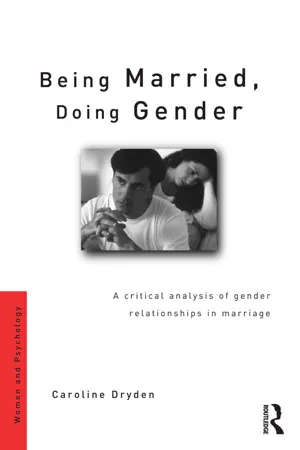
In one of the first psychological studies of women in heterosexual relationships, Caroline Dryden examines the social context of their experiences and emotional struggles. Unlike the developmental literature in which women are studied only as mothers, or the clinical literature which has little theoretical basis, Being Married, Doing Gender places case study material in the context of the power balance between women and men. Caroline Dryden finds that there are contradictions between stereotypical gender roles and the maintenance of an equal partnership that can cause problems for both women and men. Being Married, Doing Gender will be valuable to students studying psychology or gender and women's studies and to marriage guidance counsellors and psychotherapists.
eBook - ePub
Being Married, Doing Gender
A Critical Analysis of Gender Relationships in Marriage
- 176 pages
- English
- ePUB (mobile friendly)
- Available on iOS & Android
eBook - ePub
About this book
Information
1
A FEMINIST PSYCHOLOGICAL APPROACH TO MARRIAGE RESEARCH
CAROLINE: Do you, in terms of doing things, you know, in terms of cooking and cleaning and gardening, stuff like that, are there particular things that one of you do that the other one wouldn't or, how do you organise/
RICHARD: Yes…cook.
MARGARET: Cooking, I do all the cooking.
RICHARD: But nearly everything else [pause] it's/
MARGARET: In the house Richard'll… I mean Richard's put the hoover round this morning. Um, yes, you'll clean the bath and yes, he does everything round the house 'cept cooking. I do the ironing. I tend to do the ironing.
RICHARD: I don't iron.
MARGARET: [pause] Yeah, you say ‘I don't iron!’ like as if, well, I shouldn't have to iron, but it's only – you could if you put your mind to it.
RICHARD: That's – what I meant [laughing a bit like ‘oh dear’]. No, I don't iron and I don't cook. (a) cause I wouldn't enjoy ironing and there's no way I'm gonna do that and (b) [pause] er cooking I'm, I'm/
MARGARET: Why do you say there's no way I'm gonna do that?
RICHARD: I don't wanna be standing there with an iron. No thank you.
MARGARET: Fine! [pause] Tomorrow you do the ironing*
The above is an extract from an interview with a married couple. What is going on in this dialogue? Are the couples, for example:
• giving me a list of different tasks they both do about the house?
• trying to work out what tasks they both do?
• having a disagreement in front of me about who does what?
• disagreeing about the supposed reasons why she does one set of tasks and he does another?
I think this quote is superficially about who does what around the house but that there is much more to it than this. I think there is a complex sub-text working between the lines of the above extract and that this sub-text can best be understood in terms of three interrelated aspects of:
• marital and personal identity
• gender power relations
• emotional experience.
This book is, in essence, an investigation of the complex sub-text of a marriage through an analysis of these three interrelated processes. The chapters are organised around a series of qualitative interviews with a small number of married couples talking together and separately about their lives and their relationships. As with the above reproduced dialogue, much of the data used focuses on the topic of division of labour in the home. The aim of the book is not, however, to study division of labour in marriage per se. The focus of the research is on the construction of meaning, experience and identity in marital relationships and, in particular, on the relationship between ‘meaning-making’, emotional experience, social power and social change. Discussions on division of labour are used extensively throughout the book because the topic had considerable relevance and symbolic significance for the couples whose experiences are investigated. As such, they provided an excellent vehicle for exploring the ‘meaning-making’ sub-text of couples' psychological worlds.
In writing a book about marriage for a series on Women and Psychology, it probably goes without saying that the book owes much to feminism and is feminist in orientation. This means that it also forms part of a contemporary critique of the, until recently, unswervingly anti-feminist stance of mainstream psychological research. There is now an enormous feminist literature documenting the exclusion and misrepresentation of women's experiences in social science research. Such exclusionary processes range from neglecting topics traditionally associated with women's lives, to developing general social science theories from empirical studies with male participants only, to using methods of data generation that eclipse women's lived experiences (e.g. forced choice questionnaires to test a prior, androcentric theory). Given its long and close association with the natural sciences, psychology has remained one of the hardest disciplines to ‘modernise’ in the face of such significant criticisms from feminists. However, the series for which this book is written bears witness to the fact that changes are finally occurring. Courses on psychology and women are now quite common in this country and extremely common in the United States. Feminist psychology in Britain is no longer a tiny fringe activity. From the milestone of Wilkinson's edited collection (1986) through to notable studies such as Griffin (1985) Kitzinger (1987), Hollway (1989), Squire (1989), Burman (ed.) (1990), Ussher (1991, 1997), Phoenix, Woollett and Lloyd (1991), Wilkinson and Kitzinger (eds) (1995) and Nicolson (1996) – to name but a few – the launch of the international journal Feminism and Psychology, and the development of contemporary series such as the one this book is written for, feminist psychology is clearly making its mark. The rest of this chapter is organised into three sections. The first section briefly outlines why I think there is a need for the type of research I will be drawing on in this book. The second section sets out my broad conceptual framework for studying marriage and the final section outlines the ‘nuts and bolts’ of my theoretical and methodological approach.
The need for feminist psychological research on marriage
Marriage in the public eye
The first reason why I think there is a need for research on the psychology of marriage is because the institution seems to be in turmoil viewed from a number of angles.
Statistics
Newspapers and television programmes constantly rehearse the statistical tale of doom and gloom. For a start, on current calculations, four out of every ten legal British marriages in the 1990s will end in divorce. In other words, we are close to reaching a situation where every couple getting married for the first time will have a no better than 50–50 chance of staying together until one of them dies.1 Furthermore, although at the time of writing nine out of ten people will still marry before they are 50, marriage rates are lower than they have been for seventy years with the number declining by one-third between 1980 and 1990. Marriages where neither partner has been married before are now lower than they have been this century – less than 300,000 a year. Those who do get married are doing so later – often choosing to live together first. Remarriages now constitute around 40 per cent of all marriages. Cohabitation is increasingly becoming a substitute for (as well as a precursor to) legal marriage and increasing numbers of children are born to unmarried couples or into one-parent households.
Politics and social policy
Against the statistical backdrop of marriage in turmoil, the 1980s and 1990s have seen intense political interest in the institution and its future prospects. The British Conservative Party in their years in power positioned themselves as the party of ‘traditional family values’ and championed policies designed to retrench women's position in the home. In the Conservative analysis, ‘the family’ stood outside of the normal ‘cut and thrust’ of the market and ‘the family’ equalled one man, one woman, a legally binding contract and lifelong monogamy. Yet throughout the early 1990s, media ‘exposés’ continued to underline the point that Conservative politicians seemed unable to practise their own philosophy. Reports of politicians' marriage break-ups and adulterous relationships became commonplace headline stories.
Even ‘traditionalists’ have been unable to halt the decreasing popularity of marriage and it was, ironically, the last Conservative Government that introduced the supposedly liberalising ‘Family Law Bill’ which was seen by many of the Government's own supporters as likely to undermine marriage still further by making it quicker to divorce.2 In the event, the Conservatives experienced considerable pressure from their own supporters to amend the Bill (for example, a vociferous campaign by the Daily Mail) and it is debatable whether the final Act is, in fact, ‘liberalising’. It does, however, incorporate a new emphasis on conciliation and commentators such as Rodger (1996) have argued that, at the very least, what we have seen in the last few years is a policy move in this country away from a punitive stance on marital breakdown to an approach that emphasises mediation, conciliation and therapy. Political rows continue over the possible causes of marital breakdown and what can/should be done (if anything) to halt the tide, with some public figures, such as Mrs Justice Hale (Hale 1997), making explicit links between the current situation and women's increasing expectations of equality within the marriage relationship.
The Royals
If we needed any further public proof that there is a problem with the institution of marriage, the British Royal Family seems to have provided it with the unfolding of our own royal soap opera. Royal divorces have now become commonplace, e.g. Margaret, Anne and Andrew. And, of course, 1996 was the year of the end of a fairy tale when the marriage of Charles and Diana was officially declared to be over. The beautiful young girl became engaged to a prince. She walked down the aisle in yards of taffeta and silk. They disappeared into the sunset to produce heirs to the throne and live happily ever after. A symbol of beautiful, romantic, wedded bliss…. But then came the adultery, bulimia, reported suicide attempts, separation and public slanging matches. As the Archdeacon of York put it on News at 10 (19 August 1996) ‘The fantasy has gone of the happy family at the centre of the Nation.’
In 1997, the death of Diana served to renew public concerns about marital breakdown and the possible effects on children. Much has been made of the fact that Diana herself was from a broken home and various public commentators speculated on how this could have contributed to making her an insecure and vulnerable person. At the same time, there has been considerable attention to Diana's history of adult unhappiness and psychological ill health in her own marriage following the adultery of her husband. This has spawned a number of articles in the press and ‘women's pages’ on the relationship between marriage, women and psychological health.
Contradictory meanings of marriage
So what is the meaning of marriage in today's society? Confusing and often contradictory attitudes and images abound and to talk about marriage is usually to simultaneously moralise about society and about the way things should be. Marriage is variously depicted as, for example:
• A relationship for life (e.g. the Daily Mail campaign against liberalising the divorce law in this country, the Catholic Church stance on divorce).
• A relationship that may or may not be for life. For example, Giddens (1992) has argued that the Mills and Boon meaning of love as finding the perfect partner is currently being challenged in our society. The emphasis has now shifted to finding the perfect relationship, which may well necessitate moving on from time to time in serial fashion.
• A legal contract that discriminates against those in homosexual relationships (e.g. gay and lesbian rights groups have campaigned fiercely in recent years for the right to have single-sex marriages yet, in most Western countries, the law still stipulates ‘one man’ and ‘one woman’).
• A vehicle for oppressing women (e.g. feminist writers have argued that the institution is at the heart of women's exploitation in society).
• A psychological disaster area (as depicted by the proliferation of newspaper and magazine articles filled with a battery of accompanying statistics and concerns that particularly highlight psychological problems of marriage breakdown for children as well as spouses).
In recent years, then, marriage has been barely out of the public arena. Discussed, debated, rowed over, vilified, sanctified.…What is to become of this once so revered institution? What, if anything, is wrong with married people? What should be done about its declining popularity? It seems clear that a psychology related topic that merits so much public attention should be a prime candidate for psychological research.
The neglect of marriage in academic psychology
The second reason why I think there is a need for research on the psychology of marriage is because there is currently rather a strange gap. Pick up any article on marriage in the popular press or any novel that touches on the topic and you are likely to find yourself reading about phenomena such as love, pain, hate, fear, insecurity, jealousy etc. In other words, you are likely to be reading about psychological experiences. Pick up any number of mainstream psychological journals in the library and you are likely to have a long search before you find any reference to marriage at all. To read about the topic you will have to go to the clinical and applied journals (where there is a clear recognition that marital relationships can cause significant psychological problems in people's lives), the largely American interdisciplinary area of interpersonal communication, the social science disciplines of sociology and social policy or to explicitly feminist outlets. The strange fact is that, over the years, mainstream academic psychology has not been very interested in marriage.
The gap between what is of everyday psychological interest to women versus what is contained in the mainstream p...
Table of contents
- Cover
- Half Title
- Women and Psychology
- Title Page
- Copyright Page
- Table of Contents
- Acknowledgements
- 1 A feminist psychological approach to marriage research
- 2 A feminist biography of married couples
- 3 Wives and the struggle to construct relational equality
- 4 Husbands and the struggle to defend relational inequality
- 5 Marital identity versus gender identity – a crisis for husbands
- 6 The wasteland at the crossroads of a marriage: a husband's construction of a wife's insecurity
- Conclusion
- Notes
- References
- Index of Couples
- Index of Names and Subjects
Trusted by 375,005 students
Access to over 1.5 million titles for a fair monthly price.
Study more efficiently using our study tools.
Frequently asked questions
Yes, you can cancel anytime from the Subscription tab in your account settings on the Perlego website. Your subscription will stay active until the end of your current billing period. Learn how to cancel your subscription
No, books cannot be downloaded as external files, such as PDFs, for use outside of Perlego. However, you can download books within the Perlego app for offline reading on mobile or tablet. Learn how to download books offline
Perlego offers two plans: Essential and Complete
- Essential is ideal for learners and professionals who enjoy exploring a wide range of subjects. Access the Essential Library with 800,000+ trusted titles and best-sellers across business, personal growth, and the humanities. Includes unlimited reading time and Standard Read Aloud voice.
- Complete: Perfect for advanced learners and researchers needing full, unrestricted access. Unlock 1.5M+ books across hundreds of subjects, including academic and specialized titles. The Complete Plan also includes advanced features like Premium Read Aloud and Research Assistant.
We are an online textbook subscription service, where you can get access to an entire online library for less than the price of a single book per month. With over 1.5 million books across 990+ topics, we’ve got you covered! Learn about our mission
Look out for the read-aloud symbol on your next book to see if you can listen to it. The read-aloud tool reads text aloud for you, highlighting the text as it is being read. You can pause it, speed it up and slow it down. Learn more about Read Aloud
Yes! You can use the Perlego app on both iOS and Android devices to read anytime, anywhere — even offline. Perfect for commutes or when you’re on the go.
Please note we cannot support devices running on iOS 13 and Android 7 or earlier. Learn more about using the app
Please note we cannot support devices running on iOS 13 and Android 7 or earlier. Learn more about using the app
Yes, you can access Being Married, Doing Gender by Caroline Dryden in PDF and/or ePUB format, as well as other popular books in Psychology & History & Theory in Psychology. We have over 1.5 million books available in our catalogue for you to explore.