eBook - ePub
Natural Ventilation in the Urban Environment
Assessment and Design
- 266 pages
- English
- ePUB (mobile friendly)
- Available on iOS & Android
eBook - ePub
Natural Ventilation in the Urban Environment
Assessment and Design
About this book
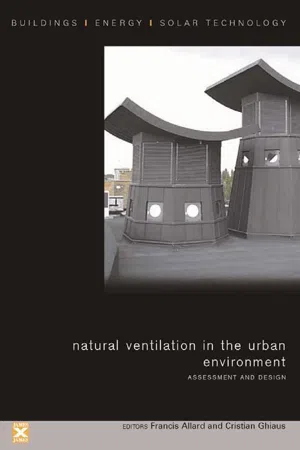
Throughout the world, there is an increasing interest in ecological design of buildings, and natural ventilation has proved to be the most efficient low-energy cooling technique. Its practical application, however, is hindered by the lack of information on the complex relationship between the building and its urban environment. In this book, a team of experts provide first-hand information and tools on the efficient use of natural ventilation in urban buildings. Key design principles are explained, enabling readers to decide on the best solution for natural ventilation of buildings, taking into account climate and urban context.In the initial sketches, architects need answers to open problems such as 'what kind of solution to adopt' and 'how to modify existing strategies to exploit the potential of the site'. This book formalizes the multi-criteria analysis of candidate solutions based on quantitative and qualitative estimation of the driving forces (wind and buoyancy), as well as of the barriers induced by the urban environment (wind speed reduction, noise and pollution) and gives a methodology for optimal design of openings. The book is accompanied by downloadable resources, containing software for assessing the potential of a given site, estimating wind speed and dimensioning the openings for natural ventilation. The methodologies and tools are tested, self-contained and user friendly.About the editorsThe editors, Cristian Ghiaus and Francis Allard, are affiliated with the University of La Rochelle, France. The authors and reviewers combine expertise from universities, research institutions and industry in Belgium, France, Great Britain, Greece, Portugal and Switzerland.
Information
1
Energy in the Urban Built Environment: The Role of Natural Ventilation
Mat Santamouris
INTRODUCTION
During the second half of the last century, the world’s urban population has increased tremendously. In the 1950s, there were no more than 200 million urban residents; but by the end of the century their total number was close to 3 billion and it is expected to increase to approximately 5 billion by 2025 (UNFPA, 1998). Migration to cities has primarily occurred, and will continue to happen, in the so-called less developed countries as the result of increased economic and social opportunities offered in urban areas and the degradation of rural economies and societies.
The growth rate of the urban population is much faster than that of the rural one. It is reported that almost 80 per cent of the world’s population growth between 1990 and 2010 will be in cities, and most probably in Africa, Asia and Latin America (UN, 1998). Put simply, 60 million urban citizens are added to the population every year, which, as mentioned by UNEPTIE (1991), ‘is the equivalent of adding another Paris, Beijing or Cairo every other month’.
The extremely rapid urbanization has resulted in the dramatic increase in size of urban agglomerations. According to the United Nations (UNCHS, 2001), our planet hosts 19 cities with 10 million or more people, 22 cities with 5–10 million people, 370 cities with 1–5 million people and 433 cities with 0.5–1 million people. This has led to extremely serious environmental, social, political, economic, institutional, demographic and cultural problems. A detailed discussion of the problems is given in Santamouris (2003). In developed countries, the more important problems include over-consumption of resources, particularly energy; increased air pollution, primarily from motor vehicles; heat island and increase in ambient temperature because of the positive heat balance in cities; noise pollution; and solid waste management. On the other hand, poverty, environmental degradation, lack of sanitation and other urban services, and lack of access to land and adequate shelters are among the more serious issues in developing countries.
Energy consumption defines the quality of urban life and the global environmental quality of cities. Energy is linked with all aspects of development and has a tremendous impact on the well-being of urban citizens: on health, education, productivity, economic opportunities and so on. Unfortunately, the current situation regarding energy supply and consumption is extremely unfair, and wide disparities exist between the developed and the developing world. Almost one third of the world’s population has no access to electricity, with another third having only very limited access (WEHAB Working Group, 2002). Although 75 million people gain access to electricity annually, the total number of people lacking electricity does not change (Albouy and Nadifi, 1999). People in the rich parts of the world consume almost 25 times more energy per person than those living in the poorest areas (Albouy and Nadifi, 1999).
Energy is the most important engine to improve quality of life and fight poverty. Given that by 2020 almost 70 per cent of the world’s population will be living in cities, and 60 per cent will be below the poverty line, it is estimated by the World Bank (Serageldim and Brown, 1995) that many of the population will be energy poor. Thus, for the next decades, thousands of megawatts of new electrical capacity have to be added. Estimates (Serageldim and Brown, 1995) show that the cost of the new power generation plants over the next 30 years will amount to over US$2 trillion. However, developing countries already pay too much for energy. Citizens in these countries spend 12 per cent of their income on energy services, five times more than the average in Organisation for Economic Co-operation and Development (OECD) countries (Construction Confederation of International Contractors Association, 2002). In parallel, energy imports are one of the major sources of foreign debt. As reported during the Johannesburg summit in 2002 (Saghir, 2002), ‘in over 30 countries, energy imports exceed 10 per cent of the value of all exports’, while ‘in about 20 countries, payments for oil imports exceed those for debt servicing’.
It is thus evident that alternative energy patterns have to be used. The use of renewable sources in combination with energy-efficient technologies could provide the necessary energy supply to the ‘energy-poor’ proportion of the world’s population to improve their quality of life, and could make a significant contribution to reducing over-consumption of resources in the developed countries. A recent study by Lawrence Berkeley Laboratory (Der Petrossian, 1999) shows that developing countries could avoid having to spend US$1.7 trillion on oil refineries, coal mines and new power plants by spending US$10 billion annually for the next 30 years to improve energy efficiency and conservation. Another estimate by the US Office of Technology Assessment shows that developing counties have the potential to halve their electricity production if energy is used more effectively.
Ventilation and, in particular, natural ventilation is one of these technologies. Natural ventilation should not be seen just as an alternative to air conditioning. This is a very arrogant approach as it is true for only a tiny part of the world population. Natural ventilation is a more effective instrument to improve indoor air quality in urban areas, to protect health, to provide thermal comfort and to reduce unnecessary energy consumption.
This chapter aims to present, in a global way, the importance of natural ventilation technologies for urban buildings. An attempt is made to document its impact on energy, indoor air quality and thermal comfort, and to prove that natural ventilation, although not an energy ‘machine’, is an effective engine for progress and development.
ENERGY AND URBAN BUILDINGS
The Impact of the Construction Sector
Construction is one of the most important economic sectors by far. It is estimated that the total world annual output for construction is close to US$3000 billion, which constitutes almost one tenth of the global economy (Leitman, 1991). About 30 per cent of this capital is from Europe, 22 per cent from the US, 21 per cent from Japan, 23 per cent from developing countries and 4 per cent from the rest of the developed countries.
Construction represents more than 50 per cent of national capital investment and, with more than 111 million employees, it accounts for almost 7 per cent of total global employment and 28 per cent of global industrial employment. However, given that every job in the construction sector generates two new jobs in the global economy, it can be said that the construction sector is directly or indirectly linked to almost 20 per cent of global employment (Leitman, 1991).
In parallel, almost one sixth of the world’s major resources are consumed by the construction sector (Bitan, 1992). Buildings consume almost 40 per cent of the world’s energy, 16 per cent of the world’s freshwater and 25 per cent of forest timber (LRC, 1993), while they are responsible for almost 70 per cent of sulphur oxide and 50 per cent of carbon dioxide emissions (Bitan, 1992).
Energy and Urbanization
Recent urbanization has put the emphasis on urban buildings. Urban buildings differ from rural buildings with regard to economy, society, energy and environment. In particular (ICLEI, 1993):
- There are many specific environmental problems in cities of both developed and less developed countries that do not occur in non-urban areas.
- The energy consumption per capita in cities is higher than in rural areas.
- Cities have a serious environmental, economic and social impact on suburban and rural areas.
- As the economic growth rate in cities is much higher than in rural areas, the demand for energy is increasing and environmental problems are accelerating.
Urbanization has a dramatic effect on energy consumption. As reported by IBGE (1993), a 1 per cent increase in the per capita gross national product (GNP) leads to an almost equal (1.03 per cent) increase in energy consumption. However, an increase of 1 per cent in the urban population increases energy consumption by 2.2 per cent (i.e. the rate of change in energy use is twice the rate of change in urbanization).
Comparison of the energy consumption per capita for the inner and outer parts of selected cities shows that the consumption in the inner part is considerably higher. For example, inner London presents 30 per cent higher energy consumption per capita than the outer part of the city (WEC, 1993). There are also many examples from developing countries showing that urban citizens consume more. For example, urban dwellers in five principle cities of Senegal consume 265kg of oil equivalent per person annually, compared with 110kg for rural dwellers (ICLEI, 1993).
Buildings are the largest energy consumers in cities. Data on the energy consumption of various European cities (Bose, 1990; WEC, 1993; Stanners and Bourdeau, 1995) show that the end-use energy consumption of the residential sector varies from 48 per cent in Copenhagen to 28 per cent in Hanover. At the same time, buildings in the commercial sector account for between 20 and 30 per cent of the final energy consumption of the cities.
Data from developing countries show almost the same tendency. Although detailed data on energy consumption for buildings are not available, reports from eight major developing countries, representing a very high percentage of the total energy consumption, show that the building sector accounts for almost 21 per cent of energy needs without taking into account electricity (Rees, 2001a). Another study for Delhi indicates that the housing sector is by far the most important consumer of fuel and accounts alone for over 60 per cent of gross energy use (Rees, 2001b)
Energy Characteristics of Urban Buildings in Developed Countries
Energy and environmental problems have completely different characteristics in cities of the developed nations compared with those of less developed nations. The main problems of cities in the developed world are the consumption of energy and resources that exceed their natural production, and the production of degraded energy, wastes and pollution at levels greater than the assimilative capacity of the ecosphere can cope with. By contrast, poverty and the lack of the necessary infrastructures to ensure the health and well-being of all citizens are the main problems in ...
Table of contents
- Cover
- Half Title
- Title Page
- Copyright Page
- Table of Contents
- List of Figures and Tables
- List of Contributors and Reviewers
- Foreword
- List of Acronyms and Abbreviations
- 1. Energy in the Urban Built Environment: The Role of Natural Ventilation
- 2. The Role of Ventilation
- 3. The Physics of Natural Ventilation
- 4. Wind and Temperature in the Urban Environment
- 5. Noise Level and Natural Ventilation Potential in Street Canyons
- 6. Outdoor–Indoor Pollutant Transfer
- 7. Strategies for Natural Ventilation
- 8. Specific Devices for Natural Ventilation
- 9. The Design of Optimal Openings
- 10. Natural Ventilation Potential
- 11. Whole Life Costing of Ventilation Options
- Index
Trusted by 375,005 students
Access to over 1.5 million titles for a fair monthly price.
Study more efficiently using our study tools.
Frequently asked questions
Yes, you can cancel anytime from the Subscription tab in your account settings on the Perlego website. Your subscription will stay active until the end of your current billing period. Learn how to cancel your subscription
No, books cannot be downloaded as external files, such as PDFs, for use outside of Perlego. However, you can download books within the Perlego app for offline reading on mobile or tablet. Learn how to download books offline
Perlego offers two plans: Essential and Complete
- Essential is ideal for learners and professionals who enjoy exploring a wide range of subjects. Access the Essential Library with 800,000+ trusted titles and best-sellers across business, personal growth, and the humanities. Includes unlimited reading time and Standard Read Aloud voice.
- Complete: Perfect for advanced learners and researchers needing full, unrestricted access. Unlock 1.5M+ books across hundreds of subjects, including academic and specialized titles. The Complete Plan also includes advanced features like Premium Read Aloud and Research Assistant.
We are an online textbook subscription service, where you can get access to an entire online library for less than the price of a single book per month. With over 1.5 million books across 990+ topics, we’ve got you covered! Learn about our mission
Look out for the read-aloud symbol on your next book to see if you can listen to it. The read-aloud tool reads text aloud for you, highlighting the text as it is being read. You can pause it, speed it up and slow it down. Learn more about Read Aloud
Yes! You can use the Perlego app on both iOS and Android devices to read anytime, anywhere — even offline. Perfect for commutes or when you’re on the go.
Please note we cannot support devices running on iOS 13 and Android 7 or earlier. Learn more about using the app
Please note we cannot support devices running on iOS 13 and Android 7 or earlier. Learn more about using the app
Yes, you can access Natural Ventilation in the Urban Environment by Francis Allard, Cristian Ghiaus, Francis Allard,Cristian Ghiaus in PDF and/or ePUB format, as well as other popular books in Architecture & Architecture General. We have over 1.5 million books available in our catalogue for you to explore.