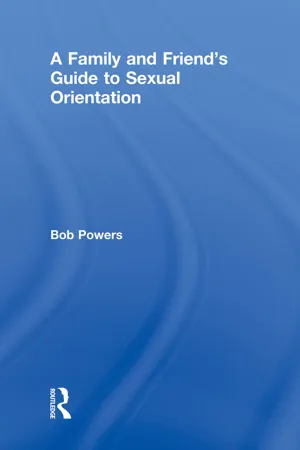
A Family and Friend's Guide to Sexual Orientation helps individuals and families to bridge the divide between gay and straight, to heal wounds that often accompany individuals and families' negative feelings about lesbians, gay men, bisexuals, and transgendered persons. Consisting of thirty stories by individuals who have come to accept and embrace their own sexuality, twelve of the stories are by heterosexuals who, in addition to talking about their own sexuality, speak of the homosexuality of a loved one. The book also includes five personal stories from two families.
eBook - ePub
A Family and Friend's Guide to Sexual Orientation
Bridging the Divide Between Gay and Straight
- 286 pages
- English
- ePUB (mobile friendly)
- Available on iOS & Android
eBook - ePub
A Family and Friend's Guide to Sexual Orientation
Bridging the Divide Between Gay and Straight
About this book
Information
1
Getting Started
The Road from the closet Door to the Magic Line

The Heterosexual Closet
While many of us are well aware of the proverbial closet door with which gays, lesbians, and bisexuals have contended, few people are conscious of the impact those closets have on heterosexuals and fewer still know that heterosexuals—families and friends of sexual minorities—face a heterosexual closet door.

This closet contains the same dark emotions—fear, terror, dread—that initially crippled and ultimately led lesbians and gays to fling their closet doors open in a quest for self-acceptance. For most heterosexuals, the closet is terrifying.
When I told my mom I was gay, I realized that while that step was one step on my journey of self-acceptance, for my mom, it was one step into her own private hell—her closet. How can I possibly tell anybody, she asked? [I’m so ashamed.]
Family and friends, upon learning that a loved one is gay, lesbian or bisexual, are immediately thrown into a process of “coming out” as a parent, a child, a spouse, a friend—similar to the process gone through by any sexual minority.
It’s not unlike the process that anybody faces when they are hiding—whether it be an addiction, a sick family member, or an abundant inheritance. Hiding takes its toll! And, heterosexuals need to learn how to fling open their closet doors. They too need to “come out”—to go through the steps of self-acceptance. Yet, when it comes to sexual orientation, most families have adopted a U.S. Military-like policy of “DON’T ASK, DON’T TELL.” In other words, “I won’t ask if you’re gay and I don’t want you to tell me if you are.” This approach has a disastrous effect on family life for it completely destroys any chance of an intimate family relationship.
In the Closet: Our Top Ten Fears
So why do so many families fall victim to such a situation that decreases the possibility of family intimacy? The answer lies in fear. A DON’T ASK, DON’T TELL family develops out of our fears. Here are ten fears that keep families closeted.
1) Fear of personal shame.
Our culture and many of its institutions send negative messages about homosexuality, and, as a result, many gays and heterosexuals experience shame about either being gay or having a relative or friend who is gay. These feelings of shame come from our having internalized these negative messages.
2) Fear of public embarrassment or social ostracism.
In light of the negative stereotypes and the shame that have been associated with homosexuality, gays and heterosexuals alike fear public ridicule or ostracism when one’s homosexuality or that of a loved one is revealed.
3) Fear of being labeled as “not normal.”
In many ways this fear is the result of the personal shame and public embarrassment that lead us to feel that we do not “fit in.” Many people tend to seek others’ approval, which leads them to act in conforming ways so as to appear “normal.” The fear of being labeled as “not normal” is very real.
4) Fear of discussing unpleasant or sexual topics within the family.
Many families have difficulty communicating about serious matters and avoid discussion of all topics that create discomfort. Often, sexuality is one such topic. The hiding or ignoring of significant aspects of family members’ lives, however, often leads to a complete breakdown in family communication.
5) Fear of loss of family and friends.
One of the most predominate fears many people experience is that talking about sexual orientation will lead family and friends to disown or abandon them. This fear of loss will cause many people to remain closeted.
6) Fear of confusion about one’s own sexuality.
Any deviation from perceived norms can lead one to experience confusion about his or her own sexuality. This can be disturbing. Because of our culture’s conflicting messages about sexuality, it is not surprising that all of us, at some time or another, find ourselves confused about our sexuality—it is part of normal psychological development.
7) Fear of violence.
Every day there are numerous attacks on gays and lesbians simply because of their sexual orientation. In some cases, these attacks are extended to heterosexuals who support and love gay people. Such attacks are often the result of another person’s insecurities and confusion about his or her own sexuality. Whatever the cause, however, this is a fear that families face in coming out on this issue.
8) Fear of being “hit upon.”
During the DON’T ASK, DON’T TELL military hearings, many soldiers expressed fear that, if gays were allowed into the military (they are already there in large numbers), they would be subject to sexual advances and morale would suffer. For most gays and lesbians, making a sexual advance towards a heterosexual is akin to going to a hardware store to buy a loaf of bread.
9) Fear of economic or job discrimination.
This fear can create tremendous challenges for gays and straights alike to come out at work about their own sexual orientation or that of a loved one. Discrimination occurs (as you will read in Lisa Busjahn’s story) and the fear of losing one’s job often means that coming out at work is one of the last stages in most people’s road to acceptance. In several of the life histories, you will see how coming out at work actually led to greater security and financial success.
10) Fear of AIDS.
Because of misinformation about AIDS and the association of AIDS with the gay community, some people fear that contact with gays puts them at risk for contracting the disease. This is simply inaccurate. Unless one engages in intimate sexual contact, sharing needles, or some other activity that results in blood-to-blood contact, there is no possibility of contracting the disease. It is not transmitted through casual contact. The virus does not discriminate on the basis of sexual orientation—it hasn’t a clue as to whether you are gay or straight.
The preceding ten fears represent some of the more obvious fears that keep people in the closet. Ultimately, we all have the opportunity to both acknowledge and face these fears and then to make choices that will help us move towards greater acceptance and a DO ASK, DO TELL family environment.
The Choices Gay and Straight People Face
In a DON’T ASK, DON’T TELL household, the gay or lesbian family member has no choice but to:
1) Force the issue out into the open.
2) Distance him/herself from the family.
3) Hide her/his true self.
Few children have the tools to effectively force the issue. So, most kids distance themselves from their family—often moving or running away to places where they can live openly. Others remain and keep their life hidden from their family members. Any of these alternatives can create huge rifts in family relationships. Forcing the issue often results in blow ups; distancing and hiding contribute to building a closet of self-hate and low self-worth. All three options result in a loss of intimacy among family members. So when family members question if the closet has any effect on heterosexuals, they can know that the answer is a resounding YES. The closet contributes to and ensures the destruction of intimate, loving family relationships.
Peter’s parents were ready to celebrate their fiftieth wedding anniversary. Peter’s family operated in a DON’T ASK, DON’T TELL environment. They all knew that Peter was gay but … Peter’s siblings met to plan a surprise anniversary celebration for their parents. Peter was not invited to the planning session. During the session they became worried that Peter might bring a lover. “What would people say?” one of the sisters asked, and they all concluded that it would be unfair to the parents to force them to deal with this issue on such a wonderful occasion as their fiftieth wedding anniversary. So, they canceled the celebration.
Variations of this scenario occur in every DON’T ASK, DON’T TELL family. Straight people face choices too. Families and friends have three basic choices they can make when it comes to the issue of a loved one’s sexual orientation.
1) They can fight it.
2) They can accept it.
3) They can prepare for it.
Fighting and accepting are reactionary. Preparing for the possibility that someone in their family might be gay is visionary. Let’s look at each of these options.
Denial is probably the most common form of fighting it. “Oh, John isn’t gay, why, he dated Sally just last week.” Or, “It’s just a phase, she’ll be through it in no time.” Sometimes the denial is strong—“There’s never been a homosexual in this family and I can guarantee you there never will be, not so long as I’m alive.” Sometimes the fight is life-threatening.
Timmy lived in New Orleans. One afternoon, his parents took him to one of the city’s finest restaurants. He was enjoying the lighthearted conversation when his father abruptly changed the subject and asked, “Are you a homosexual?”
Until then he had always lied to his parents about his homosexuality. He was tired of lying. He loved his parents and wanted desperately to include them in his life. He had wondered if maybe it was possible to tell them the truth. He concluded he had to tell them. So he did. He told them the truth.
“Yes, I am gay,” he said in response to his father’s query. With that pronouncement, his father began to pound on the table; his mother screamed. He felt as if he were in a dream. Before he was able to collect his thoughts, his parents had stood up and stormed out of the restaurant. He sat alone in silence, with dozens of disapproving strangers and the bill. He went home and cried.
Two days later, his doorbell rang. He opened the door to face his mother and father along with every other adult member of his family. Among them was a ...
Table of contents
- Cover
- Half Title
- Title Page
- Copyright Page
- Dedication
- Table of Contents
- Acknowledgments
- 1. Getting Started: The Road from the Closet Door to the Magic Line
- 2. Gaining Acceptance: Stories of Families and Friends
- 3. Gaining Knowledge: Stories of A Diverse Community
- 4. Deepening Knowledge: Stories from the Workplace and Stories of Spiritual and Religious Development
- 5. Taking Action: 101 Steps on the Road to Acceptance
- 6. Using Resources: Tools for the Trip
Trusted by 375,005 students
Access to over 1.5 million titles for a fair monthly price.
Study more efficiently using our study tools.
Frequently asked questions
Yes, you can cancel anytime from the Subscription tab in your account settings on the Perlego website. Your subscription will stay active until the end of your current billing period. Learn how to cancel your subscription
No, books cannot be downloaded as external files, such as PDFs, for use outside of Perlego. However, you can download books within the Perlego app for offline reading on mobile or tablet. Learn how to download books offline
Perlego offers two plans: Essential and Complete
- Essential is ideal for learners and professionals who enjoy exploring a wide range of subjects. Access the Essential Library with 800,000+ trusted titles and best-sellers across business, personal growth, and the humanities. Includes unlimited reading time and Standard Read Aloud voice.
- Complete: Perfect for advanced learners and researchers needing full, unrestricted access. Unlock 1.5M+ books across hundreds of subjects, including academic and specialized titles. The Complete Plan also includes advanced features like Premium Read Aloud and Research Assistant.
We are an online textbook subscription service, where you can get access to an entire online library for less than the price of a single book per month. With over 1.5 million books across 990+ topics, we’ve got you covered! Learn about our mission
Look out for the read-aloud symbol on your next book to see if you can listen to it. The read-aloud tool reads text aloud for you, highlighting the text as it is being read. You can pause it, speed it up and slow it down. Learn more about Read Aloud
Yes! You can use the Perlego app on both iOS and Android devices to read anytime, anywhere — even offline. Perfect for commutes or when you’re on the go.
Please note we cannot support devices running on iOS 13 and Android 7 or earlier. Learn more about using the app
Please note we cannot support devices running on iOS 13 and Android 7 or earlier. Learn more about using the app
Yes, you can access A Family and Friend's Guide to Sexual Orientation by Bob Powers,Alan Ellis in PDF and/or ePUB format, as well as other popular books in Social Sciences & LGBT Studies. We have over 1.5 million books available in our catalogue for you to explore.