eBook - ePub
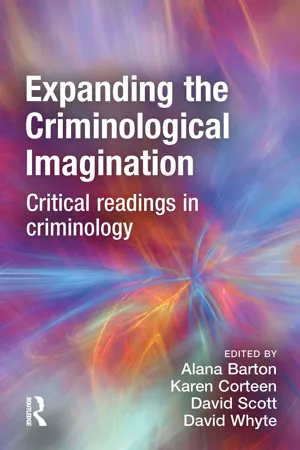
Expanding the Criminological Imagination
- 256 pages
- English
- ePUB (mobile friendly)
- Available on iOS & Android
eBook - ePub
Expanding the Criminological Imagination
About this book
This book brings together a series of writings on the problems facing contemporary criminology, highlighting the main theoretical priorities of critical analysis and their application to substantive case studies of research in action. Its main aim is to establish the conceptual and practical foundations for a new generation of studies in criminology, and to set a new agenda for critical criminology. Each chapter will critically assess the main conceptual and empirical problems they have encountered in their research, and to bring to life the key theoretical debates within the discipline. This book will be essential reading for students seeking an understanding of the nature of the discipline of criminology and criminological research.
Information
Chapter 1
Introduction: developing a criminological imagination
Alana Barton, Karen Corteen, David Scott and David Whyte
Future generations of social scientists will look back critically at this period and ask why liberal democracies continued to expand their apparatuses of criminal justice when, at the same time, officially measured and defined rates of ‘crime’ had been in steady decline. They will question why the UK government's response had been to create more and more criminal offences (over 1,000 since 1997 at the last count), expand the range of ‘interventions’ in the lives of the young, fill the prisons to bursting point and build a new generation of prisons for profit. They will question how and why some of the fundamental principles of due process, such as the right to trial by jury and habeas corpus, were being eroded. They will question why policing costs were spiralling out of control and why more police officers and new legions of community safety officers were being recruited when they had little impact on reducing reported crime rates or even on reducing the fear of crime (Crawford et al. 2003). They will also question how, despite substantial evidence to the contrary, individual or socio-pathological explanations of criminal and anti-social behaviour prevailed and why, subsequently, ‘problematic’ individuals and their families were subject to greater state surveillance and intervention by Parenting and Anti-Social Behaviour Orders.
Future generations of social scientists will want to know why public resources were being ploughed into the coercive apparatuses of criminal justice while, at the same time, support services for the most vulnerable and facilities that did have a measurable impact upon offending (such as free leisure facilities for young people) were being withdrawn. They will question why social issues, such as drug use, prostitution, ‘inadequate’ parenting and teenage conceptions, were defined and responded to in a punitive manner with little or no recognition of their structural contexts. If the next generation of researchers ask what criminologists were doing to prevent social and governmental obsessions with crime careering out of control, and to counter the falsehoods and mythical assumptions upon which criminal justice policy is based, they will struggle to find an answer. Criminology's response has largely been to jump upon the bandwagon and greet the expansion of the discipline with open arms, as if the only thing that matters for the enterprise is the enterprise itself. Criminology remains largely a self-referential, self-perpetuating practice that lacks the ability to look outside itself.
The lack of challenge to this social and political obsession with crime is not necessarily down to criminologists' inability to critique: there is no shortage of work within criminology that is critical of the state and of criminal justice agencies. Since the ‘radical break’ in the 1960s (See Sim et al. (1987) for a full discussion of what became known as the ‘radical break’), some criminologists have sought to imagine new ways in which the discipline can challenge intellectually and practically the agendas of the powerful. Given the ascendancy and consolidation of a state-driven agenda within and outside criminology, a critical and creative imagination is necessary now more than ever. It is time for criminologists to reflect upon the utility of the discipline in order to reawaken, revive and expand a criminological imagination.
Current developments in mainstream and administrative criminology have presented us with an unimaginative and individualized discourse that has displaced criminal actors from their broader structural, economic and political contexts. However the limitations on what we can and should say about the problem of ‘crime’ and the contours of possible social policy responses do not have to be reduced to a discourse framed around individual or social pathologies requiring ‘solutions’ that invariably are exclusionary and punitive.
This chapter will discuss the way in which a more imaginative criminology can help visualize radically alternative visions to those proposed within the current limited framework of mainstream criminological knowledge. Further, through an overview of the chapters that follow, this chapter will expound the contribution that criminology can make to a further expansion of the criminological imagination.
The emergence and consolidation of a criminological imagination
In his classic work, the American postwar radical thinker C. Wright Mills sets out what the The Sociological Imagination entails:
a quality of mind that seems most dramatically to promise an understanding of the intimate realities of ourselves in connection with larger social realities … [It] enables us to grasp history and biography and the relations between the two within society … [and] to use it with sensibility is to be capable of tracing such linkages among a great variety of milieux … [It] enables its possessor to understand the larger historical scene in terms of its meanings for the inner life and the external career of a variety of individuals. It enables him [sic] to take into account how individuals, in the welter of their daily experience, often become falsely conscious of their social positions … [and allows the possessor to] continually work out and revise views of the problems of history, the problems of biography, and the problems of social structure in which biography and history intersect (1959: 15, 6, 11, 5, 225).1
The sociological imagination signified a way of thinking about or interpreting the world. It represented a particular way of conceptualizing and approaching social problems, their implications and resolution. It provided a broad-ranging interpretive framework for locating the individual within structural and social contexts, ultimately providing a new way of understanding the social world that makes intimate connections between individual meanings and experiences and wider collective and social realities. The sociological imagination therefore facilitated a form of interpretation that placed understandings of an individual's biography within the sensibilities of wider historical and structural contexts. It demanded that understandings of the present were firmly connected with the ways in which the phenomena under scrutiny had been produced and reproduced. In this sense individual identities and lived experiences could not be considered in isolation, for no meanings could be attributed to a person's actions outside their social, historical and structural contexts. Through this interpretive lens, while the biographical details of individual offenders remain important, their problematic, troublesome or illegal behaviour cannot be detached from their historical and material contexts. To understand the problem of ‘crime’, therefore, criminologists must use their imagination to provide clear connections between the actor, the event and location of the criminalized incident and the structural, spatial and historical determinants shaping definitions and applications of the label of ‘crime’, deviance and illegality at that particular time (Becker 1963).
This criminological imagination (as evidenced in Sim et al. 1987) provided a new means for conceptualizing ‘crime’ and its relationship to the social. In this sense it presented an alternative means of interpreting the world. A key influence here were the writings of the Italian Marxist Antonio Gramsci (1971) developed in the work of Stuart Hall et al. (1978) and Hall (1988). Hall pointed to the importance of creating an alternative ‘counter-hegemonic’ discourse, infused with socialist values and principles, that reconceptualized the organization of society. In a similar vein adoption of the criminological imagination challenged existing and dominant individualized ways of thinking about crime and punishment. Connecting individual offenders with their (less visible) historical and structural contexts inevitably provided an opportunity to reinterpret or reimagine the real. This itself, as Gramsci hoped, delivered an opportunity to foster a new form of radical consciousness facilitating alternative means of conceptualizing and dealing with both the personal and the social.
Mills (1959) had made this approach to sociological problems most clear in his discussion of the relationship between ‘private troubles’ and ‘public issues’. A trouble is a private matter that occurs within the lived experiences of the individual and affects his or her immediate relationships and social world. An issue, on the other hand, is a public matter which should be understood through an analysis of the political and economic structures of a given society. The two are intimately tied as:
many personal troubles cannot be solved merely as troubles, but must be understood in terms of public issues – and in terms of the problems of history-making. Know that human meaning of public issues must be revealed by relating them to personal troubles – and to the problems of individual life (Mills 1959: 226).
Through the sociological imagination, troubles were translated into issues in terms of presenting the individual with a new and plausible ‘bigger picture’ of his or her social world, one that offered new orientating values, feelings, motives, understandings and meanings.
What the discussion above draws us towards is an understanding of the importance of fostering and further developing a criminological imagination. That is, the encouragement and enhancement of:
a kind of criminological imagination that is able and willing to break free of old constraints and look at the problems of crime and punishment with fresh eyes. That kind of criminological imagination has always been a great strength of the movement we loosely call critical criminology (Currie 2002: viii).
As Currie points out, then, the theoretical and political priorities of critical criminology have been the realization of a criminological imagination (Sim et al. 1987; Scraton and Chadwick 1991; Scraton 2002). The development of critical criminology since the 1970s has been rooted in a synthesis between the Meadian-inspired symbolic interactionism (Becker 1963), focusing on everyday social relations and the experiential, and social structures, first around class and production by Marxist-inspired criminologists (Taylor et al. 1973), but later around ‘race’ (Hall et al. 1978) and gender (Smart 1977). In so doing critical criminology has produced a new vocabulary or critical discourse for understanding lived experiences, and therefore represented a radical departure from the decontextualized analysis found in much criminological, political and media discourses on ‘crime’.
Rather than focus upon the individualized or family-centred causes of crime, critical criminologists focused attention on understanding the social, economic and political contexts that produce both crime itself and state responses to crime. Critical analysis has examined the relationship between the individual and the social through emphasizing the boundaries placed upon everyday interactions, choices, meanings and motivations of criminals and deviants through these contexts. Alongside this has been a problematization of the political and ideological construction of ‘crime’ and deviance and the processes which have led to the naturalizations of these dominant conceptions. This has included a concern not only with the structural processes which have led to the sedimenting of the dominant discourse on what ‘crime’ is understood as meaning, but also with those social harms which have been excluded from such a definition or under-enforced, for example around gendered and racialized harms, state-sanctioned violence, economic deprivation, poverty, war and crimes of the powerful. Dominant definitions of ‘crime’ have been understood through an examination of the power–knowledge axis within social structures arising in a given historical period. This has led to questions concerning power and legitimacy, and as identified above, three structural contexts have been central to their understanding in the criminological imagination: class, ‘race’ and gender, though concerns around age and sexuality have emerged more recently (Sim 2000; Scraton 2002; Corteen 2003; Wahidin 2004).
Critical criminology has located the problem of ‘crime’ within the contours of advanced capitalism and the unequal distribution of wealth. Rather than seeing the law as a crude instrument of capitalist oppressors, critical criminologists have pointed to the contradictory nature of the law in capitalist societies. While the law and its enforcement can, and do, protect the general population and while many ‘crimes’ that are recorded in the official figures tend disproportionately to victimize vulnerable and/or impoverished individuals, the criminal justice system at the same time plays a decisive role in maintaining structural divisions in society. ‘Crime’ and law enforcement cannot be understood outside this context. Consequently, a central concern within critical criminology has been to connect processes of criminalization, class conflict, poverty and other forms of ‘social exclusion’. The almost exclusive focus by law enforcement agencies on the criminality and subsequent punishment of what have been described variously as the ‘sub-proletariat’ (Hall et al. 1978), the non-productive labour force or the un- or underemployed, has reinforced the social marginalization of the most structurally vulnerable.
A further point highlighted in critical analysis has been the statistical over-representation of black people and under-representation of women in the administration of criminal justice and state punishments. This requires explanation. For critical criminologists the continued subjugation of African-Caribbean, Asian, Chinese and other minority ethic groups must be located within the structural context of neocolonialism. Through the combination of xeno-racism and economic, political and social exclusion minority communities are increasingly over-represented in the surplus populations of advanced capitalist societies (Sivanandan 2002). In addition, critical criminology in the last 30 years has started to recognize how law and regulation are intimately connected with reproduction; that the lived experiences of men and women cannot be detached from gendered hierarchies of power (Bosworth 1999; Ballinger 2000; Malloch 2000; Corteen 2003; Barton 2005; Corcoran 2006). Problematizing the masculinist basis of ‘criminological knowledge’, the marginalization and exclusion of women and the consolidation of heteronormativity critical criminology has highlighted the complexity of the existing relationship between ‘justice’ and the exploitation and subjugation of marginalized groups. Concerns around patriarchy and masculinist hegemony reverberate in many current critical imaginaries.
Much recent critical and post-structural literature has correctly highlighted the dangers of reducing complex social phenomena to simplified essentialisms, pointing rather to the hybridity of social factors in shaping human experiences and identities. The relationship between class, ‘race’, gender, age, sexuality and (dis)ability is compl...
Table of contents
- Cover
- Half Title
- Full Title
- Copyright
- Contents
- List of contributors
- Acknowledgements
- 1 Introduction: developing a criminological imagination
- 2 Critical criminology and the intensification of the authoritarian state
- 3 Confronting the ‘hegemony of vision’: state, space and urban crime prevention
- 4 The ‘worse’ of two evils? Double murder trials and gender in England and Wales, 1900–53
- 5 ‘Talking about resistance’: women political prisoners and the dynamics of prison conflict, Northern Ireland
- 6 Changing focus: ‘drug-related crime’ and the criminological imagination
- 7 Taking crime seriously? Disaster, victimization and justice
- 8 Towards a criminology for human rights
- 9 Conclusion: expanding the criminological imagination
- Index
Trusted by 375,005 students
Access to over 1.5 million titles for a fair monthly price.
Study more efficiently using our study tools.
Frequently asked questions
Yes, you can cancel anytime from the Subscription tab in your account settings on the Perlego website. Your subscription will stay active until the end of your current billing period. Learn how to cancel your subscription
No, books cannot be downloaded as external files, such as PDFs, for use outside of Perlego. However, you can download books within the Perlego app for offline reading on mobile or tablet. Learn how to download books offline
We are an online textbook subscription service, where you can get access to an entire online library for less than the price of a single book per month. With over 1.5 million books across 990+ topics, we’ve got you covered! Learn about our mission
Look out for the read-aloud symbol on your next book to see if you can listen to it. The read-aloud tool reads text aloud for you, highlighting the text as it is being read. You can pause it, speed it up and slow it down. Learn more about Read Aloud
Yes! You can use the Perlego app on both iOS and Android devices to read anytime, anywhere — even offline. Perfect for commutes or when you’re on the go.
Please note we cannot support devices running on iOS 13 and Android 7 or earlier. Learn more about using the app
Please note we cannot support devices running on iOS 13 and Android 7 or earlier. Learn more about using the app
Yes, you can access Expanding the Criminological Imagination by Alana Barton, Karen Corteen, David Scott, Dave Whyte, Alana Barton,Karen Corteen,David Scott,Dave Whyte in PDF and/or ePUB format, as well as other popular books in Social Sciences & Human Rights. We have over 1.5 million books available in our catalogue for you to explore.