- 336 pages
- English
- ePUB (mobile friendly)
- Available on iOS & Android
eBook - ePub
About this book
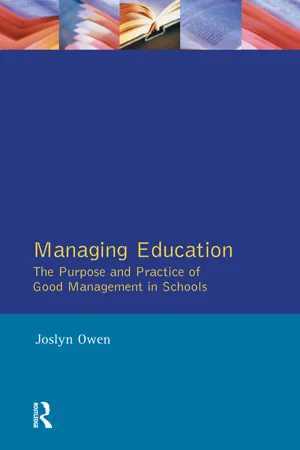
The 1988 Education Reform Act meant that schools had to manage themselves in ways which satisfied the world outside the school gates. Governors become more powerful, parents took on a greater influence and employers were given new rights. This book discusses the total management of schools as they respond to these new imperatives. It examines the responsibilities of Teachers, Head Teachers and Principals as they shape and execute their management plans. Against the background of a compulsory National Curriculum, the book also examines the management of the diverse pressures within the curriculum itself.
Information
CHAPTER 1
Education, its managers and the public
Despite the breadth of press coverage for education reforms, it is not the newspaper-reading public that will determine whether education is good or bad and whether this school shall survive and that one disappear. It is not the public at large, either, which seeks assurance about quality. That falls, instead, on parents.
The control of quality which lies behind assurances about its level is in the hands of governors, heads and other teachers. Governors know that their own position may still be largely nominal. Teachers have the power to provide quality but they – and heads too – choose to look upon the management of quality mainly as a matter of personal effort and personal trust. Procedures, the documentation of procedures, the revision of those procedures which can guarantee consistent quality – these are not regarded by heads as a main part of the tradition of management.
Instead of a detailed concern to produce a process of learning which is repeatedly, from pupil to pupil and from year to year, of good quality, heads and other teachers satisfy themselves that they are providing a good education which is suited to the individual needs of those whom they teach. Seldom is a longer-term aim described, an aim which will if realized improve life in specific ways. It is generalization and a broad brush approach which dominates. It starts with the public.
Of the three major events affecting schools between the Second World War and the turn of the century, the first was a piece of legislation. The Education Act 1944 brought into being the four-part system of primary, secondary, special and further education. It raised the minimum leaving age to 15. It modified the relationship between maintained and denominational schools. It put into practice divisions of responsibility between a Secretary of State and local education authorities (LEAs). How that Act’s changes were initially put into effect and how their daily impact was managed has not been recorded – unsurprisingly at a time when a war was being finished off and when other major social reforms were afloat.
The second event was a report of the Central Advisory Council on the education of pupils of average and less than average ability between the ages of 13 and 16. This, the Newsom Report, published in 1963, led to the equalization of opportunity, to the enlargement of the curriculum and to a further lengthening of the period of compulsory education. How the changes that it brought about were managed is again unrecorded. Slow improvements and reorganizations, not very visible to the public eye, took until the early 1970s.
The third major change was the Education Reform Act 1988. A concern about how education had been managed had become more prominent for about two decades. This book is mainly concerned with seeing how a new approach to shared management can handle the complexities of legislation which then radically changed the scene which was shaped by the 1944 Act and which set out to build rationally on the reforms which the Newsom Report had called for.
How marked was the impact of reform on public awareness? To start with Newsom, education is not often the stuff of front pages and headlines. When it is, it is sometimes a matter of outrage: boys taking charm lessons, teacher expelled over a slap, an 11+ dunce for the university, girls in peril under the showers – each of these news stories was of the kind that was given generous coverage in popular newspapers in the same month as the Newsom Report was published. As though to balance things out it was allocated a two page summary in one daily and was given its own headlines elsewhere, with an emphasis on headlines which described a ‘spotlight on our children’ and articles which described how girls were given ten shillings to ‘clear out and amuse themselves’. The example set by parents was described as ‘shaky’ and another approach was that everyone, children, students and teachers, should be required to work harder.
The Robbins Report, a week after Newsom, was interpreted in the headlines as a reproof to university teachers. Again the message was that dons and students should work harder and longer.
These represent part at least of what the country was to understand about two major reforms. Admittedly they coincided with the Profumo scandal, with the aftermath of the Great Train Robbery and with the comedienne Millicent Martin announcing that she was going to leave a popular television show, That Was The Week That Was. It was the time, too, when Harold Macmillan stepped down. The contest between Butler, Maudling and Hailsham ended up with Lord Home at Number Ten.
When that was all over, education’s major reforms were scarcely remembered by the press and, perhaps, by the general public. Osbert Lancaster’s cartoon aristocrat took a rest, now that we could all relax for a bit and give our undivided attention to pre-marital sex and the Beatles.
Thirty-eight years earlier the Daily Mail had been more zealous: it had offered prizes for the best curriculum which its readers could suggest. The largest prize (£500) went to Mr Ernest Melles, Headmaster of St Luke’s School, Chelsea, who, in addition to a detailed outline of his ideal curriculum, also laid down the allocations of time which each subject and activity should be given. His suggestions do not make the national curriculum of 1988 appear very new.
What we do not know about 1925 or 1963 is what action was taking place in central government or in local authorities or in schools and training colleges. The Hadow Report, which provided a context for at least some public interest in education in 1925, said little about parents, nothing about governors and managers and nothing about education beyond the limits of schooling. Newsom had a good deal to say about the social and economic environment of those children who did not benefit from secondary education but, again, nothing about governors or vocational training after school – not that this meant that working life was not somewhere in the picture. John Newsom, the chairman, said that his mental image as he worked on his report was the boy in the leather jacket and jeans and the girl in the tight skirt and beehive hairdo. They would probably be married in five years’ time – with the boy probably becoming a labourer and the girl a factory worker on the production line. His concern was that they should be helped to become full persons and to break through the barriers society had rigged against them.
Words into actions
Contact between any report and its surrounding reality used to be left in the first place to legislation and regulation (raising the school leaving age, introducing the Certificate of Secondary Education) which initially reached only some teachers and some schools. Changes until 1988 had not been implemented in such a way as to affect the inner workings of all schools and all colleges of further education at the same time. Nor had they given the impression that there would at some stage be a single moment when the benefits of change and reform would become obvious enough and powerful enough to influence the way in which people live.
In contrast, the intention that it should have a universal effect meant that the Education Reform Act 1988 should for once get over the difficulties of separateness and disparities of timing. It looked to the future in requiring that assessments of children’s performance in the curriculum should affect the way they were taught in each phase which followed key stages at the ages of about 7, 11 and 14. The short-term effect of formative evaluation might be open to question since it was unlikely to contribute much to the picture of overall change which we might expect, for instance, in any period of two or three years. But the long-term effect was virtually certain.
Will education’s effect change by the year 2000?
We shall know if the changes in education between now and the beginning of the next century are successful if we see that they establish at that time a previously undescribed view of what education should produce. It may be that we will then realize that an ideal of getting the majority of the population into higher education is practicable. It may be that education will produce a richness of mind which will not allow boredom to be the alternative for the type of employment which now takes a day’s energy. It may be that education will produce a complete understanding of other people, of other parts of the world and of alternative ways of living.
As they stand, these examples themselves reveal some limits: the first ideal is that education should lead to more education. The second is that education is a source of activity which differs from work. The third is that education can alter feelings as well as enlarge knowledge. But the education system we already have makes it clear that education can only partially touch each of these. What has not happened is that changes have come about on a universal scale. Instead, we know that an experience of a little education may deter some people from seeking more, that some activities which are an alternative to work can become obsessive or unhelpful or dangerous. And as far as larger understandings go, we know that, for example, literacy may increase rather than diminish our prejudices.
Limited or not, our knowledge tells us that the more education we receive the more of it we want only if it is an education which suits us, which we find comfortable and stimulating and which above all fits in with a view we hold about ourselves and our future. And that view in itself is not always within the perspective of the person who receives education directly; it may be that of a parent or some other influencer – not least the teacher or tutor.
We know, too, that although it is a long way from being universal, education does have something to do with creating the desire to follow activities other than those of daily work. And, lest a glib comment about literacy destroys the real picture, we see that an educated understanding of world affairs is often accompanied by a sense of immediacy, a sense of the smallness of the planet and a feeling that the troubles of one country belong to us all.
Because we already have a limited experience of the benefits of education, it is difficult to think of benefits which might go far beyond that experience. Famine and cancer might become things of the past partly through education producing better systems of growing, distributing and affording food and partly through education creating a level of research and skill which allows either prevention to be total or therapies to be discovered and, again, made affordable on a large scale. More education or better education at the basic level, in these circumstances, is taken as the ground floor: more people have their intelligence fed and sharpened to a higher level and in numbers which have not so far been possible. But if education can do good because more people of intelligence can work to benign ends, it is also almost inevitable that some intelligence will be devoted to malign purposes – such as those of encouraging racism or of manufacturing drugs which are damaging and addictive. With 4-year-olds and 14-year-olds we do not know in which direction their education will take them – and at 24 the story is scarcely different.
At less dramatic levels of what is good and bad, education may domestically and in world terms lead us to live within our means. At the beginning, this would involve our being educated so as to be immune to some of the less helpful influences of commerce and credit finance. More broadly it would lead us to be unwilling to use and consume things which have a finite limit in the natural world.
At a very personal level, education would help us to live by good principles without being pietistic. It would, so to speak, make us realistic enough to see that the virtue of confining our diet so as to avoid eating meat might be balanced out by the harm done to the economies of those countries where wages and living-standards depend on providing meat for world markets. And even in the process of balancing the equations of harm and benefit, we would need to remind ourselves that always seeing both sides of a question can result in inertia: knowledge has to be connected with the exercise of will.
At another level, education may make us better at using and running a democracy. This would involve us in learning that not everything can be known, public, open and debated. But it would indeed assist us in reaching as full an understanding as we are capable of in those things which are accessible – and in transforming understanding into action.
These hopes for the future apply in the school and the classroom. Among members of a single group of teaching staff and in a single school, common understandings are sometimes hard to create. The questions are: how are they best sought and how is it known that one approach to a common understanding is better than another? How are differences to be reconciled?
Teachers
Major differences between individual teachers may at first sight seem likely to be their age and the time which has elapsed since they were trained. In a nine-class primary school it is not unusual to find two teachers who are fairly new to the profession and who see nothing too awkward about the requirements of the 1988 Act: ten subjects have not previously been explicitly identified in the curriculum of young children but teachers do know when they are teaching history and not geography or when they are teaching science and not history. On the other hand, when they move from teaching to assessing they do not find it easy to record precisely how much time they have dedicated to each subject. Nor do they find it easy to distinguish among, say, twenty-five children in a teaching group, precisely when they can be assessed as to their competence in geography rather than in their capacity to communicate what they know. And when English is being assessed, is it what they are writing about or their skill in the actual business of writing which can be the more readily gauged?
Even for the newly-trained teacher this difficulty of maintaining separateness about assessing what is being learned creates some hesitation. A teacher in mid-career who has taught in the same school and with the same age-group for five years or more will find it is slightly challenging (but perhaps no more than that) to ascribe a judgement about progress and development – or their absence – to children who, until the 1988 requirements for assessment, had been looked at in the round. The strengths of the past, such teachers believe, lay in their completeness of approach. There may be some nervousness that the sense of the entire child may disappear in the new curriculum and with new requirements of assessment. Nevertheless, even the diffident teacher admits that one is unlikely to be much of a teacher if he or she does not retain a sense of the personality of the children and of the totality of their capabilities and interests – even when the most detailed descriptions are hammered out about separate facets of development.
What does create nervousness, for those in mid-career as much as for those who are new, is the question of whether enough time is going to be available to record everything that is needed. Will the description be clear enough to provide a good jumping-off point for formative work based on one assessment in the term and in the years which follow? And, particularly if it is a teacher in another school or even in another part of the same school, will another ‘receiving teacher’ give the same weight and understanding to the assessment as the originator? If the answer is to be based on what is commonly said to have happened even at a time, such as the past two decades, when record-keeping and continuity received much attention, no one would be too optimistic about the formative uses of assessment. It will be a matter for persistence and good management.
Making use of assessment
Even if a continuous record of achievement, including the assessment at each statutory stage, is maintained in detail, who will use it? This question at the start of new schemes creates a puzzle rather than a deterrent. Those in secondary schools are accustomed to reporting in written form to parents. Most teachers, at the primary as well as the secondary stage, are accustomed to giving, from time to time, an oral report. But now the requirement is for a written record which will be open to the parent as well as to the next teacher – and open in certain circumstances to governors. No teacher has been accustomed to this last demand.
Any assessment can, if an individual parent complains, be used as the basis of a judgement about what a particular teacher has done for an individual child. What is new here may be that the written assessment could be used rather in the same way as the policeman’s notebook. What has been said has been said. There could be no going over it again – and it would not be for the headteacher solely to go through the complaint with the teacher. The governors or the local authority may also now come in – something which was admittedly possible but rarely used in the past.
While it would be comforting to give the impression either to the new teacher or to the teacher in mid-career that any extreme use of a record and an assessment will be unusual, it does still present an edgy new element. It is something to be anxious about – not least because until the present it has lain in the realm of untested law and regulation. What has been comforting, on the other hand, is that the earliest documents from the Schools Examination and Assessment Council (SEAC) (notably Pack C of the 1990 Guide to Teacher Assessment) expressed their guidance about access to information with sensitivity: assessment records had to be used in providing information which was part of the decision-making process within the school, between linked schools at transition points and with the LEA and the community. In summary the shape of access to information is that (SEAC 1990b: 75):
• Parents and legal guardians have a statutory right to view pupil records.
• Teachers who are to receive pupils at transition points need access to assessments of individuals to inform their planning decisions.
• Headteachers have access to the records in order to review and monitor the work of the school. They also require summary documents in order to respond to queries from parents.
• Members of governing bodies and LEAs also have statutory access to school records for purposes of review and monitoring.
This is clear enough until the time is reached when the first complaint is made by any individual parent, interest group or local authority. It is at that point that even the teacher who is a late entrant into the profession, who has previously experienced, let us say, the ways of industry or commercial business, now has to keep his or her nerve. It is not the diffident new teacher or the teacher who has been accustomed to matters being decided by di...
Table of contents
- Cover
- Half Title
- Title Page
- Copyright Page
- Table of Contents
- Preface
- Acknowledgements
- Introduction
- 1 Education, its manager and the public
- 2 Managers of development and change: the shift from expecting to requiring
- 3 Training
- 4 Corporate management
- 5 Marshalling attitudes
- 6 Managing connections within education
- 7 Lessons from the past
- 8 Managing the new
- 9 New training for new management
- 10 Responding to alternatives
- 11 New demands on management
- 12 New responses from management
- 13 Responsibility and self-justification
- End note
- References
- Index
Trusted by 375,005 students
Access to over 1.5 million titles for a fair monthly price.
Study more efficiently using our study tools.
Frequently asked questions
Yes, you can cancel anytime from the Subscription tab in your account settings on the Perlego website. Your subscription will stay active until the end of your current billing period. Learn how to cancel your subscription
No, books cannot be downloaded as external files, such as PDFs, for use outside of Perlego. However, you can download books within the Perlego app for offline reading on mobile or tablet. Learn how to download books offline
Perlego offers two plans: Essential and Complete
- Essential is ideal for learners and professionals who enjoy exploring a wide range of subjects. Access the Essential Library with 800,000+ trusted titles and best-sellers across business, personal growth, and the humanities. Includes unlimited reading time and Standard Read Aloud voice.
- Complete: Perfect for advanced learners and researchers needing full, unrestricted access. Unlock 1.5M+ books across hundreds of subjects, including academic and specialized titles. The Complete Plan also includes advanced features like Premium Read Aloud and Research Assistant.
We are an online textbook subscription service, where you can get access to an entire online library for less than the price of a single book per month. With over 1.5 million books across 990+ topics, we’ve got you covered! Learn about our mission
Look out for the read-aloud symbol on your next book to see if you can listen to it. The read-aloud tool reads text aloud for you, highlighting the text as it is being read. You can pause it, speed it up and slow it down. Learn more about Read Aloud
Yes! You can use the Perlego app on both iOS and Android devices to read anytime, anywhere — even offline. Perfect for commutes or when you’re on the go.
Please note we cannot support devices running on iOS 13 and Android 7 or earlier. Learn more about using the app
Please note we cannot support devices running on iOS 13 and Android 7 or earlier. Learn more about using the app
Yes, you can access Managing Education by Joslyn Owen in PDF and/or ePUB format, as well as other popular books in Éducation & Éducation générale. We have over 1.5 million books available in our catalogue for you to explore.