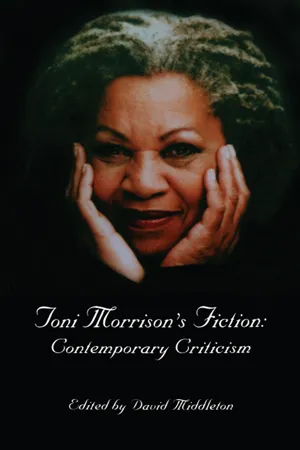
This collection of contemporary criticism explores her concern with racial and gender issues and analyzes her in relation to other major modern authors, her philosophical and religious speculations, and her preoccupation with the process of fiction-making.
These classics provide a broad look at critical argument about Toni Morrison's meanings and significance during the past 10 years. From the formative effects of learning one's Otherness as a result of majority perception, to the apocalyptic implications of racial memory, to the moral and psychologically constructive act of storytelling, to the structural function served by improvisational jazz music, to the imagery associated with both flight and naming, to the uniquely female experience of community-major issues raised by Morrison's body of work are explicated here.
- 324 pages
- English
- ePUB (mobile friendly)
- Available on iOS & Android
eBook - ePub
About this book
Information
PART 1
The Bluest Eye
Storytelling and Moral Agency
In fine, he gave himself up so wholly to the reading of Romances, that a-Nights he would pore on ’til ’twas Day, and a-Days he would read ’til ’twas Night; and thus by sleeping little, and reading much, the Moisture of his Brain was exhausted to that Degree, that at last he lost the Use of Reason. A world of disorderly Notions, pick’d out of his Books, crowded into his Imagination; and now his Head was full of nothing but Inchantments, Quarrels, Battles, Challenges, Wounds, Complaints, Amours, Torments, and abundance of Stuff and Impossibilities; insomuch, that all the Fables and fantastical Tales which he read, seem’d to him now as true as the most authentick Histories.
Cervantes, Don Quixote
The dangers of excessive reading are nowhere more brilliantly portrayed than in Cervantes’s tale of the tragicomic Don Quixote.1 A storyteller himself, Cervantes here displays the usual belief that if we want to learn about life from books, we should turn to history, not fiction. This bias runs so deep that even some novelists tend to justify fiction on the grounds of its inherent veracity; that is, they tend to make fiction a form of history. Henry James, for instance, has said that “the only reason for the existence of a novel is that it does attempt to represent life.”2 Some writers, less concerned with justifying fiction than James is, would nevertheless echo Virginia Woolf ‘s claim that “fiction is like a spider’s web, attached ever so lightly, perhaps, but still attached to life at all four corners.”3
Quixote’s world is attached to life, at least to its moral dimension. If we cannot draw a sharp distinction between fiction and history, and there is reason to think that we can’t, then we’ll have to look elsewhere for the significance of Quixote’s situation. Quixote is good but misguided; his problems are epistemic but moral. Usually we ask how Quixote went so wrong, how he came to be confused about the nature of the world. I propose to ask how he went so right. After all, even though he seems silly, we give him credit for moral goodness. Even those who do not praise Quixote at least see him as a moral agent. Since participation in the practice of storytelling seems to be a key to Quixote’s situation, and since we each may face the danger of becoming a crazed contemporary of Quixote, we must inquire into the moral value of storytelling itself.
I. STORYTELLING
It is useful to begin with an understanding of what a story is, and how it is distinct from other forms of discourse. I join Robert Scholes in taking a story to be “a narrative with a certain very specific syntactic shape (beginning-middle-end or situation-transformation-situation) and with a subject matter which allows for or encourages the projection of human values upon this material.”4 A story has a structure, and this structure is dynamic.
The question “why should we tell stories?” lends itself to several interpretations. Practical answers typically explain the value of stories and literature for increasing our knowledge of the world and our skill at perceiving the world.5 Moral answers typically tend to focus on the content of the stories as providing moral examples. I know of no answer to this question that explains what narrative, particularly fiction, contributes to our becoming moral agents.6 Accordingly, the question I address is whether storytelling is necessary to moral agency.
Since storytelling involves both a teller and a listener, our basic question breaks down into two: Why should anyone tell a story? Why should anyone listen to a story? The reasons for telling may be quite different than the reasons for listening.
Storytelling as a practice includes both constructing one’s own story and performing that story or a story made up by someone else. When considering the teller of a story, I am not concerned with the performance of the story but rather with its construction, so I’ll speak as if stories are always original. This isn’t meant to deny the Brothers Grimm but simply to focus on the more difficult case. In telling an original story, one articulates what one thinks about a set of events, a particular character, a set of characters, an issue, a problem, or whatever. One has one’s say. In addition, one presents a perspective, a character, and a set of judgments that delimit each.
In listening to a story, on the other hand, one confronts a perspective, a character, and a set of judgments. (For the listener, it may not matter whether the story is the teller’s own or a “stock” story; what surely does matter is whether the listener has heard it before.) Sympathy and imagination help the listener to try that perspective on for size, while reason and comparison allow the listener to differentiate himself or herself from both the portrayer and the portrayed in the story.
I propose to explore the notion that telling stories to ourselves is necessary for being moral agents. As moral agents we must be able, in principle, to give an account of our own actions and the actions of others; however, such an account need not be a story. I will not argue that as a moral agent one must always in fact tell a story to account for one’s own actions or those of others but rather that one must be capable of doing so. We will see that the minimal necessary features of moral agency involve the capacities necessary for articulation, and we will see that articulation is an important part of what we learn and practice through telling stories.
II. AGENCY AND ARTICULATION
Moral agency admits of two sorts of interpretations: on one it is categorical and on the other it admits of degrees.7 As categorical, it is a status that one either has or lacks. Insofar as it admits of degrees, it is something that one can develop and refine. These are not competing interpretations, however, for just as one may completely fail to be a moral agent, once one is an agent, then one exhibits greater or lesser degrees of sophistication as an agent. In our discussion of agency, it will sometimes be useful to distinguish between a concern with what we call “categorical agency” and a concern with degrees of sophistication as an agent.
Moral agency is characterized by at least three features. First, one must have the capacity to represent, and that is, to take X as a Θ. Second, one must have a sense of self, which involves an ability to distinguish oneself from others. And third, one must be capable of making judgments marked by what we may call “authority.” Without these three features one isn’t even on the moral map; without them, one cannot be considered capable of taking the responsibility for one’s actions. To lack these three capacities is to lack categorical agency.
To say that a moral agent must have the capacity to represent, to take something as fitting into categories or having certain features, is just to say that a moral agent is at least a minimally intentional being.8 Moral agents have minds. This does not entail that one is to be able to prove that X is a Θ, nor does it require a keenly developed ability for abstract reasoning. Persons fail to be agents if they are incapable of representing their behavior. We can see how this applies to the Quixote case. The accuracy of Don Quixote’s representations is not an issue in deciding whether he is a categorical agent but is at issue in deciding just how sophisticated an agent he is and what exactly he is responsible for.
A moral agent must have a sense of self and must be able to distinguish itself from others. This requirement is most often made explicit in discussions of personhood or theories of the self. Daniel Dennett, for example, argues that agents tend to resist their own dissolution, have (generally) a capacity to control things and themselves, a capacity for significant self-improvement (through learning), and have a capacity for self-evaluation and self-definition.9 Careful examination of Dennett’s list of capacities lends support to Annette Baier’s claim that “persons are the creations of persons.”10 Baier argues that simple consciousness is not sufficient for personhood, which requires a more reflective and reflexive consciousness which she calls “Cartesian.” This consciousness of oneself and one’s world crucially involves not just a “consciousness of stimuli relevant to what in fact is self-maintenance in that world” but also a sense of oneself as a being in time, with a past, present, and future, with forebears and perhaps heirs (88). A person is essentially historical and social.
In addition to simply being able to make judgments, an agent must be capable of making judgments marked by what I shall call “authority.” The notion of authority has both causal and normative aspects. First, one must be able to act according to one’s decisions.11 To be a moral agent, one must be capable of acting intentionally, of choosing an act and then doing it as chosen. The root of “authority” is “author,” which the Oxford English Dictionary defines in its verbal form as “to originate, cause, or occasion.” To be a moral agent, one must be capable of being the author of one’s deeds; an agent is competent and has self-control.12 This is the causal aspect. One cannot author one’s deeds unless one makes judgments about oneself, one’s place in society and in the world, and the similarities and differences between one’s own situation and the situation of others. So this third feature presupposes the other two. The normative aspect of authority requires the ability to engage in the practice of justifying one’s decisions (and actions) to others in one’s community in terms of shared conceptions of both how things are and how things should be. (Of course, if one’s actions are particularly evil or eccentric, one may not be able to justify these particular actions in terms of shared conceptions.) It is with respect to this normative aspect of authority that telling stories develops and refines our agency.
Telling stories does not necessarily help us gain the capacity to act according to our judgments but it does develop a sense of self, a sense of self in relation to others, and the capacity to justify one’s decisions. Being a moral agent, after all, involves understanding or at least attempting to understand people. To understand people, whether others or oneself, one must put their actions into the appropriate context and produce hypotheses about their reasons for acting. That is, one must give an account. A story is a special kind of account, for it recognizes and essentially uses the fact that the agent is a particular person living at a time within a particular society. Although particular features of this person’s context may be abstracted away, the very format of the story recognizes a person’s social and temporal nature. Articulation, putting the story together, makes the story tellable and treats the actor as an agent.13 Although actually telling any particular story aloud is not necessary for moral agency, the practice of storytelling is necessary, for it teaches us how to articulate people’s lives. It is through the articulation of events, motives, and characters that we become moral agents.
One reason we tell stories is to see what sort of a story we can tell; in these cases, telling a story is a sort of self-examination by self-exposure. Often we find out what we think by listening to what we say. Telling stories helps us to find out who we are, as both Alasdair Maclntyre and Martha Nussbaum have urged.14 But stories don’t just tell us who we are or who we have been. Stories tell us what we are capable of, and so they tell us who we might be. Stories provide a way of exploring, logically and emotionally, actions occurring in contexts and actions performed by agents with particular beliefs, motives, and desires, with which we sympathize or not.
The thesis under consideration is not the claim that the storyteller or novelist must tell only stories in which there are clear distinctions between the good and the bad, in which only morally good characters triumph and so on. This is the position of William D. Howells, for instance, who maintains that the novelist is “bound to distinguish so clearly that no reader of his may be misled, between what is right and what is wrong, what is noble and what is base, what is health and what is perdition, in the actions and characters he portrays.”15 In claiming that the novelist has a duty to present what is good as good and what is evil as evil, Howells is prompted by an imitation theory of the value of literature. Such a view echoes the Platonic theme that since art imitates life, and since life in turn imitates art, art should imitate only the best of life. Without rehearsing the host of familiar criticisms of this view, let us note that there is some truth in it. Surely we may admire literary characters and the way they cope with their circumstances, and we certainly may seek in ourselves traits we admire in our literary heroes and heroines. Literature which provides clear moral examples and which attempts, by way of examples, to address and solve moral crises, is certainly to be classed as “moral literature.”16 The moral value of literature (and storytelling) goes far beyond the confines of this set, however.
On Howells’ account, what matters most is what the novelist or storyteller depicts; content reigns supreme. Howells keeps with tradition in emphasizing the effect of narrative on the reader. In doing so, Howells takes the product of the articulation to be the key to the relation between morality and literature.
There is a more basic way in which the very practice of telling stories is morally required. No matter what the novelist depicts and whatever judgments the narrator makes, engaging in the practice of storytelling contributes to the development of the moral agency of both the teller and the reader or listener. A morally corrupt narrator may make as positive a contribution to a reader’s subsequent standing as a moral agent as may a morally good narrator. Storytelling, because of its narrative structure, is an aid to moral epistemology and so moral development. It is not the product but rather the process of articulation that is of the first significance.17 The process of articulation provides a general enough focus to encompass both the readers and writers, for each articulates the tale by gauging the articulation of the other.
Articulation is not simply a matter of putting one sentence after another until one has set out a series of events in some sort of logical order. Consider, for example, Virginia Woolf ‘s criticism of Percy Lubbock’s Earlham as “a thoroughly bad book—not a book at all, in fact.” Woolf explains that in Earlham
Everybody is combed and clipped into their nice, portly, respectable waistcoats and flounces—that, to me, is the heart of the mischief—this conspiracy to misrepresent the human soul in the interest of respectability and, I suppose, of the defunct Henry James, until what with the mildew and the mold and the tone and the mellowness and the setting sun—the rooks cawing and so on and so on, nothing approaching bone or blood is left…. Never a venture or an oath or one word more important than another.18
The bone and blood of the story is in the structure of significances the storyteller imparts. The decisions the teller makes about what to say and what not to say, about what is central and what is peripheral, about who is central and who is not, and so on, are all part of the process of articulation. A story or a nov...
Table of contents
- Cover Page
- Half Title page
- Front1
- Title Page
- Copyright Page
- General Editor’s Preface
- Dedication
- Contents
- Reading from Without and Within: Critical Argument and the Study of Toni Morrison
- Part 1: The Bluest Eye
- Part 2: Sula
- Part 3: Song of Solomon
- Part 4: Tar Baby
- Part 5: Beloved
- Part 6: Jazz
- Contributors
- Credits
- Index
Trusted by 375,005 students
Access to over 1.5 million titles for a fair monthly price.
Study more efficiently using our study tools.
Frequently asked questions
Yes, you can cancel anytime from the Subscription tab in your account settings on the Perlego website. Your subscription will stay active until the end of your current billing period. Learn how to cancel your subscription
No, books cannot be downloaded as external files, such as PDFs, for use outside of Perlego. However, you can download books within the Perlego app for offline reading on mobile or tablet. Learn how to download books offline
Perlego offers two plans: Essential and Complete
- Essential is ideal for learners and professionals who enjoy exploring a wide range of subjects. Access the Essential Library with 800,000+ trusted titles and best-sellers across business, personal growth, and the humanities. Includes unlimited reading time and Standard Read Aloud voice.
- Complete: Perfect for advanced learners and researchers needing full, unrestricted access. Unlock 1.5M+ books across hundreds of subjects, including academic and specialized titles. The Complete Plan also includes advanced features like Premium Read Aloud and Research Assistant.
We are an online textbook subscription service, where you can get access to an entire online library for less than the price of a single book per month. With over 1.5 million books across 990+ topics, we’ve got you covered! Learn about our mission
Look out for the read-aloud symbol on your next book to see if you can listen to it. The read-aloud tool reads text aloud for you, highlighting the text as it is being read. You can pause it, speed it up and slow it down. Learn more about Read Aloud
Yes! You can use the Perlego app on both iOS and Android devices to read anytime, anywhere — even offline. Perfect for commutes or when you’re on the go.
Please note we cannot support devices running on iOS 13 and Android 7 or earlier. Learn more about using the app
Please note we cannot support devices running on iOS 13 and Android 7 or earlier. Learn more about using the app
Yes, you can access Toni Morrison's Fiction by David L. Middleton in PDF and/or ePUB format, as well as other popular books in Literature & Literary Criticism. We have over 1.5 million books available in our catalogue for you to explore.