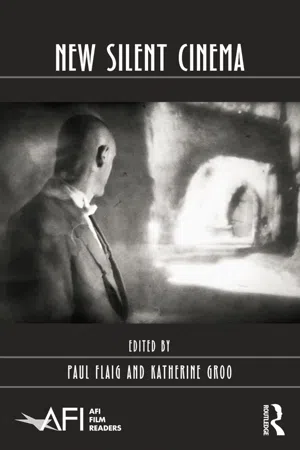
With the success of Martin Scorsese's Hugo (2011) and Michel Hazanavicius's The Artist (2011) nothing seems more contemporary in recent film than the styles, forms, and histories of early and silent cinemas. This collection considers the latest return to silent film alongside the larger historical field of visual repetitions and affective currents that wind their way through 20th and 21st century visual cultures. Contributors bring together several fields of research, including early and silent cinema studies, experimental and new media, historiography and archive theory, and studies of media ontology and epistemology. Chapters link the methods, concerns, and concepts of early and silent film studies as they have flourished over the last quarter century to the most recent developments in digital culture—from YouTube to 3D—recasting this contemporary phenomenon in popular culture and new media against key debates and concepts in silent film scholarship. An interview with acclaimed Canadian filmmaker Guy Maddin closes out the collection.
- 350 pages
- English
- ePUB (mobile friendly)
- Available on iOS & Android
eBook - ePub
New Silent Cinema
About this book
Information
alice in the archives
one
When the British Film Institute (BFI) completed the preservation and restoration of Cecil Hepworth and Percy Stow’s Alice in Wonderland (1903) in 2010, the organization uploaded the digital file to its YouTube channel, where it joined hundreds of other films and film clips from the national archive. The restoration of this particular film coincided with the UK-wide release of Tim Burton’s adaptation of Lewis Carroll’s novel, a mixture of live-action footage, computer-generated animation, and 3D imaging produced and distributed by Disney. The convergence of BFI’s digital platform, the market forces of commercial Hollywood cinema, and the itinerant interventions of contemporary social media produced an unlikely viral sensation out of this scrap of early cinema. To date, the film has received more than 1,700,000 views on BFI’s YouTube channel alone. It has been reposted, tweeted, blogged, and remixed ad infinitum. It is likely that more viewers have seen Alice in Wonderland since 2010 than had seen the film during the entire twentieth century. Archivist and early film blogger Luke McKernan speculates that the extraordinary circulation of the film owes to the spectacular disappointments of the contemporary Alice: Burton’s film, he argues, made viewers long for a simpler cinema and they found it in the Hepworth studio.1
But what exactly had viewers seen? What kind of artifact had they been invited to encounter? And just how simple are the historical expressions of early cinema as it migrates from the physical to the digital archive? Its restoration notwithstanding, Alice in Wonderland remains a badly damaged film. Scratches, tears, and decomposition join the many diegetic forces that threaten Alice’s bodily integrity. She shrinks and expands, but also disappears as the image erodes and erodes her in turn. Both the digital transfer and its compression for online circulation contribute yet another layer of visual and historical noise. The image pixelates and blurs as it stretches to fill in the gaps of the original analog document and those created by reducing the detail of the restoration for virtual consumption.
Alice in Wonderland bears the trace of other historical inscriptions, other genres of forgetting and loss. Just eight minutes of the film survive. When the film was originally released, it was the longest ever made in Britain at just over 800 feet (about twelve minutes). The unusual length of the film ensured that it rarely would have been screened in its entirety. Rather, the film was divided into twelve vignettes (following the structure of the novel), each of which could be hired and screened independently as part of a variety program. Taken together, the film did not retell the tale of Alice, but invited spectators (as so many early film adaptations of literature often did) to recall key scenes from the book. In other words, the film was physically and narratively fragmented from the start. A complete recovery and restoration of Alice in Wonderland would not have bridged the gap between contemporary and turn-of-the-twentieth-century spectators. Indeed, the failures of preservation and restoration—that is, the absences and discontinuities in the archival document—along with the style of spectatorial scavenging that digital video platforms encourage more closely approximate the original document and its reception than twelve uninterrupted minutes of Alice ever could.
The viral version of Alice in Wonderland is a curious artifact, an index of multiple film-historical events and documents: the original, the unrestored copy, the “real” restoration archived at the BFI, and, finally, the self-same digital copy that the archive circulated in order to promote the archive, its restoration work, and Disney’s own (mis)adventure in wonderland. However, the film also draws our attention to the broader intersection between early film objects and archival digitization. For its part, the BFI has expanded its digitization strategy since the early days of its YouTube channel. At the end of 2012, the organization announced plans to digitize 10,000 British films by the end of 2017 as part of a £500 million Film Forever scheme and, just one year later, it launched its own media player in which early and silent cinema remain a centerpiece.2 Numerous institutions join the BFI as they transition film’s first decades to digital formats and negotiate the contemporary proliferation of social media, digital video, and remix culture. These new archival and artifactual formations raise crucial questions both for recent theorizations of the digital archive and for early and silent film history. How do these early images intervene in our thinking about the digital? And what does the digital do to our conception of the early archive? The film artifact? The film historian? What kind of histories do these archives encourage or exclude? And where do the images produced out of the archive—the digital, virtual, viral, etc.—belong among the “original” objects of cinema’s past? It is precisely these questions that I intend to take up here.
No matter the many echoes that seem to sound between old and new media, physical and virtual archives, I do not collapse the distance between them or cut the digital to fit the shape of its early ancestors. Nor do I understand the intervention of the digital as a radical break, one that (depending on your disciplinary perspective) either annihilates film history or finally rescues it from the influence of archival institutions. Instead, I am interested in the simultaneous and irreconcilable differences that these archives produce, the historical confusions that they both signify and inscribe upon the surface of their collections, their movement in two directions at once. This discussion of Alice in Wonderland, then, is not just a rhetorical gesture, a way of beginning or deferring. And the film itself is more than an accidental appearance in the circulation of early cinema. Alice offers an initial figure for understanding the ambivalent historical expressions of the digital early film archive.
The genealogy of Alice in Wonderland moves us from a nineteenth-century novel to early and contemporary cinemas to new media, but its narrative also explicitly takes up questions of genealogy, or the relationship between beings and the processes of coming into being. Gilles Deleuze dedicates several chapters in The Logic of Sense to the writing of Lewis Carroll and Alice in Wonderland in particular. The text involves a special category of things he calls “pure events” or “pure becoming.”3 As many familiar with Deleuze’s writing and thought will know, this category stands in contradistinction to “limited and measured things,” to the fixed object and the present tense.4 For Deleuze, Alice embodies a kind of interminable movement, elasticity, and rebellion, “a veritable becoming-mad, which never rests.”5 The event of pure becoming—whether Alice or (as I will argue here) an archive—presses very forcefully against the structures of good, common sense. In so doing, it equally withdraws from the historical methodologies that have shaped early film studies for more than three decades. Deleuze writes:
[B]ecoming does not tolerate the separation or the distinction of before and after, or of past and future. It pertains to the essence of becoming to move and to pull in two directions at once: Alice does not grow without shrinking, and vice versa. Good sense affirms that in all things there is a determinable sense or direction (sens).6
Of course, Alice lacks this kind of sense. And so, too, as I will argue, do digital archives of early film.
In this essay, I concentrate on Images for the Future, a recent digitization project that exceeds the contingent effects of BFI’s vision of early film forever. The project began in 2007 as a collaborative effort to preserve the audio-visual heritage of the Dutch archives. Like BFI’s initiative, Images for the Future is a large-scale, government-funded endeavor, dedicated to the restoration and digitization of more than 700,000 hours of film. Images for the Future also aims to distribute its digital content as widely as possible and develop a contemporary community of archival “users.” The project not only aims to preserve Dutch visual history for the future but also actively encourages the production of future images out of the visual past. To this end, the Dutch consortium has partnered with social media and software design firms to create several digital applications that experiment with new modes of archival encounter. In this archival formation, the digital is not an invisible architecture that serves early film objects. It does not repeat or re-present, nor does it extend effortlessly into a utopian future of limitless preservation and open access (as the title of BFI’s Film Forever project would seem to suggest). Instead, Images for the Future stages a series of interactive encounters (or what Deleuze might call “events”). Here, I am using the term “interactive” to describe not only the relationship between users and archives, but also, and more interestingly, a visible reciprocity between old and new media, imagination and calculation, the past of film history, the present of its production, and a speculative future of archival objects. I am also suggesting that the operation at work in these archives exceeds the techno-utopian similitude of “convergence.”7
In what follows, I sketch a brief genealogy of post-structuralist engagements with the archive. This foundational series of interventions informs a recent wave of scholarship in film and new media studies that takes the technological substrate of the digital archive as a starting point for understanding how our artifacts and modes of historical telling change in the twenty-first century. While this recent work goes some way towards challenging conservative historiographies and conceptions of the archive, neither this contemporary scholarship, nor its post-structuralist antecedents accommodate the specters of past time and old media that continue to inhabit the “new” and the “now” of digital archives. I therefore pivot from this précis to the specificities of Images for the Future in order to explore a different model of the digital archive and another mode of contemporary archival thought. The figure of Alice returns in my conclusion. She is the madness at the center of film history and metahistorical thought.
the new archivists
Nearly two decades after the publication of The Archaeology of Knowledge, Foucault’s seminal work on discursive historical regimes, Deleuze claimed that “a new archivist” had been appointed and a “new age” had dawned in historical thought.8 The emphasis on the “newness” of Foucault must have seemed a little odd (at least for Foucault), given how long his arguments had been in public circulation. The belatedness of this nomination speaks to just how much disciplinary resistance Foucault’s original incursion into the field of historical studies had met and just how little had changed in historical thought. Even twenty years later, Deleuze remarks, Foucault appeared, at best, to operate independently of the disciplinary mainstream and, at worst, to be forcefully excluded.
A set of metahistorical claims underpins both the radical threat and the seeming newness of the Archaeology. Here, Foucault collapses the boundaries between language and objects, words and things. Both, he claims, are part of and produced out of discursive systems that bind them together and define their encounter. Foucault thus encourages us to dispense with “the enigmatic treasure of ‘things’ anterior to discourse” and abandon our incessant search for origins, “the ground, the foundation of things” (emphasis in original).9 He redirects our attention to the body of rules that produces discourse.
The archive is one such body of rules. It does not recuperate history or secure its artifacts but rather constitutes a certain arrangement of past time and a particular formation of objects. Foucault explains, “Instead of seeing, on the great mythical book of history, lines of words that translate in visible characters thoughts that were formed in some other time and place, we have in the density of discursive practices, systems that establish statements as events […] and things […]. They are all these systems of statements (whether events or things) that I propose to call archive.”10 In this reformation of historical practice and knowledge, the archive surrounds us and yet remains unavailable to us. The archive belongs to the conceptual category of the dispositif, or apparatus, and, in this way, governs the activities of human subjects. It is “the law of what can be said,” thought, or remembered.11 It does not receive our active search (on the great book of history) but rather acts upon us and determines the possibilities (creative, historical, epistemological) of this encounter in advance.
Foucault’s conception of the archive as determinative in the construction of historical knowledge crucially intersects with Jacques Derrida’s multivalent mal d’archive (though disagreement sustained their debates about the archive more often than consensus, a point to which I will return in my conclusion).12 For Derrida, the archive instantiates the mal—the danger, threat, evil—of state authority and power. It is the place where commandment commences, where the law begins and builds. The dangers of the archive and the annihilation of memory it necessarily guarantees derive from the kind of spatio-temporal relationship that the archive maintains with the very things (subjects, objects, events) it claims to preserve. Insofar as the archive is separate from the origins of objects and events, consigned “to an external place, which assures the possibility of memorization, of repetition,” it can only ever approximate those origins with other histories and different kinds of writing.13
While Foucault and Derrida understand the archive as an expression of power, they equally acknowledge that these expressions radiate from manifold sources. In other words, in redefining the archive as a discursive system or a set of rules (rather than, say, a physical structure), the archive ceases to be just one thing, one monolithic or monumental authority. No longer synonymous with the library (or even the book), the archive becomes multiple, flexible, and, most importantly for our purposes here, subject to change. Indeed, Derrida acknowledges that his own conception of the archive as an external, amnesiatic operation draws upon specific archivo-technological formations or “machine tools,” forever consigned to the outside and after of experience, including (among others) Fre...
Table of contents
- Cover
- Title
- Copyright
- Contents
- list of figures
- introduction: celluloid specters, digital anachronisms
- 1. alice in the archives
- 2. eternally early
- 3. “historicity begins with decay and ends with the pretense of immortality”
- 4. paris 1900: archiveology and the compilation film
- 5. after life, early cinema: remaking the past with hirokazu kore-eda
- 6. playback, play-forward: anna may wong in double exposure
- 7. the living nickelodeon and silent film sound today
- 8. intertext as archive: méliès, hugo, and new silent cinema
- 9. cross-medial afterlives: the film archive in contemporary fiction
- 10. supposing that the archive is a woman
- 11. the life cycle of an analog medium: tacita dean’s film
- 12. from silence to babel: farocki’s image infoscape
- 13. found memories of film history: industry in a post-industrial world, cinema in a post-filmic age
- 14. a youtube bestiary: twenty-six theses on a post-cinema of animal attractions
- 15. laughter in an ungoverned sphere: actuality humor in early cinema and web 2.0
- 16. “the biggest kuleshov experiment ever”
- contributors
- about the american film institute
- index
Trusted by 375,005 students
Access to over 1.5 million titles for a fair monthly price.
Study more efficiently using our study tools.
Frequently asked questions
Yes, you can cancel anytime from the Subscription tab in your account settings on the Perlego website. Your subscription will stay active until the end of your current billing period. Learn how to cancel your subscription
No, books cannot be downloaded as external files, such as PDFs, for use outside of Perlego. However, you can download books within the Perlego app for offline reading on mobile or tablet. Learn how to download books offline
Perlego offers two plans: Essential and Complete
- Essential is ideal for learners and professionals who enjoy exploring a wide range of subjects. Access the Essential Library with 800,000+ trusted titles and best-sellers across business, personal growth, and the humanities. Includes unlimited reading time and Standard Read Aloud voice.
- Complete: Perfect for advanced learners and researchers needing full, unrestricted access. Unlock 1.5M+ books across hundreds of subjects, including academic and specialized titles. The Complete Plan also includes advanced features like Premium Read Aloud and Research Assistant.
We are an online textbook subscription service, where you can get access to an entire online library for less than the price of a single book per month. With over 1.5 million books across 990+ topics, we’ve got you covered! Learn about our mission
Look out for the read-aloud symbol on your next book to see if you can listen to it. The read-aloud tool reads text aloud for you, highlighting the text as it is being read. You can pause it, speed it up and slow it down. Learn more about Read Aloud
Yes! You can use the Perlego app on both iOS and Android devices to read anytime, anywhere — even offline. Perfect for commutes or when you’re on the go.
Please note we cannot support devices running on iOS 13 and Android 7 or earlier. Learn more about using the app
Please note we cannot support devices running on iOS 13 and Android 7 or earlier. Learn more about using the app
Yes, you can access New Silent Cinema by Katherine Groo, Paul Flaig, Katherine Groo,Paul Flaig in PDF and/or ePUB format, as well as other popular books in Media & Performing Arts & Film & Video. We have over 1.5 million books available in our catalogue for you to explore.