- 192 pages
- English
- ePUB (mobile friendly)
- Available on iOS & Android
eBook - ePub
Quality in Postgraduate Education
About this book
This text is designed to respond to the uppermost area of concern in postgraduate education today - that of achieving quality. The book discusses issues of quality and research culture, including criteria for evaluating theses and research applications, and women and overseas students.
Information
Part One
Issues of Quality and Institutional Research Culture
Chapter 1
Planning for Quality in Graduate Studies
Introduction
Over the past few years graduate studies have attracted attention from governments, institutional researchers, student bodies and those concerned with equity and access as well as supranational bodies.
Economic and social well being are seen as closely related to how well prepared our future scientists, future academics or the professoriate are, and whether the continuing education of our leaders in the public and private sector and the professions is comparable and produces equivalent or better outcomes than in other countries.
Graduate education is a growth area in higher education. In Australia, we include in graduate studies (or postgraduate studies as it is generally called) postgraduate certificates and diplomas, Masters degrees and PhDs, and professional doctorates (e.g. DBA, DPhil, DEd, DLitt). The growth of these areas is illustrated in Table 1.
Table 1: Postgraduate enrolment in Australia in 1982 and 1992
| 1982 | % of total enrolment 1992 | 1992 | % of total enrolment 1992 | |
|---|---|---|---|---|
| Higher degree | ||||
| Research | 12,990 | 3.8 | 24,286 | 4.3 |
| Coursework | 11,857 | 3.5 | 29,275 | 5.2 |
| Postgraduate | ||||
| Cert/diploma | 30,965 | 9.1 | 49,894 | 8.9 |
| Total | 55,812 | 16.3 | 103,455 | 18.5 |
Higher degree students are only a minority of students; however they are an increasing minority and as a body are as large as the total enrolment in Australian universities in 1960, when there were just over 53,000 students.
At Masters level we tend to differentiate between coursework and research degrees, although the boundaries are fluid and artificial. Masters courses have an important function but in the following I want to concentrate on research degrees, notably PhDs. It is mainly through our researchers, at postdoctoral level, and as academic staff members and scientists that we stay in touch with the international community of scholars and contribute to an extension of knowledge.
The quality debate
The 1980s were the decade of efficiency and effectiveness in higher education and accountability for both. Thus planning for quality in graduate education in contrast to trusting the academic staff and academic departments to ensure and deliver quality is not new.
In July 1992 the Higher Education Council published its draft advice to the Minister on The Quality of Higher Education. Relatively little was said about research education (HEC, 1992), but the Council noted:
… the enrolment of students in research training programmes should be dependent on the existence of a strong and active research presence in that area. The Council is concerned that there is evidence of expansion into research training occurring ‘the other way around’ — that is, driven by demand from prospective students, with little regard for the capacity to provide them with a quality education at that level. (33)
The Council acknowledged links between teaching, research and professional practice and commented:
An institution which does not have as part of its ethos the search for and transmission of new knowledge will not be one capable of instilling in its staff, students and graduates the willingness and ability to assess critically the bases of current thinking, and strive continually for new solutions.… while all institutions should develop a research culture, and the values inherent in quality research activity, this does not mean that all academics, at all times, must be actively engaged in research, nor that every university will comprehensively cover the full spectrum of research activities in all of the disciplines and fields of study that they offer. It is better that institutions be selective and do a few things well, rather than many things badly. (34)
The question, then, of selectivity, of concentration, of fostering quality, not quantity, has remained on the agenda.
Quality in PhD education — supervisors, students and the education process1
The quality of PhD education is to a very large extent determined by the postgraduate students themselves. Their formal qualifications in the discipline and research training, their prior experiences as students, as professionals, and as persons shape their expectations and their approaches to study, and these and their motivations have great impact on how students experience graduate study.
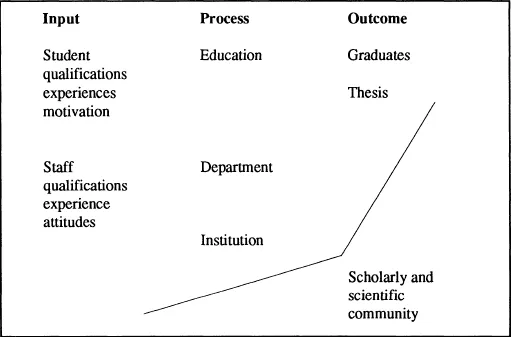
Academic staff as supervisors of these postgraduate students also contribute to the quality of PhD education. Their formal qualifications which signify subject competence and research training, their active involvement in research and publication, as well as their knowledge of the research process, constitute competence as supervisors which is important to the success of graduate students. Their attitudes, their own philosophy of higher education and of PhD education in particular, contribute to the quality; their attitudes, often based on their own past experience, shape the interaction with students — the amount of direction and control, of guidance and structure, and of freedom and autonomy their students experience.
The postgraduate student population has changed dramatically over the past few years, and staff need to take account of that, change some of their practices, some of their attitudes, and acquire and hone some new skills.
The process is the education students experience over three, four, five, six years. It is a teaching-learning process, supervised research training, a process which takes students from a directed, structured programme to a substantial piece of research which demonstrates their research performance and certifies them as independent researchers henceforth.
What happens in these years, in the educative process, is very much determined by the department [I use this term to connote the basic academic unit.] As we all know, the department:
•provides the resources, ethos, and environment in which staff–postgraduate student and student–student interaction can flourish — or not
•in which postgraduate students feel welcome and respected as fellow researchers — or not
•in which postgraduates are integrated and nurtured — or not.
And as all of us well know, the institution has an impact on the quality of PhD education by signalling the importance of graduate studies to its staff, students and departments. Resources provided to the department, rewards for supervision, guidelines for supervision, training for supervisors, adequate administrative procedures — all the ‘quality assurance’ mechanisms so much debated in the public forums now, have an impact on that quality.
When we talk about ‘output’ we do not mean merely a product. Above all we are talking about individual people, graduates, who as individuals have experienced a highly personal supervised research training programme over several years and have gained during that time — which is often longer than their undergraduate studies! — advanced knowledge, skills and understanding. What our graduates learn during the education process is what equips them later to work as academics, researchers, or professionals in leading positions.
But entry to these positions is by the ‘Thesis of Merit’, a product indeed. The criteria for the thesis are similar around Australia: a demonstration of originality (however defined), of the ability to work independently, and of understanding of the broader context, a contribution to knowledge, and sometimes even the suitability of the thesis for publication (e.g. at the University of Queensland).
The thesis examination process takes the ‘quality’ issue outside the university and puts it into the broader disciplinary community in Australia or overseas. The convention in Australia is that several of the examiners are external to the university, and often they are from overseas. Assessment is never internal as can happen in graduate schools in the US. This ensures that the PhD graduate is accepted as a full member of the wider disciplinary community, it underlines the international scope of scholarship, and it also highlights the importance of the supervisor as teacher and mentor and of his or her knowledge of the scientific conventions, the schools of thought in the field, and the suitability of examiners. Thus there is a direct link back to staff qualifications and experience.
Quality assurance in graduate study
We are being judged already by the quality of our graduate students and the educative process, and from 1994 onwards, $70 plus million will be distributed on ‘quality’ criteria. Hence institutions need to look afresh at graduate study and the educational experience of graduate students.
Table 2: Quality assurance in graduate study
| Institutional admission criteria •student qualifications and experience Institutional policies •supervisor qualifications/accreditation •departmental/school resources •supervision guidelines •half-yearly reports •interim assessments Departmental/school policies •assistance to supervisors •assistance to students •monitoring of supervision process Institutional research •monitoring of completion times and rates •monitoring of half-yearly reports •regular reviews of examiner reports •regular feedback from students |
Institutions largely control whom they admit as postgraduate students — even though there are conventions. A good Honours degree, certainly a first class Honours degree, admits students to any PhD programme. If students do not have this qualification they may be admitted with an ‘equivalent’ qualification; institutions can determine how this equivalence is demonstrated. This is particularly important in the new universities — or the new faculties in older universities, which often draw on a student population which has a less traditional educational career path. Most students from the former College of Advanced Education (CAE) sector would need to demonstrate ‘equivalence’. Hence institutions which admit these students — and it is laudable that the rigidity has gone — need to make available courses and opportunities for students to gain or enhance skills in areas which were covered in the traditional Honours degree.
Student experiences, and particularly motivation, also have an impact on the educative process, and it helps supervisors to know about these. Recent studies in various universities show that many of the factors which influenced students in their decision to enrol in a PhD were job-related. But nearly three-quarters of students at the University of Melbourne in a survey some years ago (Powles, 1988) were intrinsically interested in research. In a newer university, the University of Technology Sydney, a study conducted in 1992 produced similar results.
Table 3: Greatest influence on decision to enrol in research degree (%)
| PhD | M | |
|---|---|---|
| Aspiring to academic career | 22 | 20 |
| To improve job prospects | 31 | 43 |
| To develop high-level research skills for current profession | 30 | 35 |
| Extension of knowledge for current prof. | 36 | 42 |
| Personal satisfaction from being engaged in research and discovery | 50 | 48 |
Clearly, student motivation to enrol in a research degree has an impact on what students expect from supervisors and from graduate study itself.
Institutions also determine the qualifications a supervisor needs to have; this is normally a qualification at least at the same level as the de...
Table of contents
- Cover
- Half Title
- Title Page
- Copyright Page
- Table of Contents
- Notes on Contributors
- List of Acronyms
- Foreword
- Introduction
- Part One: Issues of Quality and Institutional Research Culture
- Part Two: Educational Processes to Achieve Quality
Trusted by 375,005 students
Access to over 1.5 million titles for a fair monthly price.
Study more efficiently using our study tools.
Frequently asked questions
Yes, you can cancel anytime from the Subscription tab in your account settings on the Perlego website. Your subscription will stay active until the end of your current billing period. Learn how to cancel your subscription
No, books cannot be downloaded as external files, such as PDFs, for use outside of Perlego. However, you can download books within the Perlego app for offline reading on mobile or tablet. Learn how to download books offline
Perlego offers two plans: Essential and Complete
- Essential is ideal for learners and professionals who enjoy exploring a wide range of subjects. Access the Essential Library with 800,000+ trusted titles and best-sellers across business, personal growth, and the humanities. Includes unlimited reading time and Standard Read Aloud voice.
- Complete: Perfect for advanced learners and researchers needing full, unrestricted access. Unlock 1.5M+ books across hundreds of subjects, including academic and specialized titles. The Complete Plan also includes advanced features like Premium Read Aloud and Research Assistant.
We are an online textbook subscription service, where you can get access to an entire online library for less than the price of a single book per month. With over 1.5 million books across 990+ topics, we’ve got you covered! Learn about our mission
Look out for the read-aloud symbol on your next book to see if you can listen to it. The read-aloud tool reads text aloud for you, highlighting the text as it is being read. You can pause it, speed it up and slow it down. Learn more about Read Aloud
Yes! You can use the Perlego app on both iOS and Android devices to read anytime, anywhere — even offline. Perfect for commutes or when you’re on the go.
Please note we cannot support devices running on iOS 13 and Android 7 or earlier. Learn more about using the app
Please note we cannot support devices running on iOS 13 and Android 7 or earlier. Learn more about using the app
Yes, you can access Quality in Postgraduate Education by Yoni Ryan,Ortrun Zuber-Skerritt in PDF and/or ePUB format, as well as other popular books in Education & Education General. We have over 1.5 million books available in our catalogue for you to explore.