This book dives into student development theory, unpacking key foundational and emergent theories of college student development while providing contemporary examples and application. Showcasing a diversity of programs, practices, and services across a variety of institutional types, Applying Student Development Theories Holistically demonstrates how professionals are intertwining the science of theory with the art of practice in multidimensional, holistic ways. Helping aspiring higher education and student affairs practitioners grasp and use theories holistically, this important text brings to life theoretical knowledge to enhance the development and learning of college and university students.
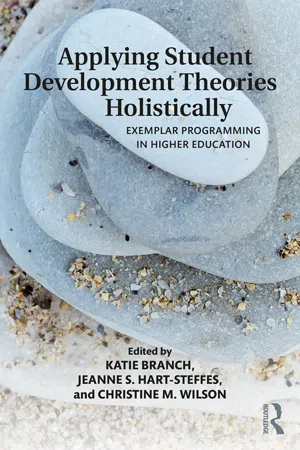
eBook - ePub
Applying Student Development Theories Holistically
Exemplar Programming in Higher Education
- 184 pages
- English
- ePUB (mobile friendly)
- Available on iOS & Android
eBook - ePub
Applying Student Development Theories Holistically
Exemplar Programming in Higher Education
About this book
Information
Chapter 1
Introduction:
Developmental Theories as Exemplar Programming Guides
Student success in higher education environments, especially co-curricular settings, emphasizes potential human development outcomes. Theories that guide understandings of such outcomes provide insight into complex college student development trajectories. Twenty-first century college students encounter myriad experiences and challenges that call for the holistic use of theories in contemporary practices designed to further their advancement along unique developmental pathways. This chapter provides a rationale for the holistic use of college student development theories and describes the impetus for this book. Next, we explain the process used for gathering the contemporary examples of theory-in-practice included in this book, and provide overviews of the theories and models discussed in subsequent chapters. Additionally, the template used for the perspectives shared by contributing chapter authors is outlined. Finally, we remind readers that applying theories holistically, while not magic, involves a confluence of often subtle, yet ever-changing scholarly knowledge and intentional practices—as if looking at vibrant images through a kaleidoscope.
What is your professional why? This question and variations of it are associated with a motivational TED [Technology, Education, & Design] Talk given by Simon Sinek in 2009 (see https://startwithwhy.com; Challenging, 2017). The Student Personnel Point of View (American Council on Education, 1937), which is the document credited with helping to establish the academic discipline of college student personnel in the United States, calls for an emphasis on the holistic development of students. Publications that are more recent also reinforce the need to address multiple forms of adult development and to continue multidimensional approaches to knowledge application (ACPA, 1996; Keeling, 2004). The emphasis on synergy that can be accomplished through melding research with educational practices to influence positively human development and learning is often the raison d’être (i.e., reason for being) for today’s student affairs practitioners. After a thorough analysis of 13 student affairs philosophical documents with publication dates ranging from 1937 to 1999, Evans and Reason (2001) noted that hallmarks included a holistic perspective on students as well as on how college student personnel work is carried out. “The most prevalent and foundational concept found in all of the statements we reviewed is the notion that the ‘whole’ student must be considered in every educational endeavor” (p. 370).
The overarching premise of this book is to prompt utilization of human development theoretical knowledge that enhances the positive outcomes of participating in higher education for students and society. College student success, as explicated by Kuh, Kinzie, Schuh, Whitt, and Associates (2005/2010) includes not only persistence and educational attainment rates but also quality dimensions of student learning, which is inclusive of development. The purpose of Applying Student Development Theories Holistically is to provide examples of comprehensive applications of college student development theories, especially programs implemented and assessed by higher education professionals working in co-curricular capacities. Because the theory applications selected for this book have twenty-first century college students as participants, diversity and social justice are core concepts. Before moving on to the examples offered by our contributing authors, this chapter explains further what prompted our desires to produce this publication, describes the process used for soliciting and selecting contributions, gives brief summaries of the theories used in subsequent chapters, and provides the template used to organize the next nine chapters.
The Need for This Book: Why Now?
The need for a book that explicates holistic applications in higher education settings of student development theories originates from a variety of sources. One source is our experiences as individuals who have taught college student development academic credit courses and non-credit workshop series. Students enrolled in academic course work, as well as individuals attending professional development events, often ask for examples of current uses of theory in actual practice settings. Students want to be inspired by higher education professionals who are using the knowledge that they are learning; this book meets that need. Furthermore, professional staff development initiatives designed to encourage the intentional, holistic use of theoretical knowledge can benefit from examining the work of others in the field.
Another impetus for the contents of this book—at this particular point in time—was noticing not only a continued interest by graduate students in focusing on psychosocial aspects of college student development but also publications that emphasized social identity (e.g., Jones & Abes, 2013; Patton, Renn, Guido, & Quaye, 2016). While psychosocial and social identity theories and related initiatives are important, they are not fully inclusive of the range of knowledge and examples needed for comprehensive, effective professional practice. This book assists with recalibrating the scholarly focus of theory development and application to a multidimensional, holistic approach that aligns closely with the educational mission of higher education.
Caveats: Depth of Theory Coverage and Lag Time
We envision that the contents of this book will serve as a companion to other publications that provide detailed descriptions of human development theories and accompanying research. Ideally, scholarly practitioners monitor and read original works by researchers that are published in peer-reviewed journals and books. However, with both the volume of knowledge produced and the pace of information flow in today’s word, it is practical to assume that many scholarly practitioners keep current through publications that provide analytical overviews of theories and related research. For example, Student Development in College: Theory, Research, and Practice (Patton et al., 2016) is a book that serves as a primary text used in many graduate-level student development courses. The theories used in our book coincide with several discussed in that text; however, what is unique about our content is that it demonstrates how practitioners are using these theories in their current work, how assessment is conducted, and what is being learned about the complexities of applying human development theories in multidimensional, holistic ways. Additionally, recommendations and resources are proffered for use when doing the translational work between theory and practice.
When examining the applications of theory, the lag time among research that leads to theory, publication of these theories in peer-reviewed outlets, research that suggests revisions to the original theory, and practical applications of theory is often noticeable. One result of this lag time is a need to look at the socio-historical context of theories and when, how, and why they are used in contemporary practice. For example, traditionally, psychologically based developmental theories have understood the term holistic to reference individually oriented aspects of self as well as internal ways of making sense of the world. What this interpretation may underestimate, despite complementary theories that emphasize the influence of context, is a socio-ecological dimension that influences how humans navigate and interact with the world around them. We loosely define this socio-ecological dimension as the interaction among forces (e.g., culture, power, stereotypes, social norms, rules) that govern one’s positionality—which is amendable to local, national, and global contexts. The socio-ecological dimension adds a considerable degree of complexity to what is meant by holistic student development, often translated to supporting “the whole student” (Evans, Forney, Guido-DiBrito, Patton, & Renn, 2010). Supporting the whole student in absence of the socio-ecological dimension is an incomplete, inadequate approach. True holistic student development, then, cannot be achieved if there is failure or refusal to acknowledge power and privilege as influencing students’ sense of self and their interpretations of society at large. Scholarship such as Critical Race Theory (Ladson-Billings & Tate, 1995) and intersectionality (Crenshaw, 1989; see Bartlett, 2017; Tefera, Powers, & Fischman, 2018) help us examine how systems afford power and privilege to certain groups, perpetuate dominant ideologies, and facilitate the erasure of persons, voices, and experiences. The publication of Abes’ (2016) Critical Issues on Student Development Theory is designed to help scholarly practitioners understand these complex concepts.
Finally, some newer aspects of theoretical concepts are too recent to have research beyond that which was done to publish a nascent theory or subsequent applications of this knowledge. For example, the incorporation of scholarly work on neuroscience into student affairs practice is not yet widely spread (see Bliming, 2013; Bresciani Ludvik, 2016; Kartoshkina, 2017; Schwitzer, 2015). As Evrard, Annese, and Bresciani Ludvik (2016) note, “The fascination with the brain is all around us, so it is indeed time to intentionally incorporate neuroscience discoveries into the design, delivery, and evaluation of higher education” (p. 27).
Process for Gathering Theory-in-Practice Examples
The co-editors of this book recruited and selected manuscripts from a diversity of authors representing a range of higher education settings. We received a variety of submissions from scholarly practitioners—meaning those who ground their work in theory and research but are not likely to publish in research journals. Contributors’ knowledge and expertise were crucial in meeting the espoused purpose of this text. In the process of soliciting proposals for contributions to this book, the co-editors were intentional about reaching out to individuals and to forums that could result in finding newer ideas. During a call-for-proposals process, messages were sent to professional association listservs, faculty, and other leaders in higher education and student affairs at a variety of institutional types, and individuals who had presented recently on topics related to student development theory at the two annual gatherings of umbrella student affairs organizations (i.e., ACPA: Student Affairs Educators International & NASPA: Student Affairs Administrators in Higher Education).
In our Call for Proposals, the co-editors asked potential contributors to share their programs, practices, or other initiatives of contemporary applications of college student development theory; institutional context, including the socio-demographic composition of student populations; specifics about the program, practice, or initiative; intended developmental and learning outcomes; assessment and evaluation; and lessons learned about theory-practice links. It was explained that the contributions selected for inclusion would emphasize one or more of the theories or models listed here—or co-editors could be contacted with alternative suggestions.
- For psychosocial and social identity: Chickering and Reisser (identity: college impact), Cross and Fhagen-Smith (nigrescence, Black identity), Helms (White racial statuses), Phinney (ethnic minority identity), Kim (Asian American identity), Torres (Latino identity), Root (multiracial heritage), Cass (homosexual identity—male emphasis), Fassinger (gay, lesbian identity), D’Augelli (lesbian, gay, bisexual identity), Worthington et al. (heterosexual identity), Bem or Lev (gender identities, roles), Gibson or Forber-Pratt and Aragon (students with disabilities), Hurst or Ostrove (social class), and Davis (first-generation status).
- For cognitive development: Perry (general intellectual reasoning), Belenky et al. (Women’s Ways of Knowing), Baxter Magolda (epistemological reflection), Kitchener and King (reflective judgment), Kohlberg or Rest (moral—justice voice), Gilligan (moral—care voice), Fowler (faith), Parks (spiritual, meaning-making), and Baxter Magolda (self-authorship).
- For influences on development: Bronfenbrenner (developmental ecology), Schlossberg (transitions), Kolb (experiential learning), Jung or Myers and Briggs (personality type), Clifton and Anderson (personality strengths), Sedlacek (non-cognitive variables), and Strayhorn (sense of belonging).
Theory Clusters
To maximize the utility of this book, theory-in-practice examples were organized into the three parts or theory clusters that have historical associations with the student affairs literature: psychosocial, cognitive, and influences on development (Evans, Forney, ...
Table of contents
- Cover
- Half Title
- Title
- Copyright
- Contents
- Foreword: It Is Not Magic
- Preface
- Acknowledgments
- List of Figures and Tables
- 1 Introduction: Developmental Theories as Exemplar Programming Guides
- Part I: Who Am I? Psychosocial and Social Identity Development
- Part II: How Do I Make Meaning? Cognitive Development
- Part III: Influences on Development
- Contributing Authors
- Index
Trusted by 375,005 students
Access to over 1.5 million titles for a fair monthly price.
Study more efficiently using our study tools.
Frequently asked questions
Yes, you can cancel anytime from the Subscription tab in your account settings on the Perlego website. Your subscription will stay active until the end of your current billing period. Learn how to cancel your subscription
No, books cannot be downloaded as external files, such as PDFs, for use outside of Perlego. However, you can download books within the Perlego app for offline reading on mobile or tablet. Learn how to download books offline
Perlego offers two plans: Essential and Complete
- Essential is ideal for learners and professionals who enjoy exploring a wide range of subjects. Access the Essential Library with 800,000+ trusted titles and best-sellers across business, personal growth, and the humanities. Includes unlimited reading time and Standard Read Aloud voice.
- Complete: Perfect for advanced learners and researchers needing full, unrestricted access. Unlock 1.5M+ books across hundreds of subjects, including academic and specialized titles. The Complete Plan also includes advanced features like Premium Read Aloud and Research Assistant.
We are an online textbook subscription service, where you can get access to an entire online library for less than the price of a single book per month. With over 1.5 million books across 990+ topics, we’ve got you covered! Learn about our mission
Look out for the read-aloud symbol on your next book to see if you can listen to it. The read-aloud tool reads text aloud for you, highlighting the text as it is being read. You can pause it, speed it up and slow it down. Learn more about Read Aloud
Yes! You can use the Perlego app on both iOS and Android devices to read anytime, anywhere — even offline. Perfect for commutes or when you’re on the go.
Please note we cannot support devices running on iOS 13 and Android 7 or earlier. Learn more about using the app
Please note we cannot support devices running on iOS 13 and Android 7 or earlier. Learn more about using the app
Yes, you can access Applying Student Development Theories Holistically by Katherine Branch,Jeanne Hart-Steffes,Christine Wilson in PDF and/or ePUB format, as well as other popular books in Education & Education General. We have over 1.5 million books available in our catalogue for you to explore.