- 232 pages
- English
- ePUB (mobile friendly)
- Available on iOS & Android
eBook - ePub
About this book
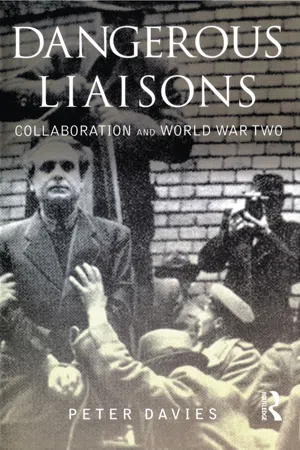
The Nazi regime in Germany was terrible enough without even accounting for the policy of collaboration. So what extra does collaboration say about Hitler and his plans for Europe? Peter Davies explores the mindset and political attitudes of Hitler and also many other controversial pro-Nazi leaders in Western Europe, Scandanavia, Central and Eastern Europe, and also beyond. Delving into four different "types" of collaboration: political, financial, the Holocaust, and collaboration at a social level, he asks some difficult questions. The story of collaboration is brought up to date, assessing both the legacy and its contemporary parallels.
Information
CHAPTER 1
What was collaboration?
Give me your watch and I’ll tell you the time.German view of collaboration1
The Nazis’ newspaper in Jersey, Insel Zeitung, was keen to publicise the fact that the islanders were enthusiastic about the occupation and keen to be Germanised:
In the course of a band concert given in the Royal Square and largely attended by children and young people, at a given moment, the bandmaster attracted the attention of his juvenile audience by calling out that he had a question to ask them. He then enquired, with an insinuating air, if they liked chocolate, requesting those who did to raise their right arms. There naturally arose a forest of eager arms. That was the moment at which the waiting photographer pressed the button. The following day the current number of the Insel Zeiting contained a picture showing young Jersey standing at the Nazi salute while, the caption stated, the band was playing the Horst Wessel Song, or some other patriotic air.2
Of course, some types of collaboration were bogus. Others, by contrast, were very real.
Governmental elites engaged in political collaboration with the Reich. Ordinary women formed sexual relationships with occupying German soldiers. And there were many other forms of ‘improper’ behaviour – some that could be described as collaboration, some that could not, and some that nestled somewhere in between. In time, collaboration enveloped huge chunks of Europe, aided the Nazis in their quest to eradicate the Jewish community, and since 1945 it has left an unpleasant legacy.
But what, fundamentally, did collaboration mean? What different varieties of collaboration existed? And how have historians viewed it? These are important questions to dwell on before we start to explore collaboration in any greater depth. We should also be aware that collaboration, as a historical phenomenon, looks very different from different angles. In the post-war period, it has been very easy, and very natural, for historians and commentators to talk in terms of ‘black’ and ‘white’ – the collaborators were the ‘baddies’, the resisters were the ‘goodies’. We know the outcome of the war, we are aware of the horror of the Hitler regime, and we can now come to some fairly definitive judgements.
But, at the time, things were much more complex and difficult. Ordinary people and governments had no idea how the war was going to develop and had few clues about how their decisions and choices were going to be viewed, and judged, in retrospect. This is a crucial point to make. Areas were greyer during the war, and this needs to be acknowledged.
According to the Concise Oxford Dictionary, to collaborate is to ‘work jointly … cooperate traitorously with the enemy’. However, this standard definition requires a lot of unpacking. Some political leaders who threw in their lot with Hitler, or were forced to, genuinely believed that they could, indeed, ‘work jointly’ with the Führer. This was an illusion, and was proven to be so when new political arrangements and relationships – not all identical – began to develop in the early years of the war, and then when they reached ‘maturity’ towards the end of the conflict. The notion of ‘partnership’ was stillborn, and it says a lot about the mental state of some ‘puppet’ leaders – those individuals who headed pro-Hitler regimes across Europe – that they actually believed they could engage the Reich in genuinely ‘joint’ ventures. What happened in reality was quite the reverse: the Germans exploited the ‘partner’ states and trampled all over their independence – both political and economic. Michael Burleigh reveals that the Führer had difficulty pronouncing the word, ‘Kollaboration’. This was highly symbolic because he did not actually conceive of collaboration in the same way that others conceived of it. For him, ‘domination’ was the key word. This is an important preliminary point to make.
Moving on, to what extent, and in what ways, did politicians and other figures, ‘cooperate traitorously with the enemy’? Clearly, this is a matter of interpretation. Only a minority of people collaborated as self-confessed ‘traitors’. Some intellectuals, some informers, did so, but they were imbued with the most warped of ideas and ideology. Most people did not ‘cooperate traitorously’, but rather dealt with the occupiers because they had to and because there was no alternative. They were not ‘born collaborators’; they were just ordinary folk who had to develop some kind of survival mechanism, however risky and questionable in ethical terms. This is why collaboration is such a fascinating theme. It was like a spider’s web that eventually trapped significant sections of the population. Some were genuine collaborators, but a sizeable proportion were not.
We must distinguish between ‘official’ and ‘unofficial’ histories of collaboration. This adds to the complexity of the subject. Sweden, Switzerland and Spain were officially neutral powers, but this has not halted the flow of post-war innuendo regarding the behaviour of governments and ordinary people in these countries. In the Balkans, it is the numbers game. Today, if you’re a loyal Croat, you would probably claim that the Ustashe-run Independent State of Croatia (NDH) – Hitler’s puppet administration in Zagreb – killed ‘only’ tens of thousands of Serbs between 1941 and 1944; if you’re a Serb, you would reckon the figure to be in the hundreds of thousands. Official history, unofficial history.
In France, the situation is similar. General Charles de Gaulle, the man who came to personify the new liberated nation, was keen to foster the view that France was ‘a nation of resisters’, even though he and everyone else knew that this was not the case and that many French people had compromised with the Germans in a variety of spheres – either as fullblown collaborators or wait-and-see ‘accommodators’. Unashamedly, de Gaulle was trying to manipulate public opinion in an effort to stabilise and solidify the post-war political settlement.
Who collaborated with the Nazis and their proxies? There is no simple answer to this question. It was anybody and everybody – a genuine cross-section of the population. This is a random sample: anti-Zionist Muslims in the Balkans and the Middle East; peasants in Ukraine and Belorussia; right-wing zealots such as Ferenc Szálasi in Hungary; workers in various countries who were subject to ‘labour transfers’; high-ranking civil servants in the Netherlands; Norwegian women in search of love and affection; senior Catholic churchmen like Archbishop Alojzije Stepinac in Croatia; learned French intellectuals. And an ex-resistance fighter in Serbia called Colonel Dragoljub-Draža Mihailović. Phyllis Auty says that the Germans met Mihailović at an inn near Valjevo and decided that they could use him, even though they didn’t trust him fully.3 Yes, collaboration was as secretive, sinister, dirty and amoral as this. Why this man and others collaborated is a complex question – one that will be dealt with in full in Chapter 3.
‘Narrow’ and ‘broad’ definitions
Gerhard Hirschfeld explains that, for the most part, collaboration has been defined and interpreted (perhaps mistakenly) in fairly narrow terms. In essence, it was a political relationship between victor and vanquished, between occupier and occupied. It was exemplified best by the agreement reached by Hitler and Marshal Philippe Pétain, the French head of state, at Montoire in October 1940.4 Here were two leaders, both attired (significantly) in military uniform and both committing themselves to a new type of political ‘alliance’. Philippe Burrin says that Pétain’s speech ‘was formulated with great prudence: the government was “entering upon the path of collaboration” and this must at once be “sincere” and also “exclude any thought of aggression’“.5
According to Rab Bennett, the Marshal’s government was the only one in Europe to adopt ‘state collaboration’ as official policy.6 In one sense, Pétain had no choice, but in another, he genuinely believed that he was doing the right thing. Given the predicament that France found itself in, he viewed collaboration as a most ‘honourable’ path to tread. Hence his sincerity and pride at Montoire – symbolised by his military garb.
In one sense, Vichy France was a puppet state; in another, it was an ‘independent’ government. After October 1940, the ramifications of its position were significant. As Rupert Butler argues, once the ‘principle’ of collaboration had been conceded – and whether it meant dependence or independence in practice – Pétain was forced ‘to keep going the extra mile’.7 Some historians would argue that Vichy’s policy towards the Jews – the measures enacted without German encouragement – was the most compelling proof of this position. One view is that because Pétain was willing to go ‘the extra mile’, the terms of Germany’s occupation of his country were less brutal, relatively speaking, than elsewhere.
Other regimes, of course, engaged in collaboration, without formalising it in such a grand manner as Pétain did. In the early years of the war, Mgr Jozef Tiso in Slovakia, Dr Ante Pavelić in Croatia, Vidkun Quisling in Norway and General George Tsolakoglu in Greece all took on the role of puppet leaders, which basically meant that they were Hitler’s proxies in their respective states. In other countries – like the Netherlands and Denmark – Hitler exerted a considerable administrative and political influence, thanks in no small part to the pro-German position taken up by some local officials. These individuals felt they were doing the right thing in working with the Führer, but some would have a fight on their hands in trying to convince others of this fact.
So far, we have viewed collaboration in fairly narrow terms, as a phenomenon that had its major impact in politics and government....
Table of contents
- Cover
- Half Title
- Title Page
- Copyright Page
- Table of Contents
- Acknowledgements
- Introduction
- 1 What was collaboration?
- 2 The story of collaboration
- 3 Why did collaborators collaborate?
- 4 The scientist and the laboratory: political collaboration
- 5 Sex and sinners: collaboration and society
- 6 Greed, profit and exploitation: economic collaboration
- 7 Agents of the Holocaust
- 8 The legacy of collaboration
- Evaluation
- Bibliography
- Index
Trusted by 375,005 students
Access to over 1.5 million titles for a fair monthly price.
Study more efficiently using our study tools.
Frequently asked questions
Yes, you can cancel anytime from the Subscription tab in your account settings on the Perlego website. Your subscription will stay active until the end of your current billing period. Learn how to cancel your subscription
No, books cannot be downloaded as external files, such as PDFs, for use outside of Perlego. However, you can download books within the Perlego app for offline reading on mobile or tablet. Learn how to download books offline
Perlego offers two plans: Essential and Complete
- Essential is ideal for learners and professionals who enjoy exploring a wide range of subjects. Access the Essential Library with 800,000+ trusted titles and best-sellers across business, personal growth, and the humanities. Includes unlimited reading time and Standard Read Aloud voice.
- Complete: Perfect for advanced learners and researchers needing full, unrestricted access. Unlock 1.5M+ books across hundreds of subjects, including academic and specialized titles. The Complete Plan also includes advanced features like Premium Read Aloud and Research Assistant.
We are an online textbook subscription service, where you can get access to an entire online library for less than the price of a single book per month. With over 1.5 million books across 990+ topics, we’ve got you covered! Learn about our mission
Look out for the read-aloud symbol on your next book to see if you can listen to it. The read-aloud tool reads text aloud for you, highlighting the text as it is being read. You can pause it, speed it up and slow it down. Learn more about Read Aloud
Yes! You can use the Perlego app on both iOS and Android devices to read anytime, anywhere — even offline. Perfect for commutes or when you’re on the go.
Please note we cannot support devices running on iOS 13 and Android 7 or earlier. Learn more about using the app
Please note we cannot support devices running on iOS 13 and Android 7 or earlier. Learn more about using the app
Yes, you can access Dangerous Liaisons by Peter Davies in PDF and/or ePUB format, as well as other popular books in Historia & Historia europea. We have over 1.5 million books available in our catalogue for you to explore.