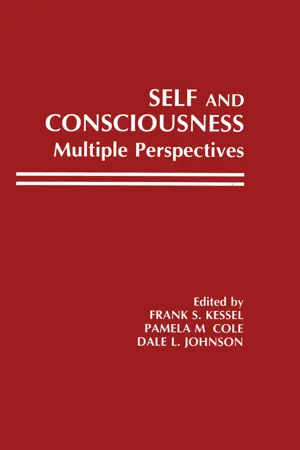
This volume contains an array of essays that reflect, and reflect upon, the recent revival of scholarly interest in the self and consciousness. Various relevant issues are addressed in conceptually challenging ways, such as how consciousness and different forms of self-relevant experience develop in infancy and childhood and are related to the acquisition of skill; the role of the self in social development; the phenomenology of being conscious and its metapsychological implications; and the cultural foundations of conceptualizations of consciousness. Written by notable scholars in several areas of psychology, philosophy, cognitive neuroscience, and anthropology, the essays are of interest to readers from a variety of disciplines concerned with central, substantive questions in contemporary social science, and the humanities.
eBook - ePub
Self and Consciousness
Multiple Perspectives
- 132 pages
- English
- ePUB (mobile friendly)
- Available on iOS & Android
eBook - ePub
Self and Consciousness
Multiple Perspectives
About this book
Information
Publisher
Psychology PressYear
2014Print ISBN
9781138996014
9780805805321
Edition
1eBook ISBN
9781317784180
1 The Development of Consciousness and the Acquisition of Skill
Ulric Neisser
Emory University
Emory University
Author's Retrospective Preface
This chapter presents an early version of a theory that has more recently undergone changes of both substance and emphasis. Because the focus of the Houston Symposium was explicitly on consciousness, it provided a unique opportunity to determine whether my own ecological approach to cognition could be reconciled with something like a phenomenological analysis of conscious experience. As will appear below, the result of this attempt was the discovery that self-relevant experience falls rather naturally into three distinct categories. In the present chapter, they are called the "ecological self," the "extended self," and the "evaluated self" respectively. Each "self " has its own characteristic course of development, and the argument as a whole has a strongly developmental flavor. Partly for that reason, these three categories also fit certain aspects of the acquisition of skill - a topic in which I have long been interested (Neisser, 1983, 1985).
Three years later, I returned to the same set of problems from a slightly different point of view. Further reflection had suggested that conscious experience per se may not be the most effective way to approach the problem of the self; the concept of available information provides a more appropriate starting point for development and ecological analysis. A preliminary theory based on this insight appears in a recent paper called "Five Kinds of Self-Knowledge" (Neisser, 1988). In that paper, categories of the self are explicitly defined by the kinds of information on which they are based. Despite this difference, the two theories still have a great deal in common. The 1988 version, like the one described here, begins with the notion of a directly perceived "ecological self." The two theories also share the concept of an "extended self" that transcends the present, though they define it somewhat differently. However, they do not share the category that is here called the "evaluated self." In the later paper, that concept gives way to no less than three new "selves": An "interpersonal self" that arises from imediate social interaction, a "private self" based on introspective experience, and a "conceptual self" derived from language and culture. This added complexity may be unfortunate, but - in my view - no simpler system can do justice to the rich variety of self-relevant information that becomes available over the course of a human life. But whatever their merits, these later theoretical elaborations do not invalidate the argument of the present chapter. It stands on its own as an ecologically-oriented account of the development of consciousness itself, and of the relation between aspects of consciousness and the acquisition of skill.
This chapter is based on the assumption that consciousness can best be understood from a developmental perspective. The greater part of my argument will concern the changes in consciousness and self-awareness that occur during infancy and childhood. Recent research has forced us to abandon some long-held views. The baby's world is not a "blooming, buzzing confusion," as William James believed; infants perceive their environments realistically from the first. How does consciousness develop from that point forward? I will suggest three principal trends in development: First, there is an increase in the richness and detail of objective awareness. Because that awareness includes the perceiver as well as the surrounding environment, it results in the formation of what I will call an ecological self. Second, the increasing flexibility of anticipation and memory enable the infant to imagine situations other than those that presently exist, and to develop an imagined, extended self. Third, the cumulative result of social perception and interpersonal communication is the development of an emotional self-consciousness, and the consequent formation of an evaluated self.
Growing up is not the only kind of cognitive change. Further development occurs whenever an individual masters some new domain of knowledge or acquires a new skill. These achievements, too, are accompanied by changes in consciousness. In the last section of this chapter, I will try to relate them to the forms of development described earlier. I will suggest that mastery of a skill extends two of the basic developmental trends: The expert has an even wider awareness of the actual and the possible than the novice. The third trend does not continue in the same way, however, and may even be reversed: Evaluative self-consciousness is generally incompatlble with skilled performance, and can be expected to diminish with increasing expertise.
Objective Awareness and the Ecological Self
Infants are capable of veridical perception from the very beginnings of their lives. What they perceive is the objective world around them–the same world we see--and their own positions and actions in that world. Before I elaborate on these ideas, I must clarify the notion of "perception" itself. My usage follows that of James J. Gibson (1966, 1979), whose ideas are central to this part of the argument. To perceive is to pick up information about the objectively existing situation. That information is available to us because our sensory systems are attuned to certain types of structure. In particular, visual perception is based on optical structure. The perceiver, whose eye is either at rest or moving through the environment, may be thought of as sampling from an array of optical information. The array itself would exist whether anyone was sampling from it or not. Its structure corresponds in precise but complex ways to real properties of the environment. The layout of surfaces, the trajectories of object motions, and sometimes even the compositions of the objects themselves are specified in the light. (Many aspects of the environment are also given in the acoustic array and in the haptic structures available to touch. The present discussion is restricted to vision for the sake of simplicity.) Perspective gradients and texture gradients in the array specify surfaces at various orientations, for example. Occlusion of the texture of one surface by that of another specifies that the former has gone behind the latter; rapid symmetrical magnification of a texture, called "looming," occurs when an object approaches the point of observation. Not everything that is specified will be seen: The optic array is infinitely rich in information, and no one uses all of it. Seeing does not depend on a preliminary inventory of isolated sensations, to be later assembled and understood: The visual system has evolved to pick up information directly from optical structure.
What aspects of the world can be perceived? The examples above--the placement and slant of surfaces, the fact that one object lies behind another or that an object is approaching the perceiver--all concern what Gibson called the "layout" of the environment, the arrangement of the furniture of the local world. That is the traditional subject matter of the study of perception, but it does not exhaust what is specified in the light. One can also see a good deal about oneself. One's own hand and feet, for example: The optic array specifies them as things that move in certain ways and make contact with nearby surfaces. The perceiver's position in the environment and the course of his or her movements are also visible; they are specified by flow patterns in the optic array. We can see whether we are moving, and where we are going. Gibson called this "visual kinesthesis" (1979, p. 126). Rapid expansion of the entire optic array indicates that we are moving toward a surface; lateral flow specifies movement parallel to a wall. Experiments have demonstrated that both adults and children use visual kinesthesis to maintain their posture and orientation (Lee & Aronson, 1974; Lee & Thomson, 1982).
Besides seeing where we are, we can see what we are doing. The optical consequences of our own actions, often called "reafference" or "feedback," provide critical information. What we do has visible effects. And even before we see what we are doing, we see what we might do. The furniture of the world around us makes certain actions possible; it affords those actions, as Gibson puts it Floors afford walking, small objects afford grasping. (Affordances are different for different species; ceilings afford walking for a fly, but I am only considering human perception here.) Affordances can be perceived. The walk-on-ableness of the floor is specified in the light just as completely as its position or its slant The pass-through-ableness of an open door is specified, too; seeing the vista beyond, we perceived the door as an opening through which we could pass. An affordance is a kind of meaning. To the extent that the meaning of an object or event consists in what we can do to it--or what it can do to us--many meanings are directly specified in the optic array. The environment we perceive is rich in immediate possibilities.
I suggest that we are conscious of all this; it is a constant, overt, describable aspect of our experience. We are aware of the local environment and its affordances, and of our own situation in that environment. This kind of consciousness may be called "objective awareness." It includes a certain definite awareness of our own selves, more specifically, of what may be called our "ecological selves." The ecological self is to be distinguished from the "extended" and "evaluated" selves to be considered later. It is immediately given; we see the positions and motions of our ecological selves as directly as we see the layout of the environment around us.
How much of all this does an infant perceive? Surely less than an adult. We know that the acquisition of perceptual skill takes time, and the infant has not had much time yet. It is unlikely that four-month-olds notice all the things that we do or are as precisely aware of their own positions and movements. Nevertheless they see a great deal. Here are some examples from modem studies of perceptual development:
- Looming. The expanding optical flow field that specifies the approach of an object is taken by infants to mean just that; they move their heads back as the object comes closer. ...
Table of contents
- Cover
- Title
- Copyright
- Contents
- Foreword
- Preface
- 1. The Development of Consciousness and the Acquisition of Self
- 2. The Role of the Self in Social Behavior
- 3. Being Conscious is Being-in-the-World
- 4. Culture and Consciousness: A Problem in the Anthropology of Knowledge
- 5. Brain Modules and Belief Formation
- 6. The Self as the Center of Narrative Gravity
- Author index
- Subject Index
Trusted by 375,005 students
Access to over 1.5 million titles for a fair monthly price.
Study more efficiently using our study tools.
Frequently asked questions
Yes, you can cancel anytime from the Subscription tab in your account settings on the Perlego website. Your subscription will stay active until the end of your current billing period. Learn how to cancel your subscription
No, books cannot be downloaded as external files, such as PDFs, for use outside of Perlego. However, you can download books within the Perlego app for offline reading on mobile or tablet. Learn how to download books offline
Perlego offers two plans: Essential and Complete
- Essential is ideal for learners and professionals who enjoy exploring a wide range of subjects. Access the Essential Library with 800,000+ trusted titles and best-sellers across business, personal growth, and the humanities. Includes unlimited reading time and Standard Read Aloud voice.
- Complete: Perfect for advanced learners and researchers needing full, unrestricted access. Unlock 1.5M+ books across hundreds of subjects, including academic and specialized titles. The Complete Plan also includes advanced features like Premium Read Aloud and Research Assistant.
We are an online textbook subscription service, where you can get access to an entire online library for less than the price of a single book per month. With over 1.5 million books across 990+ topics, we’ve got you covered! Learn about our mission
Look out for the read-aloud symbol on your next book to see if you can listen to it. The read-aloud tool reads text aloud for you, highlighting the text as it is being read. You can pause it, speed it up and slow it down. Learn more about Read Aloud
Yes! You can use the Perlego app on both iOS and Android devices to read anytime, anywhere — even offline. Perfect for commutes or when you’re on the go.
Please note we cannot support devices running on iOS 13 and Android 7 or earlier. Learn more about using the app
Please note we cannot support devices running on iOS 13 and Android 7 or earlier. Learn more about using the app
Yes, you can access Self and Consciousness by Frank S. Kessel,Pamela M. Cole,Dale L. Johnson,Milton D. Hakel in PDF and/or ePUB format, as well as other popular books in Psychology & History & Theory in Psychology. We have over 1.5 million books available in our catalogue for you to explore.