To hear politicians talk, one would think the entire purpose of school is to assess children rather than educate them. Excitement about learning doesn't seem to be on anyone's agenda. The villains are those who profit from testing mania, make the tests, coach for testing, publish the books on which the tests are based, and believe that the results matter. Children are being taught things they don't need to know and nobody seems to care.
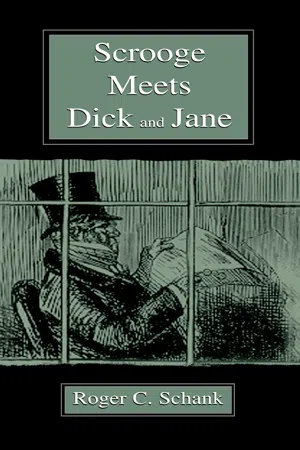
Scrooge Meets Dick and Jane is a cautionary tale of the dangers of educational testing and outmoded curriculum design. Bringing a new twist to Charles Dickens' classic story, A Christmas Carol, Scrooge is recast as the head of an educational testing service. He is faced with the ghosts of Education Past, Present, and Future as well as his former mentor, John Dewey. As he observes a horrible future, he comes to understand the harm he has done and its repercussions on the school system. His time with the ghosts and John Dewey leads him to a dramatic turnaround regarding schools and scholastic teaching. It haunts him until he decides to undo the damage he has done to children all over the world.
- 134 pages
- English
- ePUB (mobile friendly)
- Available on iOS & Android
eBook - ePub
Scrooge Meets Dick and Jane
About this book
Information
2nd Stanza
The first or the Three Spirits
WHEN Scrooge awoke it was so dark that, looking out of bed, he could scarcely distinguish the transparent window from the opaque walls of his room. He was endeavoring to pierce the darkness with his ferret eyes, when the chimes of the neighboring church struck three quarters of an hour. So he listened for the hour.
To his great astonishment, the hour struck six, and then seven, all the way up to twelve; then stopped. Twelve! It was past two when he went to bed. The clock on Broadway was wrong. An icicle must have got into the works. Twelve!
He put on his glasses and looked at the clock by his bed. The clock bells must have been off. It too said twelve. Then the light went out from the clock. The power had failed!
“Why it isn’t possible,” said Scrooge, “that I can have slept through a whole day and far into another night. It isn’t possible that anything has happened to the sun and this is twelve at noon!”
The idea being an alarming one, he scrambled out of bed and groped his way to the window. He was obliged to rub the frost off with the sleeve of his pajamas before he could see anything and he could see very little then. There was no noise of cars or trucks or people panicking in the streets as there unquestionably would have been if night had beaten off bright day, and taken possession of the world. This was a great relief because the SATs were to be administered the next day and things would have been chaotic indeed if they had to be rescheduled.
Scrooge went to bed again, and thought it over and over, and could make nothing of it. Scrooge remembered that the Ghost had warned him of a visitation when the bell tolled one. At precisely one, light flashed up in the room upon the instant, and Scrooge, starting up into a half-recumbent attitude, found himself face to face with an unearthly visitor.
It was a strange figure—like a child: yet not so like a child as like an old man. Its hair, which hung about its neck and down its back, was white as if with age; and yet the face had not a wrinkle in it, and the tenderest bloom was on the skin. The arms were very long and muscular; the hands the same, as if its hold were of uncommon strength. Its legs and feet, most delicately formed, were, like those upper members, bare.
“Are you the Spirit, sir, whose coming was foretold to me?” asked Scrooge.
“I am!”
The voice was soft and gentle. Singularly low, as if instead of being so close beside him, it were at a distance.
“Who, and what are you?” Scrooge demanded.
“I am the Ghost of Education Past.”
Scrooge made bold to inquire what business brought him there.
“The welfare of the children!” said the Ghost.
Scrooge expressed himself much obliged, but could not help thinking that a night of unbroken rest would have been more conducive to that end. The Spirit must have heard him think for it said immediately:
“Your reclamation, then. Take heed!”
It put out its strong hand as it spoke, and clasped him gently by the arm.
“Rise! and walk with me!”
“I am a mortal,” Scrooge remonstrated, “and liable to fall.”
“Bear but a touch of my hand there” said the Spirit, laying it upon his heart, “and you shall be upheld in more than this!”
As the words were spoken, they passed through the wall, following the length of the road to Connecticut, which seemed to change centuries every twenty miles until they reached the town of New Haven where Scrooge was born. Then they followed Whitney Avenue until suddenly it turned into an open country road, and they were in front of a one-room country school house. The urban sprawl of Connecticut had entirely vanished. Not a vestige of it was to be seen. In its place was the pretty New England town of Hamden, sparsely populated, with the smell of fires burning in the air. The darkness and the mist had vanished with it, for it was a clear, cold, winter day, with snow upon the ground.
“Good Heaven!” said Scrooge, clasping his hands together, as he looked about him. “I went to school in such a place!”
They entered the school. The boys were in great spirits, and shouted to each other, until the teacher entered the room.
“These are but shadows of the things that have been,” said the Ghost. “They have no consciousness of us.”
The children sat at their desks. Why was he filled with sadness when he heard them become quiet and begin to open their books? What was children’s jocularity to him? Education was about discipline after all. They would have no merriment until school was over for the day. There would be no joy in learning, but that was as it should be. He paused to listen as the children recited their lessons from the New England Primer:
I will fear God, and honour the King.
I will honour my father and mother.
I will obey my superiors.
I will submit to my elders.6
Then he heard a piece of the catechism they had memorized:
Q: What rule hath God given to direct us how we may glorify and enjoy him?
A: The Word of God which is contained in the Scriptures of the Old and New Testament, is the only Rule to direct us how we may glorify and enjoy him.
“The school is very quiet,” said the Ghost. “The children no longer seem happy nor are they interested in what they are learning.”
Scrooge said he knew it. And he sobbed.
“But what is school for?” asked Scrooge. “Is it meant to take the joy out of childhood?”
“Why don’t we inquire of the villager standing near the church?” replied the Ghost. Having said this he turned himself into the very picture of the modern seventeenth century Pilgrim, politely introduced himself as a traveler searching for a proper town in which to raise his family and inquired after the local educational philosophies. He was taken aback by the response:
“School sir, is primarily intended to teach submission to authority. The children must learn to read and write so as to better understand and submit to the laws of religion and government,” replied the man.7
The Ghost reappeared in his ghostly form and returned to Scrooge. They left the small village of Hamden and headed back towards New Haven.
“But who could have thought that children would be educated by memorization?” asked Scrooge. “Surely, no one could have believed that thinking would be fostered by blind obedience!”
“They weren’t trying to encourage thinking,” replied the Ghost. “The Founding Fathers wanted order. They already knew what to think.”
Suddenly, Scrooge found himself recalling the words of Dewey:
“While we may lead a horse to water we cannot make him drink;…while we shut up a man in a penitentiary we cannot make him penitent… We need to distinguish between physical results and moral results. A person may be in such a condition that forcible feeding or enforced confinement is necessary for his own good…. But no improvement of disposition, no educative effect, need follow…. When we confuse a physical and an educative result, we always lose the chance of enlisting the person’s own participating disposition in getting the result desired and thereby of developing within him an intrinsic and persisting direction in the right way.”8
“Dewey was right,” thought Scrooge. “How can memorizing actually teach anyone how to act?”
They soon approached a school of dull red brick, with a little weathercock-mounted cupola on the roof, and a bell hanging in it. It was a large house, but one of broken fortunes; for the spacious offices were little used, their walls were damp and mossy, their windows broken, and their gates decayed.
They went, the Ghost and Scrooge, across the hall, to a door at the back of the school. It opened before them and disclosed a long, bare, melancholy room, made barer still by lines of plain deal forms and desks. At each of these boys were reading near a feeble fire; and Scrooge sat down upon a form, and wept to see these poor children. But, in fact, these were not children of the poor. They were simply children attending Hopkins Grammar School. They were preparing for Yale, learning the rules of Latin and Greek, “reciting them, parsing and construing, translating from Latin to English and back again, “making Latin,” translating Greek, and puzzling over its rules—this was the course the scholar followed un...
Table of contents
- Contents
- 1st Stanza Dewey’s Ghost
- 2nd Stanza The first or the Three Spirits
- 3rd Stanza The Second of the Three Spirits
- 4th Stanza The Last of the Spirits
- 5th Stanza The End of It
Trusted by 375,005 students
Access to over 1.5 million titles for a fair monthly price.
Study more efficiently using our study tools.
Frequently asked questions
Yes, you can cancel anytime from the Subscription tab in your account settings on the Perlego website. Your subscription will stay active until the end of your current billing period. Learn how to cancel your subscription
No, books cannot be downloaded as external files, such as PDFs, for use outside of Perlego. However, you can download books within the Perlego app for offline reading on mobile or tablet. Learn how to download books offline
Perlego offers two plans: Essential and Complete
- Essential is ideal for learners and professionals who enjoy exploring a wide range of subjects. Access the Essential Library with 800,000+ trusted titles and best-sellers across business, personal growth, and the humanities. Includes unlimited reading time and Standard Read Aloud voice.
- Complete: Perfect for advanced learners and researchers needing full, unrestricted access. Unlock 1.5M+ books across hundreds of subjects, including academic and specialized titles. The Complete Plan also includes advanced features like Premium Read Aloud and Research Assistant.
We are an online textbook subscription service, where you can get access to an entire online library for less than the price of a single book per month. With over 1.5 million books across 990+ topics, we’ve got you covered! Learn about our mission
Look out for the read-aloud symbol on your next book to see if you can listen to it. The read-aloud tool reads text aloud for you, highlighting the text as it is being read. You can pause it, speed it up and slow it down. Learn more about Read Aloud
Yes! You can use the Perlego app on both iOS and Android devices to read anytime, anywhere — even offline. Perfect for commutes or when you’re on the go.
Please note we cannot support devices running on iOS 13 and Android 7 or earlier. Learn more about using the app
Please note we cannot support devices running on iOS 13 and Android 7 or earlier. Learn more about using the app
Yes, you can access Scrooge Meets Dick and Jane by Roger C. Schank in PDF and/or ePUB format, as well as other popular books in Education & Education General. We have over 1.5 million books available in our catalogue for you to explore.