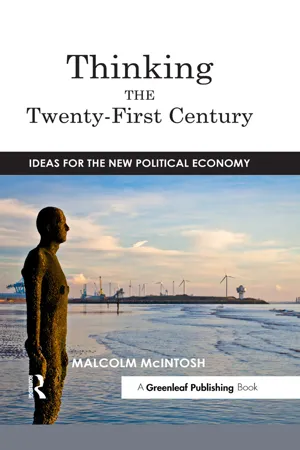
- 256 pages
- English
- ePUB (mobile friendly)
- Available on iOS & Android
eBook - ePub
About this book
In a sophisticated and far-reaching blend of theory and reflection, Thinking the Twenty-First Century takes a provocative look at the changes required to build a new global political economy. McIntosh charts five system changes essential to this transition: globality and Earth awareness; the rebalancing of science and awe; peacefulness and the feminization of decision-making; the re-organization of our institutions; and, evolution, adaptation and learning. That they are all connected should be obvious, but that they are written about together is less common.McIntosh argues that these five changes are already under way and need to be accelerated. Combining science, philosophy, politics and economics, Thinking the Twenty-First Century questions our current model of capitalism and calls for a much-needed new order. This forceful call to action advocates a balanced political economy with trandisciplinarity, connectivity, accountability and transparency at its centre, as an alternative to a world built on the failing system of neoliberal economics.From one of the pioneers of the global corporate sustainability and social responsibility movement, this unique book combines analysis, diary and reflection to present a radical way forward for the twenty-first century.
1
Rescuing globality
Astronaut Neil Armstrong, looking back at Earth from the Moon in 1968, said, ‘I put up my thumb and shut one eye, and my thumb blotted out the planet Earth. I didn’t feel like a giant. I felt very, very small.’ Standing on Earth, make a small hole in the sky with your thumb and forefinger and hold it up to a dark patch in the night where there are no visible stars. But with a large enough telescope and a long enough exposure you could discern perhaps 100,000 galaxies each containing billions of stars. Since supernovae explode once per hundred years per galaxy, with 100,000 galaxies in view you should expect to see, on average, about three stars explode on any given night. Before industrialisation and night sky pollution, experiencing the connection of seeing the cosmos in glorious detail was commonplace for all humans.
For this chapter I have used the term ‘globality’ because it needs rescuing from those who have taken it to imply the end point of economic globalisation. This was Francis Fukuyama’s mistake in 1992 when he said that neoliberalism equalled the end of history. Why does everything have to be seen through the lens of economics and financialisation? The answer is: it doesn’t; and when I talk about globality I mean the sense of one shared space. In the 1960s the image of Spaceship Earth became common through the work of Kenneth Boulding and Barbara Ward.1 I have previously called Earth planethome.2
It is also necessary to distinguish between globalisation, globalism and globality. I see these as separate but connected and interlinked phenomena. Globalisation and globalism are subsets of a growing sense of Earth awareness or globality.
The current form of twentieth - and twenty-first-century globalisation is an economic and political process convened by neoliberalists under the banner of market freedom and political tolerance for neoliberalism. Its essence is consumption and its vehicles are limited-liability companies; distanced investment and management; a firm belief that markets are the ultimate information system; that markets are rational; and that we are each and all of us rational decision-makers. Central to this fundamentalism is the nostrum that planning is per se, especially if it’s public, a bad thing, and that public management is always inefficient. The evidence does not support this last fundamental tenet of neoliberalism.
Globalism currently runs parallel to globalisation but is slightly more benign in that it says that ideas can be non-economic. Globalism is the spread of ideas on a global basis whether they be the proselytising of Christianity or Islam, the Occupy movement, the United Nations, FIFA’s World Cup or Nike’s slash. The point about globalism, as a subset of globality, is that the spread of simple but affective ideas is as important as grand narratives.
Globality and Earth awareness is a change of consciousness from the political and economic frontier-building process of globalisation. This recaptured understanding of globality leads on from an understanding of the Anthropocene, and is connected to the coming cosmological or planetary age. Globality is not the end point of economic globalisation, as globalisation is bound to fail as it devours all in its way. The frontier economy will eat itself as it destroys its host.
Globality is simply an emotional, spiritual, aesthetic sense of the globe: that we share one liveable space, one planet, one home, planethome. Earth. If we do not grow this sense of globality, and if this sense is not built into our decision-making and governance structures, we will not survive as a species; for the forces of destruction, consumerism and resource depletion will meet themselves coming over the hill and in our end we will truly know our beginning.
The world is at a confused point as it moves from tribalism, nationalism and misogyny to emergent forms of global governance that are founded on a shared territory and not on territories stolen, fought for or devised. Many of the world’s national boundaries were arbitrarily formed by European powers during the great period of colonisation and empire from 1750–1950. Because of this often arbitrary nation building, it is no surprise that most people when asked ‘where do you come from?’ respond with their national identity. But this is changing, as city-states become more powerful and natural geographical regions become more dominant. Paradoxically, the fact that nation-states rule is a source of stability and yet a scourge of the global governance debate: it is an accident of history rather than necessarily a sensible way to proceed. One of the issues, discussed later, that has emerged from the Occupy movement activists was that of identity: ‘who are we (am I) in a globalised economy?’ Perhaps encapsulating the dilemma for the new cosmopolitanism, the Canadian novelist Margaret Atwood said, ‘you may be born somewhere, and you may die somewhere, but this doesn’t necessarily define your identity’.3
Just look at the map of Africa, the Middle East or Australia and wonder at the very straight lines that cut through natural barriers such as rivers and mountain ranges and through bio-communities and social networks. Of course, these notso-ancient organising systems, nation-states, are how we officially compartmentalise the world, but they are no longer the way the world is necessarily managed or the way many people now see themselves – or the way forward. The conservative force in the argument is that, at present, we have no other way of convening global, or dare I say ‘international’, meetings. Increasingly complex urban environments, or cities, meet to discuss governance with global corporations and realign the world around supply chains, consumers, markets and population density. This is the historian Arnold Toynbee in 1934: ‘The spirit of nationality is a sour ferment of the new wine of democracy in old tribal bottles.’4 Toynbee may not have been correct in equating nationalism to tribalism but he was correct in identifying nationalism as a form of tribalism, and danger ous at that. As Albert Einstein said, ‘nationalism is an infantile thing. It is the measles of mankind.’5 In my experience nationalism, tribalism and organised religion often seem to block out reason in conversation.
The other diminution of the power of nation-states to control global governance comes in the shape of our everyday behaviour vis-à-vis our consumption patterns and media interactions. Both are observed, tracked, mediated by business and governments. Megadata is the new governance. It’s not democracy and it can easily by corrupted soundlessly and unknowingly, while we sleep. The biggest part of megadata is metadata. It is not the private bits or the secret conversations about bombs, sex or politics that matter, but the metadata capture of the when, where, who of our lives that tell business and government what we’re about, who we talk to, what we consume, what time we go to bed, and where we sleep. As the former CIA operative Edward Snowden said in 2014: ‘Meta-data does not lie…you can trust the metadata…metadata’s often more intrusive [than megadata].’6
Megadata capture and analysis relies on algorithmic analysis which is essentially digital. Yet we remain analogic: emotional, rational and irrational, metaphoric, eulogistic, ecstatic, sexual, aesthetic, moral beings – and sometimes wrong. As Nobel prizewinning economist Daniel Kahneman said, we have two ways of thinking: the first is intuitive and immediate and the second is thoughtful, reflective and analytical.7 We live, we evolve, we adapt, and all by learning. We learn, and have evolved, by making mistakes, but there are no mistakes in megadata capture. As Edward Snowden has observed, you’re either in or out: there’s no halfway in the digitised world. So, what does the nation-state matter when our every action is monitored by national governments and by supraterritorial corporations?
In the virtual world, which an increasing number of people inhabit continually, it matters which effective rather than affective tribe we belong to, and what technology that tribe has at its disposal. The virtual world is often empatheticless and asocial. The habitués play games with themselves, shop online, and grow obese on their self-infatuation (as there are no buttresses to social correction) and consume fast food sold to them by companies that know all about their bad habits and their basic greed for salt, sugar and fat. From pre-industrial muscle to mechanisation to digitisation to the end of human possibility. It has been suggested that just as we are reaching the end of our physical longevity potential – medicine has taken us so far and can take us no further – we will morph into the computer machines we have made in our own image.
Both government and business govern and manage by monitoring, sweeping up deviants and nudging us to conform as citizens and consumers. Governance becomes more like flying an unstable aircraft by sweeping up and analysing mega - and metadata. On the plus side, mega - and metadata allow a better understanding of the fact that society is a series of nested networks with lives of their own – interrelated, interactive but complex adaptive systems.
Seeing the Earth for the first time
I’m at WOMAD in the beautiful city of Adelaide, South Australia. WOMAD stands for the World of Music And Dance and was started in 1980 by Genesis singer Peter Gabriel who lives just outside Bath in England. To say that I am confused by what is on display here today would be an understatement of postmodernism. The band now playing, Hanggai, are a Mongolian–Chinese punk-rock six-piece using a mixture of instruments that derive from around the world through thousands of years. It’s loud, invasive, incessant and compelling. Of greatest interest to me are the embedded references to calls across the Mongolian steppes, to rhythms that are not of standard rock music, and the use of ancient musical instruments to thump out the defiance that is punk music. The lead singer has stripped to the waist. He’s paunchy, and doesn’t quite have the vocality of Elvis Presley, the gyrations of Mick Jagger or the athleticism of Chris Martin or Iggy Pop. He sings in English and Mongolian: the crowd loves the mélange; such is their thirst for things exotic and their cosmopolitanism. The band says their influences include Pink Floyd, Neil Diamond and Radiohead as well as punk and Mongolian folk songs. There is an issue of identity here, or is this the coming alternative global homogeneity, so derided when it’s McDonald’s ‘I’m lovin’ it’, Microsoft’s Windows, or Starbucks’ ‘all-coffee-tastes-the-bland-same’ cultural invasion? Is pop and rock the real global homogeneity? Is this globalism (the spread of global ideas) the real globality?
One of the progenitors of punk I referred to earlier, Malcolm McLaren, said that punk heralded a new age of the conspicuous consumption of ideas, rather than the conspicuous consumption of things: a shift from having to being and doing, a rebalancing of yin and yang. With Hanggai we have the conspicuous consumption of global ideas hung around a punk-rock drumbeat with soft references to exoticism for easy Western ears.
The modern globality revolution started in the US – they took the pictures of the Earth from the Moon and gave birth to rock ’n’ roll – but was carried forward and given momentum by the availability of bananas 24/7, intercontinental ballistic missiles and The Beatles. When John Lennon said in March 1966 that The Beatles were more popular than Jesus (but that both would die), their records were burned in some US states. But he was actually talking about globalism: their music was being listened to everywhere, by everyone.8 It was casteless and classless, it was catchy and memorable, and it spoke of everyday concerns – love, the planet, and humanity.
In the twenty-first century Lennon’s song ‘Imagine’ is as potent a revolutionary message as Karl Marx’s pamphlets and books or Charles Darwin and Alfred Wallace Russell’s evolutionary theory. Lennon was as reviled and loved then as evolutionary theory is disputed by some reactionary conservatives today. Similarly, the universality of human rights is often denied today.
In a sense, Václav Havel summed up the idea of globality in Summer Meditations, which was quoted earlier: ‘the idea that the world might actually be changed by the force of truth, the power of the truthful word, the strength of a free spirit, conscience, and responsibility – with no guns, no lust for power, no political wheeling and dealing’ ran counter to the conflictual view of history, including, within his own sphere, that of the former communist state of Czechoslovakia, and Marxist dialectical materialism.9
When Václav Havel was 52, William Anders on Apollo 8 came out from behind the Moon, on 24th December 1968, and shouted:
Oh, my God! Look at that picture over there!
Here’s the Earth coming up. Wow, is that pretty!10
In 1948, just a few years after US rockets, based on German World War II V2 rockets, had roughly mapped the Earth’s surface from space, Fred Hoyle, a British astronomer and writer (and the inventor of the theory of black holes and dark matter), made the observation that when we could see the Earth from beyond then a revolution in thinking would occur. That revolution, or evolutionary adaptation, is now taking place. Here is what Hoyle said in 1948:
Once a photograph of the Earth, taken from outside, is available, we shall, in an emotional sense, acquire an additional dimension…Once let the sheer isolation of the Earth become plain to every man, whatever his nationality or creed, and a new idea as powe...
Table of contents
- Cover
- Half Title
- About the author
- Title
- Copyright
- Contents
- Acknowledgements
- First thoughts and preface
- Introduction
- 1: Rescuing globality
- 2: Rebalancing science and awe
- 3: Co-existence, peace and feminisation
- 4: Re-organising and the political economy
- 5: Quiet leadership: evolution, adaptation, learning
- Bibliography
- Index
Trusted by 375,005 students
Access to over 1.5 million titles for a fair monthly price.
Study more efficiently using our study tools.
Frequently asked questions
Yes, you can cancel anytime from the Subscription tab in your account settings on the Perlego website. Your subscription will stay active until the end of your current billing period. Learn how to cancel your subscription
No, books cannot be downloaded as external files, such as PDFs, for use outside of Perlego. However, you can download books within the Perlego app for offline reading on mobile or tablet. Learn how to download books offline
Perlego offers two plans: Essential and Complete
- Essential is ideal for learners and professionals who enjoy exploring a wide range of subjects. Access the Essential Library with 800,000+ trusted titles and best-sellers across business, personal growth, and the humanities. Includes unlimited reading time and Standard Read Aloud voice.
- Complete: Perfect for advanced learners and researchers needing full, unrestricted access. Unlock 1.5M+ books across hundreds of subjects, including academic and specialized titles. The Complete Plan also includes advanced features like Premium Read Aloud and Research Assistant.
We are an online textbook subscription service, where you can get access to an entire online library for less than the price of a single book per month. With over 1.5 million books across 990+ topics, we’ve got you covered! Learn about our mission
Look out for the read-aloud symbol on your next book to see if you can listen to it. The read-aloud tool reads text aloud for you, highlighting the text as it is being read. You can pause it, speed it up and slow it down. Learn more about Read Aloud
Yes! You can use the Perlego app on both iOS and Android devices to read anytime, anywhere — even offline. Perfect for commutes or when you’re on the go.
Please note we cannot support devices running on iOS 13 and Android 7 or earlier. Learn more about using the app
Please note we cannot support devices running on iOS 13 and Android 7 or earlier. Learn more about using the app
Yes, you can access Thinking the Twenty‐First Century by Malcolm McIntosh in PDF and/or ePUB format, as well as other popular books in Economics & Business General. We have over 1.5 million books available in our catalogue for you to explore.