- 396 pages
- English
- ePUB (mobile friendly)
- Available on iOS & Android
eBook - ePub
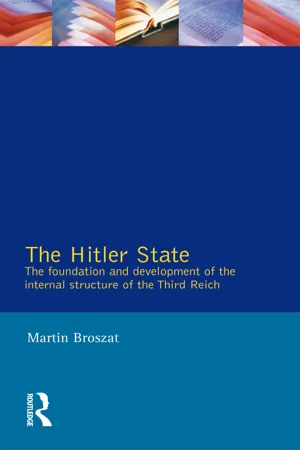
The Hitler State
About this book
Interpretative study of the Hitler state now available in English. An important contribution to the study of totalitarian states.
Information
Chapter One
The political and constitutional preconditions of the Third Reich
The National Socialist coalition with the national conservative right and the political exclusion of the democratic left
The crisis-ridden years of the Weimar Republic, from the Treaty of Versailles to the occupation of the Ruhr and the inflation, were the background to the early history of the NSDAP; the years of the Party’s first political successes, still confined to Bavaria and South Germany, which ended with the abortive Hitler putsch of 9 November 1923. The ensuing phase of relative stability for the Republic coincided with the decline of the NSDAP which was refounded at the beginning of 1925. The spread of its organization during this period to West, North and East Germany cannot conceal the fact that between 1925 and 1928 the Hitler movement was politically almost wholly unsuccessful. Its membership fluctuated markedly and support was largely stagnant, and the aim after 1925 of a legal takeover of power through the elections yielded only meagre results in the Länder and in the Reich (Reichstag elections 1928: 2.6 per cent of the vote for the NSDAP). The third, crucial phase did not begin until the combined economic and national crisis of 1929/30. The National Socialist Party, which for ten years had been a small radical rightist minority, suddenly became a nationwide gathering mass movement which had absorbed 75 per cent of former voters of the parties of the middle and right within three years and was able to capture 37.4 per cent of all votes by July 1932.
Table 1.1 The decline of the middle-class parties 1928–1932
Reichstag elections | Socialist parties (SPD, KPD) | NSDAP | Centre Party | Other middle-class parties |
(%) | (%) | (%) | (%) | |
20.5.1928 | 40.5 | 2.6 | 15.1 | 41.8 |
14.9.1930 | 37.6 | 18.3 | 14.8 | 29.3 |
31.7.1932 | 36.2 | 37.4 | 15.7 | 10.7 |
The success story of the NSDAP mirrored the tragedy of the Republic and vice versa. No other party – not even the KPD – was so dependent for its success on the crisis. More precisely, success or failure was determined by the extent to which the socio-political forces of the ‘bourgeois middle’ and conservative right were prepared to treat with the NSDAP, to join it or to make arrangements with it. The sudden mass swing to the NSDAP after 1929/30 far exceeded any other movements between the parties during the Weimar Republic’s history. It was due almost exclusively to the mobilization of hitherto non-voters and of the bulk of those middle-class voters who had been far less firmly attached to their loosely-grouped liberal interest parties than the ideologically-committed supporters of the Centre Party or of the Socialist parties. This was less a matter of a shift within the democratic party system than its destruction through the activation and rallying of those who had so far avoided the democratic process of decision-making or who had participated in this unwillingly. The NSDAP could not accomplish such a revolution by itself. It required the protection, or at least the goodwill, of middle-class and conservative forces in the government, armed forces, the Church, commerce and politics, which had also been the case in Munich before 1923. The NSDAP thrived on the sort of desire for more decisive measures so easily aroused during crises, and on the demand for a more effective and, if need be, enforced cure for Germany’s ills. In that respect the Nazi Party was not so much a revolutionary as a parasitic force; the most effective power agitating for the restoration of authoritarian notions of order in state and society and at the same time a militant popular enemy of Socialism and Communism. The circumstances permitting the rise of the NSDAP in Bavaria before 1923 were as appropriate for it as the situation in the Reich from 1929/30.
The reactionary regime which gained power in Munich after the overthrow of the Soviet Republic there provided the ideal breeding ground for the early NSDAP. The active encouragement which the Bavarian Reichswehr, imbued as it was with the counter-revolutionary spirit of the Freikorps, bestowed on the völkisch-patriotic organizations from the summer of 1919, and on the anti-Socialist Home Guards and their later substitute organization the patriotic Defence Leagues, was of crucial importance for the development of the NSDAP and the S.A. Influential patrons gave official protection and provided the essential material and personal preconditions for political and militant action; patrons like the ambitious staff officer and later S.A. Chief, Ernst Röhm, or the Police Chiefs Ernst Pöhner and Hans von Seisser, who gained office through the Bavarian ‘Law and Order Bloc’ under Gustav Kahr in 1920/1. Without such top-level backing a social nonentity like Hitler would hardly have been so willingly ‘passed round’ the bohemian circles, salons and associations of patriotic Munich society (Dietrich Eckhart, the publisher Bruckmann, the piano manufacturer Bechstein, Professor Karl Haushofer, etc.) like some sort of super political-agitator, nor would he have been given the contacts and assistance which were so vital to the NSDAP at that stage.
Although its followers were then still few, the Hitler movement’s involvement with an influential sector of the local notables and with the state executive helped to ensure that in Bavaria in 1922/3, it became the vanguard of those anti-democratic forces aiming for an authoritarian national dictatorship. Chief State Commissioner von Kahr and the Commander of the Bavarian Reichswehr division, von Lossow, were already in breach of the constitution when Hitler tried to get them openly to oppose the central government, but the putschist style of the attempted coup d’état of 9 November 1923 cannot disguise the fact that Hitler was then even less able than in 1932/3 to seize power with National Socialist forces alone. Without the crucial support of respected and established forces in state and society nothing could be achieved in either situation. To that extent there was no difference between the ‘government’ of Hitler, Kahr, Ludendorff, Pöhner, and Seisser, which was proclaimed under false pretences on the evening of 8 November 1923, and the government of Hitler, Hindenburg, Papen, Hugenberg, and Seldte, which actually came into being on 30 January 1933.
This sort of protection from the anti-Republican, National Conservative camp, similar to that in Bavaria before 1923, also enabled the NSDAP to come in from the political wilderness of radical sectarianism for the first time after 1929/30 on the national stage and to become the focal point for the discontented whose numbers rose rapidly with the economic crisis. The agreement between the ‘National Opposition’ which the new leader of the German Nationalist People’s Party (DNVP), Alfred Hugenberg, had called into being during the summer of 1929, before the real depression set in, to campaign for a referendum against the Young Plan, was of particular significance. As a result of this arrangement – the forerunner of the Harzburg Front of October 1931 – Hitler could play an active role for the first time in a central issue of German politics, this time as a partner of Hugenberg, of Stahlhelm leader Seldte, and other worthy members of the national right. The campaign against the Young Plan lasted several months and it was not only free publicity in the Hugenberg press which the NSDAP got out of it. It also gradually made the Hitler movement respectable and credit-worthy once more – for after 1925 it had been tainted with failure, a near illegal putschist party. It also brought the movement new, powerful patronage, including that of the former President of the Reichsbank, Schacht, who resigned over the negotiations for the Young Plan and joined the National Opposition. The campaign was not always opposed with conviction and skill by the government but above all it gave the NSDAP the chance to play its trump card in the contest with its reactionary and conservative partners; namely its superior powers of agitation. Thus, after years of political stagnation, the NSDAP gained its first striking electoral successes during the second half of 1929, in individual Länder and municipalities and in the student bodies at the universities. This political overture to the economic crisis (a sharp rise in unemployment was first evident in the winter of 1929/30) allowed the NSDAP to present itself as a new, active force of opposition and gave it the prestige and attraction from which it then benefited during the crisis and which automatically continued after further successes, as long as the crisis lasted and intensified.
Yet the final stage of the Republic also showed what could be done to counter the ominous growth of the Hitler movement if it was resolutely opposed, as when Brüning’s emergency government and the Prussian government, controlled by the Social Democrats, adopted combined political and executive measures because of their alarm at the growth of the NSDAP and its disruptive agitation.1 And in fact the Republic was not really breached by the weight of ballot papers, for the NSDAP fell far short of gaining an absolute majority even during its greatest successes. The growing readiness of government circles to bargain with Hitler was more important, a trend which was also noticeable in the agrarian and business interest groups. One crucial trial of strength, which the NSDAP won, concerned the ban on the S.A. by Brüning’s government on 13 April 1932. The ban was lifted in the summer of that year, thanks to the deciding influence of the Reichswehr (Schleicher), which notwithstanding its suspicions of Hitler was keen to exploit the military potential of the S.A. and in any event wanted to avoid a direct conflict with it. As a result, first the Reich Minister of the Interior, Groener, then the whole Brüning government resigned. Papen’s reactionary interim government knocked away a few more important props of democracy, especially by its coup against the acting Social Democratic government of Prussia and the disposal of the Social Democratic representatives and heads of the Prussian administration. This in itself paved the way for the later ‘co-ordination’ (Gleichschaltung) in the Third Reich. The final political engagement was lost when Schleicher, the last Chancellor of the Republic, was not empowered by the Reich President to continue with an emergency government backed by force of arms, which alone could have prevented Papen meanwhile from preparing the ground for Hitler to become Chancellor in coalition with members of the National Opposition. The intervention of agrarian and business interest groups was a key factor here. Influential protection from above was more important than any direct financial support of the NSDAP and helped to hoist Hitler into the Chancellor’s saddle.
By contrast the real hardship of the NSDAP in the years 1924 to 1928 was due to the almost complete loss of their earlier protection because of Hitler’s prison sentence and the ban against his speaking in certain Länder. Really it was only in this phase, when its ideology and propaganda moved farther to the left and it temporarily assumed national-revolutionary rather than nationalist, antisemitic traits, that the NSDAP was outside political society and swimming against the current. Indeed, these crisis-free years revealed that left to its own devices the NSDAP could do little to throw off the stigma of being a political outsider.
The functioning and stability of the Weimar Republic depended largely on the ability and readiness for coalition between the liberal parties of the middle and the Social Democrats, who had assumed the leadership of the young democracy in 1918/19 and who remained the strongest party in the Reich until the summer of 1932 and the most important and reliable supporters of the Republic. The decline of the Republic was thus to a considerable extent identical with the inability of the Weimar Coalition to govern, and more specifically with the loss of power by the Social Democrats. The fact that the severe crises between 1919 and 1923 were ultimately overcome, particularly the attempted subversion by the right (the Kapp Putsch, the Küstrin Putsch of the ‘Black’ Reichswehr, the Hitler Putsch), was due above all to the co-operation between the liberal ‘middle’ parties and the Social Democrats, with their shared determination to defend the parliamentary Republic. This was expressed among other things by the Law for the Defence of the Republic of 1922. It was surely significant that in 1923 the Chief of the Army Command, General von Seeckt, did not risk using the powers which were given him by the state of emergency to deal with leftist and rightist enemies of the Republic in order to set up a military dictatorship, as both left and right alike had feared.
At that time the conservative and German Nationalist right shrank from a direct challenge to the forces of democracy, not least because there was still a real danger of revolution by the radical left, in the struggle against which the Social Democrats were hardly dispensable. True, the anti-Communist marriage of convenience between Ebert and Groener, which in socio-political terms also functioned as a joint defence of the Socialist revolution, indeed benefited the Reichswehr and the conservative forces in state and society, but it also bound these to the Social Democrats as long as revolution threatened from the left.
This constellation changed after 1923, when Moscow called off the revolutionary tactics of the German Communists. The KPD, with an average of between 9 and 13 per cent of the vote, remained a strong but nonetheless calculable political constant, still causing unrest but hardly an acute threat to the state. The end of this direct threat from the left and the economic consolidation did indeed temporarily relieve the Republic but did not favour its longterm stabilization. On the contrary, prosperity and the end of anxiety about revolution rather weakened the attachment to democracy of the liberal middle classes and upper classes whilst the economic improvement brought a restoration of their traditional political and social attitudes. These were also strongly encouraged in the industrial sector by the marked concentrations of big businesses and corporations.
The changed situation expressed itself both in the more bitter socio-political conflicts between trade unions and employers (Ruhr iron strike at the end of 1928) and above all in the fact that in 1924 the conciliation nurtured between the liberal middle parties and the Socialists between 1919 and 1923 began to disappear. The SPD was no longer represented in Reich governments between November 1923 and June 1928. There was a clear shift of political opinion towards the right and this was also marked by the election of Hindenburg as Reich President in 1925.
The period of economic prosperity also exposed more clearly the defects and negative qualities of the parliamentary system: the rapid change of governments, the dependence of Ministers on their parties, with a consequent weakening of any coalition cabinet, the interference in government by party leaders and parliamentary parties, the dominating influence of interest groups and thus the diminished authority of governments. As a result even before the world economic crisis had made itself felt in Germany, opinion was widespread among the middle classes that the party system was finished. The former governing parties – Democrats, German People’s Party (DVP), Centre Party, German Nationalist People’s Party (DNVP) – forfeited 10 per cent of their votes in the Reichstag election of May 1928. The electors of the DNVP in particular reproached their strongly monarchical and anti-democratic party for some of its leading personalities giving up their policy of obstruction in principle and participating in government (decline of the DNVP from 20 to 14 per cent of the vote).
After this election, which greatly intensified the splintering of parties, the only way for governmental policies to be continued, especially Stresemann’s foreign policy, was to renew the cooperation between the parties of the middle and the SPD. But such co-operation, demanded by the election results and reasons of state, conflicted far more than had been the case before 1924 with the self-confidence and power of the parties and interest groups to the right of the SPD, not least the Reichswehr and bureaucracy. The fact that the SPD won an electoral victory in 1928 in spite of this development burdened the ‘Great Coalition’ intolerably from the outset. Under their new leader, Hugenberg, the DNVP moved sharply into opposition after the election results. As a result the parties of the middle and right still represented in the government were all the more compelled to work with the SPD, even to allow it to have the dominating position. In turn, discomfort with this coalition grew in the parties to the right of the SPD and was fanned by numerous disputes and conflicting interests. And parallel with this, efforts increased to change this state of affairs in non-democratic ways, since things could not be put right by parliamentary governments. During the year 1928/9 the Centre Party also moved farther to the right under its new chairman (Prelate Kaas). The spokesmen both of the agrarian ‘Green Front’ and of heavy industry openly expressed their displeasure with the Great Coalition, which also lost its most important unifying force with Stresemann’s death in 1929. In the winter of 1929/30, when it was obvious that compromise over certain social policy issues was no longer possible between the employers’ wing of the DVP and the trade union wing of the SPD, the political leaders of the Reichswehr (Schleicher, Groener) urged the creation of an authoritarian ‘Hindenburg Cabinet’ of the right-middle without the SPD. And because at the crucial moment stubborn vested interests triumphed over a readiness for compromise within the SPD this also contributed decisively to the collapse of the last parliamentary government under the Social Democrat Hermann Müller and to the SPD’s withdrawal from the responsibilities of government.
But the transition to Brüning’s emergency government was by no means the result of the pressure of reasons of state. On the contrary, the makers of Brüning’s minority government agreed that the Reich President’s authorization to issue emergency decrees (Article 48 of the Constitution) should only be granted to a cabinet based on the right...
Table of contents
- Cover
- Half Title
- Title Page
- Copyright Page
- Table of Contents
- Glossary and abbreviations
- Foreword to the English edition
- 1. The political and constitutional preconditions of the Third Reich
- 2. Modus-operandi and structure of the Hitler movement before 1933
- 3. The monopoly of political power (1933)
- 4. The coordination of the Länder outside Prussia and the new problem of centralism and particularism
- 5. The foundation and alteration of the social system
- 6. Party and state in the early stages of the Third Reich
- 7. The civil service and the administration
- 8. The Reich government and the Führer’s authority in the first years after 1933
- 9. Departmental polyocracy and the forms of Führer absolutism
- 10. Law and justice
- 11. Conclusion
- Bibliography
- Index
Trusted by 375,005 students
Access to over 1.5 million titles for a fair monthly price.
Study more efficiently using our study tools.
Frequently asked questions
Yes, you can cancel anytime from the Subscription tab in your account settings on the Perlego website. Your subscription will stay active until the end of your current billing period. Learn how to cancel your subscription
No, books cannot be downloaded as external files, such as PDFs, for use outside of Perlego. However, you can download books within the Perlego app for offline reading on mobile or tablet. Learn how to download books offline
Perlego offers two plans: Essential and Complete
- Essential is ideal for learners and professionals who enjoy exploring a wide range of subjects. Access the Essential Library with 800,000+ trusted titles and best-sellers across business, personal growth, and the humanities. Includes unlimited reading time and Standard Read Aloud voice.
- Complete: Perfect for advanced learners and researchers needing full, unrestricted access. Unlock 1.5M+ books across hundreds of subjects, including academic and specialized titles. The Complete Plan also includes advanced features like Premium Read Aloud and Research Assistant.
We are an online textbook subscription service, where you can get access to an entire online library for less than the price of a single book per month. With over 1.5 million books across 990+ topics, we’ve got you covered! Learn about our mission
Look out for the read-aloud symbol on your next book to see if you can listen to it. The read-aloud tool reads text aloud for you, highlighting the text as it is being read. You can pause it, speed it up and slow it down. Learn more about Read Aloud
Yes! You can use the Perlego app on both iOS and Android devices to read anytime, anywhere — even offline. Perfect for commutes or when you’re on the go.
Please note we cannot support devices running on iOS 13 and Android 7 or earlier. Learn more about using the app
Please note we cannot support devices running on iOS 13 and Android 7 or earlier. Learn more about using the app
Yes, you can access The Hitler State by Martin Broszat in PDF and/or ePUB format, as well as other popular books in Histoire & Histoire de l'Europe. We have over 1.5 million books available in our catalogue for you to explore.