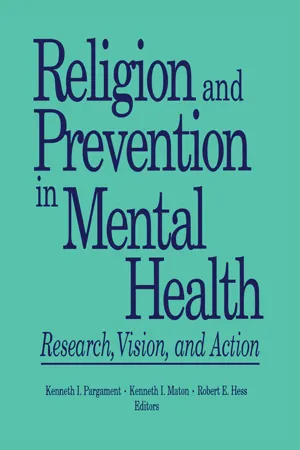
Here is the first book which highlights the unique resource of religion in the field of prevention. Until now, religious systems have been a largely undertapped resource of talent, energy, care, and physical and financial assets. Religion and Prevention in Mental Health is a significant new volume that lays a general foundation for preventive work in the religious area. It presents a number of reasons for examining religion as a source for aiding prevention and well-being. The authors dispute the popular notion of religion as damaging to mental health, as well as the idea that religious affiliation is entirely predictive of better mental health. Instead they focus on the framework for living that religions provide which assists believers in anticipating, avoiding, or modifying problems before they develop. For the human service professional willing to build a collaborative relationship with religious systems, this vital book depicts the richness and diversity of religion and shows the interface of religion, well-being, and prevention. Important issues such as the impact of religion on American society and the ethos of mental health and prevention, the historical and contemporary role of the African-American church as an empowering agent and mediating structure for black citizens, the critical roles of theology in determining the attitude of religious systems toward prevention and well-being, the importance of community and personal narratives, and the limitations of religious settings due to their survival concerns and methods to increase their potential to heal are all discussed thoroughly. Through a better understanding of religious settings, programs, and processes, human service professionals can more effectively utilize religion and reach a neglected portion of the population in need of help. In addition, religious leaders, mental health professionals including counselors, social workers, program developers, evaluators, and administrators, and psychologists, sociologists, and anthropologists will benefit from the comprehensive material provided in this timely book.
eBook - ePub
Religion and Prevention in Mental Health
Research, Vision, and Action
- 346 pages
- English
- ePUB (mobile friendly)
- Available on iOS & Android
eBook - ePub
Religion and Prevention in Mental Health
Research, Vision, and Action
About this book
Information
PART ONE:
RELIGION AS A RESOURCE
FOR PREVENTIVE ACTION:
CONCEPTUAL
AND EMPIRICAL
FOUNDATIONS
Religious Perspectives on Prevention: The Role of Theology
SUMMARY. Both conceptually and in actual practice, the Judeo-Christian heritage has always been involved in the prevention of individual and social problems. Focusing on American Protestant Christianity, two main theological trends, traditional and modernist, are delineated and explored with respect to their positions concerning prevention. Beginning with the premise that theology performs as cultural ideology, and acts to legitimate social, economic, and political power, in the main, traditional theology is shown to support conservative individualistic preventive views and actions. There are notable exceptions to this position, but they have not been culturally influential. In contrast, modernist theology challenges the status quo by adopting a collective social orientation to prevention that stresses the significance of transaction and context on all levels from the situational to the societal. Relative to the development and utilization of prevention ideas and practices, these variant theological positions are likely to find expression in competing political agendas.
In its over 2000 year history, the western religious heritage has always been a party to psychosocial distress and disorder. Paradoxically, religion sometimes supports conditions that exacerbate human misfortune while concurrently working to alleviate suffering (Moberg, 1962; Tawney, 1926). Still, as Maton and Pargament (1987) poignantly note, “Religion represents an important resource for efforts to prevent significant personal and social problems” (p. 161).
This historical record of religious ambivalence attests to the difficulty within Christianity of attaining theological accord regarding social issues and remedial methods. In terms of preventing social problems, the most pertinent theological categories involve human nature, sin and evil, the nature of God, and the means of salvation. These are most relevant to prevention precisely because they directly address such concerns as health and disease, individual and social responsibility, and questions of ultimate meaning.
Though there has been increasing recognition that the problems of men and women often relate to their place in the social order, religious bodies have had great difficulty addressing social issues in collective terms. Historically, Christian churches and their supporting theologies view human problems as products of individual action (sin). The accompanying suffering has been seen as “one's cross to bear” upon the road to salvation. Moral instruction has likewise aimed at inculcating righteousness in the individual. Only recently has such education attempted to broaden personal morality to include the cultural milieu.
Where once Christianity defined a more or less single religious direction for all humanity, in today's world, this focus has become more complex and fragmented. Secularization and the increasing significance of social science has stimulated a wide range of both theological accommodation and resistance to these new religious views. Generally speaking, the contemporary task is one of making choices between individualism and community, and supernaturalism versus naturalism. Broadly defined, the issue is religion in or out of the world. Classical theological doctrines that denote the nature of God, humanity, evil, sin, salvation, sanctification, justification, the Bible, and so forth, have been modified. When these modern tenets are compared with their traditional counterparts, the sociocultural significance of religious institutions and their ideologies is made explicit. Their import for the broad realm of prevention is, of course part of this picture.1
Since theology, for example, has always had much to say about marital relations, it is relevant to the issue of domestic violence. Typically, in such situations, the woman is psychologically victimized and socially ostracized. Preventive measures may be variously understood depending on one's theological perspective. For example, a traditional perspective is likely to adopt an almost exclusively personalistic orientation to this problem. Marital discord is regarded a manifestation of sin, as neither the husband nor wife is living in accordance with God's will. The woman's sin may be defined as failure to submit herself to the divinely ordained role proper for a wife. This is often viewed as the sin of pride. Conversely, the man's sin may be a refusal to properly exercise his authority and husbandly responsibilities as spiritual leader and shepherd of the family.
In contrast, a modernist theological orientation looks at the issue of domestic violence in inclusive terms. Sin now considers the individual, society, and culture. The sociocultural milieu, by perpetuating dualistic standards for men and women, supports the attitude that women are “second class citizens.” This patriarchal outlook implicitly abets male aggression toward females. The modernist perspective therefore indicts individuals and institutions alike. Both are culpable and sinful to the degree they maintain psychosocial support for what is fundamentally “systemic sin” that fosters injustice. In specific, a modernist-feminist viewpoint sees sexism and its cultural backing as “the original sin” (Daly, 1973). Personal sin lies in the victim's refusal to leave the abusive situation as well as in the perpetrator's continued violent acts. Preventive action now includes removal of the victim from the situation, therapeutic intervention for the abuser, and sociocultural correction of sexual inequities.
Previous research (Bridges, 1989) indicates that modernist-traditional theological understandings of male-female relationships, and the presumed roles of each sex to God, are sharply polarized. These differences also relate to variant images of God, human nature, and salvation, leading to contrasting views of what preventive measures should be employed. Workers in this area would then utilize different methods with traditionalists than with modernists.
We are suggesting that the core elements relating religion and prevention emanate from the ideological (theological) bases of the Judeo-Christian tradition. Our focus is upon (1) the dominant historical form of Christianity that prevails in the American milieu, i.e., those views that underscore the American value of “individualism;” and (2) the more modern emphasis of Christianity upon the values of relationship and communal cooperation. We must also recognize that both of these perspectives have been influenced by what Cogley (1968) calls our “secular age.” As Niebuhr (1957) observed “theological opinions have their roots in the relationship of the religious life to the cultural and political conditions prevailing in any group of Christians” (p. 16).
Although this issue goes well beyond the present paper as it concerns the legitimation and transformation of religious themes into sociocultural norms (see below), it does affect our ideas about prevention. For example, Rotenberg's (1978) demonstration of the influence of Calvinist ideas on modern secular conceptions of deviance on both personal and societal levels supports not only abnormal forms of self-blame and possibly depressive and suicidal reactions, but also individualistic punishment-treatment approaches to personal and social disorder.
THEOLOGY IN THE CONTEXT OF WESTERN CULTURE
Theologies function as world-views for many people, and have been subtly integrated into the basic values of society. Thus they make claims not only about God, but also the nature of the cosmos, the natural world, social reality, and humanity. Theology further offers interpretations of personal and social life-situations through metaphysical assumptions that provide “a coherent set of categories for the interpretation of all experience” (Whitehead, 1929, p. 7). These assumptions are often couched in a theological terminology that connects life experience to an “ultimate reality.” As Novak (1968) observed:
… the astute reader of theological discourse will soon discover that every sentence in such discourse, however, obliquely, refers to human actions, or dispositions, or programs…. The “Kingdom of God” … has an other worldly, apocalyptic concomitant; yet in its own right, it is a concrete this-worldly ideal. Theology studies ultimate visions of communal relationships and personal identity, insofar as these affect actual human experience, (p. 52)
Theology as legitimation. In previous work, the authors suggested that “theologies … represent ideas which become legitimated by being religiously attached and interpreted so that they influence the world-views of large groups of people” (Bridges & Spilka, 1988, p. 2). The term “legitimation” is used by Berger (1967) to denote “socially objectivated ‘knowledge’ that serves to explain and justify the social order” (p. 29). Basically, legitimations define realities. Berger and Luckmann (1967) further assert that “legitimations explain the institutional order by ascribing cognitive validity to its meanings … and justif(y) the order by giving normative dignity to its practical imperatives” (p. 93). Finally, Berger (1967) notes religion “has been historically the most widespread and effective instrumentality of legitimation” (p. 32). This “instrumentality” is initially formed in the theologies that both justify the spiritual order and its sociocultural context by giving the latter divine (ontological) status. Among other emphases, some of these theologies are highly individualistic, others social. With regard to prevention, the personal or collective implications of various programs may determine whether religionists and churches offer a particular program support or criticism.
THE NATURE AND CONTENT OF THEOLOGY
Even though theology has been defined as “an undistorted hearing of God's word with a view to salvation” (Rahner & Vorgrimler, 1965, p. 456), historically and contemporaneously, the message has not been clear. There are not only theologies for every religious group that has ever been formed, but within such bodies, agreement comes hard. All we can say is that theologians have attempted to apply scripture and theology to every aspect of life, and in the process, as already noted, theologies have become “world views” for many people. These are basically interpretations of scripture, the religious writings of past thinkers, and current experience.
To illustrate the kind of problem that has implications for prevention, we may examine that most central issue in theology, the religious path to salvation. This has been a major source of conflict in religious quarters. Conservatives of a Calvinist bent argue that the “attempt to reform individuals, primarily by improving their income and living conditions ignores Christ's method of bettering society by remaking individuals” (Berkhof quoted in Smith, 1985, p. 145). This choice continues the classical tradition of effecting social change by inculcating morality (righteousness) in the individual. In contrast, religious modernists locate the sin in the individual and the social order. To illustrate, the traditionalist would support self-monitoring by an industry in order to maintain ethical standards; the modernist would sponsor legislation to punish wrong-doers while attempting to strengthen individual moral codes. Theologically, the issue is whether each person pursues salvation as a single, separate entity in prime relationship to God, or gains salvation through a “consciousness that human existence … is the process by which men and women make themselves by making their own cultures and societies” (Ogden, 1979, p. 12). This latter view sponsors community action, whether it be political, economic, or social.
This individual-social dichotomy is further exacerbated by the difficulties of transformations that have taken place in theological concepts over time. If scripture is to be the ultimate reference, the issue becomes which scripture and for what purpose is it to be used. For example, Schoenfeld (1989) points out the significance of justice in the Old Testament, and its replacement by love (agape) in the New Testament. Of import to the social role of prevention, he notes the association of justice with power, and observes that
… an emphasis on agape and minimization of justice has important consequences for political views supported by the Christian church. The most important ones are a conservative political orientation coupled with an opposition to social change. It is for this reason that liberal theologians are seeking to give new meaning to the New Testament's ideal of love so that it can be used in their quest for social justice, (p. 243)
In other words, emphasizing love constitutes a politically conservative agenda that takes religion out of the cultural sphere, and places responsibility fully on the individual.
We have been speaking of Christian theology rather broadly, when each of the 200 plus Christian religious organizations in the United States claims uniqueness, though their theologies greatly overlap. Moving to a level above the many specific points that distinguish among these groups, a manageable number of theological perspectives may be abstracted. These are usually identified as fundamentalist, pentecostal, evangelical, process, feminist, and liberation. Theoretical distinctions among these empirically reduce to two broad patterns (Bridges, 1989). Basically, these may be denoted as traditional and modernist. The former includes the first three forms noted above, while the latter contains the last three ideologies. In brief, traditional theology emphasizes Scripture as the revealed “truth” about the world, regardless of the teachings of modern secular knowledge. It seeks to maintain pre-modern views of (1...
Table of contents
- Cover
- Half Title
- Title Page
- Copyright Page
- Table of Contents
- About the Editors
- Religion as a Resource for Preventive Action: An Introduction
- Part One: Religion as a Resource for Preventive Action: Conceptual and Empirical Foundations
- Part Two: Religion as a Resource for Preventive Action: Toward the Promised Land
Trusted by 375,005 students
Access to over 1.5 million titles for a fair monthly price.
Study more efficiently using our study tools.
Frequently asked questions
Yes, you can cancel anytime from the Subscription tab in your account settings on the Perlego website. Your subscription will stay active until the end of your current billing period. Learn how to cancel your subscription
No, books cannot be downloaded as external files, such as PDFs, for use outside of Perlego. However, you can download books within the Perlego app for offline reading on mobile or tablet. Learn how to download books offline
Perlego offers two plans: Essential and Complete
- Essential is ideal for learners and professionals who enjoy exploring a wide range of subjects. Access the Essential Library with 800,000+ trusted titles and best-sellers across business, personal growth, and the humanities. Includes unlimited reading time and Standard Read Aloud voice.
- Complete: Perfect for advanced learners and researchers needing full, unrestricted access. Unlock 1.5M+ books across hundreds of subjects, including academic and specialized titles. The Complete Plan also includes advanced features like Premium Read Aloud and Research Assistant.
We are an online textbook subscription service, where you can get access to an entire online library for less than the price of a single book per month. With over 1.5 million books across 990+ topics, we’ve got you covered! Learn about our mission
Look out for the read-aloud symbol on your next book to see if you can listen to it. The read-aloud tool reads text aloud for you, highlighting the text as it is being read. You can pause it, speed it up and slow it down. Learn more about Read Aloud
Yes! You can use the Perlego app on both iOS and Android devices to read anytime, anywhere — even offline. Perfect for commutes or when you’re on the go.
Please note we cannot support devices running on iOS 13 and Android 7 or earlier. Learn more about using the app
Please note we cannot support devices running on iOS 13 and Android 7 or earlier. Learn more about using the app
Yes, you can access Religion and Prevention in Mental Health by Robert E Hess,Kenneth I Maton,Kenneth Pargament in PDF and/or ePUB format, as well as other popular books in Psychology & History & Theory in Psychology. We have over 1.5 million books available in our catalogue for you to explore.