A widely acclaimed trilogy that has become established as the leading work in this field. As well as taking account of current Building Regulations, Codes of Practice and recent technological advances. Special attention has been paid to the reduction of fuel costs and environmental factors.
This volume covers the essential design calculations for pipe-sizing, drainage, electrical installations, thermal problems, ventillation and air conditioning, gas installations, lighting and solar heating.
Speed is defined as the rate of change of distance moved with time. Velocity is defined as the rate of change of distance moved with time in a specified direction. Speed is a scalar quantity whereas velocity is a vector.
When travelling by car it is speed that can be read on the speedometer because the direction is unimportant. A speed of 50 km/h is known as a scalar quantity while a velocity of 50 km/h due south is a vector. Velocity can therefore be represented by a straight line drawn to scale in a given direction.
Average speed
Unless travelling on a motorway, a motorist cannot usually maintain a constant speed for any length of time. When deciding the time to allow for a particular journey, the motorist must have some idea of the average speed at which it is possible to travel.
Example 1.1. Find the average speed during a journey of 276 km which takes 6 hours.
Uniform velocity
A body is said to move with uniform velocity if its rate of change of distance with time in a specified direction is constant.
In services the distance and time are expressed in metres and seconds respectively.
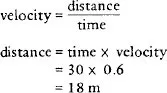
Example 1.2. A travelator (moving pavement) moves at a velocity of 0.6 m/s. Calculate the distance a person would move on the travelator in 30 seconds.
Acceleration
Acceleration is a natural progression from velocity, and is defined as the rate of change of velocity with time.
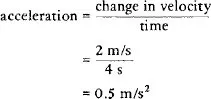
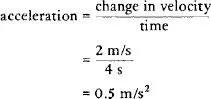
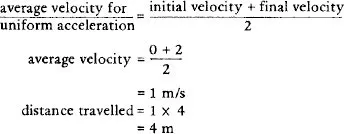
Example 1.3. A lift car accelerates uniformly from rest to 2 m/s in 4 seconds. Calculate the acceleration and the distance travelled by the car.
In order to calculate the distance travelled by the car, the average velocity is required.
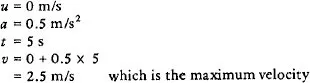
Example 1.4. A lift car starts from rest and is accelerated uniformly at the rate of 0.5 m/s2 for 5 s. It then maintains a constant velocity for 10 s. The car is then uniformly retarded at the rate of 0.5 m/s2 for 5 s. Find the maximum velocity of the car and the total distance it travels.
Method 1. By calculation
u = initial velocity in m/s
a = acceleration in m/s2
v = final or maximum velocity in m/s
t = time for which acceleration continues in seconds
s = distance travelled in m
To find the maximum velocity
First stage. Distance travelled is the average velocity m/s multiplied by time in seconds.
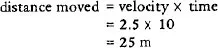
Second stage.
Third stage. The distance travelled in the third stage will be the same as that in the first stage.
Method 2. Graphical solution
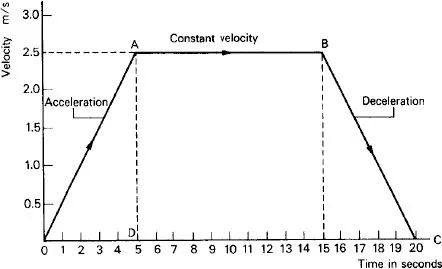
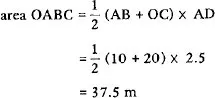
Draw the velocity-time graph (Fig. 1.1).
Fig.1.1 Velocity-time graph for a lift car
The area under the graph gives the distance travelled by the car.
Gravitational acceleration
A well-known rate of acceleration is that due to gravity. If a body is falling freely near to the surface of the earth it has an acceleration due to gravity of 9.81 m/s2, which is applicable to most geographical locations.
The velocity of a falling body does no...
Table of contents
Cover
Half Title
Title Page
Copyright Page
Table of Contents
Preface
Acknowledgements
Chapter 1 Speed, velocity and acceleration
Chapter 2 Force and pressure
Chapter 3 Hydraulics
Chapter 4 Flow in drains and open channels, sewage disposal
Chapter 5 Rainwater pipes and gutters, flow over weirs
Chapter 6 Electrical and gas installations
Chapter 7 Heating
Chapter 8 Temperature drop through structures, condensation
Chapter 9 Pipe sizing for heating, pump duty
Chapter 10 Ventilating ducts and fans
Chapter 11 Heat gains, solar heating
Chapter 12 The heat pump, degree days
Chapter 13 Cold- and hot-water storage, expansion of materials, Boyle’s and Charles’ laws
Chapter 14 Passenger lifts, electric lighting
Appendix SI units (International System of units)
Index
Trusted by 375,005 students
Access to over 1.5 million titles for a fair monthly price.
Study more efficiently using our study tools.
Frequently asked questions
Yes, you can cancel anytime from the Subscription tab in your account settings on the Perlego website. Your subscription will stay active until the end of your current billing period. Learn how to cancel your subscription
No, books cannot be downloaded as external files, such as PDFs, for use outside of Perlego. However, you can download books within the Perlego app for offline reading on mobile or tablet. Learn how to download books offline
Perlego offers two plans: Essential and Complete
Essential is ideal for learners and professionals who enjoy exploring a wide range of subjects. Access the Essential Library with 800,000+ trusted titles and best-sellers across business, personal growth, and the humanities. Includes unlimited reading time and Standard Read Aloud voice.
Complete: Perfect for advanced learners and researchers needing full, unrestricted access. Unlock 1.5M+ books across hundreds of subjects, including academic and specialized titles. The Complete Plan also includes advanced features like Premium Read Aloud and Research Assistant.
Both plans are available with monthly, semester, or annual billing cycles.
We are an online textbook subscription service, where you can get access to an entire online library for less than the price of a single book per month. With over 1.5 million books across 990+ topics, we’ve got you covered! Learn about our mission
Look out for the read-aloud symbol on your next book to see if you can listen to it. The read-aloud tool reads text aloud for you, highlighting the text as it is being read. You can pause it, speed it up and slow it down. Learn more about Read Aloud
Yes! You can use the Perlego app on both iOS and Android devices to read anytime, anywhere — even offline. Perfect for commutes or when you’re on the go. Please note we cannot support devices running on iOS 13 and Android 7 or earlier. Learn more about using the app
Yes, you can access Building Services and Equipment by F. Hall in PDF and/or ePUB format, as well as other popular books in Technology & Engineering & Construction & Architectural Engineering. We have over 1.5 million books available in our catalogue for you to explore.