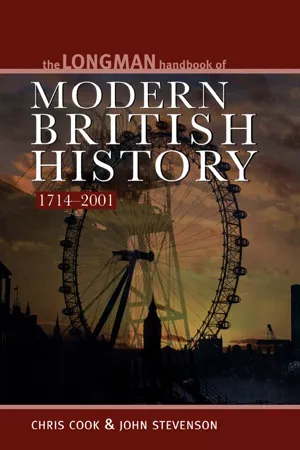
This compact and accessible reference work provides all the essential facts and figures about major aspects of modern British history from the death of Queen Anne to the end of the 1990s. The Longman Handbook of Modern British History has been extended to include a fully-revised bibliography (reflecting the wealth of newly published material in recent years), the new statistics on social and economic history and an expanded glossary of terms. The political chronologies have been revised to include the electoral defeat of John Major and the record of New Labour in office. Designed for the student and general reader, this highly-successful handbook provides a wealth of varied data within the confines of a single volume.
- 520 pages
- English
- ePUB (mobile friendly)
- Available on iOS & Android
eBook - ePub
Longman Handbook to Modern British History 1714 - 2001
Section One
POLITICAL HISTORY
POLITICAL CHRONOLOGY
Note: (i) In order to reflect the more personal character of politics and the less organized nature of parties in the eighteenth and the first half of the nineteenth centuries, governments up to 1868 are given the name of their principal minister or ministers. After 1868 governments are designated by their party label, (ii) In the eighteenth century leaders of administrations usually held the post of First Lord of the Treasury or one of the secretaryships of state, no formal office of Prime Minister existing. From the early nineteenth century this term came into more common usage and has been adopted from the 1820s for the description of leaders of administrations.
1714
May Schism Act passed. No person allowed to keep a school unless a member of the Anglican Church.
July Henry St John (Bolingbroke) secures dismissal of the Earl of Oxford and begins attempt to pack administration with Jacobite sympathizers. Severe illness of Queen Anne forces calling of Privy Council. Pro-Hanoverian Duke of Shrewsbury appointed Lord Treasurer in place of Oxford (30th).
Aug. Death of Queen Anne (1st); George I proclaimed King in London and leading cities. Bolingbroke dismissed from office.
Sept. George I arrives in England (18th). Whig administration formed under Lord Stanhope. Principal figures: Lord Stanhope (Secretary of State); Lord Halifax (First Lord of the Treasury); Lord Townshend (Secretary of State); Earl of Nottingham (Lord President of the Council); Lord Sunderland (Lord Lieutenant of Ireland).
1715
Mar. Meeting of first parliament of George I with large Whig majority.
June Bolingbroke, Ormonde and Oxford impeached. Flight of Bolingbroke and Ormonde; Oxford committed to the Tower. Widespread rioting followed by Riot Act strengthening power of magistrates by making many riots a capital offence.
Sept. Jacobite rising in Scotland under the Earl of Mar.
Dec. Pretender (James III) arrives in Scotland.
1716
Feb. Pretender flees Scotland after failure of England to rise in support. Impeachment of Jacobite leaders; execution of Derwentwater and Kenmure.
May Septennial Act extends maximum duration of parliaments to seven years.
1717
Jan. Triple Alliance formed between England, France and Holland to uphold the Treaty of Utrecht.
Feb. Convocation of the Church of England ceases to meet regularly.
Apr. Walpole and Townshend resign from administration.
1718
Aug. Quadruple Alliance formed between England, France, the Emperor and Holland.
Dec. War between England and Spain. Repeal of the Occasional Conformity Act and the Schism Act.
1719
Dec. Defeat of administration’s Peerage Bill in House of Commons.
1720
Jan. Spain joins Quadruple Alliance, ending hostilities with England.
Feb. South Sea Company’s scheme for taking over part of the National Debt in return for exclusive trade in the South Seas accepted by the House of Commons.
June South Sea stock reaches record level.
Aug. South Sea stock falls rapidly in value.
Dec. Walpole begins restoration of public credit. Secret Committee appointed to investigate affairs of South Sea Company. Directors of company expelled from the House of Commons; Chancellor of the Exchequer (Aislabie) sent to the Tower.
1721
Feb. Lord Townshend becomes Secretary of State in place of Stanhope.
Apr. Walpole administration formed. Principal figures: Robert Walpole (First Lord of the Treasury); Lord Townshend (Secretary of State); Carteret (Secretary of State).
1722
Apr. Death of Sunderland, Walpole’s chief rival.
May Atterbury Plot by Jacobites discovered. Leading Jacobite sympathizers arrested.
Oct. Meeting of Parliament (9th). Habeas Corpus suspended; penal taxes levied on Catholics and non-jurors. Francis Atterbury (Bishop of Rochester) banished.
1724
Apr. Carteret becomes Lord Lieutenant of Ireland, Duke of Newcastle becomes Secretary of State and Henry Pelham Secretary at War.
1725
Apr. City Elections Act, regulating conduct of elections in London and increasing power of Court of Aldermen, passed by Walpole in spite of strong protests in the capital.
Sept. Treaty of Hanover between England, France and Prussia. Bolingbroke pardoned and ret...
Table of contents
- Cover Page
- Half Title page
- Series page
- Title Page
- Copyright Page
- Contents
- Preface
- Acknowledgements
- List of abbreviations used in sources
- Section One: Political history
- Section Two: Social and religious history
- Section Three: Economic history
- Section Four: Foreign affairs and defence
- Section Five: Biographies
- Section Six: Glossary of terms
- Section Seven: Topic bibliography
- Index
Trusted by 375,005 students
Access to over 1.5 million titles for a fair monthly price.
Study more efficiently using our study tools.
Frequently asked questions
Yes, you can cancel anytime from the Subscription tab in your account settings on the Perlego website. Your subscription will stay active until the end of your current billing period. Learn how to cancel your subscription
No, books cannot be downloaded as external files, such as PDFs, for use outside of Perlego. However, you can download books within the Perlego app for offline reading on mobile or tablet. Learn how to download books offline
Perlego offers two plans: Essential and Complete
- Essential is ideal for learners and professionals who enjoy exploring a wide range of subjects. Access the Essential Library with 800,000+ trusted titles and best-sellers across business, personal growth, and the humanities. Includes unlimited reading time and Standard Read Aloud voice.
- Complete: Perfect for advanced learners and researchers needing full, unrestricted access. Unlock 1.5M+ books across hundreds of subjects, including academic and specialized titles. The Complete Plan also includes advanced features like Premium Read Aloud and Research Assistant.
We are an online textbook subscription service, where you can get access to an entire online library for less than the price of a single book per month. With over 1.5 million books across 990+ topics, we’ve got you covered! Learn about our mission
Look out for the read-aloud symbol on your next book to see if you can listen to it. The read-aloud tool reads text aloud for you, highlighting the text as it is being read. You can pause it, speed it up and slow it down. Learn more about Read Aloud
Yes! You can use the Perlego app on both iOS and Android devices to read anytime, anywhere — even offline. Perfect for commutes or when you’re on the go.
Please note we cannot support devices running on iOS 13 and Android 7 or earlier. Learn more about using the app
Please note we cannot support devices running on iOS 13 and Android 7 or earlier. Learn more about using the app
Yes, you can access Longman Handbook to Modern British History 1714 - 2001 by Chris Cook,John Stevenson in PDF and/or ePUB format, as well as other popular books in History & British History. We have over 1.5 million books available in our catalogue for you to explore.