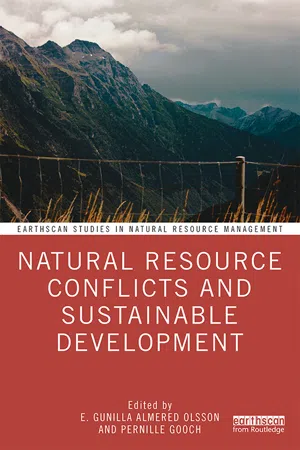
Providing both a theoretical background and practical examples of natural resource conflict, this volume explores the pressures on natural resources leading to scarcity and conflict.
It is shown that the causes and driving forces behind natural resource conflicts are diverse, complex and often interlinked, including global economic growth, exploding consumption, poor governance, poverty, unequal access to resources and power. The different interpretations of nature-culture and the role of humans in the ecosystem are often at the centre of the conflict. Natural resource conflicts range from armed conflicts to conflicts of interest between stakeholders in the North as well as in the South. The varying driving forces behind such disputes at different levels and scales are critically analysed, and approaches to facilitate and enforce mediation, transformation and collaboration at these levels and scales are presented and discussed. In order to transform existing resource conflicts, as well as to decrease the risk of future conflicts, approaches that enhance and enforce collaboration for sustainable development at global, regional, national and local levels are reviewed, and sustainable pathways suggested. A range of global examples is presented including water resources, fisheries, forests, human–wildlife conflicts, urban environments and the consequences of climate change.
It will be a valuable text for advanced students of natural resource management, environment and development studies and peace and conflict management. The book will also be of interest to practitioners in the field of natural resource management.
eBook - ePub
Natural Resource Conflicts and Sustainable Development
- 228 pages
- English
- ePUB (mobile friendly)
- Available on iOS & Android
eBook - ePub
Natural Resource Conflicts and Sustainable Development
About this book
Information
1 The sustainability paradox and the conflicts on the use of natural resources
The conflicts on the use of natural resources steadily bring us new facets. Now, in December 2018, the world is looking towards Katowice and the ongoing climate negotiations for a possible new global agreement on measures to stop the increasing climate change. In the search for replacement of fossil energy sources there is a global surge for batteries producing electrical energy for driving all types of vehicles and also aircrafts in the near future. However, there is a challenge – the batteries demand components containing rare and precious metals like lithium and vanadium. This has led to an exponential increase of the number of exploration activities for vanadium in Sweden and intensified mining, for example, the huge lithium mines in Bolivia and Chile. Those activities have led to profound conflicts at the local level and massive protests against devastation of ecosystems, rural landscapes and local livelihoods for peoples. At the same time the mining operations are defended by governments as promoting green energy, climate smart solutions and offering employment opportunities. The battle on mining concessions in the arctic environments in Northern Sweden was recently complemented by a similar conflict on natural resources, the exploration for mining of vanadium, in the core of Scandinavian cultural landscapes, Österlen in South Sweden. The legacy of European colonialism in withdrawing natural resources from Africa is seen in the ongoing violent conflicts on minerals and oil in many locations, devastating human livelihoods, not least in Congo, and reported on in many publications, for example Eichstaedt (2011) and in other media. The mineral extraction is intensified and also driven by the exploding computer and cellphone business. This gives a thought-provoking background for discussion of the current interpretations of sustainability.
A possible narrative of our current planetary situation could be that the sustainability transitions that are part of the overarching global policy goal are influencing all activities in our societies. It would be logical since such development was formulated and agreed upon by more than 175 countries already in 1992 at the Earth Summit in Rio de Janeiro (UNCED, 1992). This aspiration was later reaffirmed as an overriding goal in The 2030 Agenda for Sustainable Development, adopted by all United Nations member states in 2015 (UN, 2015). At its heart are the 17 Sustainable Development Goals (SDGs), which are an urgent call for action by all countries – developed and developing – in a global partnership. Unfortunately the global reality is very different. The majority of activities in human societies are not only significantly non-sustainable but often outright destructive for maintenance of the ecosystem functions and thus threatening for human survival. The reality is further, that the destructive activities that have already led to trespassing some of the ‘planetary boundaries’ (Steffen et al., 2015), are executed by a minority of the human population while the majority make relatively small environmental imprints – simply because they are poor. This is related to the unequal access to resources as well as the unequal burden of the environmental consequences of the extraction and processing of the natural resources (Anguelovski and Martinez-Alier, 2014). The significant inequality in human access to resources is one side of the sustainability paradox.
The sustainability concept is highly normative as well as greatly contested, and thus opens for a number of different interpretations and even different discourses (Hugé et al., 2013). The triangular depiction of sustainable development with environmental, social and economic dimensions has prevailed for a long time and has its origin in the Brundtland declaration in 1987 (WCED, 1987). An interesting demarcation in the sustainability debate is between the weak and strong interpretations of sustainability, where weak sustainability is linked to the view that natural and biological resources can be substituted by technological products and manufactured assets. In contrast, the interpretation of strong sustainability implies non-interchangeability of natural resources based on non-substitutable ecosystem processes and functions (Neumayer, 2003). An example of irreversible processes is the extinction of biological species and the linked ecosystem services. This is exactly what is seen in the conflicts of mining for battery minerals defended in the spirit of weak sustainability, that the technological innovations will compensate the pollution and loss of waterways, ecosystems and biodiversity.
The sustainability paradox has another side. It is an increasing insight that the economic growth based on continuous extraction of non-renewable resources is entirely incompatible with sustainable development in the strong sense, and the idea of continuous economic growth as a motor for a good life in human societies is faulty. More accurately it is seen as the root of the environmental and socio-economic crisis (Gomez-Baggethun and Naredo, 2015). ‘Business as usual’ is no longer an option – and this understanding is stimulating the development of interesting and enthralling alternatives to the current economic growth model based on consumption of natural resources. Such alternatives are emerging in several contexts, often with a basis in community and grass-root actions and networks, for example, sharing economies and cooperatives, and formulated in circular economy and degrowth economy (Jackson, 2009; D’Alisa et al., 2015). It has also become evident that environmental and social sustainability and the equity dimension can no longer be separated. This was implicit already in the Brundtland declaration – ‘intergenerational equity’ – although most often overlooked at the praise of undisturbed economic growth. Admitting irreversibility of depletion of natural resources should lead us to implementing a precautionary principle – logically following from the intergenerational equity dimension in the sustainability discourse (Summers and Smith, 2014). Alternatives to the economic growth paradigm have been compellingly outlined by Kate Raworth in the Doughnut Economics concept where the environmental planetary boundaries are combined with socio-economic dimensions as a ‘social foundation’ for activities at all scales in the global social-ecological system (Raworth, 2017).
In conventional conflict theory (Lederach, 2015), conflicts are seen as a prerequisite for development to another state, better fitting the current setting. Numerous conflicts on access and use of natural resources are shaping livelihoods and life for most humans on the planet. An example: for some peoples in the well-off part of humanity there might be a small conflict in use of economic resources for private consumption in convenient everyday life or buying a cheap weekend trip by air to some metropolitan city for shopping, while for others this action is adding drivers to the ongoing climate warming implying drought problems for mountain farmers, failed harvests and jeopardized food security.
Another scenario is possible – conflicts can be seen as opportunities for change as they open up a range of new options and demand innovations for transitions to sustainable alternatives. The ongoing environmental conflict on climate change, a conflict of lifestyle and overconsumption by the few, a conflict on where the different dimensions of equity, in space and over time, intergenerational equity, are at the conflict centre, could be our great opportunity to enter the transition towards a sustainable future. For the climate change discourse and conflict the accumulated knowledge and data is vast and we would like to agree with Duncan and Bailey (2017): ‘we need a little less conversation, a little more action’.
Many of the conflicts presented in this book have at the core a dimension of equity, in space and over time, and are directly linked to issues of participation and inclusiveness in decision making. In effect, many of the cases are examples of ‘ecological distribution conflicts’ (Scheidel et al., 2018) that illuminate the conflicting values put on environmental resources and the conflicts could, in a socio-political context, be used as forces for sustainability transitions.
The span of this book is global with case studies from both Global North and South. The themes elaborated and discussed are exemplified in the case studies and have the ambition to represent the major environmental conflicts – although far from exhaustive. The overriding theme of this book, ‘Natural Resource Conflicts and Sustainable Development’, can be sub-divided into three themes.
Theme one – human-environment relationship
Our basic epistemological position is that humans are part of the ecosystem, of ‘Nature’. People have been part of, lived from and affected the ecosystem, in parallel to other animals, along an evolutionary time scale since we became Homo sapiens, some 300,000 years ago (Schlebusch et al., 2017). We have acquired knowledge from the use of the local ecosystem and its different components with a sustainability aspect which is a prerequisite for persisting use. We have learnt how to cope with ongoing changes in the ecosystem, for example floods and dry periods. Values and qualities for human well-being are linked to humans as parts of the ecosystem and it is pointless to separate humans from the global ecosystem since we are addressing our time on the planet. The demarcation between ‘Nature’ and ‘Culture’ becomes very indistinct and obscure, in fact not possible to identify since nature-culture is shifting in different environments and is pronouncedly context dependent. Opposed to this view is the interpretation that humans are external to the ecosystem and that humans have a right to exploit the natural resources in the ecosystems. This view, even formulated as an exploitation imperative for humans, for instance in the Old Testament, bears implicit the idea that the exploitation of natural resources is an engine to the prosperity of human development, and is rooted in the Newtonian world view (Merchant, 1980). A third view of the human–environment relationship is also taking the stance of humans outside of and external to the ‘natural’ ecosystem by applying a conservationist world view. This implies that the ‘natural’ ecosystem and its components are valued higher in the absence of humans. This latter world view is reflected in the numerous conservation areas, nature reserves etc., where humans have been evicted. Often the expected positive effects on biodiversity have turned out to be negative since the historical influence of human use and shaping impact on biodiversity has been neglected, both in tropical and alpine environments (Gómez-Pompa and Kaus, 1992; Olsson et al., 2004; Olsson, 2018).
The human–environment relationship and the development of voluntary self-governance instruments among Swedish fishermen and the intriguing background to the current fishery management debate in Sweden is presented in Chapter 5 (Larsson). The conflicts related to different world views and the human–nature relationships become evident and are well illustrated in several chapters. The study of reintroduction of a large raptor bird, in the grazing lands for domestic livestock in the agricultural landscapes in Ireland (Chapter 6, O’Rourke), elucidates the rift in the stakeholder’s interpretation of the landscape and ecosystem, in essence the different views on nature-culture. The conflict is analysed in depth and possible conflict transformation is discussed. Some conflict traits from the Irish countryside are shared with the case study from the forested slopes of Indian Himalaya (Chapter 7, Gooch, P.). This chapter delivers a unique and personal account from the pastoralist Van Gujjars ethnic community based on periods of field work stretched over three decades. The author has been able to follow the development of an old conflict on the use rights to the forest, which is also a conflict between living in a traditional community in the forest ecosystem, shaping biodiversity, versus aiming for a forest ecosystem without people, that disables traditional resource use. The Indian conflict leads the way to the resource use conflict in Northern Sweden with the Sami reindeer herders and Adnyamathanha community in Australia in the struggle for maintaining crucial livelihood landscapes reported on in Chapter 8 (Sehlin MacNeil).
Theme two – justice and equity dimensions
The current actuality and importance of Carolyn Merchant’s book from 1980, The Death of Nature (Merchant, 1980), was referred to by Mitman (2006), writing: ‘Political struggles for the environment could not be decoupled from the struggles for economic and social justice. Ecological relationships between humans and the natural world were integral to the social relations of society’. This becomes completely clear in the chapters in this book where the recurring element in those reports is the lack of local influence and participation. Often, the resource extraction activity is enforced on local communities with the argumentation of bringing prosperity, human well-being and facilitating sustainable development. This is cynical since the development for local peoples too often takes an opposite trajectory – towards fragmentation of livelihoods and disruption of local communities and households resulting in socio-economic alienation and poverty and enforces an urbanisation trend.
The issues of land tenure, land use rights, use of commons, customary rights, privatisation of the commons, etc., are related to access and availability of natural resources – as sources for conflicts. Examples are drawn from different ecosystems with different resources such as extraction of minerals, use of forests, rangelands, mountains, water as water resource solely, or aquatic ecosystems with related resources and biological diversity including fish and seafood resources, and more. Justice and Equity dimensions are in fact relevant to all cases in this book. This holds for the chapter on water as a human right addressing power, inequalities related to water access and social sustainability (Chapter 3, Hellberg), and conflicts related to forest land tenure, legal property rights, power and state versus local communities (Chapter 4, Gooch, J.). The theme is evident in the texts on Van Gujjars pastoralists in India (Chapter 7, Gooch, P). The text on land use rights in forested landscapes in post-war Columbia has interesting repercussions for environmental justice (Chapter 9, Krause). This theme is outspoken in the chapter on land use in Sapmi and A...
Table of contents
- Cover
- Half Title
- Series Page
- Title Page
- Copyright Page
- Table of Contents
- List of illustrations
- List of contributors
- Preface and acknowledgements
- 1. The sustainability paradox and the conflicts on the use of natural resources
- PART I: Overview of natural resource use conflicts in relation to sustainable development
- 2. Natural resource conflicts in the Capitalocene
- 3. Water, conflict and social sustainability: Bringing power into the water security discourse
- 4. Forest-related community–outsider conflicts through the lens of property rights, access and power
- 5. Conflicts in the management of fisheries: The change in roles and perception of the Swedish fishing industry
- PART II: Case Studies
- 6. The raptor and the lamb: Reintroduction of carnivores in agricultural landscapes in Ireland
- 7. From dystopia to utopia – and back again: The case of the Van Gujjar forest pastoralists in the Indian Himalayas
- 8. Undermining the resource ground: Extractive violence on Laevas and Adnyamathanha land
- 9. Forest governance in post-agreement Colombia
- 10. To change, or not to change? The transboundary water question in the Nile Basin
- PART III: Transforming natural resource conflicts
- 11. Benefit sharing for project risk–conflict reduction and fostering sustainable development: Current understanding and mechanisms
- 12. Power and knowledge use in coastal conflict resolution
- 13. Environmental conflicts: Towards theoretical analyses of social-ecological systems
- 14. The transformative potential of the food system concept: Sustainability conflicts or sustainability transitions?
Trusted by 375,005 students
Access to over 1.5 million titles for a fair monthly price.
Study more efficiently using our study tools.
Frequently asked questions
Yes, you can cancel anytime from the Subscription tab in your account settings on the Perlego website. Your subscription will stay active until the end of your current billing period. Learn how to cancel your subscription
No, books cannot be downloaded as external files, such as PDFs, for use outside of Perlego. However, you can download books within the Perlego app for offline reading on mobile or tablet. Learn how to download books offline
Perlego offers two plans: Essential and Complete
- Essential is ideal for learners and professionals who enjoy exploring a wide range of subjects. Access the Essential Library with 800,000+ trusted titles and best-sellers across business, personal growth, and the humanities. Includes unlimited reading time and Standard Read Aloud voice.
- Complete: Perfect for advanced learners and researchers needing full, unrestricted access. Unlock 1.5M+ books across hundreds of subjects, including academic and specialized titles. The Complete Plan also includes advanced features like Premium Read Aloud and Research Assistant.
We are an online textbook subscription service, where you can get access to an entire online library for less than the price of a single book per month. With over 1.5 million books across 990+ topics, we’ve got you covered! Learn about our mission
Look out for the read-aloud symbol on your next book to see if you can listen to it. The read-aloud tool reads text aloud for you, highlighting the text as it is being read. You can pause it, speed it up and slow it down. Learn more about Read Aloud
Yes! You can use the Perlego app on both iOS and Android devices to read anytime, anywhere — even offline. Perfect for commutes or when you’re on the go.
Please note we cannot support devices running on iOS 13 and Android 7 or earlier. Learn more about using the app
Please note we cannot support devices running on iOS 13 and Android 7 or earlier. Learn more about using the app
Yes, you can access Natural Resource Conflicts and Sustainable Development by E. Gunilla Almered Olsson,Pernille Gooch in PDF and/or ePUB format, as well as other popular books in Biological Sciences & Ecology. We have over 1.5 million books available in our catalogue for you to explore.