- 173 pages
- English
- ePUB (mobile friendly)
- Available on iOS & Android
eBook - ePub
About this book
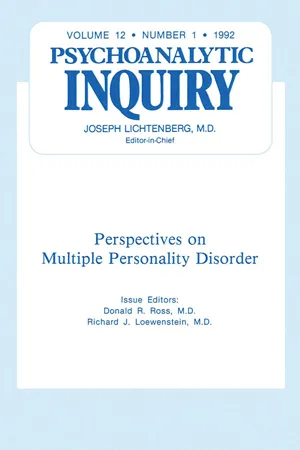
First published in 1992. The Volume 12, number 1 1992 of Psychoanalytic Inquiry offer viewpoints in a collection of articles on Multiple Personality Disorder which evolved from a symposium on 21st April 1990.
Information
Multiple Personality and Psychoanalysis: An Introduction
OVER THE LAST DECADE, MULTIPLE PERSONALITY DISORDER (MPD) and dissociation have become areas of increasing interest in psychiatry. Once thought to be extremely rare, recent epidemiological studies suggest that up to 10 percent of the general population may suffer from a dissociative disorder including one to three percent with MPD (Ross, 1991). Reports are increasingly common in the scientific literature describing the clinical features and/or therapeutic results with large series of MPD patients (Putnam, 1989, 1991a; Ross, 1989). The Seventh Annual Meeting on Multiple Personality and Dissociative States held in Chicago in November 1990, drew over 700 participants. Currently, there are about a dozen psychiatric hospitals with specialty programs that treat patients with dissociative disorders. The International Society for the Study of Multiple Personality and Dissociation (ISSMP&D) currently has over 2100 members. Dissociation, a journal devoted to the study of dissociation and MPD, is now in its fourth year of publication.
Despite this dramatic increase in clinical interest, diagnosed cases, and research on MPD, a large number of clinicians, including many psychoanalysts, remain skeptical about the disorder. There are a number of reasons for this. First, despite the lack of systematic studies or clinical reports to support the position, there is a long tradition in psychiatry that links the origins of MPD to suggestibility and self-delusion, not to a bona fide mental disorder (Fahy, 1988; Dissociation Symposium, 1989; Putnam, 1991a). Also, it may be difficult for clinicians without first-hand experience with these patients to separate the scientific study of MPD, much of which has not reached a wide audience, from the shameless, sensational exploitation of MPD patients in the media or from highly publicized forensic cases in which dissociation or MPD is claimed as a defense. Similarly, sober clinicians may be dismayed at the fascination and overinvolvement that MPD patients typically generate in the neophyte clinicians. Finally, to experienced psychiatrists and psychoanalysts who are certain that they have never seen a case during their many years of practice, the idea that these disorders are quite prevalent may seem unbelievable.
What exactly is MPD? How can it be that a condition once considered rare to the point of vanishing now is thought by some to be at least as prevalent as schizophrenia? Additionally, how is it possible that many solid, careful clinicians claim to see many MPD cases while others insist that the disorder rarely occurs (Dell, 1988)?
Loewenstein (1988, and in press), has suggested that a conceptual model borrowed from Kuhn (1970) can be helpful in understanding these issues. Kuhn posits that scientific endeavors progress through the development of organizing “paradigms” that shape the work of those in a field of scientific study. Kuhn argues that science does not advance solely by a slow, steady accretion of new knowledge. Rather, he proposes that fundamental changes in scientific thought occur through “scientific revolutions.” These sudden “non-cumulative” shifts in conceptualization reorganize entirely the understanding of certain natural phenomena. In revolutions “an older paradigm is replaced in whole or in part by an incompatible new one” (Kuhn, 1970, p. 91).
Kuhn argues that when a paradigm shifts, the world is perceived differently because what it can contain has changed for the adherent to the new paradigm: “During revolutions scientists see new and different things when looking with familiar instruments in places they have looked before. … In so far as their only recourse to that world is through what they see and do, we may want to say that after a revolution scientists are responding to a different world” (p. 111).
In addition, Kuhn suggests that these perceptual shifts may subsequently lead to far-reaching alterations in understanding many other phenomena as well. Although he does not focus attention on biological, medical, or social sciences, Kuhn mentions that “skeptics” of his view of the development of science “might remember that color blindness was nowhere noticed until John Dalton’s description of it in 1794” (p. 192).
In psychiatry and medicine, shifts in organizing paradigms have occurred regularly over the last several decades. For example, the understanding of systematic lupus erythematosis (SLE) as an autoimmune disease alters our view of the clinical manifestations of the disease, the focus for investigations of pathophysiology, and the relationship to SLE to other diseases, such as diabetes and multiple sclerosis, previously thought not to have commonalities with lupus.
Indeed, the development of psychoanalysis can be understood from the Kuhnian perspective as well. Freud’s revolutionary theories and clinical observations have led to momentous paradigm changes in psychology and psychiatry, as well as in many other intellectual and cultural domains. Nonetheless, many outside the paradigm remain skeptical about psychoanalytic ideas. In recent years, to the dismay of many psychoanalysts, the psychoanalytic model has been replaced by the descriptivist, biomedical model as the dominant paradigm in American psychiatry. Some psychoanalysts believe that valuable knowledge about human mental life is being discarded with this shift. They think that many influential proponents of the biomedical paradigm have little interest in or sympathy for analytic approaches to assessment and treatment.
One of Kuhn’s most radical assertions is that revolutions in science do not gain adherents only through logic and experimental persuasion. Instead, he posits that the fundamental shift to adherence to the new paradigm is similar to joining a revolutionary political movement: “Like the choice between competing political institutions, that between competing paradigms proves to be a choice between incompatible modes of community life” (p. 94).
Kuhn’s ideas may help us understand aspects of the battle between the “believers” and the “skeptics” of the new paradigm in the study of MPD (see Dell, 1988):
The proponents of competing paradigms practice their trades in different worlds … Practicing in different worlds, the two groups … see different things when they look from the same point in the same direction. Both are looking at the world, and what they look at has not changed. But in some areas they see different things, and they see them in different relations one to the other. That is why a law that cannot even be demonstrated to one group of scientists may occasionally seem intuitively obvious to another. Equally, it is why, before they can hope to communicate fully, one group or the other must experience the conversion that we have been calling a paradigm shift. Just because it is a transition between incommensurables, the transition between the competing paradigms can not be made a step at a time, forced by logic and neutral experience. Like the gestalt switch, it must occur all at once (though not necessarily in an instant) or not at all [p. 150].
Clearly, it can be argued that the apparent “explosion” in the diagnosis of MPD and dissociative disorders is really a result of recognition of patients who have always been with us, but simply not really “seen” before there was a paradigm to allow us to do so.
The New Paradigm for Dissociation/MPD
The new paradigm of MPD states that it is a complex, chronic form of developmental posttraumatic dissociative disorder, primarily related to severe, repetitive childhood abuse or trauma, usually beginning before the age of five.1 In MPD, it is thought that dissociative defenses are used to protect the child from the full psychological impact of severe trauma, usually extreme, repetitive child abuse. Under the pressure of a variety of developmental factors, secondary structuring and personification by the child of the traumatically induced dissociated states of consciousness leads to development of multiple “personalities.” Once dissociative defenses are in place, they may be used preferentially to handle subsequent traumatic experiences as well as to cope with a variety of other developmental issues.
Further, the new model suggests that, in about 95 percent of cases, the clinical picture of MPD is characterized by dissimulation and secrecy, not by dramatic display and floridity (Kluft, 1985a, 1991a). In addition to the manifestations and interactions of the alter personalities (including switching, passive-influence symptoms, and pseudohallucinations), an array of dissociative symptoms characterize the disorder. These include complex, recurrent amnesias; autohypnotic symptoms (spontaneous trances, age regressions, negative hallucinations, etc.); multiple conversion and somatoform symptoms; posttraumatic stress disorder (PTSD) symptoms; and affective symptoms. Despite this, most dissociative symptoms are actually covert in their manifestations; patients will only rarely admit to them, even to clinicians they have seen for years, unless asked directly about them. However, these symptoms can be readily elicited in a clinical mental status examination designed to elicit dissociative symptoms and a history of childhood abuse. Because of this covert presentation and lack of diagnostic suspicion by clinicians, the typical MPD patient has been in treatment an average of about seven years and has had between three to four prior diagnoses before the diagnosis of MPD is made (Putnam et al., 1986).
This new paradigm replaces one that conceptualized MPD as a florid, dramatic disturbance rooted in hysterical suggestibility and characterized by alters based on unresolvable conflicts between id impulses and superego constraints; e.g., a mousy, inhibited, sexually-repressed alter alternating with a promiscuous, flashy, uninhibited one (West, 1967). Although these types of alters are not uncommon in actual MPD patients, the posttraumatic frame of reference, as we shall show, significantly changes the understanding of the origins and psychodynamic functions of such entities.
From the phenomenological perspective, the old model posited an alter system made up of only a few (usually no more than two or three) highly discrete, well-developed, alters in a stable configuration. Treatment was based on suppression of these entities and encouragement of the “real” person to give up reliance on these “delusional” fictions to handle conflict (Berman, 1981, quoting Kernberg; see also Stoller, 1973, for a discussion of shifting from this view to one more consistent with the new paradigm). From this viewpoint, appearance of additional alters invariably is understood as a sign of worsening of the pathology. This phenomenon is thought to indicate undue fascination by the therapist, leading to suggestions (either implicit or explicit) that the patient attempts to gratify by developing more personalities.
In the new MPD paradigm, the alter personality system is seen not as a static entity but rather as a creative, “structured process” (Kluft, personal communication, 1987) related to a variety of intrapsychic and defensive functions. In this view, the system of alters can be understood as having defensive, representational, and symbolic purposes, as well as being-in-the-world aspects. Hence, some MPD patients may develop a relatively large number of alters over developmental time and may preferentially use creation of new entities to handle many life issues, including additional trauma, object loss, the need for restitutive fantasies after being abused, and more or less conflict-free functions such as alters that handle work, handle parenting, perform specific tasks, etc. In this view, the whole system of self-states is seen as the “real” person. Additionally, data exists to support the position that MPD patients frequently have a unique form of personality organization based on dissociative and posttraumatic factors, not a borderline or psychotic character structure (Armstrong & Loewenstein, 1990; Armstrong, 1991). The treatment approach is to actively elicit all parts of the mind in an attempt to achieve a new synthesis based on contemporary reality, not on a posttraumatic childhood adaptation. In addition, the therapy seeks to help the patient relinquish reliance on dissociative and autohypnotic defenses and to develop other defensive modes for handling life issues. In many ways the treatment model is an ego-psychological approach to a patient conceptualized as having a profound, complex posttraumatic neurosis of childhood onset, not a borderline or psychotic condition.
Definitions of Terms
Much of the lack of conceptual clarity about dissociation and MPD results from failure to define terms carefully. Disagreements about dissociation, MPD, alter personalities, etc. can be heatedly engaged in with the participants never specifying what is being discussed (Loewenstein, 1984).
Let us start with dissociation. We have observed frequently that discussions of dissociation among clinicians, as well as in the literature, mix clinical levels of analysis and theoretical framework. For example, in DSM-III-R, dissociation is defined descriptively as a form of psychopathology: a “disturbance or alteration in the normal integrative function of memory, identity, or consciousness” (American Psychiatric Association, 1987, p. 269). Here the term dissociation is used to encompass a variety of psychopathological phenomena, including a subjective dividedness of self-concept, illustrated in the extreme by MPD alter personalities; marked disjunction of ideation and manifest affect; spontaneous autohypnotic phenomena such as trances, age regressions, or perceptual alterations; amnesia and fugue; and alterations in consciousness. MPD patients usually display most or all of these dissociative disturbances. However, some of these can occur alone without other dissociative manifestations being present. Clinicians should attempt to be clear as to which dissociative phenomena they mean when using the term descriptively. Also, from this perspective, an increase in dissociative symptoms, such as more MPD alters, implies that the patient is displaying more pathology. In this psychopathological framework, suppressive treatment approaches might make considerable sense.
On the other hand, West defines dissociation as “a psycho-physiological process whereby information – incoming, storage, or outgoing – is actively deflected from integration with its usual or expected associations” (1967, p. 890). He suggests that dissociation exists on a continuum from simple daydreaming and highway hypnosis (normal) to amnesias, fugue states, and alter personality formation (pathological). Ludwig (1983) hypothesizes that dissociation can be conceptualized as a specific response to overwhelming stimuli that is based in the evolutionary history of mammalian organisms and that may be related to the freezing response of animals confronted with a predator or other life-endangering threat.
Similarly, in terms of intrapsychic adaptation, dissociation can be understood as a form of defense. Spiegel states that “dissociation has rec...
Table of contents
- Cover
- Table of Contents
- Editorial Note
- Prologue
- Multiple Personality and Psychoanalysis: An Introduction
- The Psychotherapy of Multiple Personality Disorder: A Case Study
- Shattered Mirror: A Fragment of the Treatment of a Patient with Multiple Personality Disorder
- Discussion: Are Alter Personalities Fragments or Figments?
- Discussion: A Psychoanalyst’s Perspective on Multiple Personality Disorder
- Discussion: An Agnostic Viewpoint on Multiple Personality Disorder
- Discussion: A Specialist’s Perspective on Multiple Personality Disorder
- Epilogue
Trusted by 375,005 students
Access to over 1.5 million titles for a fair monthly price.
Study more efficiently using our study tools.
Frequently asked questions
Yes, you can cancel anytime from the Subscription tab in your account settings on the Perlego website. Your subscription will stay active until the end of your current billing period. Learn how to cancel your subscription
No, books cannot be downloaded as external files, such as PDFs, for use outside of Perlego. However, you can download books within the Perlego app for offline reading on mobile or tablet. Learn how to download books offline
Perlego offers two plans: Essential and Complete
- Essential is ideal for learners and professionals who enjoy exploring a wide range of subjects. Access the Essential Library with 800,000+ trusted titles and best-sellers across business, personal growth, and the humanities. Includes unlimited reading time and Standard Read Aloud voice.
- Complete: Perfect for advanced learners and researchers needing full, unrestricted access. Unlock 1.5M+ books across hundreds of subjects, including academic and specialized titles. The Complete Plan also includes advanced features like Premium Read Aloud and Research Assistant.
We are an online textbook subscription service, where you can get access to an entire online library for less than the price of a single book per month. With over 1.5 million books across 990+ topics, we’ve got you covered! Learn about our mission
Look out for the read-aloud symbol on your next book to see if you can listen to it. The read-aloud tool reads text aloud for you, highlighting the text as it is being read. You can pause it, speed it up and slow it down. Learn more about Read Aloud
Yes! You can use the Perlego app on both iOS and Android devices to read anytime, anywhere — even offline. Perfect for commutes or when you’re on the go.
Please note we cannot support devices running on iOS 13 and Android 7 or earlier. Learn more about using the app
Please note we cannot support devices running on iOS 13 and Android 7 or earlier. Learn more about using the app
Yes, you can access Multiple Personality Disorder by Donald R Ross in PDF and/or ePUB format, as well as other popular books in Psychology & Abnormal Psychology. We have over 1.5 million books available in our catalogue for you to explore.