eBook - ePub
Wind Energy Pocket Reference
- 96 pages
- English
- ePUB (mobile friendly)
- Available on iOS & Android
eBook - ePub
Wind Energy Pocket Reference
About this book
Prepared and peer-reviewed by some of the foremost experts in the field, this easy-to-use pocket reference offers a wealth of information relating to wind energy and wind energy technologies.
Topics covered range from wind resources to wind turbines, covering offshore and onshore power, both stand-alone and grid-connected. The book also includes vital information on international economic support schemes and incentives and environmental issues and is peppered throughout with helpful illustrations, equations and explanations. Renewable energy professionals, students and wind energy entrepreneurs amongst others will find a host of answers in this essential book β a practical assimilation of data, fundamentals and guidelines for application.
Frequently asked questions
Yes, you can cancel anytime from the Subscription tab in your account settings on the Perlego website. Your subscription will stay active until the end of your current billing period. Learn how to cancel your subscription.
No, books cannot be downloaded as external files, such as PDFs, for use outside of Perlego. However, you can download books within the Perlego app for offline reading on mobile or tablet. Learn more here.
Perlego offers two plans: Essential and Complete
- Essential is ideal for learners and professionals who enjoy exploring a wide range of subjects. Access the Essential Library with 800,000+ trusted titles and best-sellers across business, personal growth, and the humanities. Includes unlimited reading time and Standard Read Aloud voice.
- Complete: Perfect for advanced learners and researchers needing full, unrestricted access. Unlock 1.4M+ books across hundreds of subjects, including academic and specialized titles. The Complete Plan also includes advanced features like Premium Read Aloud and Research Assistant.
We are an online textbook subscription service, where you can get access to an entire online library for less than the price of a single book per month. With over 1 million books across 1000+ topics, weβve got you covered! Learn more here.
Look out for the read-aloud symbol on your next book to see if you can listen to it. The read-aloud tool reads text aloud for you, highlighting the text as it is being read. You can pause it, speed it up and slow it down. Learn more here.
Yes! You can use the Perlego app on both iOS or Android devices to read anytime, anywhere β even offline. Perfect for commutes or when youβre on the go.
Please note we cannot support devices running on iOS 13 and Android 7 or earlier. Learn more about using the app.
Yes, you can access Wind Energy Pocket Reference by Niels I. Meyer,Peter Hjuler Jensen,Niels Gylling Mortensen,Flemming Oster, David Thorpe,ISES (International Solar Energy Society) in PDF and/or ePUB format, as well as other popular books in Biological Sciences & Renewable Power Resources. We have over one million books available in our catalogue for you to explore.
Information
I. INTRODUCTION
In 1900, wind turbines were typically used for grinding, water pumping and other rural mechanical energy needs. At that time a Danish inventor Poul la Cour at Askov HΓΈjskole (Folk High School) made experiments with Dutch wind mills converting them to fast running electricity production turbines. La Cour constructed wind tunnels for the purpose of developing aerodynamically shaped rotor blades.
The wind turbine history is summarized in Table I.1 emphasizing the Danish case as an example. Electrification of rural Danish areas was the motivation behind of the first commercial round of electricity producing turbines. During the Second World War wind energy flowered again followed by post war development of the medium sized Danish Gedser turbine. This turbine was the model for the modern development following the oil crises in the 1970s.
Many studies have estimated the total global wind energy resources. These studies have confirmed that the world's wind resources are extremely large and well distributed across almost any region and country. Lack of resource is therefore unlikely to become a limiting factor in the utilization of wind power for electricity generation. Table I.2 gives estimates of the global wind production potential (Rasmussen and Γster, 1990; BTM Consult ApS, 2007).
| Year | 1235β1900 | Application | Comments | Regulation |
|---|---|---|---|---|
| 1235β1900 | Wind roses, Dutch windmills | Mechanical energy in agriculture | Grinding mills, water pumping etc | |
| 1890β1910 | Horizontal axis turbines with 3β4 blades | Electricity production | Pioneered by Danish Poul la Cour at Askov Folk High School (Ref. I.1.) | Yawing control |
| 1910β1950 | Horizontal axis turbines with 3β4 blades | Electricity production | Pioneered by Danish Poul la Cour at Askov Folk High School (Ref. I.1.) | Yawing control |
| 1910β1950 | Horizontal axis, 3 blades. Turbine sizes of up to 5 MW | Electricity production in local power plants | Further developments in Denmark. UK, USA and USSR. Eventually outcompeted by cheap Oil | Spoiler rail for control |
| 1950β1967 | Horizontal axis, 3 blades. 200 kW stall controlled Danish Gedser Wind Turbine | Electricity production, utility demonstration prefect | The Gedser Mill (inventor Jons Juul) became the mother of modem Danish wind turbines | Stall control |
| 1974 | Start of modem phase of wind power pioneered by Danish manufacturers and developers | Grid-connected electricity production | Increasing turbine capacity from 22 kW in 1975 (inventor Chr. Riisager) Increasing sizes up to 6.5 MW in 2007 | Stall or pitch control |
| 1980 | Pitch controlled turbines | |||
| 1991 | First offshore wind farm in the Danish part of the Baltic Sea | Eleven 450 kW turbines about 2 km from the shore | Active stall control |
| Reference | Region | Potential Production | Comments |
| ETSU, Harwell, UK | Europe | 330TWh/year | Conservative estimate |
| Grubb and Meyer, in Renewable Energy, 1993 | World | 53,000 TWh/year | Surprisingly the same result as earlier by Grubb and Meyer |
1. GLOBAL DEVELOPMENT OF WIND ENERGY
1a. Global development of capacity (onshore and offshore)
1a1. Installed total wind turbine capacity globally
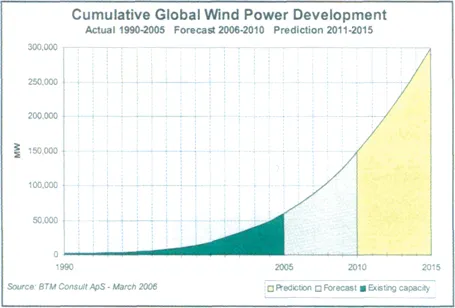
By the end of 2006 more than 74 GW of wind power was installed in the world, of which 48.6 GW or 65% was in Europe. Fig. 1.1 presents the development in global installed wind turbine capacity from 1990 to 2006 and a forecast of the expected future global capacity for the next decade (Danish Energy Agency, 1990). Global total installed capacity rose by an average of more than 25% per year since 2000; the capacity has been increased more than five times since then.
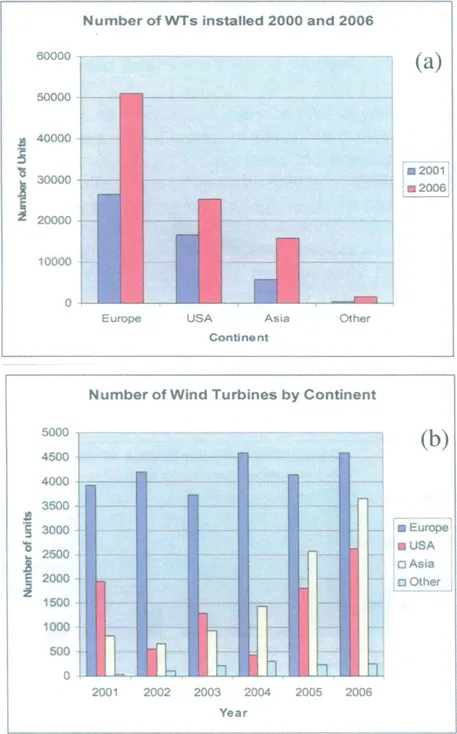
Fig. 1.2 shows the distribution by continents of wind turbine capacity world-wide. Fig. 1.3 (a and b) shows the distribution of installed wind turbines by year and continent.
1a2. Installed capacity offshore
It is expected that an increasing share of the new wind energy capacity in the future will be placed in offshore wind farms, where wind resources compared to conditions on land generally are plentiful and the wind climate less complicated favoring a longer turbine life time. Also any visual inconveniences imposed by large onshore wind turbines are eliminated or reduced. Details are given in Chapter 5.

Fig. 1.1: Installed wind power in the world: Development and forecast. (Ref I.2)

Fig. 1.2: Distribution by continents of wind turbine capacity worldwide.

Fig. 1.3:...
Table of contents
- Cover Page
- Title Page
- Preface
- Copyright Page
- Contents
- I Introduction