Statistical methodology is often conceived by social scientists in a technical manner; they use it for support rather than for illumination. This two-volume set attempts to provide some partial remedy to the problems that have led to this state of affairs. Both traditional issues, such as analysis of variance and the general linear model, as well as more novel methods like exploratory data analysis, are included. The editors aim to provide an updated survey on different aspects of empirical research and data analysis, facilitate the understanding of the internal logic underlying different methods, and provide novel and broader perspectives beyond what is usually covered in traditional curricula.
eBook - ePub
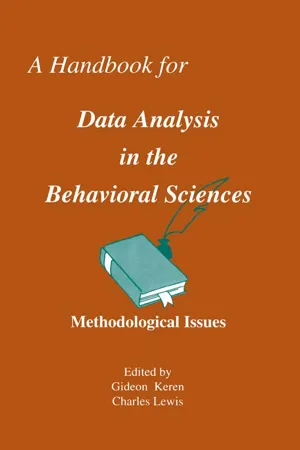
A Handbook for Data Analysis in the Behaviorial Sciences
Volume 1: Methodological Issues Volume 2: Statistical Issues
- 584 pages
- English
- ePUB (mobile friendly)
- Available on iOS & Android
eBook - ePub
A Handbook for Data Analysis in the Behaviorial Sciences
Volume 1: Methodological Issues Volume 2: Statistical Issues
About this book
Information
Publisher
Psychology PressYear
2014Print ISBN
9780805810370
9781138462519
Edition
1eBook ISBN
9781317759973
| I | (MODELS AND MEASUREMENT) |
The first section of this book is concerned with two essential topics: Mathematical models, and the measurement and scaling of psychological attributes.
Robin Hogarth from the University of Chicago has recently claimed that economics is a discipline of theory without data, whereas psychology is a discipline of data without theory. With minor modifications, we tend to endorse this statement. Our choice to start this book with a review of mathematical modeling, is meant to encourage researchers to modify their orientation and be more geared toward theory building. Stimulating the use of mathematical models is one possible step in this direction.
Strictly speaking, our (the editors) position is that every model (certainly in the behavioral sciences) is incorrect and at best can serve as a rough approximation. The importance of a model in our view is not just to provide an approximation that will be as close as possible to the “true” model, but also offer simultaneously a framework that enables researchers to ask meaningful questions and establish a consistent research program.
Representing psychological phenomena in the form of a mathematical model is not an easy task, which may account for the relative scarcity of such models. The first chapter, by Estes, provides a brief overview of models employed in various areas of psychology, their function, and how they should be tested. The following chapter, by Macmillan, introduces one of the more successful approaches to modeling in psychology, namely the Theory of Signal Detection (TSD). Although the roots of TSD are to be found in electrical engineering, it has been widely applied in different ways in the psychological literature.
Theories and models, especially when formulated in mathematical terms, require input. The meaning attached to any quantification of such input depends on the underlying measurement theory, which is presented in chapter 3, written by Norman Cliff. Measurement theory provides the justification, rationale, and underlying assumptions of the measurement operation. The concrete process by which multiple numbers are assigned to objects, attributes, or any other psychological properties is termed multidimensional scaling, and is reviewed in chapter 4 by Jones and Koehly.
Both chapters 3 and 4 are concerned with the quantification of psychological entities. Chapter 5 focuses on the quantification of a particular psychological entity namely uncertainty. Indeed, the theory of probability plays a major role in the present book. Although it is obviously impossible to summarize in one chapter the numerous books written on the topic, the chapter by Shafer provides an excellent overview of the different interpretations of the concept of probability, and offers a stimulating perspective for reconcilation among conflicting views.
| 1 | (Mathematical Models in Psychology) |
Harvard University
From the time when the earliest predecessors of experimental psychology began collecting quantitative observations of behavior, mathematical methods have been drawn on to aid in ordering and interpreting data. Measurements of the accuracy with which observers could detect simultaneous occurrences of events in astronomical observatories and determinations of sensory thresholds—that is, the intensities of stimuli just capable of evoking responses—in physiological experiments could be accomplished using only simple methods long familiar in physical science. However, these measurements were only the first steps toward a new discipline of psychophysics, or, more broadly, experimental psychology, with the new goal of generating quantitative representations of psychological attributes such as sensations, action tendencies, or values that could be inferred from observations. Moving toward this goal required a new theoretical apparatus that has come to be known as psychological measurement, or scaling, theory, and means of dealing with problems of reliability of measurements, met by the importation of statistical methods and theory developed in physical and biological sciences.
Finally, toward the middle of the first century of scientific psychology, mathematics began to be used as in older sciences, to aid the formulation of theoretical models capable of setting the stage for incisive tests of hypotheses and bringing significant relationships out of the welter of empirical facts and local theories. The term model is most commonly associated with this highest level of theoretical formulations but can well apply also to applications of formal methodology, often but not always mathematical, in measurement and statistics. New developments in the application of statistical models to psychological data constitute the main theme of this volume. This chapter focuses on theoretical models but also touches on some relationships between these and statistical models. I start with a bit of history, then discuss some salient aspects of the modeling enterprise.
By model I denote any theoretical formulation, whether mathematical, logical, or computer implemented, that allows exact computations. Embodying a scientific hypothesis or theory in a model enables us to know exactly what is assumed and to determine unambiguously the implications of the assumptions. Thus the emergence of useful theoretical models in any field is one of the prime indicants of theoretical progress. Though the term model first came into common use among psychologists only in the 1950s, efforts to formulate mathematical models as constituents of theory actually began much earlier and have played an important role in shaping the course of research.
A THUMBNAIL HISTORY OF MODELS IN PSYCHOLOGY
I group modeling efforts into three main classes: (a) the extraction of numerical laws and invariances from data, (b) the inference of structures underlying behavioral observations, and (c) the modeling of behavioral or cognitive systems.
Laws
Under this heading I include work done in the tradition of the natural sciences as explicated by Langley, Simon, Bradshaw, and Zytkow (1987). Among the earliest instances are some well-known invariances discovered in sensory psychophysiology in the 18th and 19th centuries. One example is Bloch’s law, which states that the product of intensity and duration of a brief visual stimulus is a constant; a more famous example is Weber’s law, dating from the early 19th century, which states that a just discriminable change in a stimulus is a constant fraction of its intensity. Weber’s law was incorporated by Fechner (1907) into his expression of a logarithmic relation between psychological and physical stimulus magnitudes. Though still treated as gospel in some quarters, Fechner’s law has been superseded for many experimental psychologists by the work of Stevens (1957, 1971), who distinguished classes of experimental situations in which the Weber-Fechner function is and is not approximated and showed that both could be accommodated by a power law.
The breakout of this strand of mathematical psychology from the narrow domain of sensory processes must be largely credited to L. L. Thurstone, the originator of psychological scaling theory. He showed that a model incorporating response variability could be used to transform data for judgments about stimuli that are definable only on qualitative dimensions (handwriting quality, employee performance, esthetic value) to scales calibrated in “just-noticeable differences,” thus vastly facilitating the search for invariants or simple predictive relationships (Thurstone, 1927). The line of development from Thurstone’s pioneering work led, somewhat indirectly, to the currently extremely influential “choice model” of Luce (1959, 1963). Luce’s model differed from Thurstone’s in being based on a small number of axioms derived from intuitions about the psychological basis of choice behavior. The principal axiom expresses a property of choices sometimes known as independence of irrelevant alternatives, which implies that the relative probability of choosing two objects, or other choice alternatives, is independent of the size of the set of alternatives presented to the chooser (so that, e.g., the probability of a buyer’s choosing grey over blue as an automobile color would be predicted to be the same whether only grey and blue or grey, blue, and red were the alternatives offered by a dealer). The axioms imply that the utility of any alternative to a chooser can be represented as a value on a ratio scale of measurement, with the important property that probability of choosing any given alternative from a set is given by the ratio of the scale value of the given alternative to the sum of scale values for all members of the set. The choice model has received some support from direct empirical tests (e.g., Atkinson, Bower, & Crothers, 1965), but more importantly, provides the basis for computation of choice probabilities in many current cognitive theories.
A development in this tradition that once seemed extremely promising was the importation of the mathematical theory of communication of Shannon (1948) into psychology under the rubric information theory (Attneave, 1959). A most attractive prospect was that expressing quantities of information stored in memory in informational units would reveal invariants (e.g., invariance of short-term memory span over types of materials) not apparent when the units are items such as digits, letters, or words. The promise was not realized, however, and applications of information theory are now seen mainly in the interpretation of some types of perceptual information processing (Garner, 1962).
The importance of descriptive quantitative laws is not limited to simple sensory and perceptual processing. A notable example in the domain of research on animal learning and behavior is the matching law, expressing a proportionality between rate of responding and rate of reinforcement (reward) in a variety of instrumental, or trial and error, learning situations (Herrnstein, 1974; Williams, 1988). The matching law has been extended to the human level as an ingredient in the interpretation of economic behaviors (Herrnstein, 1990).
Cognitive Structures
Another group of models with a long history in psychology is concerned not with the reduction and smoothing of data, but with the task of inferring mental structures that lie behind observed behaviors. The earliest entry in this tradition is factor analysis, a methodology for extracting estimates of the weights of factors, such as components of mental abilities, from intercorrelations of test scores. One of the first and most famous results was the extraction of a general intelligence, or g, factor from intelligence test data by Spearman (1904). The conception of an important general factor did not stand up well over the years, however, and multiple factor theories pioneered by Thurstone (1935) have come to dominate the field of ability and personality assessment. Mental factors based on correlational data have never become significant in ps...
Table of contents
- Cover
- Title Page
- Copyright Page
- Table of Contents
- Preface
- PART I: MODELS AND MEASUREMENT
- PART II: METHODOLOGICAL ISSUES
- PART III: INTUITIVE STATISTICS
- PART IV: HYPOTHESIS TESTING, POWER, AND EFFECT SIZE
- AUTHOR INDEX
- SUBJECT INDEX
Trusted by 375,005 students
Access to over 1.5 million titles for a fair monthly price.
Study more efficiently using our study tools.
Frequently asked questions
Yes, you can cancel anytime from the Subscription tab in your account settings on the Perlego website. Your subscription will stay active until the end of your current billing period. Learn how to cancel your subscription
No, books cannot be downloaded as external files, such as PDFs, for use outside of Perlego. However, you can download books within the Perlego app for offline reading on mobile or tablet. Learn how to download books offline
Perlego offers two plans: Essential and Complete
- Essential is ideal for learners and professionals who enjoy exploring a wide range of subjects. Access the Essential Library with 800,000+ trusted titles and best-sellers across business, personal growth, and the humanities. Includes unlimited reading time and Standard Read Aloud voice.
- Complete: Perfect for advanced learners and researchers needing full, unrestricted access. Unlock 1.5M+ books across hundreds of subjects, including academic and specialized titles. The Complete Plan also includes advanced features like Premium Read Aloud and Research Assistant.
We are an online textbook subscription service, where you can get access to an entire online library for less than the price of a single book per month. With over 1.5 million books across 990+ topics, we’ve got you covered! Learn about our mission
Look out for the read-aloud symbol on your next book to see if you can listen to it. The read-aloud tool reads text aloud for you, highlighting the text as it is being read. You can pause it, speed it up and slow it down. Learn more about Read Aloud
Yes! You can use the Perlego app on both iOS and Android devices to read anytime, anywhere — even offline. Perfect for commutes or when you’re on the go.
Please note we cannot support devices running on iOS 13 and Android 7 or earlier. Learn more about using the app
Please note we cannot support devices running on iOS 13 and Android 7 or earlier. Learn more about using the app
Yes, you can access A Handbook for Data Analysis in the Behaviorial Sciences by Gideon Keren,Charles Lewis in PDF and/or ePUB format, as well as other popular books in Psychology & History & Theory in Psychology. We have over 1.5 million books available in our catalogue for you to explore.