This book explores the nature of one of the most ancient tools for nonverbal communication: drawings. They are naturally adaptable enough to meet an incredibly wide range of communication needs. But how exactly do they do their job so well?
Avoiding the kinds of aesthetic rankings of different graphic domains so often made by art historians and critics, Manfredo Massironi considers an extensive and representative sample of graphic applications with an open mind. He finds a deep mutuality between the material components of images and the activation of the perceptual and cognitive processes that create and decipher them.
Massironi first examines the material components themselves: the mark or line, the plane of representation (the angle formed by the actual drawing surface and the depicted objects), and the position of the viewpoint relative to the depicted objects. The roles played by these three components are independent of the content of the drawing; they function in the same way in concrete and abstract representations. He then closely scrutinizes the choices made by the person planning and executing the drawings. Given that any object can be depicted in an infinite number of different ways, the drawer performs continuous work emphasizing and excluding different features. The choices are typically unconscious and guided by his or her communicative goals. A successful graph, be it simple or complex, is always successful precisely because the emphasized features are far fewer in number than the excluded ones. Finally, he analyzes the perceptual and cognitive integrations made by the viewer.
Drawings are not simply tools for communication but important instruments for investigating reality and its structure. Richly illustrated, the book includes a series of graphic exercises that enable readers to get a sense of their own perceptual and cognitive activity when inspecting images. Massironi's pathbreaking taxonomy of graphic productions will illuminate all the processes involved in producing and understanding graphic images for a wide audience, in fields ranging from perceptual and cognitive psychology through human factors and graphic design to architecture and art history.
eBook - ePub
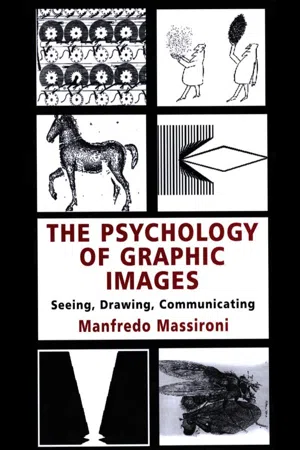
The Psychology of Graphic Images
Seeing, Drawing, Communicating
- 336 pages
- English
- ePUB (mobile friendly)
- Available on iOS & Android
eBook - ePub
The Psychology of Graphic Images
Seeing, Drawing, Communicating
About this book
Information
Publisher
Psychology PressYear
2001Print ISBN
9780805829334
9780805829327
Edition
1eBook ISBN
9781135679361
Table of contents
- Cover Page
- Title Page
- Copyright Page
- Acknowledgments
- Chapter 1: Introduction
- Chapter 2: Invariance and Transformation
- Chapter 3: The Elusive Context
- Chapter 4: The Quest for Balance
- Chapter 5: What Makes a Graphic Image Work
- Chapter 6: Visualizing the Invisible
- Chapter 7: Seeing and Showing Time
- Chapter 8: Graphics and Perception
- Chapter 9: Ambiguity and Information
- Chapter 10: Toward a Taxonomy of Drawings
- Notes
- References
Trusted by 375,005 students
Access to over 1.5 million titles for a fair monthly price.
Study more efficiently using our study tools.
Frequently asked questions
Yes, you can cancel anytime from the Subscription tab in your account settings on the Perlego website. Your subscription will stay active until the end of your current billing period. Learn how to cancel your subscription
No, books cannot be downloaded as external files, such as PDFs, for use outside of Perlego. However, you can download books within the Perlego app for offline reading on mobile or tablet. Learn how to download books offline
Perlego offers two plans: Essential and Complete
- Essential is ideal for learners and professionals who enjoy exploring a wide range of subjects. Access the Essential Library with 800,000+ trusted titles and best-sellers across business, personal growth, and the humanities. Includes unlimited reading time and Standard Read Aloud voice.
- Complete: Perfect for advanced learners and researchers needing full, unrestricted access. Unlock 1.5M+ books across hundreds of subjects, including academic and specialized titles. The Complete Plan also includes advanced features like Premium Read Aloud and Research Assistant.
We are an online textbook subscription service, where you can get access to an entire online library for less than the price of a single book per month. With over 1.5 million books across 990+ topics, we’ve got you covered! Learn about our mission
Look out for the read-aloud symbol on your next book to see if you can listen to it. The read-aloud tool reads text aloud for you, highlighting the text as it is being read. You can pause it, speed it up and slow it down. Learn more about Read Aloud
Yes! You can use the Perlego app on both iOS and Android devices to read anytime, anywhere — even offline. Perfect for commutes or when you’re on the go.
Please note we cannot support devices running on iOS 13 and Android 7 or earlier. Learn more about using the app
Please note we cannot support devices running on iOS 13 and Android 7 or earlier. Learn more about using the app
Yes, you can access The Psychology of Graphic Images by Manfredo Massironi,Translated by N Bruno in PDF and/or ePUB format, as well as other popular books in Psychology & Cognitive Psychology & Cognition. We have over 1.5 million books available in our catalogue for you to explore.