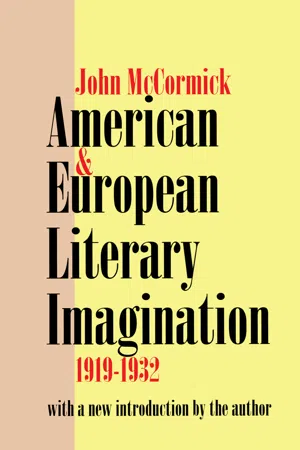
Western culture is composed of a subtle and complex mixture of influences: religious, philosophical, linguistic, political, social, and sociological. American culture is a particular strain, but unless European antecedents and contemporary leanings are duly noted, any resulting history is predestined to provincialism and distortion. In his account of American literature during the period 1919 to 1932, McCormick deals with the extraordinary work of artists who wrested imaginative order from a world in which the abyss was never out of sight.McCormick's volume is intended as a critical, rather than encyclopedic history of literature on both sides of the Atlantic between the end of World War I and the political and social crises that arose in the 1930s. Although he emphasizes American writers, the emergence of a vital and distinctly modern American literature is located in the cultural encounter with Europe and the rejection of national bias by the major figures of the period.McCormick deals with Gertrude Stein and the mythology of the "lost generation," the tensions and ambivalences of traditionalism and modernity in the work of Sherwood Anderson and F. Scott Fitzgerald, the effect and qualities of Hemingway's style as compared to that of Henry de Montherlant, and the provincial iconoclasm of Sinclair Lewis juxtaposed with the more telling satire of Italo Svevo. The formal innovations in the work of John Dos Passos, E.E. Cummings, and William Faulkner, the poetic revolution against cultural parochialism and genteel romanticism is given extensive consideration with regard to the work of T.S. Eliot, Ezra Pound, Wallace Stevens, William Carlos Williams, and Marianne Moore are also discussed. The concluding chapters discuss literary and social criticism and assess the influence of psychoanalysis, philosophical pragmatism, and radical historiography on the intellectual climate of the period.Teachers and students in English and American Literature, American History, and Comparative Literature, and the general reader interested in the writing of the period, may gain new insights from these valuations, devaluations, and re-evaluations.
- 256 pages
- English
- ePUB (mobile friendly)
- Available on iOS & Android
eBook - ePub
American and European Literary Imagination
About this book
Information
1
Lost and Found
“You are all a lost generation.” Attributed to Gertrude Stein, Ernest Hemingway’s ambiguous epigraph to The Sun Also Rises has attained a fame bordering on notoriety. It may remind us of other gnomic catchwords that history has preserved, such as “We who are about to die salute you” or “Do you want to live forever?” We have to doubt that gladiators in the Roman arena were so lucidly correct in their last minutes of life, while we may be certain that the Marines at Belleau Wood indeed wanted to live forever, like the rest of us. However gnomic, Gertrude Stein’s words and the conjunction in 1922 of the wicked old virgin from Baltimore and the talented, ambitious Hemingway in Paris offer us one of those confrontations so right, so correct, that one is tempted to think it must have been apocryphal. In Gertrude Stein, egoist, heavy-lidded and self-indulgent naif, former student of William James, self-publicist, individualist, fosterer of a tiny talent, we find a representative of the prewar world, by no means typical, yet containing within herself various components that the world would never see again. Lesbianism made her expatriation advisable; a comfortable inheritance made it possible. In her art collecting and gourmandizing she evokes the last of the nineteenth-century big spenders; in her involuted and solipsistic writing she evokes a Jewish Emily Dickinson with only a fraction of the poet’s capacity. Her fortune, together with her nostalgia for middle-class rituals, roots her firmly in the late nineteenth and early twentieth centuries, as does her view of writing as playful and non-intellectual to the point of silliness.
Hemingway, in contrast, like so many young men of the period, wanted, or pretended to want, a clean break with the pre-war world. The First World War had left a mark on him, a mark of which he was proud and which he tended to exaggerate. The war gave him, however, a subject—violence—and suggested to him an aesthetic for dealing with violence. Unlike Gertrude Stein’s, his expatriation was more apparent than real, and not terribly important to his work. Each was nostalgic for America, but in different ways. Gertrude Stein’s nostalgia was for a tree-shaded upper-middle-class residential area with plenty of Negro help in the kitchen in the Middle Atlantic or New England area, circa 1905. Hemingway’s was for a timeless pre-industrial upper Midwest and for a timeless, never-existent guilelessness. His seriousness was at odds with her playfulness; if the two shared an enormous egotism, they were at fundamental odds through differences in age and basic differences about what in life and literature was important. If she could claim that she and Sherwood Anderson between them “formed” Hemingway, he could claim vehemently that she had no part in his formation.1 Both were capable of playing cat and mouse with each other and with the public. What, then, did that tag, “lost generation,” which has performed such heavy labor in recent literary history, mean to either Gertrude Stein or Ernest Hemingway? To review its possible meanings is to embark upon a study of that curious, wonderful, and exasperating decade that subsequent decades have constructed into a transcendent metaphor, the twenties.
Before seeking secondary, tertiary, or symbolic meanings for the “lost generation,” we would do well to think of Hemingway’s own account of the phrase in A Moveable Feast, written long after the event and published after his death in 1962. Hemingway’s recollection is that the owner of a garage in Paris had said, “You are all a génération perdue” to his mechanic, who had botched his work on the ignition system of Gertrude Stein’s Ford, and that she in turn used the phrase on Hemingway and men of his age who had been in the war because they lacked respect and drank too much. Hemingway’s flow of recollection then moves, rather like that of a militaristic Proust, to identification with the told-off mechanic, who might have been wounded in the war and transported in one of the ambulances that he, Hemingway, had driven; to the statue of Marshall Ney near the Closerie des Lilas; to loyalty to Gertrude Stein for her loyalty to the dying Apollinaire, “But the hell with her lost-generation talk and all the dirty, easy labels.”2 Like The Autobiography of Alice B. Toklas, A Moveable Feast does both more and less than its author intends. Each is an amusing, splendidly written, sly self-portrait, done with loving care to establish the exact planes and shadings in the visage that the author wants the public to accept as definitive; each is therefore not so much unreliable as it is constructed on a varying scale of veracity. Hemingway’s account of the génération perdue, when scrutinized skeptically, still holds a large measure of truth if only because he had worked over that area of truth in his novel, The Sun Also Rises. There, as I shall presently suggest, Hemingway established the idea of a “generation” as it had not been established before in American writing, and only rarely in European writing. Only for two movements in German literature and one in Spanish was the idea of “generation” held so self-consciously by a significant group of writers: the Sturm und Drang movement in early German romanticism; the group attached to Stefan George before the First World War; and the Generation of 1898 in Spain. The generation that Hemingway had in mind was of course the generation born near the turn of the century, but his special reverence was reserved for those who had seen not just military service in the war but maiming combat. In much of his fiction, to say nothing of his reportage and autobiographical sketches, Hemingway indicated a mystical attachment to purification through violence and attendant suffering. At the same time, he awarded lesser marks to contemporaries of the war generation. Virtue rubbed off on them, even though they had not been so fortunate as to suffer combat, because they too were aligned against the older, pre-war group—soft and relatively carefree types like Gertrude Stein and Sherwood Anderson. “Lost,” then, meant not perdue, in the garage keeper’s meaning of incompetent, or lacking in a sense of duty to the job (oficio in Spanish), but a change in sensibility brought about by the trauma of war or of conviction about the pre-war past. It meant the revelation in life, and above all in art, of areas of existence, moral attitudes, and views of society that the deprived older generation could not understand or accept. “Lost” implied a heroic abandonment of certainties that would be rewarded by large horizons, as against the slack, indulgent bohemian posings of the earlier generation. “Lost,” in Hemingway’s sense, really meant “found”; in retrospect, we may say that no generation was less lost and more found, for there was brilliance, talent, hard work, and achievement in abundance then.
Lost implied loss, but here matters become opaque. The theme of loss—of childhood, of innocence, of a green and golden time—is as old as mythology, yet in no literature was it been so continually present as in American literature. Reasons for its prominence in the past, whether Calvinism, romanticism, the frontier, the disappearance of the Red Indians, or the savaging of the countryside, cannot detain us here. Suffice to say that after World War I, the theme of loss took a new and interesting turn. Loss meant not only the things Hemingway treated with relation to the war, it also meant loss of country in a most peculiar sense. It is a commonplace of literary history that a few very good American writers and artists and a large number of ordinary ones, to say nothing of hangers-on, casual travelers and intellectual voyeurs, left the United States for varying periods of time to take up residence in Europe, most of them in Paris. “Expatriation” is the term usually reserved for that group, but expatriation is itself ambiguous and very far from being the portmanteau word it usually is made to be in literary history.3 With respect to the American “expatriates,” it is essential to distinguish among those whose work projects a sense of unwilled banishment, willed banishment, and those who resided abroad merely because their dollars bought more drink and rent than they would have done at home.
Ezra Pound and T. S. Eliot, in varying ways, are writers whose expatriation derived from a conviction that their country could not provide what they needed for literary nourishment, in the tradition of Hawthorne’s and Henry James’ complaints about the poverty of the American landscape. Pound expressed his views through indignation and comic anger, while Eliot, finding in himself loyalty to the French and English traditions, worked his way through, in Four Quartets, to a Vergilian quality of loss and sorrow. Both Eliot and Pound functioned within a historical framework, however, that attempted to place the war in long perspective. Younger writers like Hemingway and Glenway Wescott took the war as their point of departure. Loss for them, in many of the stories in Hemingway’s In Our Time and in all of Wescott’s fiction of the twenties—The Apple of the Eye (1924), Like A Lover (1926), The Grandmothers (1927), and Goodbye, Wisconsin (1928)—is loss of the good, green America of youth, loss of innocence. And with that loss goes the inescapable suggestion that residence abroad, expatriation, was inevitable for them, determined by their time of birth, their sensibility, and their role as writers. Their views of the past are not historical, no matter how often, as in the case of Wescott, the past is invoked, because always the past is alive in the present, alive in the sensibility of the narrator or character. No matter how long their expatriation, all four writers remain American at root. Eliot’s and Pound’s banishment was willed and self-imposed; Hemingway’s and Wescott’s, in a literary sense, was not. All share, in varying degrees (Eliot, of course, far less than the others), a romantic impatience with the given, their country of birth, and a romantic disposition to confuse physical motion with interior, spiritual movement.
For the others, with a few exceptions—Kay Boyle, possibly Djuna Barnes—“abroad,” Paris in particular, was a village or an American suburb, with Gertrude Stein as Mayor and with Robert McAlmon and Harry and Caresse Crosby as Deputy Sheriffs by virtue of their having capital to publish their friends’ work. A village through which various travellers moved: Scott Fitzgerald and his wife, Sinclair Lewis, John Dos Passos, Alfred Kreymbourg, William Carlos Williams, Malcolm Cowley —the list is as long as it is familiar. Expatriation as an idea does not apply. Abroad was fashionable, useful; drink was available there, and the illusion of freedom if not license. But the impact of Europe was far more subtle than the misapplied notion of expatriation.
If Gertrude Stein was serious, or also serious, in saying, “You are all a lost generation,” where might her seriousness lie? It lay, I suspect, in her apprehension of the inability of naturalism, particularly in its American form, to cope with the post-war world. Or in other terms, it lay in her apprehension of bravado in a man like Hemingway, who may have been biting off more than he could intellectually chew. Gertrude Stein, the former clever student of William James and the hawk-eyed, long-time resident of Paris, was in a good position to assess the differences between rational America and irrational Europe. Proof may be found in her own work, in the continuing vacillation between naturalism and verbal foolishness; in her tastes in painting; and in her place as salon mistress and lion hunter. In still other terms, Paris in the early 1920’s was the scene of a rich, explosive confrontation between two basically different modes of thought and art: the American, essentially rational, mode and the European, essentially irrational, mode. After the confrontation, neither was to be quite the same again, but before we can examine the aftermath, we need to look back in time to various European and American antecedents of the post-war confrontation.
Irrational Europe, rational America. Let me construct some necessarily large generalizations to support this hypothesis. European society since the early medieval period may be seen as a series of barriers for keeping the monsters at bay. The monsters were variously identified as Satan, famine, disease, oriental invasion, and very powerful, the dispossessed, war and anarchy. For a few decades during the Renaissance and again during the eighteenth century, men seemed to have constructed a permanent barrier against the monsters, and in those periods the dominant philosophical and literary mode was in truth rational. First the Reformation, then Deism, took care of God; advances in the natural sciences apparently were taking care of nature; a return to Greek and Roman models seemed to be taking care of aesthetics. The French Revolution, however, put an end to all that. The most shattering impact of the revolution was not upon the divine right of kings, the clergy, or any of the political or economic institutions challenged, but upon European loyalty to the processes of the human mind, upon the long-held belief that man was the master of himself and of his world. In art, romanticism, before the revolution a recessive movement, became dominant after 1789, so dominant that it is still very much with us. Romanticism was not one movement, but rather a complex of movements, a devious set of related philosphies that flowed like water into a new reservoir to fill up all the gaps and low-lying places created by the revolution. So powerful a rush of water sets up counter-eddies, but invariably, thus far, the counter-eddies have not generated sufficient force to counteract the main flow. The central reason for the power of romanticism is that instead of keeping the monsters at bay, it invited them into the household, not only into the sitting room of philosophy, but on up to the bedroom of poetry and fiction. The romantic complex was efficient in its recognition of madness, in the cachet it gave to unreason, its frequent celebrations of anti-intellectualism, its terrifying blessings upon nationalism and war. Berkeley and Hume were the unwitting precursors of romanticism in their epistemological skepticism, European idealism fought a long, doomed, rear-guard action against epistemology until the current triumphs of Husserl, Heidegger, and company, who wander out of the romantic German forests with despairing, non-logical syllogisms for our neo-romantic delectation.
If one basic aspect of the romantic complex—perhaps the basic aspect—is its coming to terms with the forces of unreason, then our habit of seeing an unyielding opposition between realism and romanticism in nineteenth-century European literature is mistaken. What historians have done is to say, accurately, that such an opposition does exist between classical and romantic, as exemplified in the differences between Pope and Novalis, or Chodlerlos de Laclos and Emily Bronte. Trouble arises when the historian equates the classical with the realistic, mistaking the part for the whole, in opposition to the villain, romantic.4 There is indeed a realistic, as opposed to a romantic, sensibility. Balzac is not identical with Scott, nor Flaubert with Monk Lewis. But for nineteenth-century fiction, the words “realistic” and “romantic” are useful for defining differences in craft: diction, rhythm, length of sentence, sets of mind of a given writer; they do not define differences in philosophy. Since Balzac—indeed, since Cervantes—realist and romanticist alike have been engaged in coming to terms with monsters. The great European realists, from Balzac to Proust and including writers such as Stendhal, Flaubert, Dostoevsky, Dickens, George Eliot, Verga, Galdós, and Thomas Mann, did not differ philosphically from the romantics, while in each we find episodes, characters, attitudes, and apprehensions made possible only by the romantic revolution.5 The romantic complex opened doors never again to be closed; the road from Sturm und Drang to Nietzsche to Freud is straight, if not narrow.
In European poetry, the evidence is even more incontrovertible than it is for prose, while criticism, for once, is in substantial agreement about that evidence.6 Although this road is neither straight nor narrow, it is clear. It moves from Poe in America to Baudelaire’s amusing half-comprehension of Poe to Mallarme (via Banville and Hegel) to Valery; and from Corbiére and Verlaine to Laforgue; (it returns to America in Pound, Eliot, Hart Crane, and Wallace Stevens; it takes us to Darío in Hispanic America, and to Antonio and Manuel Machado, Jorge Guillen, and Garcia Lorca in Spain; to Montale, to George, Hofmansthal, Rilke and Benn. It takes us, that is to say, by way of French symbolism, that great taproot of modern poetry, directly into and through the modern movement. However we define that movement, whether as anti-romantic or neo-romantic, we cannot fail to recognize its break with the rational, classical past, its explicit acknowledgment of unreason, and its quasi-religious cast. The familiar point need not be labored here.
In America, however, a similar intellectual history did not necessarily produce the same conclusion. Nor, until the nineteenth century, was the history of Europe and the history of America all that similar. In seventeenth- and eighteenth-century America, theological discourse of one sort or another dominated in bulk and often in quality. Laymen’s work was mainly practical, written to entice settlers from Europe, to convince an electorate, to investigate urgent issues of the day. Addressing men in a new land having unfamiliar flora, fauna, and dangers, needing accuracy for simple survival, writers developed an attitude toward nature and objects in nature that was different from anything in Europe. An American vocabulary grew up, a distinctly American apprehension of nature, and most important, a disposition to provide an answer to every manner of question. A fair number of people emigrated to America in order to solve a theological and political conundrum; their posterity were encouraged by the long movement westward, by the Revolution of 1776, by the economic and social organization of American life to be impatient of any sort of question that seemed to have no ready answer. The monsters, European style, were not admitted to exist, or if so, they were given theological names.
That the monsters were there, however, is obvious, and true American literature might be thought of as having been invented to cope with them. It is not an accident that memorable American writing began with the first impact of romanticism. The first settlements were a product of the Reformation, not of the European Renaissance; thus Renaissance modes made negligible impact. Neo-classicism was quite unsuited to American needs, for American society had not sufficiently coagulated; it was not sufficiently rich, aristocratic, or leisured to permit neo-classical modes to flourish. But romanticism was a liberation for American writers. Bryant and Cooper found ways to name their monsters—industrialism, civilization, the destruction of the native Indians—and loose forms suited to their needs. Gothic fiction, in Europe a slight offshoot of the romantic complex, became a central American form. Charles Brockden Brown’s novels gave both the romantic frisson and the American pragmatic explanation for the frisson—mesmerism (in Wieland) and sleepwalking (Edgar Huntly)— just as Hawthorne was to do later in The Blithedale Romance. The great bul...
Table of contents
- Cover
- Half Title
- Title Page
- Copyright Page
- Dedication Page
- Table of Contents
- Acknowledgments
- Transaction Introduction
- Preface
- 1 Lost and Found
- 2 The Uses of the Past
- 3 The Useable Present
- 4 The Romantic Warriors
- 5 Lewis and Svevo
- 6 Exploding the Verb
- 7 Poets
- 8 Background versus Foreground
- 9 Literary Criticism
- 10 Summary
- 11 A Postscript on Method
- Bibliographical Notes
- Index
Trusted by 375,005 students
Access to over 1.5 million titles for a fair monthly price.
Study more efficiently using our study tools.
Frequently asked questions
Yes, you can cancel anytime from the Subscription tab in your account settings on the Perlego website. Your subscription will stay active until the end of your current billing period. Learn how to cancel your subscription
No, books cannot be downloaded as external files, such as PDFs, for use outside of Perlego. However, you can download books within the Perlego app for offline reading on mobile or tablet. Learn how to download books offline
Perlego offers two plans: Essential and Complete
- Essential is ideal for learners and professionals who enjoy exploring a wide range of subjects. Access the Essential Library with 800,000+ trusted titles and best-sellers across business, personal growth, and the humanities. Includes unlimited reading time and Standard Read Aloud voice.
- Complete: Perfect for advanced learners and researchers needing full, unrestricted access. Unlock 1.5M+ books across hundreds of subjects, including academic and specialized titles. The Complete Plan also includes advanced features like Premium Read Aloud and Research Assistant.
We are an online textbook subscription service, where you can get access to an entire online library for less than the price of a single book per month. With over 1.5 million books across 990+ topics, we’ve got you covered! Learn about our mission
Look out for the read-aloud symbol on your next book to see if you can listen to it. The read-aloud tool reads text aloud for you, highlighting the text as it is being read. You can pause it, speed it up and slow it down. Learn more about Read Aloud
Yes! You can use the Perlego app on both iOS and Android devices to read anytime, anywhere — even offline. Perfect for commutes or when you’re on the go.
Please note we cannot support devices running on iOS 13 and Android 7 or earlier. Learn more about using the app
Please note we cannot support devices running on iOS 13 and Android 7 or earlier. Learn more about using the app
Yes, you can access American and European Literary Imagination by John McCormick in PDF and/or ePUB format, as well as other popular books in Literature & European Literary Criticism. We have over 1.5 million books available in our catalogue for you to explore.