eBook - ePub
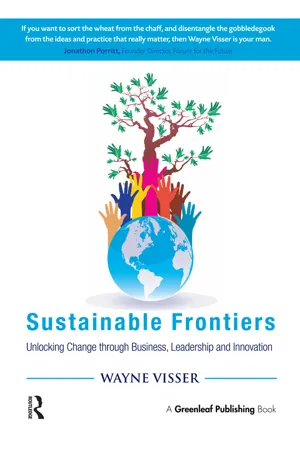
Sustainable Frontiers
Unlocking Change through Business, Leadership and Innovation
- 190 pages
- English
- ePUB (mobile friendly)
- Available on iOS & Android
eBook - ePub
About this book
Sustainable Frontiers throws down the gauntlet to business to step up and be the catalyst for a sustainable future. It presents eight keys to unlocking transformational change – through leadership, enterprise, innovation, transparency, engagement, responsibility, integration and future-fitness. Far from being another tame review of corporate social responsibility and sustainable business initiatives, the book dispels the myths of sustainability and challenges us to let go of old systems that are failing to deliver economic, social and environmental transformation. Sustainable Frontiers gets to the heart of why the sustainability and CSR movements have failed in the past and offers a new view of how sustainable business practices can shape-shift to make a genuine difference inside and outside organisations. The book gathers together experiences from across the globe and shows to the reader what can be achieved with the right vision and leadership. Expect to be challenged, engaged and inspired to join the revolution on the sustainable frontier.Making a successful transition to a more sustainable future depends on letting go. Sustainable Frontiers shows how we must find ways to let go of an industrial system that has served us well, but is no longer fit for purpose. How we will need to let go of old styles of leadership and out-dated models of business, high-impact lifestyles and selfish values. How we must learn to let go of cherished ideologies that are causing destruction and beliefs about ways to tackle problems that are failing to resolve crises.If we are to reach sustainable frontiers, it must begin with changing our collective minds - and only then will we change our collective behaviour. How we accomplish such a global mind-shift is the subject of Sustainable Frontiers. And it starts by admitting that those of us at the vanguard of the sustainability revolution also have to change. We will also have to let go of cherished beliefs and strategies that are not working - starting with the way we communicate our vital, life-saving mission.
1
Unlocking change through transformational leadership
Why today’s crisis of leadership is tomorrow’s opportunity
You have lost your reason and taken the wrong path. You have taken lies for truth, and hideousness for beauty … I marvel at you who exchange heaven for earth.
These words by author Anton Chekhov (1995) were not written about our contemporary business leaders, but they might just as well have been. I will be arguing in this chapter that we desperately need transformational leadership in order to advance the frontier of sustainability. But before we reach for those heady heights, let us revisit the muddy swamps of calamitous leadership—of catastrophic, cancerous, disastrous, pestilential, cataclysmic leadership. Is there any other way to describe the business leadership that led us all, Pied Piper-like, into the 2008 global financial crisis—the aftershock of which is still being felt and the burden of which weigh heavy on generations to come?
This was a crisis ushered in while leading companies around the world—and their celebrated CEOs—all seemed to be happily chanting “greed is good” in unison. That mantra, of course, belongs to the fictional Wall Street character, Gordon Gekko, but apparently truth is stranger than fiction. Our MBA-trained leaders all seemed to agree with Gekko, when he said: “Greed is right, greed works. Greed clarifies, cuts through, and captures the essence of the evolutionary spirit. Greed, in all of its forms—greed for life, for money, for love, know ledge—has marked the upward surge of mankind.”
Am I being too melodramatic? Maybe, or maybe not. In my co-authored book Beyond Reasonable Greed (Visser and Sunter, 2002), we attributed the phenomenon of unreasonable corporate greed at the turn of the century to boards “being collectively swept along by the prevailing paradigm of success which is purely financial”. However, we added the following rider: “In light of Enron’s failure, this judgement may be overly kind and more cases of dodgy accounting, inflated profits and insider trading by the board may pop up in Corporate America and Corporate Europe.”
And of course, since publication, they did pop up, like a popping popcorn poppathon—starting with WorldCom, but also later extending to other corporate heavyweights, such as Lehman Brothers. As a result, big business is under the whip like never before from the public and politicians alike. And the finance profession, in particular, is feeling very uncomfortable under the harsh interrogative spotlight. However, if the response to all the accounting irregularities and other misdemeanours is merely to throw a few CEOs in jail and threaten the rest with a long prison sentence unless they check the figures personally, a great opportunity for real transformation will be lost.
As business and the financial services industry begins to respond to the rising tide of international scrutiny, the word “corporate governance” is on everybody’s lips. But the critics remain sceptical, maybe justifiably so. If wave after wave of corporate scandals are revealing anything, it is that corporate governance is sometimes not worth the paper it is written on. If the people involved in implementing corporate governance do not have their hearts in the right place and if they are just going through the motions, the process becomes a charade.
You can have all the non-executive chairpersons, non-executive directors, board committees and external auditors you like, but things will go hideously wrong if ceremony has replaced substance and cynicism is the order of the day. Some non-executive directors sit on so many boards that it is physically impossible for them to exercise their fiduciary responsibilities properly—let alone wider social responsibilities.
Worse still is a situation where the Chairman and CEO are one and the same person and he (it still almost always is a “he”) has managed to load the board with his buddies. If things go right, they are the first to congratulate him and approve a handsome bonus. If things go wrong, they are the last to ask the tough questions needed to expose malpractice. They would prefer to have the wool pulled firmly over their eyes even though ignorance is no excuse in terms of the law.
Seeking a reformation in business
So let’s be clear about what we mean by transformational leadership. Rather than implementing a smattering of short-term corporate governance fixes (which are necessary, but not sufficient), what is required is nothing short of a Reformation in business, along the same lines as the one precipitated by Martin Luther in 1517. On October 31 of that year, he wrote an attack on the sale of indulgences (remissions of punishment for sin) in 95 theses, which he nailed to a church door. His basic point was that the Church had become too interested in enriching itself at the expense of its true mission of providing spiritual leadership. It had lost the support of the population at large with its mercenary practices and obsession with grandeur and wealth.
In exactly the same way, the modern corporate world has lost the confidence of the public. The high priests of business—the board of directors—are perceived as just another example of a group of privileged people driven by unreasonable greed and feathering their own nests. The customers and shareholders come a poor second and other stakeholders trail even further behind. The modern equivalent of indulgences is an astronomical salary, a large wad of share options and a corporate jet. And the modern equivalent of the flowery and unintelligible prayers which the Church used to recite in order to extract its indulgences from the peasantry is the purple prose and lofty sentiments expressed by companies in their mission statement, combined with a set of accounts that only the initiated can understand.
So reform is critical for business to restore its reputation, particularly as its presence in society rivals that of the Church in the 16th century. Hence, we see business needing to establish a new and broader role for itself, in keeping with modern times, rather than going back to the old one. Another word for this type of change is “shapeshifting”—liberating ourselves from the old form that defined and constrained us in the past and morphing into a completely new being, with new characteristics and potential for the future. And despite my cheeky dismissal of the “S-word” in the Introduction, I still believe that sustainability can be the catalyst which helps us in the process of shapeshifting.
Unfortunately, sustainability is almost a cliché now. Nevertheless, the idea behind it remains a powerful source of inspiration and is responsible for an umbrella movement encompassing as diverse a group as you can imagine. They all share one thing in common: an interest in improving human well-being by seeking a proper balance between social, economic and environmental change.
Most fundamentally, sustainability is about surviving and thriving, by finding a proper balance between economic, social and environmental development. No one of these three elements of the so-called “triple bottom line” can be pursued relentlessly at the expense of the others, or else the whole system collapses. Sadly, at the moment, there is widespread evidence that we are out of balance and that, despite economic advances (and sometimes because of them), our ecological and social systems are breaking down. We are pursuing unsustainable development.
If you are reading this book, you probably don’t need convincing of this fact. So figures should suffice to make the point. Since 1970, the expansion of our industrial economies and upgrading of our consumerist lifestyles have already resulted in vertebrate populations by over 50%, with species extinction occurring at a rate 100–1,000 times faster than the natural background rate. This is ecologically unsustainable.
At the same time, the gaps between rich and poor—and between CEO packages and workers’ wages—have all widened in the past 50 years. This is socially unsustainable. Furthermore, corruption remains unresolved, with one in four people around the world having to pay a bribe for public services. Meanwhile, many countries have mortgaged the next generation’s future to indebtedness in an attempt to recover from the 2008 global financial crisis. This is economically unsustainable.
Trading in business fangs for tusks
These unsustainable trends, many of them perpetuated by business, suggest that the very mode of modern business and the economy lies at the heart of the problem. To use an analogy, today the majority of business embodies the characteristics of a lion—an impressive predator. Let’s take this metaphor for a walk and see where it leads us.
Like lions, companies act like competitive hunters in the marketplace, looking to dominate the economic plains, thereby gaining more power and wealth for the board of directors. Not surprisingly, financial measures of success are automatically given a higher priority than impacts on local communities or the natural environment. Lionlike boards will argue that turning themselves into fat cats will somehow miraculously “trickle down” to benefit society as a whole, despite growing evidence to the contrary. All the other animals of the wild are not convinced!
By contrast (if you will indulge the wildlife metaphor a little longer), the future calls for different strengths, such as those displayed by the mighty elephant—a wise leader. They are masters of survival and adaptation, and live largely in co-operative harmony with their fellow creatures. Elephants are organized in matriarchal herds, which display highly developed social tendencies and sophisticated communication abilities (including the use of infrasound). They are extremely intelligent creatures, but also display sensitive emotions, such as affection and grief. Most of all, these gentle giants inspire all who encounter them.
There are seven critical dimensions in which shapeshifting needs to occur in order to create sustainable companies. These deal with values, vision, work, governance, relationships, communication and services. Looking at our current crisis of leadership, we have to re-examine corporate governance. But governance is not a word that lions like much. It smacks too much of giving away power. Or sharing supper. Lion directors prefer the freedom of making all their decisions in secret councils or while they’re on the run, with no justification needed and no recourse back to them. In other words, if the lion king has his way, business is a monarchy, not a democracy.
So transformational leadership means shapeshifting that goes beyond putting corporate governance ticks into boxes. At the end of the day, it is about values and behaviour. Companies that perpetuate the widening gap between rich and poor in their own payroll profile are always going to fall into the lions’ camp. Companies that persist in managing from the top down will never turn their fangs into tusks. And companies that only create partnerships that benefit themselves may learn to purr, but they will never lose their roar.
Elephant-like leaders, on the other hand, embrace the principles and practices of good governance with passion. They implement governance at a practical level, including shapeshifting in at least three areas: company incentive systems, decision-making processes and communication methods.
Shifting to return on stakeholder value
I don’t believe this shapeshifting is simply a nice thing to do. To survive in the sustainability era, companies will have to move beyond their aggressive, competitive tendencies. They will need to learn to be not only sociable, but genuinely concerned about the perspectives and wellbeing of all of their stakeholders. Of course, this is not a new idea—years ago already, Barry Nalebuff and Adam Brandenburger, in their book of the same title, called this transition Co-opetition (Nalebuff and Brandenburger, 1996), while David Wheeler and Maria Sillanpää talked about The Stakeholder Corporation (Wheeler and Sillanpää, 1997).
Companies ignore this trend at their own peril. Stakeholders, if mal-treated, can bite back and even the most macho multinational lions can find themselves bleeding. Transparency is key. However, too many companies have grown accustomed to speaking to stakeholders only on a “need to know” basis—telling whom they want, what they want, when they want. Usually, this “communication” coincides with a time when the company needs something from its stakeholders, such as support (or the absence of visible protest) to proceed with a new development. There is no shortage of lion companies who mistake “telling” for “dialogue” and get backchat from angry stakeholders as a result.
Fortunately, the next generation of corporate elephant wannabes can choose the easier route of following in the footsteps of the elephant pioneers that have gone before them—such as the Body Shop’s values reporting, Sbn Bank’s ethical accounting process, Skandia’s intellectual capital reporting, Electrolux’s environmental reporting, or Puma’s environmental profit and loss accounts.
There are also numerous do-it-yourself guides that have emerged over the years, such as the Accountability 1000 standard on social and ethical accounting, auditing and reporting and the Global Reporting Initiative’s Sustainability Reporting Guidelines. Beyond these basic frameworks, technology-enabled interactive stakeholder feedback and real-time online public reporting on the web are already well advanced and is a theme we revisit in Chapters 4 and 5.
Our comparison of lion versus elephant companies—although a playful metaphor—offers a serious glimpse of the alternative landscapes for business that may emerge over the coming decades. These are encapsulated in two contrasting scenarios, which were explored in more detail in Beyond Reasonable Greed (Visser and Sunter, 2002).
“Oases in the Desert” is where the corporate lions continue to rule, but their kingdoms are increasingly restricted by their own destructive behaviour and popular discontent. “Plains of the Serengeti”, on the other hand, is where companies shapeshift into elephants that strive for a proper balance between co-operation and competition and a continuing diversity of species, large and small, strong and weak.
What is certain is that our incumbent global cadre of executive leadership, along with business as a whole, is being forced to shapeshift, whether it likes it or not. And those that have the foresight to change fundamentally are more likely to remain a “going concern”—in other words, to survive and thrive—which is, ultimately, what sustainability means.
Systems change is a multiplayer game
But shapeshifting is difficult. That’s because, when it comes to sustainability, we are actually talking about changing a vastly complex system—encompassing economic, social, cultural and even ethical elements. As a result, it takes a complex mix of different players to bring about lasting change. Allow me to illustrate with the example of climate change.
If Shakespeare was right that “all the world’s a stage”, then consider this cast of characters: Svante Arrhenius, Al Gore, Franny Armstrong, Inez Fung, Mercedes Bustamante and Colin Beavan. Now imagine the stage is set with a few props—the IPCC (Intergovernmental Panel on Climate Change), the EU Emissions Trading Scheme (EU ETS) and the Copenhagen Accord. Finally, weave in some plot twists, such as Hurricane Katrina, Chinese solar subsidies and Fukushima.
We now have all the ingredients for an intriguing play about climate change—or, to be more precise, a story about how whole systems change happens.
Let’s begin with the individuals. Each represents a different type of person that is needed for societal change to be effective. Svante Arrhenius, the Swedish scientist who discovered the greenhouse effect in 1896 and linked it to fossil fuels, is typical of what we might call a genius heretic, someone who changes our paradigm, or the way we see the world.
Al Gore, former US vice president and star of An Inconvenient Truth (Gore, 2007), might be regarded as an iconic leader, someone who uses charisma to communicate ideas and persuade us to change. Franny Armstrong, on the other hand, with documentaries such as McLibel and The Age of Stupid, as well as her 10:10 climate campaign, is more like a freedom fighter.
So here we have three cast members and three different kinds of change agency—paradigmatic, charismatic and activist. Each individual is fairly high profile and offers the possibility of bringing about relatively rapid transformation, using ideas, persuasion and action. So how are next three individuals different?
Ines Fung is a professor of atmospheric science at the University of California, Berkley, who has been working on climate change ever since she won the MIT Rossby Award ...
Table of contents
- Cover
- Half Title
- Title
- Copyright
- Contents
- Acknowledgements
- Introduction: the art of letting go
- 1. Unlocking change through transformational leadership
- 2. Unlocking change through enterprise reform
- 3. Unlocking change through technology innovation
- 4. Unlocking change through corporate transparency
- 5. Unlocking change through stakeholder engagement
- 6. Unlocking change through social responsibility
- 7. Unlocking change through integrated value
- 8. Unlocking change through future-fitness
- Epilogue: connecting Earth and sky
- References
- Content sources
- About the author
Trusted by 375,005 students
Access to over 1.5 million titles for a fair monthly price.
Study more efficiently using our study tools.
Frequently asked questions
Yes, you can cancel anytime from the Subscription tab in your account settings on the Perlego website. Your subscription will stay active until the end of your current billing period. Learn how to cancel your subscription
No, books cannot be downloaded as external files, such as PDFs, for use outside of Perlego. However, you can download books within the Perlego app for offline reading on mobile or tablet. Learn how to download books offline
Perlego offers two plans: Essential and Complete
- Essential is ideal for learners and professionals who enjoy exploring a wide range of subjects. Access the Essential Library with 800,000+ trusted titles and best-sellers across business, personal growth, and the humanities. Includes unlimited reading time and Standard Read Aloud voice.
- Complete: Perfect for advanced learners and researchers needing full, unrestricted access. Unlock 1.5M+ books across hundreds of subjects, including academic and specialized titles. The Complete Plan also includes advanced features like Premium Read Aloud and Research Assistant.
We are an online textbook subscription service, where you can get access to an entire online library for less than the price of a single book per month. With over 1.5 million books across 990+ topics, we’ve got you covered! Learn about our mission
Look out for the read-aloud symbol on your next book to see if you can listen to it. The read-aloud tool reads text aloud for you, highlighting the text as it is being read. You can pause it, speed it up and slow it down. Learn more about Read Aloud
Yes! You can use the Perlego app on both iOS and Android devices to read anytime, anywhere — even offline. Perfect for commutes or when you’re on the go.
Please note we cannot support devices running on iOS 13 and Android 7 or earlier. Learn more about using the app
Please note we cannot support devices running on iOS 13 and Android 7 or earlier. Learn more about using the app
Yes, you can access Sustainable Frontiers by Wayne Visser in PDF and/or ePUB format, as well as other popular books in Business & Business General. We have over 1.5 million books available in our catalogue for you to explore.