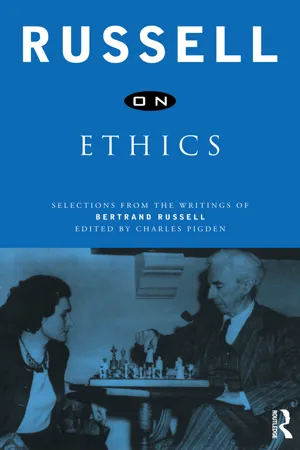
Russell on Ethics presents a coherent and comprehensive collection of Russell's ethical writings, drawing on a wide range of his publications on ethical concerns, many of which have been difficult to access by students and general readers. Charles Pigden provides an accessible introduction to the papers, situating them within the field of ethics as a whole and detailed annotations on the papers themselves, analysing their arguments and exploring their relevance to current concerns. Russell on Ethics represents a valuable insight into Russell as an ethicist, which will be useful to both specialist and non-specialist alike.
eBook - ePub
Russell on Ethics
Selections from the Writings of Bertrand Russell
- 272 pages
- English
- ePUB (mobile friendly)
- Available on iOS & Android
eBook - ePub
About this book
Information
Part I
A Moralist in the Making
The pre-Principia writings
1
Greek Exercises
Extracts 1888
Reprinted from CPBR vol. 1: 8–11. During his teenage years, Russell came to doubt the religious and moral opinions in which he had been brought up by his grandmother, Lady Russell. His first exercise in philosophy was an attempt to come to terms with these doubts. He kept a secret journal, entitled ‘Greek Exercises’, in which his philosophical reflections, though written in English, were transliterated into Greek letters according to a phonetic system of his own devising. The purpose of this subterfuge was to conceal his thoughts from prying eyes, particularly those of his grandmother. The following extracts deal with his conversion to utilitarianism and his resolution to adopt an ethic based on ‘reason’ rather than the customs that had helped to preserve that section of the human species to which he belonged. The Miss Buhler to whom Russell could open his heart had been his Swiss governess. For the full text see CPBR vol. 1: 3–21.
8
April 18th. Accepting then the theory that man is mortal, and destitute of free will (which is as much as ever a mere theory, as of course all these kinds of things are mere speculations), what idea can we form of right and wrong? Many say, if you make any mention of such an absurd doctrine as predestination (which comes to much the same thing, though parsons don’t think so), why what becomes of conscience, etc. (which they think has been directly implanted in man by God)? Now my idea is that our conscience is in the first place due to evolution, which would of course form instincts of self-preservation, and in the second place, to civilization and education, which introduces great refinements of the idea of self-preservation. Let us take for example the ten commandments as illustrative of primitive morality. Many of them are conducive to the quiet living of the community, which is best for the preservation of the species. Thus what is always considered the worst possible crime, and the one for which most remorse is felt, is murder, which is direct annihilation of the species. Again, as we know, among the Hebrews it was thought a mark of God’s favour to have many children, while the childless were considered as cursed of God. Among the Romans also widows were hated, and I believe forbidden to remain unmarried in Rome more than a year. Now why these peculiar ideas? Were they not simply because these objects of pity or dislike did not bring forth fresh human beings? We can well understand how such ideas might grow up when men became rather sensible, for if murder and suicide were common in a tribe, that tribe would die out, and hence one which held such acts in abhorrence would have a great advantage. Of course among more educated societies these ideas are rather modified; my own I mean to give next time.
9
April 20th. Thus I think that primitive morality always originates in the idea of the preservation of the species. But is this a rule which a civilized community ought to follow? I think not. My rule of life, which I guide my conduct by and a departure from which I consider as a sin, is to act in the manner which I believe to be most likely to produce the greatest happiness, considering both the intensity of the happiness and the number of people made happy. I know that Granny considers this an impractical rule of life and says that since you can never know the thing which will produce greatest happiness, you do much better in following the inner voice. The conscience however can easily be seen to depend mostly upon education (as for example common Irishmen do not consider lying wrong), which fact alone seems to me quite sufficient to disprove the divine nature of conscience. And since, as I believe, conscience is merely the combined product of evolution and education, then obviously it is an absurdity to follow that rather than reason. And my reason tells me that it is better to act so as to produce maximum of happiness than in any other way. For I have tried to see what other object I could set before me, and I have failed. Not my own individual happiness in particular, but everybody’s equally, making no distinction between myself, relations, friends or perfect strangers. In real life it makes very little difference to me as long as others are not of my opinion, for obviously where there is any chance of being found out, it is better to do what one’s people consider right. My reason is, for this view, first that I can find no other, having been forced, as everybody must who seriously thinks about evolution, to give up the old idea of asking one’s conscience, next that it seems to me that happiness is the great thing to seek after, and which practically all honest public men do seek after. As an application of the theory to practical life, I will say that in a case where nobody but myself was concerned (if indeed such a case exist), I should of course act entirely selfishly, to please myself. Suppose for another instance that I had the chance of saving a man whom I knew to be a bad man who would be better out of the world. Obviously, I should consult my own happiness better by plunging in after him. For if I lost my life, that would be a very neat way of managing it, and if I saved him I should have the pleasure of no end of praise. But if I let him drown, I should have lost an opportunity of death, and should have the misery of much blame, but the world would be the better for his loss, and, as I have some slight hope, for my life.
11
April 29th. In all things I have made the vow to follow reason, not the instincts inherited partly from my ancestors and gained gradually by them owing to a process of natural selection, and partly due to my education. How absurd it would be to follow these in the questions of right and wrong. For as I observed before, the inherited part can only be principles leading to the preservation of the species, or of that particular section of the species to which I belong. The part due to education is good or bad according to the individual education. Yet this inner voice, this God-given conscience which made Bloody Mary burn the Protestants, this is what we reasonable beings are to follow. I think this idea mad and I endeavour to go by reason as far as possible. What I take as my ideal is that which ultimately produces greatest happiness of greatest number. Then I can apply reason to find out the course most conducive to this end. In my individual case, however, I can also go more or less by conscience, owing to the excellence of my education. But it is curious how people dislike the abandonment of brutish impulses for reason. I remember poor Ewen getting a whole dinner of argument owing to his running down impulse. Today again at tea Miss Buhler and I had a long discussion because I said that I followed reason not conscience in matters of right and wrong. I do hate having such peculiar opinions, because either I must keep them bottled up, or else people are horrified at my scepticism, which is as bad with people one cares for as remaining bottled up. I shall be sorry when Miss Buhler goes, because I can open my heart easier to her than to my own people (strange to say).
2
On the Foundations of Ethics
1893
Reprinted from CPBR vol. 1: 208–11. Though Russell was studying philosophy at the time, this paper was not written for any of his courses, but for the edification of his sweetheart, Alys Pearsall Smith (1867–1951), soon to be his first wife. It starts out as a systematic criticism of T. H. Green’s Prolegomena to Ethics (1883) but ends up as an exposition of Russell’s own view which was, he thought, ‘that of most of the younger men at Cambridge’ (CPBR vol. 1: 206). Russell was probably right in this, since the opinions he advocates are largely derived from McTaggart. McTaggart (1866–1925) was a neo-Hegelian philosopher who had recently published a pamphlet, The Further Determination of the Absolute (1893). Perhaps because of its arresting title, this work enjoyed a considerable vogue at Cambridge and Russell was, in some degree, a convert to its doctrines. These included personal immortality.
I found that all I had thought about ethics and logic and metaphysics was considered to be refuted by an abstruse technique that completely baffled me; and by this same technique it was to be proved that I should live forever … for a time I more or less believed it.
(Russell 1961: 35)
McTaggart also argued that since ‘reality is exclusively spirit’, ‘the universe and ourselves are implicitly in harmony – a harmony which must some day become explicit’ (McTaggart 1931: 210–11). This harmony would be a ‘civitas dei, a community – one might say a communion – of individual spirits in a loving state of mutual awareness. Russell employs this hypothesis to solve a problem raised by Henry Sidgwick (1838–1900), Knightsbridge Professor of Moral Philosophy at Cambridge, whose course on ethics Russell was attending. In his classic work, The Methods of Ethics, Sidgwick comes to the reluctant conclusion that ‘Practical Reason’ is subject to a certain ‘Dualism’. It is reasonable to promote the general happiness and reasonable to promote one’s private happiness, but when the two come into conflict it is not more reasonable to prefer the one to the other (Sidgwick 1907: 496–509). Since Sidgwick thought that ‘ought’-judgements express the dictates of reason, this meant that ‘the Cosmos of Duty is thus really reduced to a Chaos’ (Sidgwick 1874: 473, quoted in Mackie 1976: 77). Russell jokes about the problem in a letter to Alys. ‘I wish it were my duty to come to luncheon tomorrow but alas this is one of the cases where enlightened self-interest and universalistic hedonism part company: I must therefore stay at home and read … to my grandmother’ (Griffin 1992: 16). McTaggart’s version of the Hegelian Absolute enabled Russell to restore order to Sidgwick’s Chaos. Since we are immortal, we will live to see the future harmony, and since it will be supremely pleasurable for all its participants, it is something we have an egoistic reason to promote. But the future harmony is one of mutual awareness. Hence my future happiness is dependent on that of everyone else. I cannot promote the one without promoting the other. Thus in the long run, at any rate, duty and self-interest coincide.
However, this solution rests on two whopping metaphysical posits: personal immortality and a future harmony. Russell soon came to disbelieve in them both.
NB. T. H. Green (1836–82) was the first major figure of the British neo-Hegelian movement. Russell says he is ‘involved’ in a circle in Bk III, chap. II of his Prolegomena. It is not clear to me which of several possible circles Russell has in mind.
The Art of Living, with which Ethics is concerned, includes, in its widest sense, every other art. <Art is here used, in its technical sense, as a series of rules, for the guidance of practice, based upon the laws of the corresponding Science: as e.g. the Art of Engineering on the Science of Mechanics.> It must therefore be based upon a Science which shall include every other Science, or at least be logically prior to every other Science; that is, it must be based on Metaphysics. Before we can determine what ought to be done, we must, if our proceeding is to be logical (which of course is not an obvious requirement), first determine what end we should consider desirable if attainable. If it be said that our moral sense is prior to Science and that this gives us direction as to particular duties, without any consideration of ends, I should admit the first proposition, but should maintain that our moral sense is in itself an empty form, merely telling us that we have a duty; that the filling of this form must be (and is) derived from experience and knowledge. [This process would be similar to that by which the Categories (which are supplied a priori) derive their content from experience, so that all knowledge is subsequent to experience although some elements of it are logically prior to experience.] Such an a priori element there must be in morality: since the idea of duty is obviously not derived from phenomena. But the filling of the idea of duty must be got from considerations not purely ethical and the true procedure would seem to be
1 To determine the most perfect form into which it is metaphysically possible for the universe to develop
2 To discover (if we can) the best means to the attainment of this end.
[It is clear how we require the moral sense at this stage to make us pursue our idea of perfection however the pursuit may conflict with irrational desires.] The second of the above steps is a matter of detail in any particular branch of conduct, depending upon particular sciences: it does not concern us as philosophers, but only as actors. Let us consider further the first of these steps to a philosophic Ethic.
Green throughout considers the ultimate ideal to be a universe of perfect virtue; and supposes the true end of action to be the attainment of a virtuous character by ourselves and those whom we can influence. There is undoubtedly in this view, something which commends itself to the virtuous mind: but in philosophy we must rid ourselves of the bias of virtue as of every other. And when we have effected this, we shall I think be bound to confess that Virtue can be only a means to an end, not itself an ultimate end. For what is Virtue? A disposition to obey the dictates of Ethics. These dictates must themselves then derive their sanction from some consideration which is not ethical. Or again: the perfect state must be timeless: for any change would ex hypothesi mar the perfection which had been attained. There will therefore be no action in the perfect state, for action is a process in time; virtue being then that which prompts to right action must also disappear. Or again, if the last argument appears too mystical, virtue depends upon the necessity of acting, and the necessity of acting depends upon the possibility of ameliorating something; and in the perfect state this possibility will cease to exist. Or I might appeal to McTaggart’s pamphlet for the proof that emotion alone would remain possible: desirable emotion for all spirits must therefore be the end of action. [The proof of this in the pamphlet depends in no way so far as I can see upon Hegelian metaphysics.] This doctrine is really Utilitarian; but by the assumption of the perfectibility of the universe it has been made to assume quite a different aspect from that of the Utilitarianism which regards every separate pleasure as of intrinsic value. This view would estimate the goodness of an act by its tendency to promote absolute harmony among spirits; since this harmony when established would involve the eternal happiness of all spirits, the passing pleasures and pains of our present existence in time would be of no account to it; and its precepts would often lead to acts which might increase human misery for a time, though it would reckon on an ultimate recompense.
As an example of the great difference between this doctrine (which yet considers happiness the one thing desirable per se) and ordinary Utilitarianism I may perhaps parenthetically quote another theorem of McTaggart’s, of which I do not know the proof but which we can all verify approximately from our own consciousness. He says that if y be our actual attainment at any given time and x our greatest possible attainment in the time, our unhappiness may be represented by the product y(x − y). This is largest when we have attained half as much as we might; and is zero when we have attained nothing or everything. With those whose development is less than half what it might be it becomes our duty then to make them unhappy, as the only means to greater happiness.
To return from our digression: we can by an ethic of the above kind get out of the circle in which Green is involved in Bk. III, Chap. II; at least so far as the determination of our duty is concerned: though of course if we ask why we should do our duty, the circle reappears and must reappear if the moral sense is part of the ‘a priori furniture’ of our minds, as I have supposed. But Green’s ethic gives no method by which two conscientious people who hold different views about a particular duty can argue the question on which they differ: unless we assume, as he is inclined to do, that self-sacrifice is a good in itself. The fact that his theory suggests this result ought almost to be enough to condemn it; self-sacrifice I suppose means the performance of an action from which we expect more pain than pleasure to ourselves: and although so long as evil exists such actions will be necessary, it is difficult to see how in itself self-sacrifice can be anything but an evil. The view that I have advocated is suggested as an ameliorated Utilitarianism in §360 and objected to in §361 apparently solely on the ground of indefiniteness: this objection is largely removed by such considerations as McTaggart brings forward in his pamphlet, and it seems to me that all the ordinary duties are easily deducible from it, while it draws the limit better than Green’s view between valuable self-denial and that which is purely waste, of which there is unfortunately so much just now.
But it must not be supposed that this view in any way minimises the importance of virtue: it is clearly only by action that our condition can be ameliorated, and this must always require virtue: but the more perfection is approached, the less often will self-sacrifice be necessary. When sympathy is more developed no person will be able to feel happiness in the pursuit of his own selfish pleasures if he knows he might be improving the condition of another, and thus gradually selfishness and unselfishness will become indistinguishable, the end of each will be the end of all. Previous virtue is no doubt a condition of the attainment of this s...
Table of contents
- Cover Page
- Half Title page
- Russell On… General editor's introduction
- Title Page
- Copyright Page
- Dedication
- Contents
- Preface and Acknowledgements
- Introduction
- Part I A Moralist in the Making The pre-Principia writings
- Part II Meta-Ethics
- Part III Reason and the Passions
- Part IV The Function of Morality
- Part V Contemplation and the Good Life
- Bibliography
- Index
Trusted by 375,005 students
Access to over 1.5 million titles for a fair monthly price.
Study more efficiently using our study tools.
Frequently asked questions
Yes, you can cancel anytime from the Subscription tab in your account settings on the Perlego website. Your subscription will stay active until the end of your current billing period. Learn how to cancel your subscription
No, books cannot be downloaded as external files, such as PDFs, for use outside of Perlego. However, you can download books within the Perlego app for offline reading on mobile or tablet. Learn how to download books offline
Perlego offers two plans: Essential and Complete
- Essential is ideal for learners and professionals who enjoy exploring a wide range of subjects. Access the Essential Library with 800,000+ trusted titles and best-sellers across business, personal growth, and the humanities. Includes unlimited reading time and Standard Read Aloud voice.
- Complete: Perfect for advanced learners and researchers needing full, unrestricted access. Unlock 1.5M+ books across hundreds of subjects, including academic and specialized titles. The Complete Plan also includes advanced features like Premium Read Aloud and Research Assistant.
We are an online textbook subscription service, where you can get access to an entire online library for less than the price of a single book per month. With over 1.5 million books across 990+ topics, we’ve got you covered! Learn about our mission
Look out for the read-aloud symbol on your next book to see if you can listen to it. The read-aloud tool reads text aloud for you, highlighting the text as it is being read. You can pause it, speed it up and slow it down. Learn more about Read Aloud
Yes! You can use the Perlego app on both iOS and Android devices to read anytime, anywhere — even offline. Perfect for commutes or when you’re on the go.
Please note we cannot support devices running on iOS 13 and Android 7 or earlier. Learn more about using the app
Please note we cannot support devices running on iOS 13 and Android 7 or earlier. Learn more about using the app
Yes, you can access Russell on Ethics by Bertrand Russell, Charles Pigden in PDF and/or ePUB format, as well as other popular books in Filosofia & Filosofia etica e morale. We have over 1.5 million books available in our catalogue for you to explore.