This is a short, accessible and practical guide to running venues which are in the business of hosting events. Using honest guidance peppered with the author's real-life situational anecdotes to contextualise the topics, the book is logically structured around the key stages of event management: pre-event, onsite and post-event. Topics covered include developing the client relationship, marketing, financial accountability, risk, interdepartmental communication, onsite procedures and post-event evaluation. This is a fundamental resource for all event management and hospitality students. It is also a book for anybody who manages a venue or is a venue event manager. The Practical Guide to Managing Event Venues makes the business of venue management appealing, understandable and achievable.
- 236 pages
- English
- ePUB (mobile friendly)
- Available on iOS & Android
eBook - ePub
The Practical Guide to Managing Event Venues
PART I
The management of event venues
Chapter 1
What is a venue?
1.1 Definition of venue
In my first book of this series, The Practical Guide to Organising Events, I defined an event as any live happening.
A venue is where a live happening takes place.
If the live happening is not an accident or incident, but is planned (events management is the planning of live happenings), then the venue is an event venue – even if it is used for a one-off event.
1.2 Types of venue
Now we understand what a venue is, we can identify various types of venue where events take place.
1.2.1 Dedicated venues
A dedicated venue is a place constructed for the purpose of staging or hosting events – we may call this type of venue a purpose-built venue.
This type of venue would usually be built specifically for a certain type of event, such as a conference centre for hosting conferences, or a sports stadium for hosting sporting events.
Being a venue built for purpose, the architect would design the facility specifically for the needs of that type of event. For example:
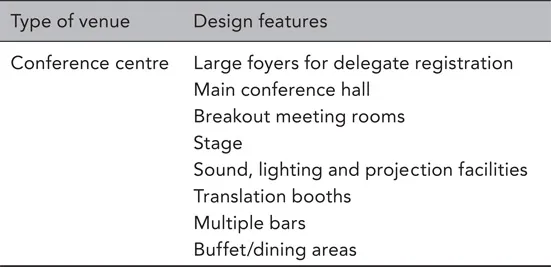
Otherwise, it could be a purpose-built multi-purpose venue, such as modern-day sports stadia which are now designed to facilitate the business of all events, not just sporting. Nowadays, a sports stadium will incorporate conference facilities, banqueting suites and nightclubs.
1.2.2 Non-dedicated venues
This type of venue is not built for the purpose of events. This could be an art gallery, nightclub, museum, library or any other building that could host an event due to its size, location, facilities or interesting architecture, but the primary purpose of the building is not events.
Venues that are not built for the purpose of events will most often have a core business that is not events driven. In such venues, their events business is secondary. These are ‘part-time’ event venues, then.
Within this category, could also be included pubs, bars and restaurants because their main purpose of business is that of retailing food and drink. Yet, most pubs host social events, such as quiz nights, live music, and New Year’s Eve parties, and most restaurants host parties, wedding banquets and private dining rooms. Even so, this does not make them dedicated event venues.
An example of this type of venue would be the Natural History Museum in London – which, although was not constructed for the purpose of hosting events, but for housing and displaying museum exhibits – does host an extraordinary number of corporate parties, weddings, conferences, fashion shows, and filming. Its primary role as a museum means that this particular venue is open to the public every day from 10:00 until 17:30. Thus, the Natural History Museum hosts events as a secondary contribution to its core business. As with most such venues, the Natural History Museum splits its role to accommodate events outside its usual operating hours.
Even if a palace, castle or historic house were now purpose-run for events – as many are these days for weddings, team-building activities, small conferences – and events have become the primary income, it would be wrong to categorise this venue as being dedicated because it cannot be assumed that all palaces, castles and historic houses are run solely for the purpose of events. Besides, a palace, castle or historic house was not built for the purpose of events.
A non-dedicated event venue may also be a ‘green-field’ site, such as a public park hosting an open-air concert, funfair or festival.
Note: A ‘green-field’ site is not necessarily a parkland or grassy area, but is the generic term applied to a venue where limited or no facilities exist. Green-field sites can be empty buildings, disused factories, warehouses, car parks or anywhere where no facilities or services exist in situ. Indeed, in many cases, green-field sites do not have electricity, water, drainage or toilet facilities.
Where there are basic facilities, the venue would be termed as a ‘brown-field’ site.
Examples of dedicated and non-dedicated venues
Dedicated | Non-dedicated |
|---|---|
Hotels | Green-field sites |
Conference centres | Historic houses |
Sports stadia | Museums |
Banqueting halls | Public libraries |
Exhibition halls | Castles |
Palaces | |
Pubs, bars, restaurants | |
Nightclubs | |
Theatres | |
Country house hotels |
Examples of popular events held at non-dedicated venues
Chelsea Flower Show | held at | The Royal Hospital Chelsea |
Hampton Court Flower Show | held at | Hampton Court Palace |
The Route of Kings Concerts | held at | Hyde Park |
The BAFTA Awards | held at | The Royal Opera House |
The Hay Literary Festival | held at | marquees at Hay on Wye |
Glastonbury Festival | held at | a working dairy farm |
1.2.3 Unusual venues
There are certain venues that fall into the unusual venue category (otherwise referred to as special venues). These are places that can already be identified as non-dedicated venues, but also they would rarely host events or may never have hosted an event.
So, whereas the Natural History Museum in London is non-dedicated for events, it has become adept at hosting many events and has an events team; it has well-practiced events procedures; and it has a portfolio of trusted suppliers, such as technical providers and event catering companies. It is important to note here that an events team in a venue such as this would be experienced in client handling and events management.
The difference which makes an unusual venue, is a non-dedicated venue that does not have an events team because the premises are not usually used for events. Therefore, none of the staff would have events experience, the venue is not practiced in managing and handling events, and there would be no chain of trusted events suppliers.
The question may arise as to why a client would seek an unusual venue. It would be because the client wants somewhere unusual – somewhere that is unique, and where no other client has yet held an event.
Such unusual venues may be country houses, warehouses, private estates, disused buildings, barns, or any place of architectural interest.
1.3 The demand for unusual venues
In simple economic terms, demand drives need. Creativity is the new need. So, event clients have learnt to search for more exciting, more innovative and more interesting venues.
And, it is an upward spiral: the more adventurous a client is with choosing a venue one year, so their need is to be even more adventurous the following year.
This does not mean that if a venue is traditional or is a dedicated events venue it will lose out to unusual or non-dedicated venues. What it does mean is that all venues need to provide their clients and guests with a top-quality event experience. Otherwise, the venue – dedicated or otherwise – will lose business to its competitors. In today’s event marketplace, where all buildings are potential venues, all other buildings are competitors.
So, achieving bookings through events is ever more an aggressive and increasingly competitive market. Venues have to try harder. They need to create their reputation for good event handling, and protect it. They require knowledgeable and trained events staff to attract and retain events business… And, so the events industry is self-regulating. It is evolving and getting better at it. There are qualifications in events management now – it has become a career!
Chapter 2
The Berners hierarchy of event needs
The demand for venues is driven for the following reasons, which we may call ‘The Berners Hierarchy of Event Needs’.
- A need to avoid traditional event venues, particularly hotels. In event circles, hotels represent lazy and boring events (this is discussed further in Chapter 3).
- The need to excel the previous event. If the event occurs annually – a Christmas party or a yearly conference, say – the company or client will need to excel the previous year’s event experience.
- The need to outdo competitors. Where a company’s competitor is providing an event for their clients, there is a need to outdo the competition.
- To continue the need for newness, excitement, progression and growth. If a company is innovative, and is growing and improving, it will not want its events to remain staid and non-progressive.
- The need to reflect the company’s profile. Often, the client will seek a venue which reflects the company profile. So, a company that designs expensive contemporary furniture, say, would not choose to place their event in a rundown local hotel.
- The need to entertain guests in a surprising and exciting environment. Another reflection of a company’s dynamics, clients strive to project the core values of the business by choosing unusual venues for their events.
- The need to generate word-of-mouth success. Clients need their event guests to be talking about a memorable event, and what a wonderful and exciting event they attended.
- To provide the ‘need’ for guests to attend the event. A poorly attended event would be a negative reflection of a company’s success. So, the venue needs to be exciting, interesting and otherwise inaccessible so as to help with the ‘need to attend’ factor. It also drives the need for guests to receive an invitation for next year’s event, and confirm their attendance.
- The need to add value to the event. An exciting and fascinating venue adds value to the guest experience.
- The need to provide guests with a unique experience. Corporate event clients do not wish to follow trends – they wish to set trends.
- The need to achieve press coverage. High-profile events tend to book unusual venues to heighten press interest and coverage.
Author’s voice box
Recently, a publishing company with offices in central London flew its sales team to Monaco for a two-day conference.
Clearly, there are many suitable venues in London, itself – within wal...
Table of contents
- Cover
- Half Title
- Title Page
- Copyright Page
- Table of Contents
- List of Contributor
- Acknowledgements
- Part I The management of event venues
- Part II Event procedures for venues
- Part III Post-event procedures
- I Event forecast
- II Venue contract
- III Function sheet/event schedule
- IV Final report
- Glossary
- Index
Trusted by 375,005 students
Access to over 1.5 million titles for a fair monthly price.
Study more efficiently using our study tools.
Frequently asked questions
Yes, you can cancel anytime from the Subscription tab in your account settings on the Perlego website. Your subscription will stay active until the end of your current billing period. Learn how to cancel your subscription
No, books cannot be downloaded as external files, such as PDFs, for use outside of Perlego. However, you can download books within the Perlego app for offline reading on mobile or tablet. Learn how to download books offline
Perlego offers two plans: Essential and Complete
- Essential is ideal for learners and professionals who enjoy exploring a wide range of subjects. Access the Essential Library with 800,000+ trusted titles and best-sellers across business, personal growth, and the humanities. Includes unlimited reading time and Standard Read Aloud voice.
- Complete: Perfect for advanced learners and researchers needing full, unrestricted access. Unlock 1.5M+ books across hundreds of subjects, including academic and specialized titles. The Complete Plan also includes advanced features like Premium Read Aloud and Research Assistant.
We are an online textbook subscription service, where you can get access to an entire online library for less than the price of a single book per month. With over 1.5 million books across 990+ topics, we’ve got you covered! Learn about our mission
Look out for the read-aloud symbol on your next book to see if you can listen to it. The read-aloud tool reads text aloud for you, highlighting the text as it is being read. You can pause it, speed it up and slow it down. Learn more about Read Aloud
Yes! You can use the Perlego app on both iOS and Android devices to read anytime, anywhere — even offline. Perfect for commutes or when you’re on the go.
Please note we cannot support devices running on iOS 13 and Android 7 or earlier. Learn more about using the app
Please note we cannot support devices running on iOS 13 and Android 7 or earlier. Learn more about using the app
Yes, you can access The Practical Guide to Managing Event Venues by Philip Berners in PDF and/or ePUB format, as well as other popular books in Business & Hospitality, Travel & Tourism Industry. We have over 1.5 million books available in our catalogue for you to explore.