eBook - ePub
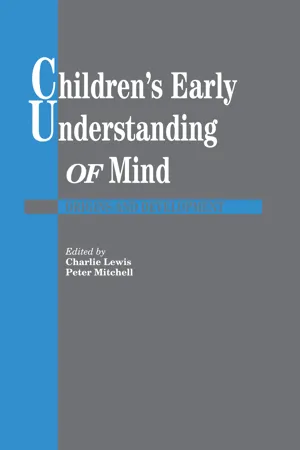
Children's Early Understanding of Mind
Origins and Development
- 493 pages
- English
- ePUB (mobile friendly)
- Available on iOS & Android
eBook - ePub
About this book
A major feature of human intelligence is that it allows us to contemplate mental life. Such an understanding is vital in enabling us to function effectively in social groups. This book examines the origins of this aspect of human intelligence.
The five sections attempt firstly, to place human development within an evolutionary context, focusing on the possibility of innate components of understanding. The second aim of the book is to examine the roles of early perception, pretence and communication as precursor skills in the development of a grasp of mental states. Thirdly, attention is given to the possibility that children know a good deal more about the mind than is apparent from many studies designed to probe their abilities. Taken together, the chapters in this book mark a new focus within a 'theory of mind' movement, examining a group of skills in infancy and early childhood which culminate towards the end of the preschool period in a more mature understanding of one's and others' mental states. Drawing together researchers from diverse theoretical positions, the aim is to work towards a coherent and unified account of this fundamental human abiity. This book will be of central relevance to psychologists and those in related disciplines, particularly education and philosophy.
Information
Publisher
Psychology PressYear
2014Print ISBN
9780863773525
9780863773334
Edition
1eBook ISBN
9781317775218
1 | Critical Issues in Children’s Early Understanding of Mind |
University College, Swansea, UK
Lancaster University, UK
INTRODUCTION
A fascination with mind and psychological states is fundamental to human intellectual functioning. For example, the diversity of literary genres, from Shakespeare to soap opera, share a common theme: exploring the reasons why people act as they do. There has been an ambivalence towards the concept of mind over the course of 20th-century psychology, but over the past couple of decades there has been an increasing consensus that our passion for dwelling upon psychological matters forms a central feature of the human condition. It is perhaps no mere coincidence that humans are unique both in their creation of culture and in their expertise in contemplating the psychological (see Crook, 1980, for a detailed socio-biological view of the emergence of culture). In this respect, we adopt the role of the “intuitive psychologist” (Humphrey, 1983).
What is the fundamental cognitive basis of our theory of mind? It is an understanding of the mind–world distinction, and that behaviour is the product of belief and desire rather than just desire (cf. Bartsch & Wellman, 1989; Wellman & Bartsch, 1988; this volume). So if we wish to triumph over someone in the game of life, or at least manoeuvre them to fulfil our needs, it is greatly advantageous to understand that misinformation instils a false belief in others, leading them to act as we want them to. So, we endeavour to influence others’ behaviour by manipulating the content of their beliefs. This is an activity premised on the assumption that people hold their beliefs as being true of reality and act on them accordingly (cf. Perner, 1991; Perner, Baker, & Hutton, this volume).
This fascination with mental states has become a major focus of attention within psychology over the past 15 years. It is now widely recognised that an ability to make inferences about others’ representational states, and to predict behaviour accordingly, is a fundamental human ability, and this topic now rightly assumes a central position in human experimental psychology. The cornerstone issue concerns the development of understanding that people, including oneself, can hold false beliefs. Such understanding liberates the individual from immediate reality, and enables a grasp of the concept that behaviour is the product of what people believe to be true rather than of what is really true. Investigating how a theory of mind develops potentially offers great insight into the character of social cognition. An explosion of research has shown that by the end of their preschool years children come to take many of these skills for granted (e.g. Astington, Harris, & Olson, 1988; Frye & Moore, 1991; Whiten, 1991). This book attempts to take the next step towards an understanding of how these developments occur. It examines what happens before as well as during the period when the child comes to demonstrate an understanding of possible discrepancies between events in the world, and people’s differential understanding of those events. So with reference to early competencies the authors of this volume ask: “How primitive is this ability?”; “Are some elements innate?”; “How do the child’s experiences feature in the emergence and refinement of a theory of mind?”
TESTS OF THEORY OF MIND COMPETENCE: THE RESEARCH LEGACY
Perhaps as a legacy of the previously dominant Piagetian approach to cognitive development, many investigators have assumed that theory of mind develops in stages (e.g. Gopnik & Wellman, 1992; Perner, 1991; Sullivan & Winner, 1991; Wimmer & Hartl, 1991), an assumption made in many of the chapters of this volume. This claim is based to a considerable extent on three-year-old children’s failure to acknowledge false belief, as demonstrated in the two following complimentary experimental paradigms.
1. The Unexpected Transfer Test. This can be regarded as the seminal demonstration in contemporary research on theory of mind that young children have difficulty acknowledging false belief. The task, devised by Wimmer and Perner (1983), is as follows. The child subject observes a story enacted with a pair of dolls. One of these is a boy called Maxi, who leaves chocolate in a kitchen cupboard (location A), and then departs from the scene. In his absence, the other doll (his mother) enters and transfers the chocolate to another cupboard in the kitchen (location B). Maxi did not witness this transfer due to his absence, and therefore is ignorant that the chocolate has moved to a new location. The observing child is then informed by the experimenter that Maxi is returning to the kitchen to get his chocolate, and is invited to judge where Maxi will look. In the seminal study, children below age five years, unlike most older children, often gave realist judgements that Maxi would look where the chocolate was stored at the time of asking, rather than in the location Maxi last saw the chocolate.
Since that initial finding, most published studies report that children of four years are proficient in acknowledging false belief, with the accompanying claim that it is specifically children below this age who are yet to develop a fully fledged theory of mind. Perner (1991) accounts for the discrepancy between earlier and later findings by noting that, in later procedures, a convention emerged for explicitly pointing out to the observing child that Maxi was ignorant of the chocolate being transferred.
2. The Deceptive Box Test. For whatever reason children fail to acknowledge false belief in the unexpected transfer test, it certainly is not merely because it is a hypothetical scenario enacted with dolls. This was demonstrated by results of the deceptive box test (Perner, Leekam, & Wimmer, 1987), which typically does not involve dolls. In this task, the experimenter will show the child a box whose exterior proclaims its content (e.g. a Smarties tube), and asks the child what she thinks is inside. After the child has replied “Smarties,” the experimenter reveals surprisingly that the contents are pencils, returns them to the tube and asks what another child will think is in the tube. As in the unexpected transfer task, children aged around three years often give the wrong answer of “pencils” (a realist judgement.
This task has been adapted to ask children to comment on their own initial belief about the deceptive box’s content (Gopnik & Astington, 1988). In doing so, children are at least as likely to commit a realist error. Having seen the true contents of the box, they judge that when they had first seen the tube they had thought it contained pencils. This finding carries important theoretical implications, since it suggests that development of a theory of mind pertains also to knowledge of one’s own mind. Firstly, it argues against the Cartesian position that the mind is transparent to itself, which implied that development takes the form of introspecting and applying insights into one’s own mind to others’ minds (Wimmer & Hartl, 1991). Secondly, it makes it inappropriate to characterise young children’s difficulty acknowledging false belief merely as a symptom of egocentrism. Young children’s difficulty is more general than one of confusing their own with others’ beliefs, since they even seem ignorant of the representational quality of their own mental states.
THE SPECIAL CASE OF AUTISM
Research into theory of mind assumed even greater significance with the advent of the “theory of mind hypothesis of autism” (e.g. Frith, 1989). This hypothesis presents autism as a disorder of social cognition, where the unfortunate individual lacks the insight into mind that most of us take for granted. Supporting evidence arose from a milestone study by Baron-Cohen, Leslie, and Frith (1985). They presented an unexpected transfer task to children with autism, and found realist errors in abundance. The finding was subsequently replicated using a deceptive box procedure (Perner, Frith, Leslie, & Leekam, 1989).
What made these findings especially relevant is that a theory of mind deficiency seemed specific to autism among children above four years of age. For example, Baron-Cohen et al. (1985) showed that children with Down’s syndrome were unimpaired in their ability to acknowledge false belief. Moreover, children with autism apparently did not experience difficulty acknowledging false belief merely because of their delayed language development. Baron-Cohen et al. selectively chose children with autism who had a verbal mental age in excess of four years, yet failure to acknowledge false belief remained rife. Emerging from the early research (e.g. Baron-Cohen et al., 1985) was a prevailing impression that children with autism lacked a theory of mind, as was hypothesised to be the case in normal three-year-olds. However, it now looks as though autism is better construed as aberrant, or different, rather than absent development (e.g. Leekam & Perner, 1991; Leslie & Thaiss, 1992).
From a research standpoint, the relation between investigations into the development of a theory of mind in normal children and in children with autism has been mutually beneficial. As well as shifting attention away from the Piagetian focus on egocentrism, research on developing theories of mind has injected new impetus into the study of autism as a developmental disorder. In particular, the creation of a framework for normal development of social cognition has provided a fruitful point of comparison for abnormal development in this domain. Conversely, studies examining how the autistic theory of mind differs from that of the normal young child’s allows us to specify a variety of cognitive components underlying the facets of theory of mind phenomena (e.g. Leslie & Thaiss, 1992).
THEORETICAL DIVISIONS AND A MOVE TOWARDS RECONCILIATION
Towards the end of the 1980s and into the early 1990s, researchers studying normal development polarised into two opposing camps. One group of researchers published converging data, suggesting that a watershed occurred around the time of the child’s fourth birthday, amounting to a radical conceptual shift (e.g. Gopnik & Astington, 1988; Gopnik & Slaughter, 1990; Perner, 1988; 1991; Perner & Ogden, 1988; Sullivan & Winner, 1991; Wimmer & Hartl, 1991). Meanwhile, another group of researchers accumulated data pointing to early acknowledgment of false belief (e.g. Chandler, Fritz, & Hala, 1989; Bartsch & Wellman, 1989; Lewis & Osborne, 1990; Mitchell & Lacohée, 1991; Siegal & Beattie, 1991; Zaitchik, 1991). Ostensibly, these latter research efforts were to shed light on the progression of development, but sadly are often cited only for their challenge to the received wisdom on the age that the child first acknowledges false belief.
However, as this volume will freely attest, there now prevails a serious and concerted effort to explain how development takes place. The aim is to ask the question “What is the origin of development and how does it progress?” and to begin to answer it. Although the authors of each chapter may ask this question, it does not follow that issues of controversy concerning whether we are underestimating young children’s competence have now vanished. Siegal and Peterson (this volume), for example, remain vociferous in their warning that much speculation on the development of a theory of mind can be questioned because of its failure to consider the clash between the conversational worlds of children and adults that occurs during testing. This valuable point should always be at the forefront of researchers’ minds when devising tests and questions for young children.
Nonetheless, there is a prevailing consensus that we must get down to the task of devising means of assessing and theorising about early competencies. In this volume, a creatively wide variety of different views are expressed. At least four themes seem to emerge from this. One examines general conceptual or innate prerequisites for a theory of mind (chapters by Baron-Cohen & Ring, Butterworth, Hobson, Mitchell, Whiten). The second focuses specifically on the developmental role of early perceptual experience (chapters by Baron-Cohen & Ring, Butterworth, Gopnik et al., Hobson). This issue is also addressed in Freeman’s analysis of the use of pictures in facilitating children’s grasp of mental representation. A third theme concerns the role of pretence in early theory of mind development (Harris, Lillard, Perner). The fourth focuses on linguistic and communication factors, both in terms of how these might play a causal role in development (Baldwin & Moses, Dunn, Robinson, Wellman & Bartsch) and in how we might avoid communication failure with young children, either in tasks (Lewis; Siegal & Peterson) or in facilitating performance by requiring children to create the conditions for false belief in another person (Chandler & Hala, pace, Sodian). Next we expand briefly on these contributions, in chapter order.
PREREQUISITES OF A THEORY OF MIND
Mitchell’s chapter challenges the stage view of development by showing that various manipulations can either decrease or increase the age threshold at which children acknowledge false belief. This evidence gives the impression that age of success is task-specific rather than due to some radical conceptual shift intrinsic to the child’s cognitive development.
Yet it is still necessary to explain why young children are inclined to refer to reality when invited to judge about belief. Mitchell accounts for this by arguing that early realist judgments are not a default consequence of not knowing about belief. Rather, he turns the issue on its head to suggest that failure to acknowledge false belief is a function of an early bias to consult reality in a variety of domains. What changes with age, therefore, is not the ability to understand belief but a diminution in the prominence that reality holds in the child’s cognition. Mitchell argues that an early reality focus could actually be adaptive for a young child whose first mission is to come to grips with the physical aspects of reality.
Of relevance to the third chapter, by Andrew Whiten, is a long-standing debate on the extent to which we should infer mentalism from overt behaviour. Lloyd Morgan’s canon warns that we should avoid such inferences if a behavioural explanation can be presented. In his chapter, Whiten points out that at least in some false belief tests we can explain children’s success in terms of behavioural explanations. For example, Maxi may simply search for the chocolate in the place he last saw it. That is, we can identify an heuristic for correct judgements without invoking the concept of an understanding of false belief.
However, Whiten goes on to argue that, although success can be achieved with complex behaviourism of this kind, it can be achieved much more simply with a cognitivism revolving around the concept of false belief. As such, a complex behaviourism can better be construed as a simple cognitivism. This analysis applies not only to the false belief test, but also to other theory of mind tasks, like the ignorance versus knowledge distinction in level-1 perspective taking (Flavell, Shipstead, & Croft, 1978). In sum, Whiten shows that there is no easily identifiable threshold that can mark the existence of a theory of mind.
Hobson’s chapter discusses the developmental role of perceiving others’ attitudes. He notes that attitudes have both behavioural and mentalistic components. That is, attitudes can be conveyed by a distinctive posture, which in turn conveys a certain frame of mind or mental orientation. As observers, we frequently see what it is in the world that provokes the attitude. For example, the presence of a snake may provoke a posture that we could describe as fear or profound anxiety. We may also see that a single event in the world provokes different reactions in different people. For example, a snake handler presumably appears at peace in the presence of a snake.
In this context, Hobson describes a special kind of attitude that is fundamental to the emergence of an understanding of the representational mind: the propositional attitude, which is captured by phrases such as, “He’s pretending that X,” or “She believes that X.” In the case of propositional attitudes, the child comes to understand that the attitude must hold a special relation with reality, particularly the attitude associated with belief. He or she will learn that beliefs are defined as propositions held to be true (though obviously a young child would not be able to express this understanding explicitly). The child might learn this from events arising in a family context; for example, disputes about who should be admonished for a misdemeanour. In sum, the child will learn that propositional attitudes are locked into reality. However, special cases could then arise where an individual is misinformed about reality, so the construct of false belief becomes pertinent to accommodate this. Hobson goes on to argue how abnormalities in autistic perception of attitudes could give rise to the well-known socially debilitating condition central to this syndrome.
Freeman’s chapter begins with a theme that has been held, albeit tacitly in some cases, by increasing numbers of researchers in this field since Chandler’s (1988) critical analysis: Perhaps too much weight has been given to the standard tests of false belief. This has been regarded as a litmus test for the possession of a theory of mind. Of the standard tests, Freeman argues that the best is that which probes chil...
Table of contents
- Cover
- Half Title
- Title Page
- Copyright Page
- Dedication
- Table of Contents
- List of Contributors
- Preface
- 1. Critical Issues in Children’s Early Understanding of Mind
- PART I ONTOGENESIS OF AN UNDERSTANDING OF MIND
- PART II ATTENTION, PERCEPTION, AND COGNITION: THE LEGACY OF INFANCY
- PART III THE ROLE OF PRETENCE
- PART IV THE ROLE OF COMMUNICATION
- PART V MISREPRESENTATION
- Author Index
- Subject Index
Trusted by 375,005 students
Access to over 1.5 million titles for a fair monthly price.
Study more efficiently using our study tools.
Frequently asked questions
Yes, you can cancel anytime from the Subscription tab in your account settings on the Perlego website. Your subscription will stay active until the end of your current billing period. Learn how to cancel your subscription
No, books cannot be downloaded as external files, such as PDFs, for use outside of Perlego. However, you can download books within the Perlego app for offline reading on mobile or tablet. Learn how to download books offline
Perlego offers two plans: Essential and Complete
- Essential is ideal for learners and professionals who enjoy exploring a wide range of subjects. Access the Essential Library with 800,000+ trusted titles and best-sellers across business, personal growth, and the humanities. Includes unlimited reading time and Standard Read Aloud voice.
- Complete: Perfect for advanced learners and researchers needing full, unrestricted access. Unlock 1.5M+ books across hundreds of subjects, including academic and specialized titles. The Complete Plan also includes advanced features like Premium Read Aloud and Research Assistant.
We are an online textbook subscription service, where you can get access to an entire online library for less than the price of a single book per month. With over 1.5 million books across 990+ topics, we’ve got you covered! Learn about our mission
Look out for the read-aloud symbol on your next book to see if you can listen to it. The read-aloud tool reads text aloud for you, highlighting the text as it is being read. You can pause it, speed it up and slow it down. Learn more about Read Aloud
Yes! You can use the Perlego app on both iOS and Android devices to read anytime, anywhere — even offline. Perfect for commutes or when you’re on the go.
Please note we cannot support devices running on iOS 13 and Android 7 or earlier. Learn more about using the app
Please note we cannot support devices running on iOS 13 and Android 7 or earlier. Learn more about using the app
Yes, you can access Children's Early Understanding of Mind by Charlie Lewis,Peter Mitchell in PDF and/or ePUB format, as well as other popular books in Psychology & Developmental Psychology. We have over 1.5 million books available in our catalogue for you to explore.