According to the moral error theorist, all moral judgments are mistaken. The world just doesn't contain the properties and relations necessary for these judgments to be true. But what should we actually do if we decided that we are in this radical and unsettling predicament—that morality is just a widespread and heartfelt illusion? One suggestion is to eliminate all talk and thought of morality (abolitionism). Another is to carry on believing it anyway (conservationism). And yet another is to treat morality as a kind of convenient fiction (fictionalism). We tend to think of moral thinking as valuable and useful (e.g., for motivating cooperative behavior), but we can also recognize that it can be harmful (e.g., hindering compromise) and even disastrous (e.g., inspiring support for militaristic propaganda). Would we be better off or worse off if we stopped basing decisions on moral considerations?
This is a collection of twelve brand new chapters focused on a critical examination of the options available to the moral error theorist. After a general introduction outlining the topic, explaining key terminology, and offering suggestions for further reading, the chapters address questions like:
• Is it true that the more that people are motivated by moral concerns, the more likely it is that society will be elitist, authoritarian, and dishonest?
• Is an appeal to moral values a useful tool for helping resolve conflicts, or does it actually exacerbate conflicts?
• Would it even be possible to abolish morality from our thinking?
• If we were to accept a moral error theory, would it be feasible to carry on believing in morality in everyday contexts?
• Might moral discourse be usefully modeled on familiar metaphorical language, where we can convey useful and important truths by uttering falsehoods?
• Does moral thinking support or undermine a commitment to feminist goals?
• What role do moral judgments play in addressing important decisions affecting climate change?
The End of Morality: Taking Moral Abolitionism Seriously is the first book to thoroughly address these and other questions, systematically investigating the harms and benefits of moral thought, and considering what the world might be like without morality.
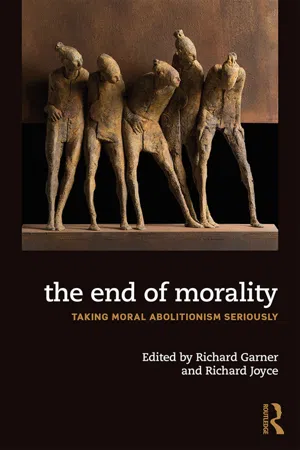
eBook - ePub
The End of Morality
Taking Moral Abolitionism Seriously
- 222 pages
- English
- ePUB (mobile friendly)
- Available on iOS & Android
eBook - ePub
The End of Morality
Taking Moral Abolitionism Seriously
About this book
PART I
Background Thinking
1
GOOD AND GOLD
Jordan Howard Sobel
Editors’ Note
Jordan Howard Sobel (1929–2010) was, at the time of his death, working on a book-length manuscript entitled Good and Gold: A Judgmental History of Metaethics From G. E. Moore Through J. L. Mackie. We are happy here to publish substantial excerpts. While the title “Good and Gold” is a sensible one for Sobel’s whole project, it is clearly somewhat misplaced when applied only to this selection; nevertheless, we prefer to leave it as he intended.1
1 Introduction
This chapter is mainly about J. L. Mackie’s projectivist error theory of the concepts and realities of ethics (Mackie 1977, 1980, 1982). The theory is in part that “the realities of the concepts” do not answer to them: this is the error part. It is for the rest that in moral thought and discourse we project what are, in reality, subjective sentiments to “make up” objective moral properties and conditions: this is the projectivist or objectificationist part. Ordinary moral views and statements in which these would-be properties and conditions are ascribed are in error, which is not to say that these views and statements are all false.2 Consequent to the particular error common to them all, ordinary moral views and statements are none of them true or false. They are, of course, grammatically truth-apt, and may be true in the superassertability-sense of Crispin Wright (1996). They are also truth-apt in the sense of Frank Jackson (1998): they do purport to represent things as being a certain way. But as a matter of philosophical fact, given failure of presuppositions of the reality of their subjects, ordinary moral views are none of them true, nor are any of them false. So goes Mackie’s projectivist error theory. [. . .]
This theory has three pillars. The first is that the realism common to ethical intuitionisms regarding “moral values” is true of the concepts of moral thought and talk. The second is that this realism is not true of the realities of this thought and talk. And the third is that the realities of this thought and talk are subjective sentiments and interpersonal demands, the projection and objectification of which are in the interest of humanity, in that they facilitate the enhancement of these sentiments, since it is in the interest of humanity that they be strong.
2 Intuitionist Realism Is Correct as a Theory of the Concepts of Ordinary Moral Thought and Talk
Intuitionism has long been out of favour, and it is indeed easy to point out its implausibilities. What is not so often stressed, but is more important, is that the central thesis of intuitionism is one to which any objectivist view of values is in the end committed: intuitionism merely makes palatably plain what other forms of objectivism wrap up.
(Mackie 1977: 38)
According to Mackie, ordinary moral thought and talk is in itself largely as intuitionists say it is. They are right as far as the semantics, logic, and concepts of moral thought and talk. They say of it nothing but “platitudes” made precise and sometimes unfamiliar by being dressed out in philosophic terms (“a priori,” “synthetic”), and terms used with particular philosophic edges (“entails,” “necessary”). There are many arguments for the power of the conceptual analysis run out by the intuitionist. Mackie organizes his own support for intuitionist realism as a good theory of the concepts of morality, and the “platitudes” surrounding them, by playing off principal alternatives in modern metaethics: naturalism and noncognitivism. Major weaknesses of these approaches to the concepts and semantics of ordinary moral thought and talk are strengths of the intuitionists’ line.
According to Mackie, moral judgments presuppose that there are objective values, that there are objectively prescriptive qualities. Simple moral judgments purport to ascribe them to things, deny them of things, and so on.
We do think of goodness [for example] as a supposedly objective ought-to-be-ness. In calling something good we do commonly imply that it is intrinsically and objectively required or marked out for existence, irrespective of whether any person, human or divine, or any group or society of persons, requires or demands or prescribes or admires it.
(Mackie 1982: 238)
Not only philosophers think of values as “at once prescriptive and objective,” as “external, extra-mental realities” which when known and appreciated do not “merely tell men what to do but will ensure that they do it” (Mackie 1977: 23). Ideas of values “at once prescriptive and objective” (1977: 23) are to be found not only in Plato. They are implicit in, they are part and parcel of (Mackie maintains), all ordinary distinctively moral thought and talk. They are central to the meanings of special words for this thought and talk: moral concepts are of such realities, such values. [. . .3]
3 Intuitionist Realism Is Incorrect as a Theory of the Realities of Ordinary Moral Thought and Talk
The first sentence of Ethics, after its preface, expresses its manifesto: “There are no objective values” (1977: 15).
Intuitionists are wrong about the realities of morality. And so are most people, though there are some, including some “outlaws and thieves” (1977: 10), who may have seen the light. If they have not clear consciences, but no consciences, this could be because they see that there is nothing moral. But such characters are rare. Most people are mistaken and encouraged by our ordinary moral concepts and ordinary moral thought and talk to take moral matters seriously.
But all of this is mistake-ridden, and centrally: it is of the essence of moral thought and talk to say that there are objective values. It is a general presupposition of all ordinary moral judgments that there are instantiable properties of objective value—which is to say that there can be objectively valuable things, or (in equivalent theoretical terms) that there are objectively valuable things in some possible worlds. This is the error Mackie finds in ethics. When he says there are no objective values, he is not saying merely that nothing is actually morally good, bad, right, wrong, and so on (“not merely”?!). He is saying that, as a matter of metaphysical fact, nothing is possibly morally good, bad, right, wrong, and so on.
It is not merely that, for example, there are no objectively wrong actions, but that there is no such thing as objective wrongness (cf. Mackie 1982: 115). It is certainly not merely that no kinds of action are actually objectively wrong, or wrong in this world, though some are wrong in other possible worlds. For the objective wrongness of a kind of action would supervene on its nature. And though (contrary to Swinburne 1976) “the logical character of this supervenience” would not be analytic (1982: 115),4 it would be necessary, so that if a kind of action were objectively wrong in any possible world, it would be actually objectively wrong in every world, and variations in what would be objectively wrong are not so much as possible. Mackie’s nihilism runs not only against there being particular actions and things that are objectively right or wrong, or good or bad; it runs not only against there being kinds of actions and things that instantiate these properties; it runs against these properties themselves of objective rightness and wrongness (objective ought-to-be-doneness, and ought-not-to-be-doneness), of objective good and bad (ought-to-be-ness and ought-not-to-be-ness). [. . .]
4 Reading Mackie’s Argument in Bayesian Terms
Mackie has negative reasons and positive reasons against ontological intuitionism. He opposes this theory somewhat as someone might (and as Mackie does) oppose the hypothesis that there is an Intelligent Designer of enormous power who is largely responsible for the variety and details of forms of life.
Negatively, a person can be impressed by features of living things that are apparently pointless and useless, and thus puzzling on the Intelligent Design hypothesis: nothing like the quite useless human appendix will be found in a well-made watch or computer. And a person can be impressed by how different a designer of forms of life would need to be from designers of which we have uncontested experience, and how different and mysterious it would be in its work. For this designer would evidently be incorporeal, since otherwise there would be the mystery of how it has gone all these years without being seen, or involved in collisions with things seen. Given this, it would have set about its great work of shaping species simple and complex, assembling genes, “tweaking” DNA, and so on (I am out of my depth!), with “no hands,” simply by the power of thought and will.
Positively, a person opposed to that hypothesis may be comfortable in his opposition because he has in hand another hypothesis that would explain the phenomena of forms of life simple and complex, especially those details that challenge designer hypotheses. There is, he might reflect, Darwin’s hypothesis of random variation and natural selection over billions of years sans intelligent intervention and free of deep mysteries of process and agency. There is, he might think, an alternative hypothesis to Intelligent Design that would have had “in the beginning”—i.e., before assimilation of the evidence of life, its history and diversity, now in hand—greater initial plausibility (that is, in terms of Bayesian confirmation theory, a greater prior probability), and which would have made the total evidence now in hand more likely (that is, in terms of Bayesian confirmation theory again, he might think that this alternative hypothesis will have had a greater likelihood for the now-in-hand evidence, or that this evidence would have been more likely) (cf. Sobel 2004, ch. 7.)
Mackie (1946: 77) writes that he pretends not “to be advancing any particularly new ideas” but to be offering a “re-statement of them” that reveals “how they may be brought together and interrelated” in a manner “radically destructive of all common views of morality.” I am offering to contribute to this project by casting the ideas Mackie’s advances in his 1977 book in terms of Bayesian “priors” for possible explanations of evidence, and “likelihoods” of this evidence on these explanations, i.e., for a Bayesian assessment that favors error theories (particularly Mackiean) over realistic theories (particularly intuitionist) of morality. I make this offer though there is no indication that Mackie was thinking in Bayesian terms when he first formulated his argument (1946: 77–86) and very little that he had it even somewhat in mind when he reformulated it in 1977. I make it because: (i) it is clear that from the start he intended an argument from many “considerations” to an “in all probability conclusion”:
In this paper I do not pretend to be advancing any particularly new ideas . . . But I think I am justified in offering this re-statement of them, because it is seldom realised how they may be brought together and interrelated, or how radically destructive they are of all common views of morality, when this is done.”
(Mackie 1946: 77)
None of these considerations is conclusive, but each has weight: together they move the moral sceptic (who is often of a scientific and inductive turn of mind . . .) to conclude that in all probability we do not recognise moral facts, but merely have feelings of approval and disapproval.
(1946: 80)
[I]n fact all the evidence suggests that not only are moral judgments derived from feelings, but there are no objective moral facts: the feelings are all that exists.
(1946: 86)
(ii) In my opinion, bringing together and interrelating “all the evidence and considerations” of chapter 1 of Mackie’s 1977 book, in terms of Bayesian “priors and likelihoods” assessment of a projective/objectifying error theory and an intuitionist theory of objective moral values, enhances the argument of this chapter for the former “in all probability” over the latter.
Further to Bayesian priors and likelihoods of an hypothesis h in relation to evidence e: What would have been unconditional probability Pr(h), before this evidence was in hand, is the prior of h; and what would then have been the conditional probability Pr(e|h) = Pr(h & e)|Pr(h), is the likelihood of h. In this scheme, what would then have been the conditional probability Pr(h|e) is the posterior of h. It is a theorem of standard probability theory that if hypotheses h and h' are probabilistically exclusive, Pr(h & h') = 0, and probabilistically jointly exhaustive, Pr(h ∨ h') = 1, then:
and similarly (of course):
so that:
Pr(h|e) > Pr(h'|e) if and only if Pr(h)Pr(e|h) > Pr(h')Pr(e|h')
Indeed, this equivalence of inequalities obtains for evidence e and alternative hypotheses h and h' whether or not these hypotheses are probabilistically exclusive and jointly exhaustive alternatives, since it is a theorem of standard probability theory that, for any probability function Pr, and propositions p and q,
This is a consequence of the so-called definition of conditional probability, and the principle that probabilities of logically equivalent propositions are equal.
A Darwinist would find that to his mind both the priors and likelihoods, in relati...
Table of contents
- Cover Page
- Half Title
- Title Page
- Copyright Page
- Table of Contents
- Contributors
- Introduction: Moral Skepticism and the “What Next?” Question
- Part I Background Thinking
- Part II The Case for Abolitionism
- Part III Alternatives to Abolitionism
- Part IV Moral Skepticism: Case Studies
- Index
Trusted by 375,005 students
Access to over 1.5 million titles for a fair monthly price.
Study more efficiently using our study tools.
Information
Publisher
RoutledgeEdition
1Year
2018Topic
PhilosophyPrint ISBN
9780815358602
9780815358596
Subtopic
Ethics & Moral PhilosophyeBook ISBN
9781351122139
Frequently asked questions
Yes, you can cancel anytime from the Subscription tab in your account settings on the Perlego website. Your subscription will stay active until the end of your current billing period. Learn how to cancel your subscription
No, books cannot be downloaded as external files, such as PDFs, for use outside of Perlego. However, you can download books within the Perlego app for offline reading on mobile or tablet. Learn how to download books offline
Perlego offers two plans: Essential and Complete
- Essential is ideal for learners and professionals who enjoy exploring a wide range of subjects. Access the Essential Library with 800,000+ trusted titles and best-sellers across business, personal growth, and the humanities. Includes unlimited reading time and Standard Read Aloud voice.
- Complete: Perfect for advanced learners and researchers needing full, unrestricted access. Unlock 1.5M+ books across hundreds of subjects, including academic and specialized titles. The Complete Plan also includes advanced features like Premium Read Aloud and Research Assistant.
We are an online textbook subscription service, where you can get access to an entire online library for less than the price of a single book per month. With over 1.5 million books across 990+ topics, we’ve got you covered! Learn about our mission
Look out for the read-aloud symbol on your next book to see if you can listen to it. The read-aloud tool reads text aloud for you, highlighting the text as it is being read. You can pause it, speed it up and slow it down. Learn more about Read Aloud
Yes! You can use the Perlego app on both iOS and Android devices to read anytime, anywhere — even offline. Perfect for commutes or when you’re on the go.
Please note we cannot support devices running on iOS 13 and Android 7 or earlier. Learn more about using the app
Please note we cannot support devices running on iOS 13 and Android 7 or earlier. Learn more about using the app
Yes, you can access The End of Morality by Richard Joyce, Richard Garner, Richard Joyce,Richard Garner in PDF and/or ePUB format, as well as other popular books in Philosophy & Ethics & Moral Philosophy. We have over 1.5 million books available in our catalogue for you to explore.