- 298 pages
- English
- ePUB (mobile friendly)
- Available on iOS & Android
eBook - ePub
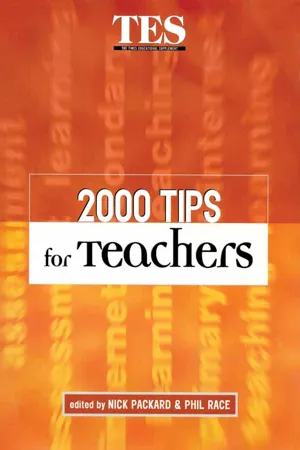
2000 Tips for Teachers
About this book
This volume brings together a wide range of advice and guidance for those teaching in primary and secondary education. It covers the full range of issues facing teachers today and is designed as a dip-in resource for experienced, newly qualified and trainee teachers alike.
Information
Print ISBN
9781138148987
Subtopic
Education General| Part 1 |
Tips across the curriculum
Techniques for effective teaching and classroom management
Planning and assessment
Using teaching and learning resources well
Supporting pupils' learning
Providing personal and pastoral care
Being an effective colleague
Information and Communications Technologies
TECHNIQUES FOR EFFECTIVE TEACHING AND CLASSROOM MANAGEMENT
This section contains some advice on some basic teaching techniques, particularly interaction with pupils. This is perhaps one of the most difficult areas on which to give advice, because the way we work with children tends to be a very personal thing. Techniques that work with one teacher can sometimes prove to be completely useless to another, and it is really important to develop your own style, with which you feel comfortable. People tend to talk about ‘natural authority’ as though it were something that one is either born with or not, but in reality everyone has good days and bad days. One of the principal advantages of being an experienced teacher is that you have learnt not to take unpleasant experience too seriously and you can learn from mistakes. In this section, we aim to share some very practical tips on teaching techniques. If you have already passed the stage of needing such suggestions, please look ahead to later sections of the book.
1. Meeting a class for the first time
There is no second chance to make a good first impression! First impressions are crucial in any work with people and none more so than with new pupils. The old adage, ‘Don't smile until Christmas’ holds a grain of truth – its always easier to loosen up later than it is to start to lay down the law once your class has decided you're soft!
■ | Don't forget to introduce yourself – and spell your name out on the blackboard if necessary. Pupils in primary school usually know their teachers quite well, and see the same teachers for a greater proportion of the time than in secondary education. It can be quite stressful for pupils to start a new school, or a new year, in which they may encounter 20 new teachers in the space of a week.
■ | State clearly what you expect of your pupils – what they can and cannot do in the classroom. Establish a few simple rules of behaviour and always stick to them. You may also wish to invite pupils to put forward their own suggestions for additional ground rules.
■ | Learn your pupils' names as quickly as you can – any instruction is much more effective if directed to an individual. Your work will also be more effective if you never forget that your class is made up of individuals, and know them as such.
■ | Help pupils to learn each others' names if they don't know them already. One way of doing this is to form them into a large circle, and ask each pupil to say, for example, ‘My name is Cheryl, and this is my friend Mark, and this is Clive, and…’, seeing who can say the most names. This helps you learn their names too!
■ | Help pupils to get to know each other (at the same time helping you to get to know them). For example, conduct a class round along the lines of, ‘My name is Jean, my favourite thing in the world is pizza, and my pet hate is spiders.’
■ | Show your pupils where they're heading. Give your pupils a clear idea of what they will be doing in the next few weeks and why they are doing it. Help them to see how your work with them fits in with the syllabus, National Curriculum programmes of study and so on.
■ | Make sure your pupils know how they will be assessed. Which pieces of work are more important for assessment? Which areas are revision of material they have already covered? Emphasize the need for them to look after their own work and take responsibility for their own progress, especially where there is continuous assessment.
■ | Use the first lessons to find out what pupils already know about the subject and build on this in your planning. You could make this into a quiz or get them to write something that is personal to them, which will help you get to know them.
■ | Explain which resources are available for pupils to use, which they can access themselves and which resources are to be obtained from the teacher, or in the library or resource centre. Encourage pupils to take responsibility for the resources in their classroom, for example keeping an eye on the number of rulers, rubbers and so on, ensuring that the stock lasts all year.
■ | React firmly if any of your rules of behaviour are transgressed. This is especially important in the first few weeks. Show the class that you notice everything that is going on and are not willing to ignore anything. Name the pupil who has done something you don't like, but be aware of individual personalities and notice if what you say is having an extreme effect on anyone. You may need to tread carefully with pupils who feel insecure or nervous. Don't be drawn into arguments; when you know pupils better you can be more flexible.
2. Gaining attention and settling a class down
Nice as it would be if all pupils were sitting quietly, ready to learn, and attentive at all times, this is not the nature of the young of the human species! Here are some tips to overcome human nature – but remember that different things work for different people, so find your own styles:
■ | Try doing nothing first. Stand there, very still, absolutely quiet. The pupils closest will notice, and the word will gradually spread. Give it a moment or two before you decide that another tactic is needed!
■ | Don't shout (yet)! If all is not quiet, avoid the instinct to shout, ‘Be quiet’ at the top of your voice! Start a quiet conversation with two or three pupils who already look ready to listen to you.
■ | Take advantage of human curiosity. It sometimes pays to whisper! Human nature includes not wishing to miss anything. Whisper to those closest to you, and many of the rest will stop talking and listen.
■ | Drop a non-attender in it! Ask a question to those who are already listening, but end with the name of someone you know has not been paying attention. Watch as all eyes turn to this pupil: the effect of someone being found out by their peers not to have been listening.
■ | Have ways of making pupils listen. Start with something that needs careful listening – for example a tape-recording or video played back quite quietly.
■ | People love praise. Praise those who are paying attention, particularly if they don't normally, rather than grumbling at those pupils who are not yet paying attention.
■ | Begin with a task. Start a session with something for pupils to do. Have printed instructions on handout materials, or write them on the blackboard in advance.
■ | Select some targets. Pick on some ‘known’ live-wires in the class by name, giving them particular tasks to do at the start of a lesson, as leaders of groups of pupils.
■ | Don't take chaos as a personal affront. Don't regard initial chaos as disrespect to you. Regard it as human nature and natural until something interesting comes up.
■ | Few want to be left out of some fun! If you can do this (we're not good at it!) start a lesson by very quietly saying something really amusing to those who have already ‘settled down’. The rest will soon become eager to be included in this.
3. Coping with interruptions
‘If only I could just get on with my teaching!’ How often have we thought this. When we're interrupted, it's natural to feel emotions including anger and frustration. However, at these times, all eyes tend to be on us – not least to see how we react. The following suggestions may help you deal with interruptions with dignity:
■ | Accept that you are in fact being interrupted. Trying to carry on as though the source of the interruption was unnoticed tends to do more harm than good, as most pupils will probably be concentrating on the interruption, and how you react, rather than on what you had been saying or doing just before the event.
■ | Keep track of where you were. Make a mental note of exactly what you were doing just before an interruption, so that when you have dealt with it, you can pick up the threads without having to say, ‘Now, where was I?’ Also, check whether there are connections between things you do and the probability of interruptions.
■ | Accept that some interruptions will be important and necessary. When this is so, make sure that anyone responsible for the interruption is not criticized or made to feel embarrassed.
■ | Be patient with colleagues. Be particularly careful when interrupted by a colleague or other member of staff. Even if the interruption is unwelcome and unnecessary, it is best to have a quiet word with the person concerned later, rather than let any frustration be noticed by your pupils.
■ | Turn interruptions into positive learning experiences. When possible, draw useful learning points from interruptions by pupils. The more they feel that their interruptions are taken notice of, the more likely they are to avoid making unnecessary ones.
■ | Keep individual ...
Table of contents
- Cover
- Half Title
- Title Page
- Copyright Page
- Table of Contents
- Our aims in this book
- Part 1 Tips across the curriculum
- Part 2 Particularly for primary teachers
- Part 3 Information Technology
- Part 4 Special educational needs
- Further reading
- Index
Trusted by 375,005 students
Access to over 1.5 million titles for a fair monthly price.
Study more efficiently using our study tools.
Frequently asked questions
Yes, you can cancel anytime from the Subscription tab in your account settings on the Perlego website. Your subscription will stay active until the end of your current billing period. Learn how to cancel your subscription
No, books cannot be downloaded as external files, such as PDFs, for use outside of Perlego. However, you can download books within the Perlego app for offline reading on mobile or tablet. Learn how to download books offline
Perlego offers two plans: Essential and Complete
- Essential is ideal for learners and professionals who enjoy exploring a wide range of subjects. Access the Essential Library with 800,000+ trusted titles and best-sellers across business, personal growth, and the humanities. Includes unlimited reading time and Standard Read Aloud voice.
- Complete: Perfect for advanced learners and researchers needing full, unrestricted access. Unlock 1.5M+ books across hundreds of subjects, including academic and specialized titles. The Complete Plan also includes advanced features like Premium Read Aloud and Research Assistant.
We are an online textbook subscription service, where you can get access to an entire online library for less than the price of a single book per month. With over 1.5 million books across 990+ topics, we’ve got you covered! Learn about our mission
Look out for the read-aloud symbol on your next book to see if you can listen to it. The read-aloud tool reads text aloud for you, highlighting the text as it is being read. You can pause it, speed it up and slow it down. Learn more about Read Aloud
Yes! You can use the Perlego app on both iOS and Android devices to read anytime, anywhere — even offline. Perfect for commutes or when you’re on the go.
Please note we cannot support devices running on iOS 13 and Android 7 or earlier. Learn more about using the app
Please note we cannot support devices running on iOS 13 and Android 7 or earlier. Learn more about using the app
Yes, you can access 2000 Tips for Teachers by Dr Phil Race,Nick Packard in PDF and/or ePUB format. We have over 1.5 million books available in our catalogue for you to explore.