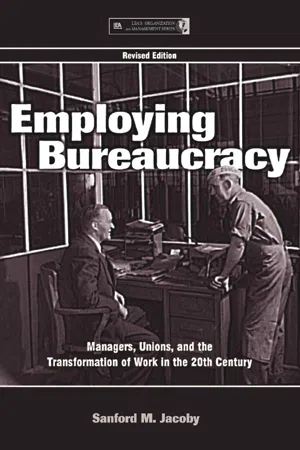
Deftly blending social and business history with economic analysis, Employing Bureaucracy shows how the American workplace shifted from a market-oriented system to a bureaucratic one over the course of the 20th century. Jacoby explains how an unstable, haphazard employment relationship evolved into one that was more enduring, equitable, and career-oriented. This revised edition presents a new analysis of recent efforts to re-establish a market orientation in the workplace.
This book is a definitive history of the human resource management profession in the United States, showing its diverse roots in engineering, welfare work, and vocational guidance. It explores the recurring tension between the new professional order and traditional line management. Using a variety of sources, Jacoby analyzes the complex relations between personnel managers, labor unions, and government from the late 19th century to the present.
Employing Bureaucracy:
*analyzes the origins of the modern employment relationship's distinctive features;
*combines a variety of disciplinary perspectives, from business and labor history to economics, sociology, and management;
*shows the transformation of the American workplace over the course of the 20th century, from market-oriented to bureaucratic to recent efforts to move back to a market orientation; and
*provides the single-best and most sophisticated history of the origins and development of the modern "HR" profession.
For historians, social scientists, and practitioners, this book is a readable and rewarding study. With the future of work currently under debate, it is critical that the historical process that produced the modern American workplace is understood.
Read the Workforce Management Magazine review about Employing Bureaucracy at www.erlbaum.com.
eBook - ePub
Employing Bureaucracy
Managers, Unions, and the Transformation of Work in the 20th Century, Revised Edition
- 296 pages
- English
- ePUB (mobile friendly)
- Available on iOS & Android
eBook - ePub
Employing Bureaucracy
Managers, Unions, and the Transformation of Work in the 20th Century, Revised Edition
About this book
Information
Publisher
Psychology PressYear
2004Print ISBN
9780805844108
9780805844092
Edition
1eBook ISBN
9781135705473
1
The Way It Was: Factory Labor Before 1915
At the beginning of the nineteenth century, most commodities in the United States were produced either in the workshops of artisans or at home. Skilled tradesmen— carpenters, cobblers, potters—crafted their wares in small shops, owned by merchants or master craftsmen, that had not yet been significantly affected by machine methods. Goods made at home were usually consumed there, although in urban areas the putting-out system was common: Merchants distributed raw materials and tools to household workers, who then wove the cloth or made the shoes and returned the finished product to the merchants for distribution and sale. By the end of the century, however, everything had changed: Most commodities were now manufactured in factories, which were enormous agglomerations of machinery and men.
America’s first factories were New England’s textile mills, which supplanted home methods of production between 1790 and 1840. These early mills shared a number of features that distinguished the factory system from other modes of production: a reliance on power-driven machinery; the integration of different production processes at a single site; an elaborate division of labor; and finally, new methods of administration based on the overseer or foreman.
The overseer was the key figure in the early New England mills. Large mills employed a number of them, each in charge of a room full of machinery and workers. Although there was an agent who dealt with the mill’s owners, the overseer did most of the work of maintaining mechanical and human order. In addition to tending machines, he selected the workers, assigned them to their tasks, and made sure that they labored diligently. Indeed, one advantage of the textile factories was that they permitted more effective labor supervision than was previously possible. Under the putting-out system, merchants could manipulate only the piece prices they paid; effort was controlled by the worker, who could take anywhere from two days to two weeks to turn in his goods. But in the factory, workers had less discretion over their work pace and methods. As one Rhode Island merchant wrote in 1809, “We have several hundred pieces now out weaving, but a hundred looms in families will not weave so much cloth as ten at least constantly employed under the immediate inspection of a workman.”1 Until the 1840s, the factory system was limited chiefly to the textile industry. By 1880, it had become the dominant production mode in most manufacturing industries. As Carroll D. Wright observed in his introduction to the census of manufactures for 1880:
Of the nearly three millions of people employed in mechanical industries of this country at least four-fifths are working under the factory system. Some of the other [than textiles] remarkable instances of the application of this system are to be found in the manufacture of boots and shoes, of watches, musical instruments, clothing, agricultural implements, metallic goods generally, firearms, carriages and wagons, wooden goods, rubber goods, and even the slaughtering of hogs. Most of these industries have been brought under the factory system during the past thirty years.
Despite this dramatic growth, the factory did not immediately displace older organizational forms. In the iron and steel industry, rural forges and small foundries coexisted during the 1860s and 1870s with giant rail mills employing more than a thousand workers. Similarly, although steam-powered machinery provided the impetus to establish shoe factories in the 1850s, certain types of women’s shoes and slippers were manufactured on a putting-out basis until the end of the century.2
Older methods persisted in yet another way.Many of the industries that shifted to the factory system after 1850 continued to depend on techniques from the earlier period. In these industries, the factory was often no more than a congeries of artisanal workshops which had been mechanized and enlarged. A steady infusion of craft skills was still required, particularly when the factory turned out small batches of an unstandardized product. As a result, proprietors in these industries were content to let their foremen and skilled workers make most of the decisions about the timing and manner of production.3
At one extreme, this practice took the form of internal contracting, which was less a system of production management than a ceding of managerial control to the contractor. The contractor, who was a highly skilled foreman, arranged with the proprietor to deliver the product within a specified time at a specified cost. The proprietor provided the contractor with tools, materials, and money, and then left him in charge of production. The contractor hired and supervised a group of skilledworkers, who in turn might employ their own unskilled helpers. This system was most common in metalworking industries—sewing machinery, locomotives, guns—where a high degree of skill was needed to process component parts to exacting tolerances.4 At the other extreme were industries that left production decisions entirely to the skilled workers, with no foreman or contractor involved. For instance, at the Columbus Iron Works during the early 1870s, workers negotiated with the firm’s owners on a tonnage rate for each rolling job undertaken by the firm. The gang members decided collectively howto pay themselves, howto allocate assignments, whom to hire, and how to train helpers. Unlike internal contracting, this was a highly egalitarian method for production management; no one interposed between the skilled workers and the owners.5
Neither the syndicalism of the rolling mill workers nor internal contracting was, however, very common. Rather, in most nineteenth-century factories, salaried foremen and skilled workers shared responsibility for administering production. Although the salaried foreman occupied a position inferior to the internal contractor’s, he nevertheless had authority to make most of the decisions about how a production task was to be accomplished, including work methods, technical processes, and work organization.
The foreman exercised his authority within limits set by the skilled workers, who guarded their autonomy in production through a multitude of working rules that governed methods of shop organization and through what one historian has called the craftsman’s “moral code.” The code included output quotas set by the workers to protect themselves from overexertion, as well as an ethos of manly defiance to any foreman who tried to subvert traditional shop rules.6
Foremen had their own moral code, one which owed a great deal to the skilled worker’s shop culture. They were arrogant, proud, conservative men, mindful of the position to which their skill and knowledge had elevated them. Often they wore white shirts to work and seated themselves at raised desks in the middle of the shop floor. But despite their former status as skilled workers, most foremen were strenuously antiunion. They were well aware that their authority depended on severing ties to their pasts. As one observer noted, “They spurn the rungs by which they did ascend.”7
By the 1880s, winds of change were beginning to erode the power of foremen and skilled workers over production management. The new industries, such as electrical machinery and chemicals, were based on a technology that had little continuity with artisanal techniques. The older industries, like iron and steel, had mechanized to the point where craft skills were no longer essential to production. After the introduction of continuous flow methods in steel manufacturing, the foreman was left with little authority. Most production decisions were now made by engineers and metallurgists. Among skilled steelworkers, who had once been “strong, even arrogant in their indispensability,” the “strong sense of independence disappeared.” In machine-paced industries like textiles, the overseer was forced to share authority with an increasing number of specialists equal or superior in rank: the chief engineer, the chief electrician, and the supervisors of piping and the waste house. Other than making occasional repairs or inspecting goods to insure their quality, the overseer had fewer and fewer responsibilities in production. In textiles, as in steel and other industries, most of the foreman’s tasks were related to employing and supervising labor. Here, however, the methods of the 1850s persisted, with little modification.8
FOREMEN IN CONTROL, 1880–1915
Whereas the foreman’s degree of control over production varied by industry, his authority in employment matters was uniform across industries. Whether in a machine shop or on the assembly line, the foreman was given free rein in hiring, paying, and supervising workers. To the worker, the foreman was a despot—rarely benevolent—who made and interpreted employment policy as he saw fit. Any checks on the foreman’s power emanated from the workers he supervised, not from the proprietor.
Recruiting and Hiring
The foreman’s control over employment began literally at the factory gates. On mornings when the firm was hiring—a fact advertised by signs hung outside the plant, by newspaper ads, or by word of mouth—a crowd gathered in front of the factory, and the foreman picked out those workers who appeared suitable or had managed to get near the front. At one Philadelphia factory, the foreman tossed apples into the throng; if a man caught an apple, he got the job. Foremen could be less arbitrary. For instance, they frequently hired their friends, the relatives of those already employed, and even their own relatives: “Oftentimes he [the foreman] is connected by blood ties with those who come under his control and he will inevitably be swayed by considerations of previous friendship no matter how hard he may strive not to be.” New foremen might dismiss current employees to make room for their friends and relatives, as occurred in a Lawrence textile mill during the 1880s. The overseers “made changes very freely in the departments committed to them, and the result was that for several months a feeling of great insecurity prevailed among the hands.”9
In addition to blood ties, foremen relied on ethnic stereotypes to determine who would get a job and which job they would get. The Irish and Germans were considered good skilled workers, while Poles and “Hunkies” were thought to be suited for heavy labor. Jews were said to be dexterous, Rumanians dishonest, Slovaks stupid, and Italians “so susceptible to the opposite sex that they could not be satisfactorily employed.” When an investigator in the steel mills asked for a job on a blast furnace, he was told “only Hunkies work on those jobs, they’re too damn dirty and too damn hot for a white man.”10
To get a job, workers often resorted to bribing the foreman with whiskey, cigars, or cash, a practice that one study found to be “exceedingly common” in Ohio’s factories. The study included an affidavit from an immigrant worker who, to get a factory job, had paid the foreman a five-dollar bribe. Several days later the foreman told the man that he would be fired unless he paid another five dollars right away, because someone else had just paid ten dollars for a similar job.11
Assignment to a job was determined in large part by favoritism or ethnic prejudice. The foreman had little interest in or knowledge of an employee’s previous work experience. If a newly hired employee proved unsatisfactory, he was easily replaced by someone else. Although intradepartmental promotions occurred, transfers and promotions between departments were rare, as were definite lines of promotion (except on skilled work). The foreman had a parochial view of the factory and was reluctant to give up his best workers to another foreman.
Few companies kept detailed employment records before 1900. Only the foreman knew with any accuracy how many workers were employed in his shop and how much they were paid. In a large firm, a worker could quit his job in the morning and get taken on by the foreman of another department in the afternoon. In 1915, the top managers of a large hosiery factory reported that they had little idea of how many people their firm hired and dismissed each week.12
The one exception to this lack of information was the bureau that specialized in screening skilled labor for open-shop employers. Henry Leland, founder of the Cadillac Motor Company, started the Employers’ Association of Detroit in 1897 to ensure that Detroit remained an open-shop city. The organization kept records on every individual who had worked for a member firm and blacklisted those who were “agitators” and union supporters. To get a job at a member firm, a worker had to apply through the Employers’ Association. By 1911, the association’s employment bureau had in its files names of more than 160,000 workers, a figure equaling nearly 90% of the Detroit labor force. Other employer organizations (including the National Metal Trades Association and the National Founders Association) set up similar local agencies to blacklist radicals and trade unionists and to supply member firms with the names of “good men” who needed work.13
Although direct recruitment was common during the nineteenth century, it was not usually done by the foreman. Instead, employers either sent their own special recruiters to the New York docks to secure immigrant workers or else relied on private agencies like the American Emigrant Company, which kept scouts in several foreign ports to recruit emigrating workers. After the 1890s, however, immigration flows had become large enough and cyclically sensitive enough to meet industrial demand. Consequently, direct recruitment was rare, except in sectors like construction and the railroads, where work was seasonal and labor requirements for certain projects could run into the thousands.14
During the heyday of mass immigration, employers recruited through the immigrants’ own informal network: Newcomers to America headed for areas where their countrymen, often men from the same European villages, had found jobs. As more men of a given nationality arrived, benefit societies were organized, priests appeared, and wives and children were sent for. Gradually a new ethnic community developed in the area. The news that a company was seeking help was transmitted to friends and relatives in the old country; sometimes, tickets were purchased for them. Letters might also warn of a shortage of jobs.15
Wages and Effort
The foreman also had considerable power in determining the wages of the workers he hired, whether for piecework or daywork. As a result, different individuals doing the same job were often paid very different rates. Because top management monitored labor costs but not the wage determination process, the foreman had an incentive to hire individuals at the lowest rate possible. It was common practice for a foreman “to beat the applicant down from the wage he states he wishes to the lowest which the interviewer believes he can be induced to accept.” Moreover, by being secretive about wage rates and production records, foremen could play favorites, varying the day rate or assigning workers to jobs where piece rates were loose. Since each foreman ran his shop autonomously, rate variations across departments were also common. In their report on the stove industry, Frey and Commons found that “molding [piece] prices were far from equal on similar work in the same shop or district.”16
Despite—or perhaps because of—the latitude they gave him in determining rates, the firm’s owners expected the foreman to hold down labor costs. This meant paying a wage no greater than the “going rate” for a particular job. But it also meant keeping effort levels up in order to reduce unit costs. When the going rate rose, effort became the key variable to be manipulated by the foreman.
The methods used by foremen to maintain or increase effort levels were known collectively as the “drive system”: close supervision, abuse, profanity, and threats. Informal rules regulating such work behavior as rest periods were arbitrarily and harshly enforced. Workers were constantly urged to move faster and work harder. Sumner Slichter defined the drive system as “the policy of obtaining efficiency not by rewarding merit, not by seeking to interest men in their work . . . but by putting pressure on them to turn out a large output. The dominating note of the drive policy is to inspire the worker with awe and fear of the management, and having developed fear among them, to take advantage of it.”17
Driving was more prevalent with daywork, where the effort wage was indeterminate. But it occurred with straight piecework too, when foremen sought to prevent workers from restricting output. An official of the machinists complained that “in many cases the rapidity with which the workingmen have been driven under the piecework and similar systems have been the means of driving the mechanics to the insane asylum.” Under the bonus wage systems that began to appear after 1890, wages did not rise in proportion to output. Thus, unit labor costs fell with additional production, creating an incentive for the foreman to drive his men even harder and arousing the unions’ anger over these new “scientific” payment plans.18
The drive system depended, ultimately, on fear of unemployment to ensure obedience to the foreman.Workers were more submissive when jobs were scarce, as was often the case before World War I. A discharge was usually devastating, since few workers had savings to cushion the hardships of unemployment and only meager relief was available. On the other hand, a tight labor market tended to undermine the foreman’s authority, forcing him to rely more heavily on discharges to maintain discipline. Data from a metalworking plant illustrate this point. In 1914, a depressed year, the plant had 225 dismissals, many of them for “unadaptability” or “slow work”; this suggests that workers who could not keep up to standard were fired during hard times. By 1916, when the economy had improved and workers could afford to be feisty, the number of dismissals rose to 467, and a relatively large number of workers were fired for “insubordination,” “troublemaking,”...
Table of contents
- Cover Page
- Title Page
- Copyright Page
- Series Foreword
- Acknowledgments
- Introduction to Revised Edition
- 1 The Way It Was: Factory Labor Before 1915
- 2 Systematic Management and Welfare Work
- 3 Vocational Guidance
- 4 Problems, Problem-Solvers, and a New Profession
- 5 Crisis and Change During World War I
- 6 A Different Decade: Moderation in the 1920s
- 7 The Response to Depression
- 8 Another Great Transformation, 1936–1945
- 9 From the 1950s to the Present
- Endnotes
Trusted by 375,005 students
Access to over 1.5 million titles for a fair monthly price.
Study more efficiently using our study tools.
Frequently asked questions
Yes, you can cancel anytime from the Subscription tab in your account settings on the Perlego website. Your subscription will stay active until the end of your current billing period. Learn how to cancel your subscription
No, books cannot be downloaded as external files, such as PDFs, for use outside of Perlego. However, you can download books within the Perlego app for offline reading on mobile or tablet. Learn how to download books offline
We are an online textbook subscription service, where you can get access to an entire online library for less than the price of a single book per month. With over 1.5 million books across 990+ topics, we’ve got you covered! Learn about our mission
Look out for the read-aloud symbol on your next book to see if you can listen to it. The read-aloud tool reads text aloud for you, highlighting the text as it is being read. You can pause it, speed it up and slow it down. Learn more about Read Aloud
Yes! You can use the Perlego app on both iOS and Android devices to read anytime, anywhere — even offline. Perfect for commutes or when you’re on the go.
Please note we cannot support devices running on iOS 13 and Android 7 or earlier. Learn more about using the app
Please note we cannot support devices running on iOS 13 and Android 7 or earlier. Learn more about using the app
Yes, you can access Employing Bureaucracy by Sanford M. Jacoby in PDF and/or ePUB format, as well as other popular books in Economics & Management. We have over 1.5 million books available in our catalogue for you to explore.