This book offers an engaging introduction to cultural and cross-cultural psychology and offers an interdisciplinary approach to the key research theories and controversies that impact on human behaviour in a global context.
How is human behavior and experience intertwined with culture? From this starting point, this second edition of Cultural Issues in Psychology explores the role of culture in relation to mainstream and critical perspectives of our discipline. Beginning with an examination of culture itself, as well as related concepts such as ethnicity, race and nation, it goes on to trace historical developments in the role of culture in psychology. Including a new chapter on migration, and additional coverage of indigenous psychologies, ethnographic research methods, and cosmopolitanism, the new edition reflects the latest developments in this global discipline. Also featuring up-to-date research examples and revision exercises, the book reviews and explains classic and contemporary approaches to cultural issues relating to social, cognitive, developmental and health psychology.
Also including chapters on culture and lifespan, and culture and psychopathology, this is the essential entry-level text on cultural and cross-cultural psychology for students taking psychology and related courses.
Frequently asked questions
Yes, you can cancel anytime from the Subscription tab in your account settings on the Perlego website. Your subscription will stay active until the end of your current billing period. Learn how to cancel your subscription.
At the moment all of our mobile-responsive ePub books are available to download via the app. Most of our PDFs are also available to download and we're working on making the final remaining ones downloadable now. Learn more here.
Perlego offers two plans: Essential and Complete
Essential is ideal for learners and professionals who enjoy exploring a wide range of subjects. Access the Essential Library with 800,000+ trusted titles and best-sellers across business, personal growth, and the humanities. Includes unlimited reading time and Standard Read Aloud voice.
Complete: Perfect for advanced learners and researchers needing full, unrestricted access. Unlock 1.4M+ books across hundreds of subjects, including academic and specialized titles. The Complete Plan also includes advanced features like Premium Read Aloud and Research Assistant.
Both plans are available with monthly, semester, or annual billing cycles.
We are an online textbook subscription service, where you can get access to an entire online library for less than the price of a single book per month. With over 1 million books across 1000+ topics, weâve got you covered! Learn more here.
Look out for the read-aloud symbol on your next book to see if you can listen to it. The read-aloud tool reads text aloud for you, highlighting the text as it is being read. You can pause it, speed it up and slow it down. Learn more here.
Yes! You can use the Perlego app on both iOS or Android devices to read anytime, anywhere â even offline. Perfect for commutes or when youâre on the go. Please note we cannot support devices running on iOS 13 and Android 7 or earlier. Learn more about using the app.
Yes, you can access Cultural Issues in Psychology by Andrew Stevenson in PDF and/or ePUB format, as well as other popular books in Medicine & Psychiatry & Mental Health. We have over one million books available in our catalogue for you to explore.
What are the philosophical roots of psychology across cultures?
How do cultural anthropology and psychology differ?
Which were the first major cross-cultural research projects?
What became of nineteenth-century racial theories of temperament?
Who were the twentieth-century pioneers of research across cultures?
What is psychological anthropology?
What this is (and isnât) a history of
Psychologists have been doing research across cultures for generations. They have also been busy establishing research traditions within their own cultures for some time (Rus & Pecjak, 2004; Hwang, 2005; Stevens & Gielen, 2007; Kashima, 2016). Of course, these are two quite different things. The early history of psychology across cultures largely draws on the ideas and journeys of thinkers, explorers and ultimately social scientists from Europe who took it upon themselves to study people from other continents. Meanwhile the history of psychological traditions within cultures draws on what have become known as the indigenous psychologies. Youâll find an extended account of these in Chapter 5. The history of psychology across cultures is our focus in this chapter.
Key Term
Indigenous psychologies. Diverse regional traditions in psychological research, reflecting differing cultural concerns.
Philosophical origins of psychology across cultures
The philosophical foundations of psychology across cultures are sunk deep in the history of European thought. Distinct though merging phases are decipherable in European philosophical traditions, and an examination of these phases reveals an evolving fascination with people from diverse places. Some aspects of this fascination have distinctly ethnocentric roots. This is unsurprising, as they are grounded in a European view of the world. Many of these ideas emerged when contact across continents was minimal and when communication with those who did venture across the oceans was subject to hearsay, fear of strangers and a distinct lack of methodological sophistication. Sadly, echoes of this ethnocentrism in European and US writing lingered into the twentieth century (Howitt & Owusu-Bempah, 1995). For now, weâll concentrate on the historic precursors of research across cultures.
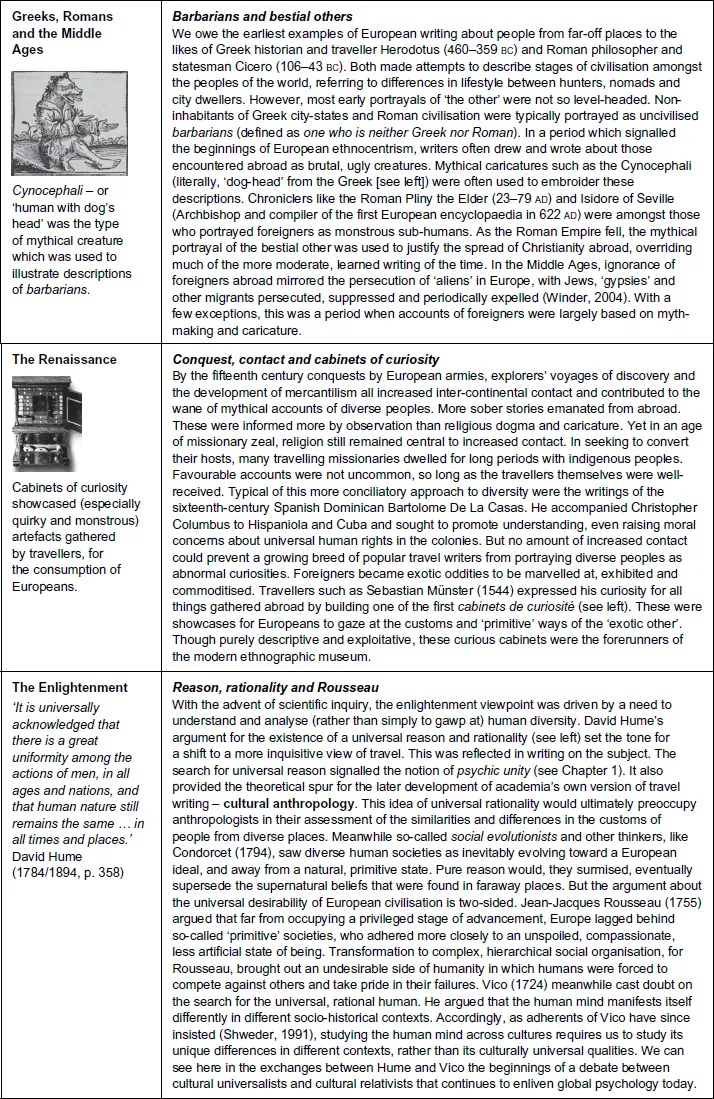
Figure 1.1 outlines the philosophical origins of European psychologyâs adventures abroad. It also hints at the early exchanges between the thinkers who argued for the universal constancy of the human mind (universalists) and those who stressed the unique manifestation of the mind in diverse cultures (relativists). First moves in the development of cultural anthropology (defined as the study of the complex social structures that make up communities, societies and nations) are also indicated in Figure 1.1. Such disciplines share with psychology an interest in the relationship between culture, experience and behaviour.
Figure 1.1 Philosophical roots of psychological research across cultures
Key Term
Cultural anthropology. The study of the complex social structures that make up communities, societies and nations.
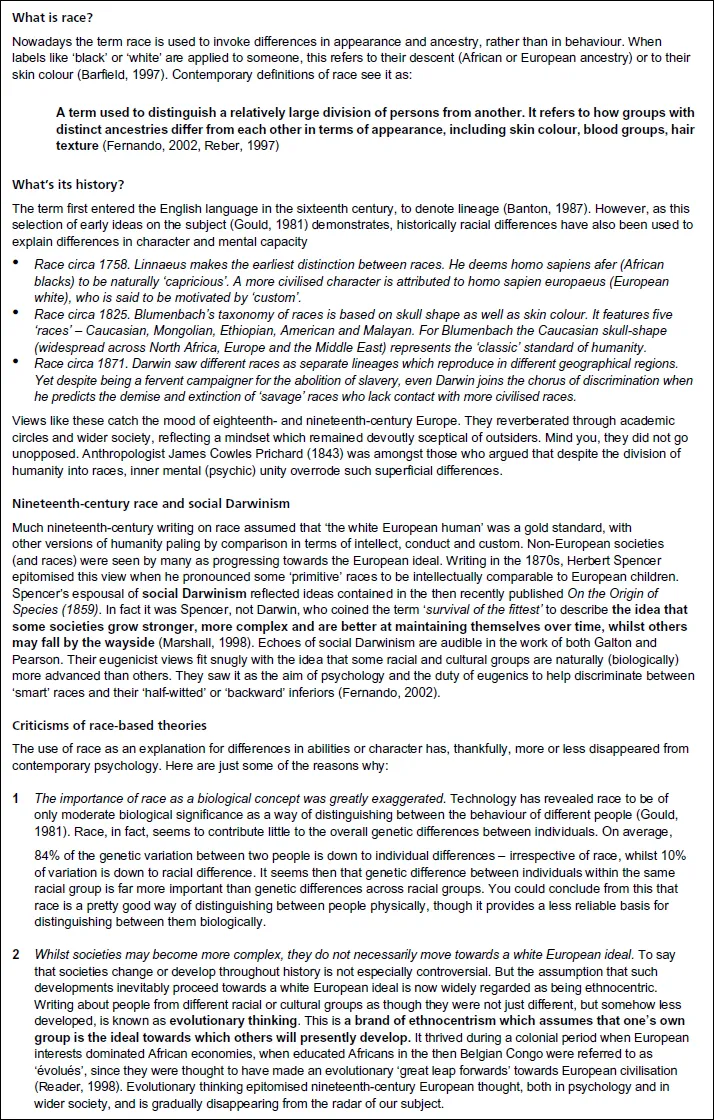
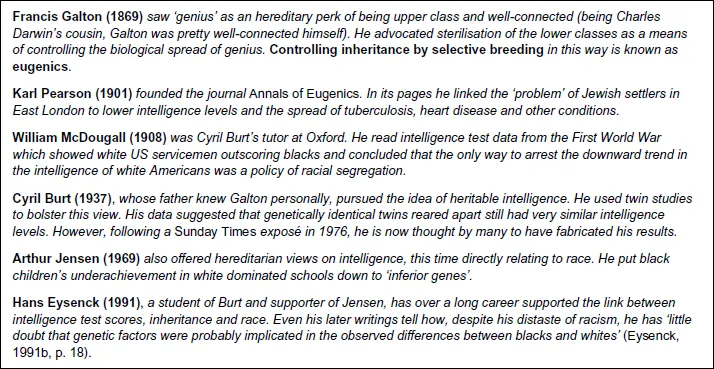
Figure 1.2 outlines some of the influential trains of thought that dominated arguments about race, temperament and behaviour in the early nineteenth century. Figure 1.3 reminds us of the unfortunate ways in which nineteenth-century racial explanations of difference and deficit in character and ability affected the work of some influential psychologists for decades to come.
Figure 1.2 Race-based theories in the nineteenth century
Figure 1.3 Sadly, ideas about race and mental ability outlasted the nineteenth century
Key Term
Race. How groups with distinct ancestries differ from each other in terms of appearance, including skin colour, blood group, hair texture.
Rivers across cultures in the twentieth century
Preoccupations with biological and racial difference temporarily arrested the development of psychological research across cultures. But as the twentieth century dawned, another milestone in the development of field research was laid. The 1889 Cambridge Anthropological Expedition to the Torres Straits (between New Guinea and Australia) was seminal for the careers of several budding researchers and for the overall emergence of research across cultures (Hart, 1998). Cambridge anthropologist Alfred Cort Haddon, who led the expedition, found room on board for a select band of researchers who are still considered to be among modern fieldworkâs founders. They included the British psychologists William McDougall and Charles Myers, the anthropologist Charles Seligman, and W.H.R. Rivers, of whom we will soon learn more....
Table of contents
Cover
Half Title
Title Page
Copyright Page
Table of Contents
1. How we got here: a short history of psychology across cultures
2. Culture and its influence: exploring a key concept in global psychology
3. Cross-cultural psychology: epistemology and ontology: Searching for human universals
4. Cultural psychology: epistemology and ontology: alternative paradigms in global psychology
5. Critical, community and indigenous psychologies
6. Culture, cognition and intellect: thinking through cultures
7. Culture, social cognition and social influence: social psychology across cultures
8. Culture and development: childhood across cultures
9. Culture and psychopathology: definitions, diagnoses and treatment across cultures
10. Culture, acculturation, biculturalism and cosmopolitanism