![]()
Changing unhealthy behaviour: some helpful material
The methods used in this book share a common platform – the use of psychological theory within a nursing framework. This first section outlines some material that will be useful across a range of behaviours.
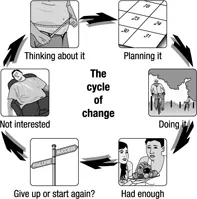
The Stages of Change model and motivational interviewing underpin much of this material.
Stages of Change model
Reference / After Prochaska, J.O., DiClemente, C.C. and Norcross, J.C. (1992) In search of how people change: Applications to addictive behaviors, American Psychologist, 47(9), pp. 1102–1114, adapted with permission.
BALANCE SHEET
One way of identifying the problems associated with changing behaviour is to ask the patient to list the advantages and disadvantages of each of the behaviours they are trying to change.
Decisional balance sheet
| BENEFITS/PROS | COSTS/CONS |
Making a change | | |
Not changing | | |
Alternatively, include an additional comment on reducing disadvantages. It is important also to assess self-efficacy (i.e. confidence to maintain change).
| Behaviour I am thinking about changing:………… |
| ADVANTAGES OF CHANGING MY BEHAVIOUR | DISADVANTAGES OF CHANGING MY BEHAVIOUR | WAYS OF REDUCING DISADVANTAGES |
| | |
The brief negotiated interview
• Establish rapport.
• Raise subject.
• Explore pros and cons.
• Explore discrepancies between actual state and goals.
• Assess readiness to change (use certainty ruler).
• Assess confidence to change (use confidence ruler).
• Assess readiness to follow intervention.
Readiness to change/confidence rulers
On a sca...