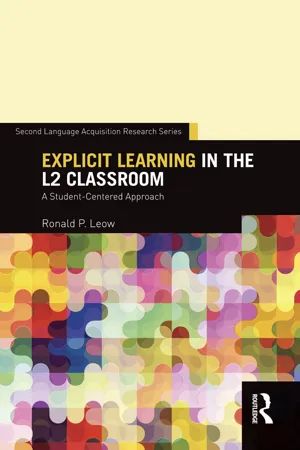
Explicit Learning in the L2 Classroom offers a unique five-prong (theoretical, empirical, methodological, pedagogical, and model building) approach to the issue of explicit learning in the L2 classroom from a student-centered perspective. To achieve this five-prong objective, the book reports the theoretical underpinnings, empirical studies, and the research designs employed in current research to investigate the constructs of attention and awareness in SLA with the objectives to (1) propose a model of the L2 learning process in SLA that accounts for the cognitive processes employed during this process and (2) provide pedagogical and curricular implications for the L2 classroom. The book also provides a comprehensive treatise of research methodology that is aimed at not only underscoring the major features of conducting robust research designs with high levels of internal validity but also preparing teachers to become critical readers of published empirical research.
- 282 pages
- English
- ePUB (mobile friendly)
- Available on iOS & Android
eBook - ePub
About this book
Information
1
Introduction, or Strolling Down Memory Lane
Raising Your Awareness
Before I jump into the nitty-gritty of the book components, I would like first to broadly describe what comprises L2 learning in this book and where this book is situated, and then I would like to take a quick stroll down memory lane regarding the many changes pertaining to our students’ role in L2 learning in the SLA field, dating back to the theoretical and pedagogical approaches to learning in the 1960s to the current empirical focus on implicit learning in SLA.
L2 Learning and Setting
L2 learning, for now (Chapter 7 elaborates on this construct), can be described broadly as a process in which many changes take place in L2 learners’ cognition as they try to create new representations for the L2 grammar, internalize such data, and restructure if necessary, all the while developing their ability to comprehend and produce the L2, either orally or written, in real time. It takes place in a setting in which the L2 is either viewed as a foreign language (as in English speakers taking the foreign language requirement in an L1 environment) or a second language (as in Japanese speakers taking English classes in an L2 environment, for example, in the USA). In either setting, L2 learners are exposed to naturally occurring languages and are interacting with the language, be it communicatively or performing a task of some ecological validity. In the typical formal classroom setting, the L2 is taught by an instructor, and students learn the so-called traditional four skills of listening, reading, writing, and speaking. There is a curriculum that provides information on, for example, the grading criteria, attendance policy, percent weight of each section of the curriculum, objectives for all four skills, and a syllabus that provides a guideline for each class session. Homework is usually assigned and students follow a prescribed textbook. The amount of time spent in this formal setting varies, but the minimum is usually around one hour either daily (for intensive classes) or three or four times a week (for non-intensive classes, depending upon the language program). SLA research that seeks to probe into learner cognition, then, needs to focus on the identification and explanation of the cognitive processes employed by L2 learners as they learn the L2 in these two settings.
Memory Lane
Now, let us situate this book’s perspective regarding our students’ role in L2 learning by taking a quick stroll down memory lane over the many selected changes in focus, both theoretical and empirical, toward what Omaggio (1993) calls the “presumed locus of control of the process of language acquisition” (p. 43) over the last several decades.
First, a quick pop quiz: How many of you are aware that the construct of awareness has always been subsumed in the teaching profession? Isn’t it true that we language teachers—well, most of us—have this innate desire to promote our students “knowledge” of what they are learning or their awareness of what they are producing? Be it theoretically, empirically, or pedagogically driven, we, as teachers of L2 languages, do incorporate activities or tasks that require some role of awareness or lack thereof on our students’ part. Now that we are on the same page, let us proceed to some previous theoretical perspectives regarding the L2 learning process.
As many of us will recall, the two dominant theoretical approaches to L2 learning in the 50s and early 60s were the behaviorist/empiricist (e.g., Hilgard, 1962; Skinner, 1957) versus the rationalist/mentalist/nativist (e.g., Chomsky, 1957) perspective of learning. The former postulated that learning was literally teacher-centered, that is, it was the teacher who was responsible for providing the appropriate stimuli or grammatical data. The student was like the little baby (or Pavlovian puppy) conditioned to absorb all this important information without any personal input or cognitive processes involved, but being rewarded when following instructions correctly (which may explain why many teachers do have jars of candy in their offices). Thus, we had our pedagogical repertoire of repetition exercises or rote memory that was relatively divorced from a relationship with meaning or even real communication (cf. the well-known Audio-lingual Methodology in the 60s). The latter theoretical approach viewed the student as a more active participant in the learning process (after all, s/he already possessed innately Chomsky’s famous language acquisition device (LAD), also referred to as “the black box”), so teachers shifted more responsibilities to the students for the learning process, and in doing so subtly acknowledged the role of cognitive processes in L2 learning. However, like in real life, the rationalist/mentalist/nativist approach to L2 learning led to several interpretations of this new learner-centered perspective of the learning process. This resulted in several variations of teaching practices, depending on one’s personal perception of language learning and teaching within this approach: Witness, for example, the Grammar Translation Method (50s), the Cognitive Code Method that placed a premium on formal instruction of grammar before practice, the humanistic perception as evident in the 70s in The Silent Way, Community Language Learning, and Suggestopedia, and the focus on communication first as in the Direct Method (60s), the Total Physical Response (70s), the Communicative Approach (70s), the Natural Approach (80s), Task-based Learning (current) and so on. I am proud to say that I have tried, during my four decades of teaching, most of these methods, approaches, techniques, etc., as bandwagons came and rode off into the sunset.
Interestingly, the two major publications, namely Corder (1967) and Selinker (1972), that provided the foundation for current research in SLA were both learner-centered and repudiations against a behaviorist approach to language learning. For language instruction, Corder suggested the need to seriously address what L2 learners bring to the task of learning an L2, which he called their “internal syllabus.” In addition, he coined the term “intake” that sought to differentiate what learners are exposed to, for example, the L2 (the input), and what they take in. Theoretically, it is assumed that not everything that learners pay attention to in the input is automatically “taken in” or processed, most likely due to processing demands and attentional constraints. Selinker suggested that we acknowledge the internal system, which he calls “interlanguage,” that L2 learners possess as they develop their ability to learn the L2. As the term connotes, interlanguage is a system that is somewhere between the first language (L1) and the L2. Given the status of interlanguage being a system with its own rules, doesn’t it make you wonder whether errors produced by our students are really systematically “correct” according to their own interlanguage system, but are being graded from a native or near-native speaker’s perspective? Put another way, perhaps they are “right” and we are “wrong.”
The 70s witnessed several empirical efforts to address Corder’s and Selinker’s calls for more focus on the learner’s involvement in the learning process. Many of these studies were essentially based on L1 research conducted within an L2 context and provided quite a contrast in their pursuits. On the one hand were the acquisition order studies (do some of you recall the famous morpheme studies by, for example, Dulay and Burt (1973, 1974) that attempted to equate the L1 acquisitional process with that of the L2 based on an apparent natural order of morphemes?), while on the other hand we had the error analysis studies that sought to prove otherwise, that is, that the L1 transfer process may not be entirely similar to the L2 (cf. Corder, 1967; Schachter, 1974).
The 80s, in my opinion, began a fruitful period of research in the L2 learning process both from an empirical and theoretical perspective. Even though the shift from a strict behaviorist perspective of language learning was relatively accepted in the SLA field, early empirical research still began to focus on the external features of the L2 input (cf. studies on simplification such as Blau, 1982; Davies, 1984; Parker & Chaudron, 1987) and the role of interaction in L2 language learning, mostly from a descriptive perspective (cf. Hatch, Shapira, & Wagner-Gough, 1978; Henzl, 1979). At the same time, there were some important theoretical underpinnings that began to focus more closely on learners’ internal processes in relation to the role of awareness. First, the term “consciousness-raising” (Sharwood Smith, 1981) came into being with a direct relationship to students’ internal processes. If we can raise our students’ consciousness of the underlying grammatical rules, this will greatly facilitate their learning (by the way, the Grammar Translation Method could be credited for doing this, though learning was defined as the ability to write or translate instead of the ability to speak). However, Sharwood Smith came to realize (became aware) that he was dealing with an internal process and, consequently, modified his term to “input enhancement” (Sharwood Smith, 1993), arguing that this term was more appropriate in depicting exactly what was being proposed, namely enhancing the L2 input via, for example, grammatical rules, additional emphasis, or anything that could potentially draw students’ attention to the enhanced aspect of the L2 input. Needless to say, this strand of research exploded in the 90s, given its relatively broad definition of what comprises input enhancement (cf. Leow, 2009, for a more elaborated and critical discussion of this issue), and is still current today.
In my opinion, there are some milestones along the theoretical and empirical routes to current studies that have gone beyond investigating the role of awareness in L2 learning to addressing whether the absence of awareness also plays a role in L2 learning (cf. Chan & Leung, 2014; Hama & Leow, 2010; Leow, 2000; Leung & Williams, 2011, 2014; Williams, 2005). The first milestone was Krashen’s (1982) Monitor Theory, with its pedagogical sidekick the Natural Approach that initiated and maximally contributed to this theoretical and empirical impetus on internal processes. The Monitor Theory, premised on children’s first language acquisition, was the first theoretical underpinning to raise the issue of the role of the construct of awareness (termed “consciousness” in those days and also today with some researchers) in the L2 learning process and to distinguish between learning (with consciousness), resulting in learned/explicit knowledge, and acquiring (without consciousness), resulting in acquired/implicit knowledge. Krashen also argued that there was no interface (connection) between implicit (acquired) and explicit (learned) knowledge, which led to quite a discussion of whether there exists in SLA a weak interface; for example, explicit knowledge can lead to implicit knowledge (e.g., R. Ellis, 2006), or implicit knowledge may be assisted by explicit knowledge (e.g., N. Ellis, 2005). A strong interface (e.g., DeKeyser, 2007) derived from skill acquisition theory in cognitive psychology (cf. Anderson, 1982) postulates that SLA is largely a conscious process, so we begin the learning process with declarative knowledge that can then become procedural knowledge (after much practice), or none at all (Krashen, 1982; Paradis, 2009).
The interesting aspect of this interface debate that rears its head every now and then is that while type of knowledge (a product) is under consideration, by attaching the dichotomies implicit versus explicit or acquired versus learned or conscious versus subconscious to the term knowledge, we have shifted the product knowledge to include a process of learning, that is, learning with or without awareness. So the theoretical question is not only whether knowledge can be identified as implicit or explicit but also how such knowledge got to be explicit or implicit. In other words, the end result (product) may not reflect the process of how the knowledge made its way into the internal system, and in order to address adequately the interface issue, concurrent or online data on learners’ processes need to be gathered instead of making extrapolations based on non-concurrent or offline data. See how convoluted the issue can become, and yet it remains charmingly challenging and stimulating to research?
In addition to other postulations, Krashen’s theory equated L2 “acquisition” with L1 acquisition and also postulated that acquisition followed a predictable order. In addition to the obvious critique of the inability to test his theory of L2 learning (“hmm, comprehensible input , to whom? input comprehensible to you may not be comprehensible to me; hmm, i plus 1, where to locate each student’s i, GPS, anyone? and what is the 1 again?”), serious questions such as, “Do we treat our adult students like babies following a first language (L1) acquisitional trajectory?” (Krashen: look at the evidence of an apparent unchangeable acquisitional sequence, albeit based on morphemes, those little pieces that make up a word), or “Do we intervene in an ‘appropriate’ way (we need to consider the psycholinguistic or sociocultural factors involved in learning) in their learning process?” (let us provide feedback at an appropriate point during interaction or let us put them into collaborative groups and learning will take place), still need to be more fully addressed.
As I mentioned above, Krashen’s scholarly contribution to the SLA field via his Monitor Model ranks very high in my estimation. While we do have the phenomenon called “Krashen bashin’” (cf. for example, Gregg, 1984; McLaughlin, 1978 and others who took him to task), without his theoretical postulations serious research on learners’ internal processes would most likely have taken place at a later date. When you publish a study or postulate a theory or model and subsequently encourage a whole string of further investigation into the issue(s) you initiated, you have my highest respect, irrespective of any potential bashing you may...
Table of contents
- Cover
- Title
- Copyright
- Dedication
- CONTENTS
- Preface
- Acknowledgments
- 1 Introduction, or Strolling Down Memory Lane: Raising Your Awareness
- SECTION 1 Theoretical Foundations
- SECTION 2 Research Methodology
- SECTION 3 Empirical Research Investigating the Role of Attention/Noticing in L2 Development
- SECTION 4 Model Building
- SECTION 5 Pedagogy
- Index
Trusted by 375,005 students
Access to over 1.5 million titles for a fair monthly price.
Study more efficiently using our study tools.
Frequently asked questions
Yes, you can cancel anytime from the Subscription tab in your account settings on the Perlego website. Your subscription will stay active until the end of your current billing period. Learn how to cancel your subscription
No, books cannot be downloaded as external files, such as PDFs, for use outside of Perlego. However, you can download books within the Perlego app for offline reading on mobile or tablet. Learn how to download books offline
Perlego offers two plans: Essential and Complete
- Essential is ideal for learners and professionals who enjoy exploring a wide range of subjects. Access the Essential Library with 800,000+ trusted titles and best-sellers across business, personal growth, and the humanities. Includes unlimited reading time and Standard Read Aloud voice.
- Complete: Perfect for advanced learners and researchers needing full, unrestricted access. Unlock 1.5M+ books across hundreds of subjects, including academic and specialized titles. The Complete Plan also includes advanced features like Premium Read Aloud and Research Assistant.
We are an online textbook subscription service, where you can get access to an entire online library for less than the price of a single book per month. With over 1.5 million books across 990+ topics, we’ve got you covered! Learn about our mission
Look out for the read-aloud symbol on your next book to see if you can listen to it. The read-aloud tool reads text aloud for you, highlighting the text as it is being read. You can pause it, speed it up and slow it down. Learn more about Read Aloud
Yes! You can use the Perlego app on both iOS and Android devices to read anytime, anywhere — even offline. Perfect for commutes or when you’re on the go.
Please note we cannot support devices running on iOS 13 and Android 7 or earlier. Learn more about using the app
Please note we cannot support devices running on iOS 13 and Android 7 or earlier. Learn more about using the app
Yes, you can access Explicit Learning in the L2 Classroom by Ronald P. Leow in PDF and/or ePUB format, as well as other popular books in Languages & Linguistics & Linguistics. We have over 1.5 million books available in our catalogue for you to explore.