Bringing together over 25 years of research into the social aspects of learning disabilities (LD), this book presents a range of topics that reflect on the richness of research interests in the discipline. In honor of Tanis Bryan, the pioneer in research on social competence of children with LD, the researchers that follow her lead systematically examine critical issues in the social relationships of these children. The book begins by placing the work of Bryan and her research associates' in context, in terms of the prevailing theoretical frameworks and social political influences that led to the enormous impact of the work. The chapters that follow discuss:
*social cognition in children and adolescents with LD;
*self-understanding and self-esteem in children and adults with LD;
*the lonely plight, peer influence, and friendship patterns of children with LD;
*parental understanding and how this understanding shapes their scaffolding of learning in their children with language disabilities;
*a new intervention approach toward enhancing self-concept and reading comprehension in LD students through bibliotherapy;
*important and timely information on interventions for enhancing peer relations and preventing drop-out in adolescents;
*models in longitudinal research with implications for research on social dimensions of LD; and
*the important role of teachers in enhancing classroom social experiences for students with LD.
Summarizing research findings and their implications in the various areas in the field, this book will be an excellent text for a special topics course in graduate programs in learning disabilities, special education, psychology, and social work. In addition, it will be a highly important resource for university/college teachers, researchers, graduate and honors students, and professionals in learning disabilities, social psychology, and social work.
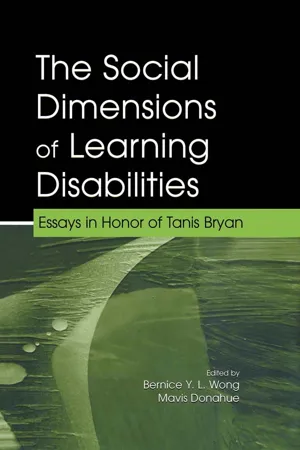
eBook - ePub
The Social Dimensions of Learning Disabilities
Essays in Honor of Tanis Bryan
- 256 pages
- English
- ePUB (mobile friendly)
- Available on iOS & Android
eBook - ePub
The Social Dimensions of Learning Disabilities
Essays in Honor of Tanis Bryan
About this book
Information
Chapter 1
How to Start a Revolution
Mavis L. Donahue
Bernice Y. L. Wong
How can a five-page research article start a revolution? In December of 1974 an article succinctly titled “Peer Popularity of Learning Disabled Children” appeared in the Journal of Learning Disabilities. Sandwiched between “The Organic Psychosyndrome of Early Childhood and its Effects on Learning” and “The Relation of Subclinical Lead Level to Cognitive and Sensorimotor Impairment in Black Preschoolers,” Tanis Bryan’s article was the “study read ‘round the world.” The notion that the social domain deserved significant attention was a radical departure from the focus on neurological/cognitive processing deficits typical of the 1960s and 1970s. For the first time the findings validated what families and teachers had long realized: that academic achievement was not the only challenge faced by children with learning disabilities (LD). Perhaps no other research topic in the field of learning disabilities has so resonated with the collective beliefs and values of those who care for and about diese students.
In 2002, the claim that peer acceptance and positive social interaction is essential to children’s development will likely receive the response “well, duh!” In fact, perhaps at no time in history have so many diverse theoretical perspectives converged on the importance of positive peer interaction to human development. Even medical models now acknowledge the benefits of peer support to physical and emotional well-being. One recent media frenzy centered on a book (Harris, 1998) that re-interpreted decades of research to support the claim that peers significantly outweigh parents in their influence on child development. In October of 2000 a federally funded conference was held at Temple University to address “The Other Side of the Report Card,” focusing on the policy implications of research on how social and emotional factors influence academic and vocational success.
Of course, forefathers and foremothers of the learning disabilities field clearly recognized the central role of positive social interaction in the development of children with LD (e.g., Johnson & Myklebust, 1967; Orton, 1937). Yet as the emerging field struggled to establish learning disabilities as distinct from mental retardation and emotional disorders, early pioneers probably felt compelled to downplay the inter-relationships among social-emotional difficulties and learning disabilities. Instead, they initiated the tradition of research on learning disabilities as a search for the specific cognitive and neurological processes that underlie language and literacy disabilities. As a result, most definitions of learning disabilities specifically exclude students whose academic or language difficulties are primarily caused by problems in social interaction.
In 1974 two articles were published that made the quality of these children’s social lives impossible to ignore. The first red flag suggested a less positive and less responsive classroom environment for mainstreamed children identified as LD than for their typical classmates (Bryan, 1974a). Using traditional sociometric methods, Bryan (1974b) confirmed these behavioral clues. She compared the peer ratings of 84 children with LD in 62 classrooms, across Grades 4, 5, and 6, with nondisabled children matched on gender, race, and classroom.
Typical of research on “individual differences,” the findings were not straightforward. Although there was a main effect showing that students with LD received fewer nominations for positive social characteristics and more nominations for negative traits, the factors of race and gender made a difference. The groups most likely to be rated negatively by peers were girls with LD, and White students with LD. One year later, these group differences were replicated with 25 of the same White children with LD, even in classrooms where there was less than 25% overlap in peer raters across the 2 years (Bryan, 1976). This study represents one of the earliest research attempts to test the reliability of children’s social characteristics across time, raters, and settings (cf. Keogh, chap. 11, this volume).
Like all revolutionary research, these findings raised more questions and speculations than were answered. Bryan (1974b) discussed three possible explanations for less positive peer ratings of the students with LD: lower intellectual and/or academic abilities, the potential stigma of the “learning disabilities” label, and differing expectations for academic achievement depending on race and gender. She then raised the issue that has perhaps sparked the most interest and controversy, that is,
that whatever factors lead a child to have a learning disability might also affect a child’s social learning. Deficits in attention, language, or perception might hinder the child in detecting critical cues or making inferences about people just as they appear to hinder the child in the acquisition of academic information. In short, the findings may support the premise that lack of peer popularity is not a question of intelligence, labeling, or expectancy, but rather another symptom of learning disabilities.
She makes an even bolder claim in 1976, when she affirms that “social status should be considered part of the child’s learning disability (p. 311).
Given this stance, Bryan (1974b) then endorsed “educational programs which have social/affective components as well as cognitive/achievement goals” (p. 624), and affirmed “the need to think of social relationships much as we think about reading, writing, and spelling” (1976, p. 311). These claims must have seemed almost blasphemous in an era dominated by academic remediation models that focused on strengthening underlying information processing deficits (e.g., auditory sequential memory and visual motor integration). In the context of intervention activities that included naming colors, repeating digits, and copying shapes, a call for improving children’s social relationships undoubtedly raised an enormous and collective sigh of relief and hope from the teachers and families of these students.
Perhaps no other study has had such an immediate and dramatic impact on research in the field of learning disabilities. These ideas begged to be tested. Within a decade the findings on peer acceptance had been theorized about, replicated, questioned, extended, critiqued, and clarified by dozens of researchers. For example, Swanson and Trahan (1986) identified the 33 most frequently cited articles in learning disabilities research published between 1976 to 1985. Remarkably, Bryan (1976), the follow-up study of Bryan (1974b), was the most frequently cited article (note that Bryan, 1974b was not in the Swanson and Trahan database). Five other articles authored or coauthored by Tanis Bryan also appeared on the list. In fact, Tanis Bryan was the most frequently cited author during that period. Of those 33 articles, the largest proportion focused on assessment practices (24%), followed closely by social interaction (22%). This contrasts with research published before 1970, which had a primary focus on perceptual processes. Surprisingly, research on reading, surely the hallmark of the LD category, comprised only 6% of these most frequently cited studies. Despite the fact that addressing reading difficulties is clearly the central endeavor of the learning disabilities field, social dimensions had become the top research priority within a decade of the publication of Bryan (1974b).
Even more impressive in a field known for its research fads and controversies is the enduring nature of this interest in social factors. An example is provided by a quick comparison of ERIC searches using the key terms “learning disabilities and reading instruction” vs. “learning disabilities and peer acceptance.” In any given year in the past two decades, the ratio of published articles on the two topics is approximately 3:1. Twenty-eight years later, the chapters that comprise this book create a dramatic testimonial to the fact that a deep understanding of the social dimensions of learning disabilities can transform our assessment and intervention models. Equally important, these chapters convince us that the revolution begun by Bryan (1974b) is definitely not over. In fact, as social competence with typical peers increasingly becomes prerequisite to gaining full access to the academic curriculum, the potential for new theories and research on enhancing social–emotional development is even more compelling.
So how did Bryan (1974b) start a revolution? An understanding of this specific phenomenon of immediate and enduring impact may shed some light on the developmental pathways of all research ideas. Like any effective revolutions, the initial explosion of research on social dimensions has led to a period of evolution, a quieter time of reflection, theory-building, and methodological advances that is essential to sustaining a true paradigm shift. We will highlight three themes that emerged from Bryan (1974b) that help us understand why the field so immediately resonated to the topic. Not surprisingly, it is these same themes that foreshadowed the “burning questions” of the current research programs described in the chapters in this volume.
THEORY-FRIENDLY
One key to starting a revolution is to invite everyone to join the cause. There is no explicit reference to theoretical framework in Bryan’s (1974b) introduction, and the stance that she took in her discussion of her findings is “theory-friendly.” In essence, she invited the reader to speculate with her about the possible explanations for her findings: factors intrinsic to the child (language, attention or perceptual issues), the effects of the LD label, and/or cultural expectancies of peers and teachers. Although there are hints of social learning theory in her suggestion that “socialization of children occurs through observation, modeling and instructions,” she did not stake a strong theoretical claim. Given the fragmented and “single-lens” nature of the theoretical frameworks in the field in 1974, this open-minded approach was notable. The implicit message was “solving the mystery of peer rejection is so important that we cannot afford to be dogmatic in our theoretical approaches.” This message essentially gave an open invitation to all theorists to join the quest.
The hundreds of citations of Bryan’s work in later studies, published in journals from many disciplines, confirm that researchers from diverse theoretical perspectives accepted her invitation. In the chapters that comprise this volume, authors invoke a variety of theoretical frameworks, often to explain similar findings, and sometimes in the same chapter. For example, they refer to frameworks from developmental psychology (e.g., Cosden, Brown, & Elliot; Keogh; Pearl), information processing (e.g., Tur-Kaspa; Sridhar & Vaughn; Wiener), social constructivism (e.g., Bay; Stone, Bradley, & Kleiner; Hutchinson, Freeman, & Steiner-Bell), family systems theory (Stone, Bradley, & Kleiner) and even attachment theory and psychodynamic models (Margalit & Al-Yagon; Sridhar & Vaughn). Even in 2002, none of these frameworks has been disqualified as having potential for how to collect and interpret data on the social–emotional lives of students with LD.
Even more compelling is the foreshadowing of transactional and risk–resilience models in Bryan (1974b) and (1976). In her speculations about possible influences on peer rejection, she assumed that data will be messy, and that child, attitudinal, and contextual factors will interact in complex ways. For example, she made a call for identifying the behavioral pathways to peer acceptance, even as she acknowledged that these attitude/behavior relationships “are neither simple, obvious, nor known” (1976, p. 310). In an uncanny foreshadowing of the unpredictable outcomes of the transactions of risk and protective factors, she recruits the notion of differing academic expectations to interpret her findings that African-American children with LD were just as popular as other children, noting that “it is then ironic that a lower expectancy for the Black children may have a positive social value.”
The notion that multiple and transactional factors are essential to explaining social developmental outcomes in students with LD is implicit in every chapter of this volume. In particular, risk–resilience models appear to be especially valued, as 7 of the 10 chapters invoke these frameworks. The attractiveness of these models is that they move away from the typical “deficit” or “pathology” conclusions that emerge when students with LD are compared with their typical peers. Instead, it is argued that examination of the interactions of child and contextual factors within groups of students with and without LD will be more useful for understanding developmental outcomes and designing interventions that minimize risk factors and enhance protective factors.
For example, Keogh argues that various models of longitudinal research are critical for assessing how risk and protective factors play out across different samples and at different developmental points. Wiener’s chapter describes a search for risk and protective influences on friendship and social adjustment that may be unique to students with LD. In two interesting findings, her data indicate that placement in self-contained special classrooms for the majority of the day is a risk factor for peer rejection, but receiving support each day in a resource room does not have adverse effects. Conversely, having high-quality friendships with children who do not attend their school is a protective factor that enhances emotional well-being for students with LD, but not for typical students. Similarly, Cosden, Brown and Elliot suggest that self-understanding of one’s learning disability will serve as a protective factor in developing positive self-esteem and self-concepts. Hutchinson, Freeman, and Steiner-Bell use multiple case studies of students with LD who had successful or unsuccessful peer relationships to delineate personality, cognitive, classroom, or family predictors that may not emerge in group design research.
METHODOLOGY MATTERS
Another critical strategy for starting a revolution is to make clear that there are multiple methodologies to overthrow old regimes. However, anarchy should not be the result. Instead, reliable and valid methodology matters. For example, Bryan (1974b) selected well-established peer nomination techniques to assess peer popularity, yet she first confirmed the validity of the positive and negative items by asking a group of fourth-grade children to rate the desirability of each description. Because of student disagreement, 6 of the original 20 items were not used. Similarly, she then statistically confirmed that positive and negative items were indeed independent. Finally, she tested the effects of gender and race to identify the generalizability of the findings across subgroups. These findings predated the thorny issues around sample definitions and the subsequent move toward research on subtypes of children with LD.
This attention to methodology was critical given the difficulty of measuring social competence, an amorphous construct in 1974. The chapters in this volume attest to the dramatic progress that has been made on this front: re-conceptualizing the construct of social development, and designing reliable and valid ways to assess multiple dimensions of social competence. For example, Tur-Kaspa highlights the advances made in defining and measuring various dimensions of “social cognition.” These refinements have revealed that not all students with LD differ from their peers on all phases of social information processing (e.g., encoding and interpreting social cues, clarifying interpersonal goals, generating and evaluating strategies, and then enacting a social response). In particular, some students with LD may be skilled at generating and evaluating effective solutions to social problems, but because of their social databases of past experiences with peers, or differing social goals, they may still select social strategies different from those of other children. Delineating these phases also enabl...
Table of contents
- Cover
- Half Title
- Title Page
- Copyright Page
- Table of Contents
- Preface
- 1. How to Start a Revolution
- 2. Social Cognition in Learning Disabilities
- 3. Development of Self-Understanding and Self-Esteem in Children and Adults With Learning Disabilities
- 4. The Loneliness Experience of Children With Learning Disabilities
- 5. Students With Learning Disabilities and Their Classroom Companions
- 6. Friendship and Social Adjustment of Children With Learning Disabilities
- 7. Preparing Prospective Teachers to Work in the Social and Emotional Worlds of Students With Learning Disabilities
- 8. Parental Understanding of Children With Language/Learning Disabilities and Its Role in the Creation of Scaffolding Opportunities
- 9. Bibliotherapy: Practices for Improving Self-Concept and Reading Comprehension
- 10. Children and Adolescents With Learning Disabilities: Case Studies of Social Relations in Inclusive Classrooms
- 11. Models of Longitudinal Research: Implications for the Study of Social Dimensions of Learning Disabilities
- Author Index
- Subject Index
Trusted by 375,005 students
Access to over 1.5 million titles for a fair monthly price.
Study more efficiently using our study tools.
Frequently asked questions
Yes, you can cancel anytime from the Subscription tab in your account settings on the Perlego website. Your subscription will stay active until the end of your current billing period. Learn how to cancel your subscription
No, books cannot be downloaded as external files, such as PDFs, for use outside of Perlego. However, you can download books within the Perlego app for offline reading on mobile or tablet. Learn how to download books offline
Perlego offers two plans: Essential and Complete
- Essential is ideal for learners and professionals who enjoy exploring a wide range of subjects. Access the Essential Library with 800,000+ trusted titles and best-sellers across business, personal growth, and the humanities. Includes unlimited reading time and Standard Read Aloud voice.
- Complete: Perfect for advanced learners and researchers needing full, unrestricted access. Unlock 1.5M+ books across hundreds of subjects, including academic and specialized titles. The Complete Plan also includes advanced features like Premium Read Aloud and Research Assistant.
We are an online textbook subscription service, where you can get access to an entire online library for less than the price of a single book per month. With over 1.5 million books across 990+ topics, we’ve got you covered! Learn about our mission
Look out for the read-aloud symbol on your next book to see if you can listen to it. The read-aloud tool reads text aloud for you, highlighting the text as it is being read. You can pause it, speed it up and slow it down. Learn more about Read Aloud
Yes! You can use the Perlego app on both iOS and Android devices to read anytime, anywhere — even offline. Perfect for commutes or when you’re on the go.
Please note we cannot support devices running on iOS 13 and Android 7 or earlier. Learn more about using the app
Please note we cannot support devices running on iOS 13 and Android 7 or earlier. Learn more about using the app
Yes, you can access The Social Dimensions of Learning Disabilities by Bernice Y.L. Wong,Mavis L. Donahue in PDF and/or ePUB format, as well as other popular books in Education & Education General. We have over 1.5 million books available in our catalogue for you to explore.