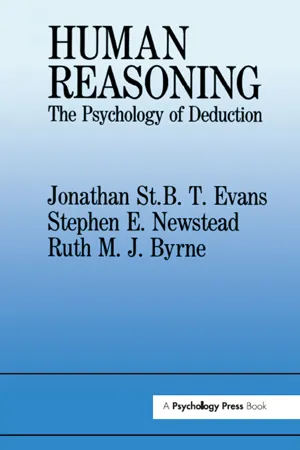
eBook - ePub
Human Reasoning
The Psychology Of Deduction
- 320 pages
- English
- ePUB (mobile friendly)
- Available on iOS & Android
eBook - ePub
Human Reasoning
The Psychology Of Deduction
About this book
Deductive reasoning is widely regarded as an activity central to human intelligence, and as such has attracted an increasing amount of psychological study in recent years. In this first major survey of the field for over a decade, the authors provide a detailed and balanced review of all the main kinds of deductive reasoning task studied by psychologists. Topics covered include conditional and disjunctive reasoning, the Wason selection task, relational inference and reasoning with syllogisms and quantifiers. Throughout the review, a careful distinction is drawn between the main empirical findings in the field and the major theoretical approaches proposed to account for these findings. Discussion of experimental findings is organized around three central questions:
What is the extent and limitation of human competence in deductive reasoning?
What factors are responsible for systematic errors and biases on reasoning tasks?
How is human reasoning influenced by the content in which logical problems are presented?
Four major classes of theory are discussed throughout the book. The long established theory that people have a mental logic comprised of formal rules of inference is contrasted particularly with the recently developed mental model theory of deductive reasoning. Explanations of many phenomena, especially biases, are also considered in terms of heuristic processes. Finally, consideration is given to accounts of content and context effects based upon the use of domain sensitive rules or schemas.
The book ends with a discussion of research on deductive reasoning in the context of the current debate about human rationality.
Information
Publisher
Psychology PressYear
2019Print ISBN
9780863773143
9780863773136
Edition
1eBook ISBN
9781317716266
1 | Introduction |
Reasoning is fundamental to human intelligence. Inferences are the means by which we can make use of our vast stores of knowledge and apply them to particular situations. Most reasoning, however, takes place automatically and efficiently and we take it for granted, in just the same way that we are largely unaware of the immensely complex processes by which the brain constructs our instant perceptions of the world around us. As an example, consider the following scenario.
You are invited to a friend’s house and he makes some introductions. “This is my father”, he says, “and my sister Mary”. Mary smiles and says, “Father is fanatical about cricket, don’t let him bore you.” It may not be immediately apparent that in following this discourse you needed to make an inference, namely that Mary’s father is the same person that was introduced to you as your friend’s father. You know as a general rule that if two people are siblings and the parent of one of them is a particular individual, then that individual is also the parent of the other. Somehow we must have applied this knowledge to infer who Mary’s father is. Such an inference would normally be made unconsciously and indeed without awareness that reasoning had occurred at all.
Consider how feeble our intelligence would be if we could not make inferences of this kind. In the above case, we would need to be told separately about each specific family relationship. We would not be able to learn and apply general principles or generalise our experience from one situation to another. Knowledge would have to be entirely specific to be useable. Without extensive reasoning, we also would not be able to understand most of the utterances which are commonly made in natural language. Suppose, for example, someone says to you: “Take my car. The keys are on the sideboard.” This comment is immediately comprehensible, but when you look at its literal content you find two apparently unconnected statements. The inferences you draw—again unconsciously in all probability—are that (a) the keys are the keys to the car and (b) that the speaker expects you to fetch them. You are only able to do this because of certain implicit rules of cooperation that speakers and listeners engage in (Grice, 1975). In particular, listeners assume that speakers will be relevant (Sperber & Wilson, 1986). Hence, the keys are assumed to belong to the car as they would otherwise be irrelevant to the context created by the first sentence. Similarly, the only way in which you can make the speaker’s reference to the location of the keys relevant is by assuming that she wishes you to collect them. Why would she tell you where the keys were if she was going to collect them herself?
Inferences are not, of course, confined to the understanding of utterances. Everyday problem solving of all kinds involves reasoning. If your car fails to start one morning, then you try to figure out the reason why so that you may be able to cure it. If you have little knowledge of cars, you may reason in a rather primitive fashion; for example, to infer that the battery was flat the last time it failed to start, then that is probably the problem this time. A more knowledgeable driver might notice that the engine is turning over but not firing, so the battery cannot be responsible (another inference). The mechanic you call out would use a more sophisticated level of reasoning again, for example by carrying out tests to distinguish between ignition and fuel faults.
What each of these examples illustrates is that we make inferences in order to bring our knowledge to bear on particular situations and make use of them. In general, the better our knowledge, then the more accurate these inferences are likely to be, although knowledge can sometimes interfere with reasoning as we will see later in this book. We have not, however, so far indicated what kind of inferences we are talking about. The focus of this book, as the title suggests, is specifically on deductive inference. Classically, this is contrasted with inductive inference, though the distinction is not as helpful as one might expect. A deductive inference is one which draws out a conclusion which is latent but implicit in the information given. New information cannot be added in a deductive inference. In contrast, an inductive inference is one which adds information and is therefore not a logically necessary conclusion. For example, when we make an inference from a generalisation to a particular case— “All swans are white, therefore this swan is white”—we are reasoning deductively. The reverse process—empirical generalisation—is a typical case of induction. Thus we may reason “All the swans I have ever seen are white, therefore all swans are white.” Such generalisations are not logically sound, but are an important and pervasive feature of our thinking about the world.
Deductive inferences are those whose conclusions necessarily follow from their premises or assumptions. The normative theory for how such inferences should be made is the study of formal logic, a subdiscipline of philosophy to which we shall return later. Of the inferences discussed so far, the one with the clearest claim to be a deductive inference is the first. Given the knowledge of parent–sibling relationships, the conclusion you drew was inevitably true. Assuming, that is, that the language used was precise, and no stepfathers or half-sisters were involved.
The second example—the case of the car keys—might appear to be a classical case of pragmatic inference, a type of inductive inference which is plausible given the context rather than logically necessary. Whether such pragmatic inferences are inductive or deductive is a matter of debate. Clearly, they go beyond the information given and so appear to be inductive. Some authors, however, prefer to describe such reasoning as involving first an elaboration of the context by use of prior knowledge and assumptions, followed by a process of deductive reasoning on the expanded representation of the problem (e.g. Henle, 1962; Sperber & Wilson, 1986).
Some inferences are, however, clearly probabilistic in nature, such as the argument that the car won’t start because the battery is flat. Even the owner of this inference had little confidence in it. Inferences whose conclusions are drawn with a certain degree of probability or confidence are often referred to as statistical inferences. Everyday statistical inferences occur frequently and form the subject of some very interesting psychological work (see Kahneman, Slovic & Tversky, 1982) which has many natural connections with the study of deductive reasoning (see Evans, 1989). A review work on statistical inference is, however, beyond the scope of the present volume.
A further distinction between explicit and implicit reasoning is also needed to define the range of psychological research to be discussed in this book. As pointed out above, many of the inferences we make in understanding language and thinking about the world are implicit, i.e. we do not know that we are engaged in reasoning when we are doing it, and may involve unconscious introduction of prior knowledge and belief. Explicit reasoning also occurs in everyday life, as for example when we try to understand rules and regulations and apply them to our own circumstances. Working out whether we qualify for a home improvement grant or a tax rebate, or whether our child can choose the combination of school subjects that he or she wishes, are all examples of explicit deductive reasoning. The information required is all laid out openly and does not rest upon hidden assumptions or extra knowledge that we bring to bear. Our reasoning can be checked by others and can be objectively demonstrated to be sound or unsound.
To write a book on implicit inference would be almost the same as writing one on the whole of cognition. Our humble enterprise is therefore to be limited not only to deductive reasoning but to explicit reasoning tasks. That is to say, we will focus on experimentation in which laboratory subjects are explicitly asked to engage in reasoning, for example by being given the premises of an argument and asked to decide what necessarily follows from it. The problems will all have solutions which are verifiable in some kind of standard logic (see below) and will not, in principle, depend upon individual knowledge and belief. In practice, as we shall see, the prior beliefs of the subjects nevertheless exert a major influence on the inferences that they make.
This restriction is a necessary one in order to delimit a literature of sufficiently limited size and clear focus to permit an in-depth review and discussion. However, the restriction we place is on the kinds of task that experimental subjects are engaged in and not on the cognitive processes which they bring to bear. There are many theories about what people do when confronted with logical reasoning problems and it is by no means apparent, as we shall see, that explicit reasoning tasks are solved by an explicit process of reasoning or on the basis of only the information presented. However, let us elaborate more upon the field of research with which we are concerned, including its history and its current concerns.
THE COGNITIVE PSYCHOLOGY OF DEDUCTIVE REASONING
Historical Background
When the history of psychological thought is taken back by more than 150 years or so, it merges with the parent discipline of philosophy. In one sense, then, one can see the psychology of deductive reasoning as being as old as the study of logic, which originated in the writings of Aristotle. However, with the separation of psychology and philosophy, logic has come to be viewed by most as a normative theory of deductive reasoning, i. e. a the...
Table of contents
- Cover
- Half Title
- Title Page
- Copyright Page
- Table of Contents
- Foreword and Acknowledgements
- 1. Introduction
- 2. Conditional Reasoning
- 3. Theories of Conditional Reasoning: Rules Versus Models
- 4. The Wason Selection Task
- 5. Disjunctive Reasoning
- 6. Relational Inferences
- 7. Syllogistic Reasoning
- 8. Reasoning with Quantifiers: Beyond Syllogisms
- 9. Overview and Conclusions
- References
- Author Index
- Subject Index
Trusted by 375,005 students
Access to over 1.5 million titles for a fair monthly price.
Study more efficiently using our study tools.
Frequently asked questions
Yes, you can cancel anytime from the Subscription tab in your account settings on the Perlego website. Your subscription will stay active until the end of your current billing period. Learn how to cancel your subscription
No, books cannot be downloaded as external files, such as PDFs, for use outside of Perlego. However, you can download books within the Perlego app for offline reading on mobile or tablet. Learn how to download books offline
Perlego offers two plans: Essential and Complete
- Essential is ideal for learners and professionals who enjoy exploring a wide range of subjects. Access the Essential Library with 800,000+ trusted titles and best-sellers across business, personal growth, and the humanities. Includes unlimited reading time and Standard Read Aloud voice.
- Complete: Perfect for advanced learners and researchers needing full, unrestricted access. Unlock 1.5M+ books across hundreds of subjects, including academic and specialized titles. The Complete Plan also includes advanced features like Premium Read Aloud and Research Assistant.
We are an online textbook subscription service, where you can get access to an entire online library for less than the price of a single book per month. With over 1.5 million books across 990+ topics, we’ve got you covered! Learn about our mission
Look out for the read-aloud symbol on your next book to see if you can listen to it. The read-aloud tool reads text aloud for you, highlighting the text as it is being read. You can pause it, speed it up and slow it down. Learn more about Read Aloud
Yes! You can use the Perlego app on both iOS and Android devices to read anytime, anywhere — even offline. Perfect for commutes or when you’re on the go.
Please note we cannot support devices running on iOS 13 and Android 7 or earlier. Learn more about using the app
Please note we cannot support devices running on iOS 13 and Android 7 or earlier. Learn more about using the app
Yes, you can access Human Reasoning by Ruth M.J. Byrne,Jonathan St.B.T. Evans,Stephen E. Newstead in PDF and/or ePUB format, as well as other popular books in Psychology & Cognitive Psychology & Cognition. We have over 1.5 million books available in our catalogue for you to explore.