- 250 pages
- English
- ePUB (mobile friendly)
- Available on iOS & Android
eBook - ePub
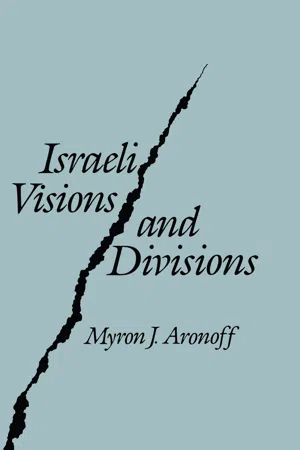
Israeli Visions and Divisions
About this book
This finely etched, on-site work examines the relationships between the changing political system and political culture in Israel, with particular focus on the decade of the 1980s. Written by a scholar equally at home in the United States and in Israel, and intellectually equally at home in political science and anthropology, Israeli Visions and Divisions is a fundamental contribution to a literature long on passion and short on reason, which perhaps is an academic reflection of social life in this deeply troubled land.Aronoff starts from the belief that the basic conflicting and even contradictory interpretations over what should be the exact character of Israel as a Jewish state continues to be the source of the most serious division among Jews within contemporary Israel. As a consequence, consensus politics yields to coalition politics; and prospects for a future consensus are dim. Conflict among Jewish political and religious groups, and between Jews and Arabs, is aggravated by the uses of Zionist symbolism in a fragmented political culture.This is a serious critique made from a sympathetic quarter. Aronoff suggests that the Israeli political system is undergoing a crisis of political legitimacy, exemplified by the rise of extraparliamentary movements. The parliamentary system accentuates' these divisions by making every minor tradition and vision part of the legislative and executive processes.Israeli Visions and Divisions is not a pessimistic reading. The author is convinced that the way is open for a move away from particularism and tribalism, and toward a new universalism and humanism. The old policies have proven bankrupt, and th,e old ideologies have lost their salience. The book is rich in detail and profound in outlook. It will be greeted by those interested in new policies as well as by students of the Middle East who hope to piece together what has gone awry in the land of milk and honey.
Information
1
The Role of Dominance: Labor and the Likud
[A] Party is dominant when it is identified with an epoch. [Maurice Duverger]
The Origins of Labor Dominance
Identification with an Epoch
The dominance of the Labor movement in Israel was established during the crisis of the early stages of nation building in the 1920s through the 1930s. Its main leaders, party, and affiliated institutions (e.g., the kibbutzim and the Histadrut, or labor federation), became identified with the heroic epoch of pioneering and the successful struggle for national independence. Each of the two most important scholarly studies of the establishment of Labor dominance during this period focuses primarily on one aspect of dominance and tends to underemphasize the importance of the other aspect. Yoseph Gorni (1973) emphasized the acquisition of ideological dominance by the party through its exceptional leaders who gained legitimacy because they were considered to be the pioneering vanguard of Zionism. They exemplified the dominant values of the time, chalutziut (Zionist pioneering), voluntarism, and egalitarianism. They displayed sufficient flexibility to incorporate a multiplicity of viewpoints as the party co-opted more groups while projecting a coherent vision of national goals and aspirations.
Yonathan Shapiro (1976) analyzed the process whereby Labor gained political dominance through the creation of a number of original sociopolitical institutions through which it mobilized power. The most important of these was the establishment of the Histadrut in 1920. The Histadrut, a unique labor federation that became a virtual state within a state in the period prior to independence, played a crucial role in the creation of, and in shaping the character of, the present state of Israel.
It is possible to comprehend the success of Labor in establishing its dominance only by explicating the interactive effect of the ideological/cultural and the political/institutional levels of dominance. They were not merely complimentary. Each was essential for the success of the other. For example, the respect that the Labor leaders received from the nonsocialist middle-class leadership of the World Zionist Organization (WZO) derived from their perception of the Labor Zionists as being the most active and creative force in settling immigrants and reclaiming (literally and figuratively) the land of Israel. Therefore the WZO heavily subsidized the Labor movement’s colonization efforts and their urban projects through the Histadrut. Through these resources Labor was able to mobilize greater political support by providing a wide range of services to the new settlers, who became clients of the party, and at the same time Labor leaders refurbished their image as the vanguard of pioneering Zionism.
Conversely, the large and amorphous middle-class General Zionists lacked charismatic leadership and a coherent ideology with a unifying myth; also they failed to build their own institutions. The Revisionist movement, which was founded in 1925, had a charismatic leader and an ideology with a central myth, but it failed miserably to develop strong and viable institutions. The organizational failure in the early period can be largely attributed to strategic errors of the leader, Vladimir Zeev Jabotinsky. As the sworn enemies of the Histadrut, the revisionists could not compete for a share of the valuable patronage of this organization. Jabotinsky focused his primary political activity on central and eastern Europe rather than Palestine, so little effort was made to develop strong organizational bases in the yishuv (the Jewish community in Palestine). His primary approach was ideological rather than organizational. His disciple and successor, Menachem Begin, made a similar strategic error in focusing almost exclusively on ideology and ignoring the building of strong institutional bases of support (discussed below). Jabotinsky’s decision to split away from the World Zionist Organization and to form his own New Zionist Organization in 1935 enabled Labor to gain a dominant position in the executive of the WZO and thereby to gain control of the valuable resources that accrued from this organization.
Capturing the Political Center
One of the more effective means by which Labor established its dominant position was through the strategic formation of coalitions that effectively made it the indispensable partner for any viable ruling coalition. Although ostensibly a socialist party, under David Ben-Gurion’s leadership Labor staked its claim as the main national party in the political center. He declared his readiness to form a coalition with any legitimate Zionist party excluding the Communist party and the nationalist Herut (the political offspring of the Revisionist movement). Ben-Gurion made a historic pact with the National Religious party, which brought it into every government formed by Labor. By balancing coalitions with socialist parties to its left and liberal and conservative parties to its right, Labor ensured its dominance and centrality. Medding (1972) analyzes the strong party machine, controlled by bosses completely loyal to Ben-Gurion, which enabled such coalition flexibility.
Another important tactic was the delegitimation of Labor’s rivals. These tactics worked with varying success at different periods with different parties. The parties of the radical left were stigmatized as anti-Zionist and/or having loyalties beyond national ones, and the rightist Herut was declared to be irresponsible and beyond the pale of legitimate Zionist politics because of its dissident activities during the war of independence and the irresponsible behavior of some of its main leaders thereafter. (This is discussed in detail in chapter 2, below.)
Loading the Dice
Lipset and Rokkan (1967) have shown that the mobilization of power in the crucial formative period of a political system determines its development for many years thereafter. James S. Coleman (1957), reanalyzing a large number of studies of community power, has concluded that the manner in which conflicts are resolved in the early stages of the formation of a community “loads the dice” and establishes patterns of conflict resolution that last long after the original issues have been forgotten. My study of a new town (Aronoff, 1974), illustrated such a case in an Israeli context. Shapiro (1976), following Lipset and Rokkan, argues that the leading and dominant role played by Labor in the formative stages of the crystallization of the Israeli political system gave it a unique advantage, which it successfully exploited to maintain a dominant position for nearly fifty years.
The Maintenance of Labor Dominance
The consolidation of Labor dominance came in the period following independence in 1948 with the institutionalization of the bureaucratic agencies of the state. During the postindependence period the character of both the ideological and the political dominance of Labor were significantly adapted to the changing social, economic, cultural, and political conditions. Many of the major services that had previously been provided by the voluntary agencies (such as the Histadrut) prior to independence were transferred to the state bureaucracy after independence. The paramilitary organizations of the various political movements were abolished by the provisional government in one of its first acts, and the Israel Defense Forces (IDF or Zahal) was created. In the ensuing years the labor exchange was transferred from the Histadrut to the Ministry of Labor, and the separate school systems controlled by the political movements were abolished and a state educational system was established, which provided for secular and religious options. The relinquishing by the Histadrut of the socialist-Zionist school system reflected a lengthy process whereby Labor, under Ben-Gurion’s leadership, had deemphasized its socialist ideological orientation in favor of a stronger emphasis on nationalism.
David Ben-Gurion articulated a new ideology of mamlachtiut (statism), which asserted that the state and its agencies, for example, the army, had taken over the role of pioneering vanguard from the prestate voluntary agencies. This ideology gave legitimacy to the transfer of important functions from the Histadrut to the state. It also appealed to a large constituency of masses of new immigrants who were not particularly attracted by Labor’s pragmatic socialism. Whereas the new myths and ceremonies that accompanied the advent of mamlachtiut appealed to larger numbers, the intensity of support among those attracted tended to be less fervent than the support of those who had been committed to socialist-Zionism. Statism became the ideology through which Labor institutionalized its authority and attempted to socialize the new immigrants with this new interpretation of Zionist civil religion.
Israel underwent a tremendous growth in population through immigration. The dynamic growth and diversification of the economy, including a stronger private sector, led to a commensurate growth and increasing complexity of government. An enormous state bureaucracy grew. Not only did the civil service grow, but also the party’s bureaucracy expanded with the growth of urban machines and a vast patronage system aimed at the mobilization of the immigrants.
Labor maintained its dominant position for as long as it did because it was relatively successful in meeting the major challenges that Israel faced in its first three decades: defense against hostile neighbors, the “absorption” of mass immigration, and the need for economic growth.1 From the outset Israel’s physical existence was challenged, and the leading role that Labor’s leaders played in the successful defense of the nation has been one of the most important bases of their authority.2 It was not until the shock of the surprise attack on Yom Kippur 1973 (termed the “earthquake” in the media) and the protest movements that followed from it that the taken-for-granted assumption of Labor’s leadership of the nation and its defense establishment was seriously called into question on a significant scale.
Labor also derived considerable authority from its leading role in the integration of the survivors of the Holocaust from Europe and hundreds of thousands of Jews from Islamic countries of North Africa and the Middle East. The young nation faced an unprecedented challenge of crisis proportions in more than doubling its population in the first few years of its existence. During a period of serious economic hardship, the needs for housing, education, and welfare of these immigrants—a large proportion of whom were indigent—severely taxed the resources of the nation. Even with the considerable help of Jews abroad and foreign nations, the “ingathering of the exiles,” which constituted a virtual raison d’être for the creation of the state, was a formidable accomplishment. However, largely in response to this challenge the party developed in directions that ultimately undermined its dominant position in the society.
As with the previous examples of the successful meeting of challenges, Labor’s success in helping to achieve high rates of economic growth eventually contributed to the undermining of its dominance. As the economy developed into a healthier and more sophisticated one with high rates of employment, the dependence of citizens on the patronage provided by the government and through the party was drastically reduced. Skills and education rather than party identification became far more important in gaining satisfactory employment. The second and third generations at both ends of the economic ladder became disenchanted with Labor for different reasons.
The Loss of Labor Dominance
Domination takes the zest from life. . . . The dominant party wears itself out in office, it loses its vigour . . . every domination bears within itself the seeds of its own destruction. [Duverger, 1967:312]
Sometimes the successes of a dominant party can contribute to the eventual undermining of its dominance. Just as the legitimacy derived from an ideology that was central to the political culture paved the way for the political dominance of Labor, the erosion of the authority provided by ideological legitimacy undermined its political dominance. Liebman and Don-Yehiya (1983:123) have speculated that one of the important factors that is likely to have contributed to the decline of statism (mamlachtiut) was the successful building of the nation: “As time passed the existence of the state no longer evoked such wonder.” Similarly, in A More Perfect Peace, Amos Oz (1985:177) observed: “Once, long ago, there was a time when all things done here were done with devotion, even with a kind of ecstasy, sometimes with enormous self-sacrifice. But then the bold dreams came true.”
A woman of the pioneering generation who had been one of the founders of her kibbutz once confided to me: “I sometimes have to pinch myself to make sure that I am not dreaming that we actually have our own Jewish state!” For her, the creation of the state of Israel is the fulfillment of a dream, the realization of a vision, which her children take very much for granted.3 Both the realization of the dream and the sense that the reality fell short of the ideal further contributed to the end of the pioneering epoch with which Labor had been identified and from which it derived its legitimacy. I shall explore the implications of this for the polarization of Israeli society, particularly during the 1981 election campaign and during the war in Lebanon, in chapter 2, below.
One area in which Labor conspicuously failed was in the socialization of succeeding generations. Studies of voting behavior indicate that Labor lost the political support of the younger generations. In most cases they failed to instill the values and ideals for which the party stood. The establishment of a Jewish Consciousness Program in the secular public schools in 1957 to counter the attraction of Canaanism (a nativist ideology that stressed the need to build a Hebrew culture without links to the Diaspora) for the youth is identified by Liebman and Don-Yehiya with the beginning of the decline of statism.
In other cases, having succeeded in instilling the ideals of the party, the leaders lost the support of the youth because their actions and policies failed to live up to these ideals. Such was the case with the National Religious party (NRP), which, through its network of religious schools, succeeded in socializing younger generations who are far more nationalistic, religiously observant, and self-confident than the preceding generation. Consequently they deserted the National Religious party in large numbers for the more militant Gush Emunim (Bloc of the Faithful) movement, the political parties closest to it, Morasha, Techiya, and the Likud.4 We shall analyze the phenomenon of Gush Emunim in chapter 4, below. The leaders of the younger generation who remained in the NRP and rose to positions of power in it were instrumental in shifting the party’s coalition alliance from Labor to the Likud. The failure of Labor to retain the traditional alliance with the NRP, or to replace it with an equally reliable alternative, was another challenge unsuccessfully met, which contributed to its downfall.
Oligarchic tendencies, which were latent from the early formative years, became increasingly manifest with the development of a dominant machine within the dominant party. The machine expanded as a response to the development of elaborate patronage networks designed to mobilize new immigrants. A system of indirect elections to party and Histadrut institutions through the use of appointments committees guaranteed elite domination of these institutions.
Those groups most supportive of the elite were over-represented and other more marginal groups were under-represented on these institutions. As they became mere rubber stamps for decisions made informally by the elite, democratic procedures and the party constitution were increasingly put aside for political expediency. Criticism of the elite and their policies was suppressed, and recruitment and mobility to higher levels became dependent upon loyalty to the elite rather than the display of independence and initiative.
The erosion of responsiveness of the party to the demands of the public coincided with a growing arrogance of the top national leaders, who became preoccupied with the perpetuation of their rule. This resulted in progressively widespread feelings of political inefficacy among the secondary national leaders, the local leadership, and the rank-and-file membership. This contributed directly to the erosion of Labor legitimacy and dominance.5
Among the alienated groups that failed to gain sufficient access to the centers of power under Labor, the most politically important were the Jews who emigrated from the Middle East, and particularly emigrants from North Africa, and their offspring. As Labor increasingly came to be perceived to be the party of the European-born veteran elite and their descendants, the Eastern Jews increasingly identified with the antiestablishment leader of the opposition Likud, Menachem Begin.6 The greater militancy and religiosity of Begin also attracted the religious voters, as they attracted the NRP (under the influence of their young leaders) as a coalition partner.
Whereas in the early years of independence Labor succeeded in denying legitimacy to its main opposition, Herut, over the years it became increasingly difficult, if not impossible, to do so.7 Although Her...
Table of contents
- Cover
- Half Title
- Title Page
- Copyright Page
- Dedication
- Acknowledgments
- Acronyms
- Introduction
- 1. The Role of Dominance: Labor and the Likud
- 2. Political Polarization
- 3. The Manipulation of Political Culture under the Likud
- 4. The Revitalization of Political Culture: Gush Emunim
- 5. Protests for Peace: Peace Now and Two Smaller Peace Movements
- 6. Interpreting Israeli Political Culture
- Epilogue
- References
- Name Index
- Subject Index
Trusted by 375,005 students
Access to over 1.5 million titles for a fair monthly price.
Study more efficiently using our study tools.
Frequently asked questions
Yes, you can cancel anytime from the Subscription tab in your account settings on the Perlego website. Your subscription will stay active until the end of your current billing period. Learn how to cancel your subscription
No, books cannot be downloaded as external files, such as PDFs, for use outside of Perlego. However, you can download books within the Perlego app for offline reading on mobile or tablet. Learn how to download books offline
Perlego offers two plans: Essential and Complete
- Essential is ideal for learners and professionals who enjoy exploring a wide range of subjects. Access the Essential Library with 800,000+ trusted titles and best-sellers across business, personal growth, and the humanities. Includes unlimited reading time and Standard Read Aloud voice.
- Complete: Perfect for advanced learners and researchers needing full, unrestricted access. Unlock 1.5M+ books across hundreds of subjects, including academic and specialized titles. The Complete Plan also includes advanced features like Premium Read Aloud and Research Assistant.
We are an online textbook subscription service, where you can get access to an entire online library for less than the price of a single book per month. With over 1.5 million books across 990+ topics, we’ve got you covered! Learn about our mission
Look out for the read-aloud symbol on your next book to see if you can listen to it. The read-aloud tool reads text aloud for you, highlighting the text as it is being read. You can pause it, speed it up and slow it down. Learn more about Read Aloud
Yes! You can use the Perlego app on both iOS and Android devices to read anytime, anywhere — even offline. Perfect for commutes or when you’re on the go.
Please note we cannot support devices running on iOS 13 and Android 7 or earlier. Learn more about using the app
Please note we cannot support devices running on iOS 13 and Android 7 or earlier. Learn more about using the app
Yes, you can access Israeli Visions and Divisions by Myron J. Arnoff, Myron J. Aronoff in PDF and/or ePUB format, as well as other popular books in Politics & International Relations & Middle Eastern Politics. We have over 1.5 million books available in our catalogue for you to explore.