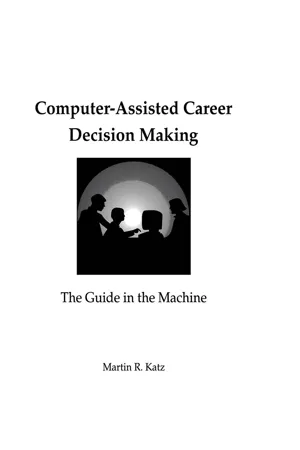
Discussing career decision making (CDM), career guidance, a computerized system of career guidance, and the interplay among them, this book describes the way people sort themselves, or are sorted, into educational and occupational options. The options represent the content of this book, and the sorting represents the process. The sequence of decisions may extend over a lifetime, but several crucial choice-points tend to occur at predictable stages in a career. Career guidance is a professional intervention in CDM; "professional" implies that practitioners conform to a standard of ethics, knowledge, and competence beyond what may be offered by other intervenors. Guidance is partly an art, but it is also partly a science -- at least an application of science, based on a synthesis of logic and evidence derived from research.
The computerized System of Interactive Guidance and Information (SIGI) is a designated guidance "treatment," clearly defined and specified. It was developed according to an explicit model, derived from a particular rationale for guidance, using modern technology to amplify the practice of career guidance. The current version -- called SIGI PLUS TM -- is being used at more than a thousand colleges and universities, as well as secondary schools, libraries, corporations, community-based organizations, and counseling agencies.
These three interdependent topics are treated in a progression: from a theory of CDM to a rationale and a model for guidance to the design and development of a system. This book weaves together theory (principles, propositions, rationales, and models), research and development. The product of that development, SIGI, helps to define theory, to exemplify it, and to test it.
- 296 pages
- English
- ePUB (mobile friendly)
- Available on iOS & Android
eBook - ePub
About this book
Information
1
Career Decision Making
Blessed is he who has found his work; let him ask no other blessedness. He has a work, a life-purpose; he has found it, and will follow it.
Carlyle (Past and Present)
Work is the curse of the drinking classes.
Anonymous
In the annals of humankind, work has been variously described as blessing and as curse, ego involving and ego denying, fulfilling and frustrating. It first appears as a curse in the expulsion from Eden: "In the sweat of thy face shalt thou eat bread." In our own time, it has been viewed, on the one hand, as a major source of gratification of psychosocial needs, implementing self-concepts and providing an abundance of rewards and satisfactions, and, on the other hand, as a source of alienation-monotonous, dreary, and demeaning-and sometimes of stress and consequent illness.
In any case, within our culture it has been widely assumed that work, for better or for worse, plays a crucial part in the passage from adolescence to adulthood. Indeed, adolescence itself may be regarded as a modern invention, dating to delayed entry of youth into the labor market. Typically, the adolescent's role is seen to be mainly that of student. Work is incidental to this role. Adults, however, are often likely to be identified by the kind of work they do (i.e., their occupation). Adolescents are instructed in this sign of passage when they are confronted with that awkward favorite of adults' conversational gambits: "What are you going to be?" Being, in this context, always refers to occupation. Any other response is nothingness. A large part of the life space of many adults is taken up by occupation. Lynd and Lynd (1937) called occupation "the most nearly dominant single influence in a man's life" (presumably, had they been writing more recently they would have included women) and "the watershed down which the rest of one's life tends to flow."
The shift in terminology here from "work" to "occupation" is no accident. Work-regardless of occupation-usually provides the basic means for livelihood and consumes the largest portion of one's waking hours. It can be distinguished only from leisure and other forms of nonwork. Occupations represent the different kinds of work. The fourth edition of the Dictionary of Occupational Titles (DOT) and its Supplement (United States Department of Labor, 1977,1986) define thousands of occupations. These occupations can be characterized and classified in many waysaccording to kinds of activity, entry requirements, wage or salary levels, working conditions and environments, opportunities for various satisfactions, and the like. This differentiation of work into occupations exercises a maj or influence on the lifestyles of many adults - involving such elements of identity as socioeconomic status, self-esteem, network of friends and acquaintances, place of residence, opinions, attitudes, and so on. The influence is not one way: Some of these elements of identity affect choice of occupation.
Differences between people have also been characterized and classified in such terms as abilities, interests, values, skills, temperaments, amount or kind of education, sex, ethnic affiliation, socioeconomic level, and so on. These attributes seem relevant to the process by which people sort themselves or get sorted into the different occupations that are available at a given time. Selection and placement (e.g., by educational institutions and employers) are part of this process. They often impose constraints but sometimes provide special opportunities. At any rate, within the elastic bounds of these external "reality factors," individuals can generally exercise considerable freedom of choice.
Indeed, a career usually involves a sequence of choices, particularly visible at regular transition points imposed by the educational, legal, or economic system. But there is more to a career than choices. There is, for example, a set of outcomes for each choice. Having chosen, a person acts to gain a certain position. If rejected, he or she may loop back to another option. If accepted, he or she performs well or poorly, enjoys satisfaction or suffers discontent. The effects of such outcomes may be felt in subsequent choices. That is to say, one can learn from experience. So the notion of a sequence suggests that any single choice bears some relationship both to antecedent and to subsequent choices.
The nature of this relationship has been described as a "means-ends chain." Because people both remember and imagine, they can evaluate their past experience and anticipate their future performance and satisfaction. Each of these evaluations and anticipations represents a self-appraisal; a number of such self-appraisals may be integrated to constitute a self-concept. Self-concept is thus engaged reciprocally with career decisions: The concept of self shapes the individual's choices and is shaped by them.
Components of Career Decision Making
These interactions among options, persons, environments, processes, and outcomes introduce major components of the career decision-making drama in which people act as they enter or pass through adulthood.
Options. First, there are the dilemmas, which provide the major content of career decision making (CDM) and get the plot moving. They define the domains of the decisions (what it is people decide about) and identify the options in each. A few examples: to work or not to work, to enroll in one educational program or another, to make a commitment to one occupation or another, to accept or reject a job offer, to remain in a position or apply for another.
Persons. Second, there is the protagonist, the person facing the dilemma and making the choices, who develops and entertains a certain self-concept, who obtains and processes information about options, who devises plans, takes actions, evaluates outcomes, and recycles through the whole procedure-or who drifts or flounders or withdraws. What dimensions of individual differences are relevant and how do they operate?
Environments. Third, there is the setting. The culture exercises great powers over the first two components. It may determine the nature of the choices to be made, restrict the options, govern the schedule. Different environments may grant vastly different resources to people and impose vastly different constraints on them. Events-such as war, depression, and invention-have potent effects, as do other conditions of time and place, of custom and legislation, of demography and Zeitgeist.
Processes. Fourth, there is the dramaturgy, the state of the art of decision making itself. A variety of approaches to CDM are extant. For example, there are different ways-at different levels of sophistication-of getting and processing information. In addition, an extensive apparatus for professional intervention has become a presence in the drama: Sometimes it plays a supporting role; sometimes it acts like a deus ex machina; sometimes it is the raisonneur; sometimes it merely carries a spear; but it is almost always there, even if only waiting in the wings for a cue.
Outcomes. Finally, there is the denouement of all the complications of CDM. How does it come out? Does the protagonist get what he or she chooses? Does he or she live happily ever after? To the betterment or detriment of society? What are the outcomes in terms of success and satisfaction, efficiency and productivity, discontent or harmony?
This chapter focuses mainly on issues in the content of CDM. (Later chapters emphasize persons, environments, processes, and outcomes.) But even in this chapter the other topics are not ignored. Like the drama critic who may discuss plot, characterization, theme, setting, and so on sequentially, we know that these components have no independent existence. They are useful for critical analysis simply because it is easier to talk about one category at a time than everything at once. We recognize, however, that the components overlap and interact and also that each component comprises some diversity of elements. We cannot discuss options without taking into account decision makers, settings, information processing, and outcomes. Identifying and labeling the components does not allow us to cut CDM into separate slices that can be buttered and eaten one at a time. Rather, each slice is a different plane through a common center. Thus, there is no slice that does not contain some part of all the others: When we have finished the content of choice, we will find a bite taken out of individual differences, environments, processes (including professional interventions), and social and individual consequences.
Content of Choice: Dilemmas, Domains, and Options
What are the decisions in CDM made about? What are the options for each choice? What are the linkages between domains? A few illustrations indicate the range of the domains. There are decisions about education: which course or curriculum or major to elect; whether to undertake postsecondary education, graduate education, "continuing" education, nontraditional or experiential education; which school to apply to or attend; whether to return to formal education after an absence; whether to attend a school full time or part time; whether to seek an apprenticeship or other on-the-job training. There are decisions about the centrality of work or commitment to work: behaviorally, whether to work overtime, full time, part time, or not at all. There are decisions about volunteer activities: whether to engage in them, what kind, for how much time. There are decisions about occupations: which occupation to prefer, plan for, prepare for, attempt to enter, or eliminate from consideration. There are decisions about jobs: which organization, industries, or companies to apply to or accept an offer from. There are decisions about positions: to remain in a given position or apply for another.
These types of decisions are usually interconnected. Nevertheless, as perceived by the decision maker at a given time, each choice may be made discretely. It may be responsive to a pressing need or want, providing immediate relief from such pressure or early gratification of such wants. Examples: A high school student elects to take Algebra 2 because she likes algebra. A high school graduate applies for a job in a local factory because he needs the paycheck. A junior executive changes jobs to move to a better climate. In many cases, however, a longer view is in evidence: A high school student elects Algebra 2 because she wants to become an engineer, and algebra is one step in preparing for that occupation. A high school graduate applies for a local factory job because it will put him in line for a toolmaker training program in that plant. A junior executive makes a lateral move across companies because he sees a better chance to get on a fast track for promotion.
To the decision makers in the second set of instances, the longer view evokes not just discrete choices but a sense of continuity. Not only an option at one point but an entire sequence of options is being chosen. Entire scenarios are envisioned. There is an awareness of possible and probable career paths and linkages involving each successive choice in the domains of education, occupation, job, and position.
Thus, career must be added to the domains for decisions. One of the alternatives is to take the long view, to make choices that take into account cumulative returns over a large portion of a career. The other, the short view, focuses on an immediate payoff. It is not entirely clear to what extent this decision is consciously made or is dependent on differences in temperament. The veridicality of information is not the issue here: The belief that a path or linkage exists need not be verified for career to serve as a domain for decision.
Definitions
Before elaborating on the dilemmas and options in some of the domains that have been mentioned, it may be appropriate to pause for some explicit definitions. A number of terms-such as work, career, occupation, job, position-have been used so far in contexts that might be expected to establish their meaning inductively. Although these terms have often been used loosely and interchangeably in the literature, there is an advantage to be gained from defining them precisely and distinctively. For the most part, the glossary given here is consistent with Shartle (1952) and Super (1976). The latter is the more extensive and warrants particular attention for two reasons: First, it was preceded by an analysis of usage in five "major works" from each of seven fields of behavioral and social science-labor economics, industrial sociology and anthropology, personality and social psychology, industrial psychology, counseling psychology, school counseling, and career education. Second, a considerable degree of consensus was reached by a panel of 15 prominent career psychologists.
Work, as used here, is both more comprehensive and more primitive in meaning than the other terms. It includes what people do in positions, jobs, occupations, and careers. It denotes activities involving economic gain, the expenditure of physical or mental energy, presumably productive-that is, intended to accomplish something of value. Thus, as a noun it evokes its homonymous verb. More basic and less differentiated than the other terms, work can stand in for them collectively. It rings of atavism: It represents what the species has done for survival.
Position is used to designate the group of tasks to be performed by one person at work. Thus, the Carl S. Gode Chair of Social Psychology at Cavern University would be a position; another position would be held by the barber who ministers to the occupant of the third chair from the window at Sal's Hairstyling Salon, and another (to make clear that a chair is not the inevitable appurtenance of a position) by the sales representative who covers a certain territory for the Whitehead Brewery. Of course, one person could hold those positions successively or even (conceivably) concurrently: The number of positions would still be three.
Positions are nested within job, a group of similar positions in a single organization. All members of the Social Psychology faculty at Cavern would have the same job. Social psychologists at Cloud University would have another job. All the barbers at Sal's would represent one job, and all the Whitehead sales representatives another.
Jobs are nested within occupation: Social psychologist, barber, and sales representative (malt liquors) are occupational titles for respectively similar jobs across all organizations (and include also similar work done by people who may be unaffiliated with any organization).
"Similar" in this definition requires some sharp judgments in order to "carve at the joints." How many specialties should be identified in psychology, in wholesale sales, and so on? Various techniques have been used for clustering and differentiating occupations: It has been convenient for many people to accept the titles embodied in the fourth edition of the Dictionary of Occupational Titles and its Supplement (United States Department of Labor, 1977, 1986) as representing the universe of occupations. (But the Dictionary, as is explained later, has its shortcomings.)
Career, as indicated previously, represents the sequence of positions held by a person over a lifetime. It is extended, however, to include not just work but also work-related roles such as student or retiree.
Decisions about Work1
Falstaff: Why, Hal, 'tis my vocation, Hal; 'tis no sin for a man to labor in his vocation. (Henry IV, Part I, I, ii)
The options for work are indicated by such questions as whether to work, when, how hard, how long. There are choices between work and schooling, work and leisure, work and retirement. There are also choices involving the degree of commitment to work, which indeed may underlie many of the other choices.
Mention has already been made of the spectrum of attitudes toward work-ranging from dedication to alienation. One pole is represented by "vocation," which retains its earlier religious connotation: a calling to the service of God, usually in some activity of a spiritual nature. Thus, the paradox in Falstaff s oily rationalization swings on the transition from religious to secular meaning: If man is called to his work, and the call comes from God, clearly " 'tis no sin" to heed the call (even if the vocation to which he has been called and has dedicated his talents happens to be "purse-taking"). "Vocation" prejudges the case for commitment, and it is interesting to note its diminishing use as a synonym for work or occupation. ("Vocation" survives in the name of at least one professional organization, the American Vocational Association; but another organization that was founded early in the century by humanitarian reformers imbued with egalitarian zeal and the conviction that everyone should seek self-fulfillment through work changed its name in 1987 from the National Vocational Guidance Association to the National Career Development Association.)
Historically, this attitude toward work as vocation appears during the Renaissance and particularly after the Reformation. Other attitudes have prevailed at various times in various cultures. As has been previously noted, after the beginning there was work. Adam's sentence to hard labor had many echoes throughout ancient times. Work was often seen as a necessary evil, as in this couplet from Pope's translation of the Iliad: "To labor is the lot of man below; And when Jove gave us life, he gave us woe." The Greeks of classical times saw no dignity in menial tasks. Slaves worked. Aside from soldiery, achievements deemed worthwhile by the Greeks required leisure. Their most notable contributions-in art, drama, philosophy, politics, and so forth-were the product of a leisure class supported by slave labor. The modern notion that the dramatist or philosopher or athlete works at his profession would have been incomprehensible to the Greeks, whose most competent "old pros" never lost their amateur status.
In the days of the Roman republic, a folk hero was Cincinnatus, who left his plow to defend the state and then returned to the plow when victory had been won. But by the time of the Caesars, the practical Romans had managed to translate their distaste for work into a 6-hour work day, and about half the days of the year were designated as holidays.
The early Hebrews, too, as Wilensky (1964) pointed out, "conceived of work as dismal drudgery," but accepted it as "an expiation. . . . Rabbinical literature held that no labor, however lowly, is as offensive as idleness." Still, neither they nor the early Christians saw work as partaking of "vocation." The Christians came to differentiate "work" from "vocation" but did not differentiate one kind of work from another.
It was not until the Reformation that work came to be identified as a major way of serving God. Luther emphasized the equal spiritual value of all kinds of work and regarded excellence of performance as a high duty. According to Weber's (1930) famous treatise, the "Protestant Ethic" assisted in the rise of capitalism by giving powerful religious approval to hard work, worldly achievement, and high profits.
Regardless of the validity of Weber's thesis, it is clear that the prevailing attitude toward work had undergone a change (at least among intellectuals). It had taken on a connotation of religious endorsement in the spirit of the Italian ...
Table of contents
- Cover
- Title
- Copyright
- Dedication
- Contents
- INTRODUCTION
- 1 CAREER DECISION MAKING
- 2 THE NEEDS FOR GUIDANCE
- 3 RATIONALES AND MODELS OF CAREER GUIDANCE
- 4 FOCUS ON FUNCTIONS OF A GUIDANCE SYSTEM
- 5 THE EVALUATION OF A GUIDANCE SYSTEM
- 6 CONCLUSION
- REFERENCES
- AUTHOR INDEX
- SUBJECT INDEX
Trusted by 375,005 students
Access to over 1.5 million titles for a fair monthly price.
Study more efficiently using our study tools.
Frequently asked questions
Yes, you can cancel anytime from the Subscription tab in your account settings on the Perlego website. Your subscription will stay active until the end of your current billing period. Learn how to cancel your subscription
No, books cannot be downloaded as external files, such as PDFs, for use outside of Perlego. However, you can download books within the Perlego app for offline reading on mobile or tablet. Learn how to download books offline
Perlego offers two plans: Essential and Complete
- Essential is ideal for learners and professionals who enjoy exploring a wide range of subjects. Access the Essential Library with 800,000+ trusted titles and best-sellers across business, personal growth, and the humanities. Includes unlimited reading time and Standard Read Aloud voice.
- Complete: Perfect for advanced learners and researchers needing full, unrestricted access. Unlock 1.5M+ books across hundreds of subjects, including academic and specialized titles. The Complete Plan also includes advanced features like Premium Read Aloud and Research Assistant.
We are an online textbook subscription service, where you can get access to an entire online library for less than the price of a single book per month. With over 1.5 million books across 990+ topics, we’ve got you covered! Learn about our mission
Look out for the read-aloud symbol on your next book to see if you can listen to it. The read-aloud tool reads text aloud for you, highlighting the text as it is being read. You can pause it, speed it up and slow it down. Learn more about Read Aloud
Yes! You can use the Perlego app on both iOS and Android devices to read anytime, anywhere — even offline. Perfect for commutes or when you’re on the go.
Please note we cannot support devices running on iOS 13 and Android 7 or earlier. Learn more about using the app
Please note we cannot support devices running on iOS 13 and Android 7 or earlier. Learn more about using the app
Yes, you can access Computer-Assisted Career Decision Making by Martin R. Katz in PDF and/or ePUB format, as well as other popular books in Psychology & History & Theory in Psychology. We have over 1.5 million books available in our catalogue for you to explore.