eBook - ePub
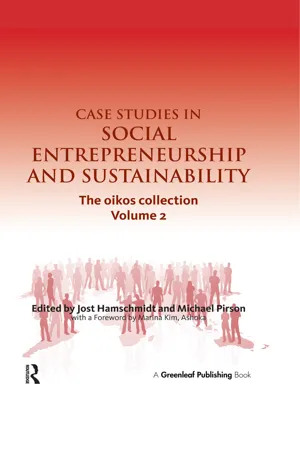
Case Studies in Social Entrepreneurship and Sustainability
The oikos collection Vol. 2
- 464 pages
- English
- ePUB (mobile friendly)
- Available on iOS & Android
eBook - ePub
Case Studies in Social Entrepreneurship and Sustainability
The oikos collection Vol. 2
About this book
The case studies in this second volume focus on entrepreneurs targeting sustainability issues, and how their personal values shape strategies and initiatives. The award-winning cases describe new patterns of value creation and the challenges of dealing with existing paradigms.
Part I
Introduction
1.1
Preface
This book is the second volume resulting from the oikos Global Case Writing Competition—an annual program launched in 2003 to promote the publication of high-quality teaching cases in Corporate Sustainability and Social Entrepreneurship. The first volume titled Case Studies in Sustainability Management and Strategy: the oikos collection was successfully published in 2007.1 Numerous positive feedbacks since then have underlined our conviction, that there is a growing need for tested case teaching materials. Against this background, the second volume expands the collection with strong cases in the rapidly growing field of Social Entrepreneurship and Sustainability. The selection includes winning cases of the oikos Global Case Writing Competition’s Social Entrepreneurship Track2 for which oikos has teamed up with Ashoka, the leading global Organization for Social Entrepreneurship.3 The nucleus of our cooperation dates back to Harvard Business School’s 2008 Social Entrepreneurship Conference, where the editors met with Marina Kim, an enthusiastic personality dedicated to bringing Social Entrepreneurship topics into the classrooms of leading Business Schools. We joined forces, expanded the international judging committee of the program to add professors in the field of social entrepreneurship and launched the first call for Social Entrepreneurship cases in November of 2008. The call gathered more than 20 submissions from leading business schools. We are happy to present the best of these cases within this volume, along with best cases of the subsequent 2010 competition edition.
oikos aims to strengthen management competence for sustainable development among tomorrow’s decision makers by integrating pressing issues into teaching and research at the world’s faculties for economics and management. The oikos Case Collection reflects this objective and aims to add relevant content to education at management schools worldwide. Both oikos and Ashoka regard the case method as one important teaching concept that is able to intertwine theoretical concepts with hands-on experiences, based on real-life organizations. We believe that this is a method that prepares the business students of today to deal with contemporary and future challenges.
In view of the growing importance of various sustainability trends, management schools are increasingly challenged to adapt their Entrepreneurship and Business curricula. Management education needs to reflect the trends and provide a broadened understanding of value creation. Sustainability is a concept that demands organizations to consider the legitimate expectations of different stakeholders in their value creation processes. At the same time, it underlines the fact that many sustainability trends offer new business opportunities that entrepreneurs will seize. As a result, value creation processes need to be reorganized in order to create economic capital while developing social capital and preserving natural capital.
Indeed, entrepreneurial organizations are increasingly dealing with these challenges. The fifteen case studies in this book explore both the opportunities and pitfalls entrepreneurs face in targeting sustainability issues and how their values and core assumptions impact their business strategies.
We are aware, that this volume can only be a start to explore the rich field of entrepreneurial social impact strategies applied by an increasing number of organizations—currently we see a growing number of groundbreaking initiatives evolving and we would be happy if scholars will cover the impact of these movements with new teaching cases in the future. We have also just launched the oikos case teaching initiative in order to bring innovative teaching cases into the classrooms of the management schools of the world.
As an incentive, the reader will find in Chapter 1.2 an introduction to the characteristics of excellent cases, but also hints on avoiding the most common mistakes in case writing. For this part we screened the written feedbacks of our case-writing judging committee, searching for patterns of the most often cited pitfalls. And in Part 6 we provide up-to-date information on external sources dealing with the case-writing process, international case competitions and case collections.
We hope that this volume will both stimulate the use and the production of Social Entrepreneurship and Sustainability Cases.
Jost Hamschmidt, St. Gallen
Michael Pirson, New York
January 2011
Michael Pirson, New York
January 2011
1 Jost Hamschmidt, Case Studies in Sustainability Management and Strategy: The oikos collection (Sheffield, UK: Greenleaf Publishing, 2007; www.greenleaf-publishing.com/oikos).
2 For more information on this competition please consult Chapter 6.4 or www. oikos-international.org/projects/cwc.
3 See: www.ashoka.org.
1.2
Cases in Social Entrepreneurship and Sustainability
What Makes an Excellent Case?
The case method of teaching was developed by Faculty of the Harvard Business School1 and the Ivey School of Business in the 1920s. The basic idea was to simulate real business challenges in the classroom in order to breathe life and instil greater meaning into the lessons of management education. Case studies can be important tools for creating learning processes on different levels—students are forced to struggle with exactly the kinds of decisions and dilemmas managers confront every day. In this reflection of reality, the values and goals of the student are systematically challenged. Uncertainty is key: students are asked what they think, how they would act, and what challenges they feel are important. The use of a case study should create a classroom in which students succeed by exercising the skills of leadership and teamwork in the face of real problems. Facts, figures and theories play an important role; but contexts, emotions and value judgments have a large influence, too. Guided by a faculty member, students cooperate, analyze and synthesize conflicting data and points of view. The objective is to define and prioritize goals, to persuade and inspire others who think differently, to make tough decisions with uncertain information, and to seize opportunities in the face of doubt.
These attributes are especially valuable in the context of social entrepreneurship, sustainability and strategy; organizations are now continually forced to value the different aspects of sustainability and their interrelations: How do social issues impact the economic bottom line? How can an environmentally sound strategy create a positive impact on employee motivation and thus have a measurable impact on economic performance? What comes first and why? These are just some of the many questions that may arise.
What makes an excellent case in social entrepreneurship? There are multiple case “recipes” available, e.g. via the Internet, and a vast literature about case writing and teaching.2 Many of these tips and hints can be applied to social entrepreneurship and sustainability cases. In this section we propose 11 features of an excellent case, which are derived from experience with the oikos Global Case Writing Competition. They also echo the lessons of a classic article by Clyde Freeman Herreid.3
- An excellent case provides a learning opportunity on a relevant topic. The case should tackle a decision situation with impact on the future of an organization and implications for corporate strategy. It should be a real case, not just a story. And it should identify clear-cut management decisions (i.e. merge or not; compete or cooperate).
- An excellent case tells an engaging story. It should have an interesting plot that relates to the experiences of the target audience. It needs a hero, a dilemma and a solution. The solution may not exist yet; it will be what the students need to supply once the case is discussed.
- An excellent case is accompanied by teaching goals and a teaching note. It should be explicit which audience is being addressed with the case. Undergraduates have a different background compared to MBA students. What does the case do for the course and the student? Which theories are employed? How should the students be involved (e.g. group works, student preparation, class interaction)? Cases can be choreographed with role-plays and/or voting. Students need to be systematically challenged to argue. Excellent cases provide suggestions for frameworks and literature for faculty and students.4
- An excellent case is based on a recent situation. To appear real the story should have the trappings of a current challenge. If a student has just seen the problem mentioned in the media, so much the better. Thus, a case on corporate strategies to deal with climate change will arouse the students’ interest more than one on Shell’s Brent Spar Platform disposal challenge.
- An excellent case includes quotations. Digital technology has made the life of case writers easier; nowadays it has become simple to produce a short film on the “hero” of a case. A face and a voice is the best way to gain empathy for the leading characters: let them speak in their own voices. If this is not possible, use quotations and add life and drama to the case. Quotations from other sources, e.g. leading newspapers, advertisements or internal documents, should be used as well. They make your case more authentic.
- An excellent case is relevant to the audience. Cases should be chosen that involve situations that the students know or are likely to face. This improves the empathy factor and makes the case clearly something worth studying. Thus, for a graduate student in finance, a case involving George Soros’s opinion on Tobin taxes might be of greater interest than barter trade in Papua New Guinea.
- An excellent case is debate-provoking. It should provide food for thought and should leave room for different interpretations. It should fuel the debate on an issue. Take, for example, the Procter & Gamble case in this book (pp. 204-27): is this pure philanthropy or a strategic investment of a multinational company?
- An excellent case is decision-forcing. Not all cases have to be dilemmas that need to be solved, but there must be an urgency and a seriousness in such cases. Best-practice cases are often boring for the reader whereas, in dilemma or decision cases, students are forced to face challenges head-on. Provide a time-line and sufficient data in order to enable well-reasoned options.
- An excellent case has generality. Cases should be of more use than addressing a minor or local problem; they should have general applicability. The case writer should make sure that the case provides useful generalizations and clear take-aways. Patterns should be recognizable and key insights should be aimed for—for on-the-job application or for confidence in mastering similar challenges in the future. Take, for example, the Better Place case in this book (pp. 292-316): what could be the implications for the global automotive industry?
- An excellent case is as short as possible. This is basically a matter of attention span. Cases should be long enough to introduce the facts of the case but they should be carefully designed in order to keep interest high. Complexity can be introduced in stages. Case series can help in structuring the information. Data can be provided accompanied by some questions and a first decision point before additional information is introduced. Remember that the average person is not able to digest more than three pieces of information at a time. Take, for example, the Gram Vikas case in this book (pp. 43-68): why is it structured as it is?
- Finally: an excellent case is one that is revised after a first try in class. Very often case writers take implicit knowledge for granted and the perception of the case presented in class is different from what was expected. Different mental models and understandings of the foundations of management might also hinder the applicability of cases in different geographical and cultural contexts. This is a growing challenge in a world economy, where regional contexts are often key to understanding markets and society in order to guarantee long-term business success.5 At the same time, this represents a great opportunity, since an explicit description of business models and dilemmas in a specific context does contribute to a better understanding of cultural foundations and underlying values of the environments in which the featured organisations are operating.
1 This introductory paragraph is based on information available at www.hbs.edu/case and McNair and Hersum 1954.
2 See e.g. Heath 2006; Leenders et al. 2001.
3 Herreid 1997.
4 For more information see also chapter 1.3 in this volume and additional hints including a sample teaching note at www.oikos-international.org/academic/cwc/what-makes-an-excellent-teaching-note.html.
5 See e.g. Friedman 2001.
1.3
Teaching Notes
Combining Contents with Concepts
Excellent cases are always linked to learning objectives, which include concepts, theories and methodologies. However, the underlying conceptual ideas are sometimes not wholly explicit in the case; therefore, teaching notes provide the means for an educator to explore the full learning potential of a case in class. Within the oikos Competition we have observed a surprisingly widespread lack of knowledge concerning concepts, goals and contents of case teaching notes. In this section we therefore provide a brief description of what useful teaching notes should look like.1
Teaching notes should provide useful background information in order to better understand a case. According to the European Case Clearing House,2 which holds the world’s biggest case collection, only about 50% of their registered cases are accompanied by teaching notes. However, 80% of the 50 most popular cases do provide teaching notes. This leads us to the assumption that teaching notes confer important benefits to case instructors.
All of the cases included in this book have excellent teaching notes, which are available for faculty, some free of charge, by request from Greenleaf Publishing at the following link:3
Basically, teaching notes are guidance documents that enable potential case instructors to teach a case, providing a case summary, teaching goals, key issues, concepts, open questions and potential approaches to the case. While the style, length and design of a teaching note may vary widely, we consider here the following elements:4
- Case summary. The case summary is a short version of the case and highlights the major points. What is the context and storyline? Who are the main players? What issue is framed by the case? The aim is to provide the case instructor with the key elements of the story as concisely as possible.
- Case teaching objectives, target audience, targeted courses. A teaching note explicitly clarifies the teaching objectives (e.g. concerning content and theoretical concepts) and target audiences (e.g. undergraduates, MBA or executive MBA students). It should also mention the courses in which the case can be applied. Is the case suitable for a mainstream marketing, strategy or management course or should it be taught in an environmental management or CSR course? What knowledge base is needed in order to successfully deal with the case?
- Sources of the case material. The case author should explain how the case was developed, including the steps involved in information gathering and data collection (e.g. interviews with company representatives and/or stake-holders, annual reports, media reports, Internet searches, press coverage, internal documents, scientific articles, etc.).
- Teaching approach and didactic elements. The teaching note should enable the transfer of knowledge. Cases are question-oriented and the teaching note should systematically help the instructor to raise relevant questions in order to promote a learning experience. It should also provide possible answers to questions that are likely to arise during in-class discussion. Questions can be developed to prepare students for in-class discussion, in order to open or to advance the discussion. It might be helpful to develop an ideal structure for this, where each issue is allocated a certain amount of time. These guidelines serve as a starting point for the instructor and will have to be adapted to suit particular circumstances. Other didactic elements can be the introduction of additional information during the course, the use of the blackboard, online research during class, suggestions for group work, role-plays, or student assignments in order to consolidate the learning process.
- Analysis and methods. Of course, the questions posed in a case require answers. Therefore, the teaching note should include the necessary links to concepts and theories and provide comprehensive response options to the questions. The frameworks provided should also help the students to develop their personal synthesis and should encourage further reflection. It should be noted that an excellent case will have multiple “solutions” to business challenges. Teaching notes should therefore reflect possible trade-offs among competing alternatives (e.g. how to evaluate a short-term cost reduction against a long-term reputational risk). The identification of trade-offs and the understanding of the logic of these trade-offs will improve the students’ strategic perspective on business challenges in a sustainability context.
- Further reading, references, media support. A further reading and reference list, us...
Table of contents
- Cover
- Half Title
- Title
- Copyright
- Contents
- Acknowledgements
- List of Contributors
- Foreword
- Part I: Introduction
- Part II: Understanding the Nature of the Social Entrepreneur
- Part III: Entrepreneurial Action for Developing Inclusive Markets
- Part IV: Topic Spotlight: SE Approaches for Tackling Water Challenges
- Part V: Scaling, Legitimacy and Profit Challenges for Mission-Driven Organizations
- Part VI: Resources
- About the editors
Trusted by 375,005 students
Access to over 1.5 million titles for a fair monthly price.
Study more efficiently using our study tools.
Frequently asked questions
Yes, you can cancel anytime from the Subscription tab in your account settings on the Perlego website. Your subscription will stay active until the end of your current billing period. Learn how to cancel your subscription
No, books cannot be downloaded as external files, such as PDFs, for use outside of Perlego. However, you can download books within the Perlego app for offline reading on mobile or tablet. Learn how to download books offline
Perlego offers two plans: Essential and Complete
- Essential is ideal for learners and professionals who enjoy exploring a wide range of subjects. Access the Essential Library with 800,000+ trusted titles and best-sellers across business, personal growth, and the humanities. Includes unlimited reading time and Standard Read Aloud voice.
- Complete: Perfect for advanced learners and researchers needing full, unrestricted access. Unlock 1.5M+ books across hundreds of subjects, including academic and specialized titles. The Complete Plan also includes advanced features like Premium Read Aloud and Research Assistant.
We are an online textbook subscription service, where you can get access to an entire online library for less than the price of a single book per month. With over 1.5 million books across 990+ topics, we’ve got you covered! Learn about our mission
Look out for the read-aloud symbol on your next book to see if you can listen to it. The read-aloud tool reads text aloud for you, highlighting the text as it is being read. You can pause it, speed it up and slow it down. Learn more about Read Aloud
Yes! You can use the Perlego app on both iOS and Android devices to read anytime, anywhere — even offline. Perfect for commutes or when you’re on the go.
Please note we cannot support devices running on iOS 13 and Android 7 or earlier. Learn more about using the app
Please note we cannot support devices running on iOS 13 and Android 7 or earlier. Learn more about using the app
Yes, you can access Case Studies in Social Entrepreneurship and Sustainability by Jost Hamschmidt,Michael Pirson in PDF and/or ePUB format, as well as other popular books in Business & Business General. We have over 1.5 million books available in our catalogue for you to explore.