- 292 pages
- English
- ePUB (mobile friendly)
- Available on iOS & Android
eBook - ePub
About this book
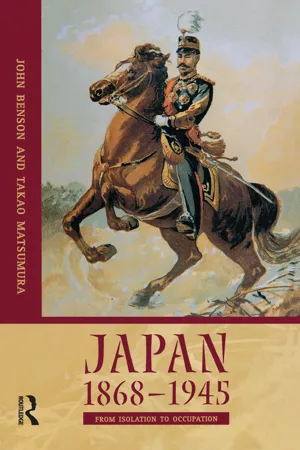
The history of Imperial Japan, from the Meiji Restoration through to defeat and occupation at the end of the Second World War, is central to any understanding of the way in which modern Japan has developed and will continue to develop in the future. This wide-ranging accessible and up-to-date interpretation of Japanese history between 1868 and 1945 provides both a narrative and analysis. Describing the major changes that took place in Japanese political, economic and social life during this period, it challenges widely-held views about the uniqueness of Japanese history and the homogeneity of Japanese society.
1
Introduction
Japan has the most extraordinary history. In a little more than a century and a quarter, this small group of islands on the edge of Asia has been transformed from an isolated, feudal backwater into a stable democracy and one of the world’s leading economic superpowers. During the three-quarters of a century covered by this book, the Japanese abolished the feudal system, established both democratic and authoritarian forms of government, laid the economic, social and cultural foundations of a modern industrial economy, acquired and lost a huge overseas empire, suffered overwhelming defeat at the hands of the Allies, and found their country occupied by the Allied Powers (or rather, the United States of America). It is no exaggeration to suggest, as several commentators have done, that Japan experienced the equivalent of five to six hundred years of European history in the three or four generations between the Meiji Restoration of 1868 and the Allied Occupation of 1945.1
‘Little men’ and ‘supermen’
It goes without saying that there were any number of countries that changed, and changed dramatically, between the third quarter of the nineteenth century and the middle of the twentieth century. But few, if any, nations were transformed as rapidly or as profoundly as Japan. When the Meiji regime came to power in 1868, it took over a feudal society that was riven by internal divisions, was still heavily dependent upon a narrow range of agricultural activities, and was only just beginning to emerge, haltingly and uncertainly, from two hundred and fifty years of self-imposed international isolation. Economically constrained, politically weak and diplomatically impotent, the new government faced rebellion at home and challenges abroad. There was little that Japan could do to break the influence of her overmighty neighbour China, not much she could do to restrain the Asian ambitions of the Western imperial powers–and nothing at all she could do to influence what was happening in the rest of the world.2
Three-quarters of a century later, Japan had demonstrated beyond any possible doubt her ability to drive forward her domestic agenda, her capacity to destabilise and dominate China, her power to conquer large swathes of Asia–and of course her power to embroil the rest of the world in her political, economic and military ambitions. The leaders of Japan took the country into the Second World War–though not of course out of it–economically successful, politically focused, diplomatically determined and militarily confident. By the late 1930s, Japan possessed the world’s third largest merchant fleet, and was self-sufficient in the machinery, power plant and major chemicals that were needed to operate a modern, industrial economy. By the early 1940s, the Japanese empire stretched from the USSR border in the north to the Dutch East Indies in the South, from Burma in the west to the Marshall Islands, thousands of miles to the east in the Pacific Ocean. The racial contempt that so disfigured Western attitudes towards Japan was changed, rather than undermined, by Japanese military successes, with stereotypes of Tittle men’ and ‘supermen’ now coexisting uncomfortably in the Anglo-American imagination.3
Economic and political transformation
That Japan could achieve so much, wield such influence in imperialist politics, and wreak so much havoc began to fascinate the outside world. There was, as all could see, a great deal to admire in Japan’s modern history, but even more perhaps to abhor. Indeed, it was the juxtaposition of industrial development and imperial expansion–alongside economic liberalism and political authoritarianism, cultural aestheticism and military aggression–that seemed somehow to encapsulate the mystery that was the Orient.4
As Japan’s economic transformation became more widely known, it won her considerable international respect. However, it was respect that was usually tinged, as one might anticipate, with caution, anxiety and hostility. Yet even those commentators who did not subscribe to the view that Japan had somehow discovered the secret of perpetual growth could not fail to be impressed by the country’s economic achievements. Between the two world wars, this tiny island, with few natural resources, few natural allies and little or no tradition of industrial development, attained levels of economic growth which were far in excess of anything achieved in advanced industrial countries such as Germany, Great Britain and the United States of America
Nor was this all. Japan’s transformation from a rural backwater to a modern industrial economy was brought about, it seemed, with little of the social and cultural dislocation that accompanied such changes in other parts of the world. What struck most overseas observers particularly forcibly was that despite the pace at which the country industrialised, Japanese society remained united, peaceful and harmonious. There were few strikes, there was little crime, there was very little sign of family dysfunction, there was almost no indication of community breakdown, and there was no evidence at all of the imperial family ever coming in for anything but sporadic and muted criticism. Even the country’s most vociferous critics generally conceded that late nineteenth and early twentieth-century Japan produced well-behaved children, amenable adolescents, stable families, valued old people, loyal workers and patriotic citizens.
On the other hand, as Japan’s political transformation became more widely known, it brought her little but international criticism and contempt. The opinion of a foreign teacher at Tokyo Imperial University in the early 1890s, as summarised by one contemporary Japanese intellectual – is representative of the kind of scorn that Japan often received:
Japan’s attitude in adopting European culture was problematic in every respect. The Japanese did not try to transplant the roots of the plant, but simply cut off eye-catching flowers. As a result the people who brought the flowers were respected enormously, but the plants that could have produced such blossoms did not come to grow…. Despite this, Japanese scholars and prodigies strutted about displaying their knowledge of Western things noisily and proudly. Dr Koeber seemed to feel that that kind of pose and pretension was utterly revolting.5
The transformation was a remarkable achievement for all that. Within forty-five years of coming to power, the Meiji regime had brought an end to two-and-a-half centuries of military rule, it had united the country, introduced a ‘modern’ system of government (complete with constitution, executive and legislature), established a well-respected civil service, and inaugurated a nation-wide system of state education. The new regime showed its military might by defeating China in 1895 and Tsarist Russia ten years later; it began to realise its imperial ambitions by acquiring Taiwan just before the end of the century and by annexing Korea a few years before the outbreak of the First World War.
Thereafter, Japan embarked upon a political roller-coaster. A short period of modest liberal democratic reform was followed, in the early 1930s, by a far better-known period of militarisation and authoritarianism. Military leaders replaced party leaders at the head of government, serious efforts were made to suppress internal criticism, and it seemed at times as if it was the armed forces rather than the cabinet that were determining the direction of government policy. In 1931 Japan seized the north-east Chinese province of Manchuria, and six years later she invaded China’s eastern provinces as far south as Shanghai and Nanking (where at least 20,000 women were raped and more than 200,000 people murdered in what became known as the Rape of Nanking). In 1940, the government established what it called the New Political Order to mobilise domestic support, and what it termed the Greater East Asia Co-Prosperity Sphere to mobilise support across East and South-East Asia. Finally, in December 1941, the imperial air force launched its lethal, surprise attack on the American fleet at anchor at Pearl Harbor, an incident which for many people continues to epitomise all that one needs to know about Japanese culture and the Japanese national character.
What it means to be Japanese
In fact, so extraordinary is the history of Japan that commentators of all nationalities and all ideological persuasions have often felt able to account for what happened only in terms of the distinctiveness of Japanese national culture and the uniqueness of Japanese national character. According to this view, the exceptional nature of Japan’s history is to be accounted for primarily, if not exclusively, by the nature of Japanese society which finds no parallel anywhere in the world. There is no doubt that this belief in Japanese uniqueness, whether or not it can be justified empirically, continues to exercise a powerful and pervasive influence upon the ways both in which the Japanese see themselves and in which the Japanese are seen by those in the rest of the world.6
It has always been common for the Japanese to point to their uniqueness, to stress the supposed purity, homogeneity and cohesiveness of the society in which they lived. Indeed, it seems to the outsider that they have spent an inordinate amount of time and energy agonising over what it was to be Japanese, the ways in which the Japanese ‘race’ differed from every other, and the ways in which this uniqueness made them superior to all the other nations with which they came into contact. Nor was this some aberration of the totalitarian 1930s and early 1940s. It has been calculated that between 1946 and 1978 alone, some 700 books were published on ‘what it means to be Japanese’.7
The belief in Japanese uniqueness continues to manifest itself in many ways. One has only to think, for example, of the popular belief within Japan that theirs is the only country in the world to enjoy four distinct seasons, or of the ways in which Japanese officials have manipulated the idea of national distinctiveness in the furtherance of national economic policy. They excuse limitations on the import of foreign skis by citing the uniqueness of Japanese snow, and justify restrictions on the import of foreign food by underlining the uniqueness not only of Japanese vegetables and rice but of the Japanese digestive system.8
It is true, some Japanese concede, that the supposed purity, homogeneity and cohesiveness of Japanese society did not always prove entirely advantageous. According to one school of thought, it was such qualities which encouraged the docility that made it possible, during the 1930s and early 1940s, for a minority of military fanatics to manipulate and dominate the mass of the population. This docility led, it is argued, to the events which culminated in the Second World War, the use of nuclear weapons against Hiroshima and Nagasaki, and occupation by the United States of America.9
However, the dominant school of thought takes a very different view. Nearly always, it is maintained, the supposed purity, homogeneity and cohesiveness of...
Table of contents
- Cover Page
- Half Title page
- Title Page
- Copyright Page
- Contents
- Acknowledgements
- Abbreviations
- Maps
- 1 Introduction
- 2 Politics and political systems
- 3 International relations and imperial expansion
- 4 Economic growth, industrial relations, consumption and saving
- 5 Education, religion and the media
- 6 Individual, family, class and nation
- 7 Epilogue: the Allied Occupation, 1945–52
- 8 Conclusion
- Appendix I Timeline of major events and developments
- Appendix II Glossary of Japanese terms
- Select bibliography
- Index
Trusted by 375,005 students
Access to over 1.5 million titles for a fair monthly price.
Study more efficiently using our study tools.
Frequently asked questions
Yes, you can cancel anytime from the Subscription tab in your account settings on the Perlego website. Your subscription will stay active until the end of your current billing period. Learn how to cancel your subscription
No, books cannot be downloaded as external files, such as PDFs, for use outside of Perlego. However, you can download books within the Perlego app for offline reading on mobile or tablet. Learn how to download books offline
We are an online textbook subscription service, where you can get access to an entire online library for less than the price of a single book per month. With over 1.5 million books across 990+ topics, we’ve got you covered! Learn about our mission
Look out for the read-aloud symbol on your next book to see if you can listen to it. The read-aloud tool reads text aloud for you, highlighting the text as it is being read. You can pause it, speed it up and slow it down. Learn more about Read Aloud
Yes! You can use the Perlego app on both iOS and Android devices to read anytime, anywhere — even offline. Perfect for commutes or when you’re on the go.
Please note we cannot support devices running on iOS 13 and Android 7 or earlier. Learn more about using the app
Please note we cannot support devices running on iOS 13 and Android 7 or earlier. Learn more about using the app
Yes, you can access Japan 1868-1945 by Takao Matsumura,John Benson in PDF and/or ePUB format, as well as other popular books in History & Asian History. We have over 1.5 million books available in our catalogue for you to explore.