- 208 pages
- English
- ePUB (mobile friendly)
- Available on iOS & Android
eBook - ePub
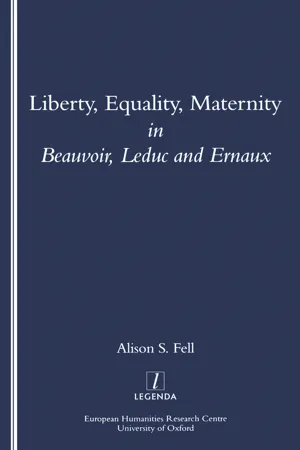
Liberty, Equality, Maternity
About this book
"The concept of motherhood emerges strongly in the writings of Simone de Beauvoir, Violette Leduc and Annie Ernaux, whose work is examined here in the light of current debates about women's reproductive function and the longstanding glorification of the mere au foyer in France, driven by fear of a falling population. In this interdisciplinary study of twentieth-century French women's writing, Fell uncovers tensions at the heart of the literary critique. She shows these authors challenging the patriarchal view of motherhood as the sole justification for a woman's existence while at the same time confronting the conflict inherent in their relationship with their own mothers. A survey of theoretical and historical material demonstrates vividly that the changing concept of motherhood remains a problematic and highly contentious issue for French feminists, whether writing in 1940 or 1999."
Information
Chapter 1
Writing Motherhood
In The Mother/Daughter Plot: Narrative, Psychoanalysis, Feminism (1989), Marianne Hirsch asks 'What is a mother? What is maternal?'1 The answers to these questions may seem self-evident. However, by raising them Hirsch pinpoints the principal difficulty encountered in any discussion of representations of the mother in literary, theoretical and historical discourses; that is, the problem of definition. As a linguistic signifier, 'mother', like its associate terms 'motherhood' and 'maternity', is richly polysemic: all three terms are charged with a multiplicity of connotations which vary according to the differing contexts in which they are articulated. Such connotations can be wide-ranging in their field of reference; the term mother, as Evelyn Glenn points out, is capable of encompassing multiple contradictions: 'Mothers are romanticized as life-giving, self-sacrificing, and forgiving, and demonized as smothering, overly involved and destructive. They are seen as all-powerful—holding the fate of their children and ultimately the future of society in their hands—and as powerless—subordinated to the dictates of nature, instinct and social forces beyond their ken.'2 Thus, despite its apparent straightforwardness, the question 'What is a mother?' can give rise to a complex array of possible answers.
It is equally difficult to clarify the differences between the related concepts of 'motherhood' and 'maternity'. Adrienne Rich makes a useful distinction in her study Of Woman Born (1977) in which she takes maternity to refer to women's (potential or realized) biological capacity to become mothers, and motherhood to refer to the institutionalization of prescribed rules and regulations by which the practice of mothering is carried out.3 One of the reasons why Rich's definition is productive relates to the extent to which references to motherhood have functioned as vehicles for the exploration of broader debates concerning, for example, education, the moral and physical welfare of the population, women's labour rights, ideas of nationhood, and the roles of nature and culture in the development of social and gender roles. The centrality of motherhood in such debates inevitably not only inflects the ways in which we think about the roles and importance of mothers, but also influences the ways in which authors represent mothers and mother–child relationships in their literary texts.
My primary focus in this study is twentieth-century French literary representations of motherhood, particularly in female-authored texts. In France, certain connotations of the terms mère and maternité have been fundamental in articulations of individual and national identity. Numerous French politicians, writers, artists and thinkers have positioned mothers as the custodians of that which they identify as 'Frenchness'. Motherhood, that is, is frequently envisaged as being inescapably bound up with the country's self-image and future prosperity. An obvious point of departure in an examination of a Catholic nation's understanding of motherhood is with representations of the Virgin Mary. As Marina Warner and Julia Kristeva have demonstrated, the Virgin has for centuries been the most enduring and powerful image of the mother in France. In the innumerable representations of the mother influenced by what Julia Kristeva has referred to as the 'cult' of the Virgin Mary, motherhood is presented as unsullied by sexuality; mothers are posited as sacred but not sexual.4 The symbol of the Virgin Mary encodes motherhood as both natural and supernatural. Although its ideal of non-sexual maternity is, evidently, unrealizable, the sacred role of the Virgin is one to which every woman is able to aspire, for which every woman is, indeed, biologically destined. The Virgin Mary often appears in opposition to the other dominant image of womanhood within Christian doctrine: the subversive, sexualized and sinful woman, embodied biblically in the figures of Eve and Mary Magdalene. As Marina Warner summarizes: 'Together, the Virgin and the Magdalene form a diptych of Christian patriarchy's idea of woman. There is no place in the conceptual architecture of Christian society for a single woman who is neither a virgin nor a whore.'5
The Virgin/Magdalene dichotomy has cast its shadow, directly or indirectly, over a variety of debates in France that have dealt with issues of motherhood. In the early twentieth century, for instance, the opposition was prominent in debates concerning the problem of a decline in population growth. Politicians and statisticians exercised by the threat of depopulation drew on the notion that motherhood constituted a sacrosanct and biologically destined role for French women in order to introduce measures to encourage women to have more children. In contrast, women who wished to remain childless, or who attempted to prioritize paid work over maternal duties, were demonized as 'unnatural' and were financially penalized by legislation that limited married women's labour rights. The reasons underpinning (both Catholic and secular) French politicians' deployment of the virgin/whore opposition in their examinations of the question of depopulation were primarily economic. It was argued that France required a larger population in order, on the one hand, to compete with other industrial nations and, on the other, to fulfil the need for more soldiers to improve the country's military strength. What the exploitation of the Virgin Mary myth in French twentieth-century political rhetoric demonstrates is the degree to which any evocation of the mother within a particular discursive context can potentially become embroiled in a web of connotations. The definition of the status, virtues (or vices) and needs of mothers is never an innocent activity. Rather, the definition of motherhood has frequently been related to the attainment of important political and economic objectives.
It is not only politicians who draw on pre-existing myths in their understanding and definitions of motherhood. Individual women, in their relationship to their maternity and their approaches to and expectations of motherhood, are similarly affected by the past and present, multiple significations with which the term is charged. As Kathryn Woodward argues, our experience is always, to some extent, mediated by 'ideals or myths of motherhood which operate at the psychic level of the conscious and the unconscious, as well as being subject to interventions by institutions like the state which construct ideas about practice'.6 It is important to emphasize, however, that women's conception and experiences of motherhood are not dependent upon any single ideal or myth of the mother. In their Histoire des mères (1977) Yvonne Knibiehler and Catherine Fouquet point to the large gap that existed between nineteenth-century idealizations of motherhood that attempted to confine women to the domestic space, and working-class women's actual understanding and practice of their maternity: 'Les classes dominantes, qui réinventent la maternité comme vocation féminine exclusive, sont en contradiction absolue avec la réalité concrète: beaucoup de femmes travaillent au dix-neuvième siècle et doivent assumer leur maternité dans les conditions les plus dures.'7 It is open to question whether French working mothers in the nineteenth century were able to identify with cultural models of motherhood as a 'vocation féminine exclusive'. That said, it remains the case that our understanding of motherhood is mediated by dominant cultural and political interpretations of motherhood, even if the ideals and myths of the mother we encounter reflect, in terms of our own experience, only a possibility rather than an actuality.
How do cultural and political myths of the mother affect women's literary representations of motherhood? In the chapters which follow I discuss the representation of motherhood in a range of works by three prominent French women writers: Mémoires d'une jeune fille rangée (1958) and Une mart très douce (1964) by Simone de Beauvoir; L'Asphyxie (1946) and La Bâtarde (1964) by Violette Leduc; and La Femme gelée (1981), Une femme (1987) and 'Je ne suis pas sortie de ma nuit' (1997) by Annie Ernaux. In my discussions of these texts, I argue that the authors' representations of motherhood and mother–daughter relationships are necessarily inflected both by ideals and myths of the mother and by state-constructed ideas about mothering practice. I assume, in short, that just as women must engage with different political and cultural connotations of maternité in their approaches to the institution of motherhood and in their experience of maternity, women writers cannot represent the mother in their texts without engaging, consciously and unconsciously, with the past and present cultural and ideological connotations with which motherhood has been charged.
The maternal figures who feature in the work of Beauvoir, Leduc and Ernaux are ambiguous constructs whose daughters' relationships with them fluctuate between a positive affirmation of their unique affinities and a need to sever the bonds that unite them. This oscillation between love and hate, between identification and rejection, is characteristic of representations of motherhood in twentieth-century women's writing, which have tended to fluctuate between the two extremes of hagiography and denunciation. In several female-authored texts, the mother functions as a (romanticized) site of an alternative female identity, one not dependent upon patriarchally constructed gender norms or upon difficult and unequal heterosexual relations. The autobiographical novels written by Colette, for example, particularly La Maison de ma mère (1922), La Naissance du jour (1928) and Sido (1929), foreground a quasi-mythic mother figure, who is cast by her daughter as the source of life and light, and whose maternal love appears to transcend the vagaries of time and sexual desire. Colette's heroines are able to construct a serene and stable identity through their relation to the maternal, which contrasts sharply with the conflictual, dissatisfying and ephemeral nature of the heterosexual relationships inscribed in manv of her works.
To some degree, Colette's portraits of the earthy, nurturing Sido, from whom the daughter gains a positive and enduring sense of self, prefigure representations of maternity in 1970s French women's writing. Chantal Chawaf, in her poetic narratives Retable/La Rêverie (1974) and Blé de semence (1976), attempts to re-create the intensity of the intra-uterine mother–daughter relationship. As Monique Saigal summarizes, Chawaf 'cherche à créer une véritable langue maternelle semblable à celle qu'elle a connue dans la matrice. Cette langue est pour elle un véhicule qui dit l'expression et la préservation de la vie.'8 In 1986, Chawaf published Elwina, le roman-fée, a novel which, in a style similar to that deployed by Marie Redonnet in Rose Mélie Rose (1987), exploits the genre of the fairy-tale to explore further the daughter's relation to the maternal. In these works, the daughters look back to a nurturing and symbiotic mother–daughter dyad, not only as an alternative locus for their identity (in opposition to the urban, structured and barren masculine order), but also as a means of releasing their creativity. The focus 011 the value of matrilinearity as a source for women's identity and creativity is also present in literary works produced outside metropolitan France. In novels by Maryse Condé and Simone Schwarz-Bart, both from Guadeloupe, the mother or grandmother plays a pivotal role in the characters' lives. Schwarz-Bart underlines the importance in Caribbean culture of the mother's transmission of knowledge, traditions and wisdom: 'Quand l'homme antillais faisait des enfants sans revendiquer la paternité, celle qui devait assumer la lignée, accomplir les tâches quotidiennes, s'occuper des enfants tout en leur transmettant les traditions ancestrales, c'était naturellement la femme.'9 In Condé's Ségou (1984–5) and Moi, Tituba, sorcière ... Noire de Salem (1986) and Schwartz-Bart's Pluie et vent sur Télumée miracle (1972), the mother figure provides a refuge for younger generations of women, embodying a mythical homeland which has provided sustenance and continuity in the face of the invading powers of colonialism and patriarchy.
If many women writers have emphasized positive aspects of maternal identification, other authors have 'demonized' the mother by focusing on more negative aspects of the mother–daughter relationship. In Les Petits Enfants du siècle (1961), Christiane Rochefort offers a satirical attack on the glorification of the mother evident in pronatalist policies in post-war France. The novel's heroine, a bright and resourceful working-class girl living on a large Parisian housing estate, eventually succumbs to the lure of the romantic ideals of marriage and motherhood, thereby repeating her mother's fate and giving up any chance of emotional, intellectual or sexual freedom. Identification with the mother in Rochefort's novel imprisons the daughter in a futile and oppressive existence, in which her human potential is wasted. Jeanne Hyvrard, in texts such as Mère la mart (1976) and La Jeune Morte en robe de dentelle (1990), also depicts the dangers of identification with the mother. In her texts, the daughter seeks to escape from an oppressive and smothering mother–daughter relationship: 'Elle me dénie le droit à une existence propre, des désirs, une volonté, un champ d'action. Ce qui est à moi est à elle, mes vêtements, mes affaires, mon corps.'10 In Hyvrard's writing, mother-love is closely associated not with re-birth and creativity, but with disease, death and madness. Insanity in relation to motherhood also features in novels by Marguerite Duras and Marie Cardinal. In Duras's L'Amant (1984) and L'Amant de la Chine du Nord (1991) and Cardinal's Les Mots pour le dire (1975), the mother bequeaths to her daughter an ambiguous legacy. The daughters struggle to rid themselves of their mother's madness, which, it is implied, leaves its mark on their emotional and sexual lives as adults. But the hatred the mother's insanity arouses in the daughter is always mingled with an equally powerful love. Duras's and Cardinal's daughter-narrators shift from love and identification with the mother to hate and a desperate need for separation from her. In this way, their texts embody in microcosm the contradictions and ambiguities that lie at the heart of the representation of motherhood and the mother–daughter relationship in twentieth-century French women's writing. In the diverse texts discussed above, mothers tend to function either as idealized role-models or as oppressive marâtres, impeding their daughter's sexual and emotional development. Or, in the case of writers such as Duras and Cardinal, the mother-figure oscillates between these two poles. This dichotomous portrayal of mothers is by no means a new phenomenon. Although female authors have provided diverse, often innovative portraits of mothers, the love-hate attitude to motherhood evident in many texts can, to some extent, be seen to mirror the traditional opposition of women (and mothers) as angels or demons. As Martine Sageart comments in her Histoire littéraire des mères (1992), the figure of the mother in both male-and female-authored texts is more often than not founded upon familiar cultural clichés: 'Déesse, elle est monstresse. Mater Nutrix, elle est la mère ogresse. Totalement reconnaissable, elle est inquiétante. Sainte, elle est l'obscur objet du désir,'11 In this sense, the representation of the mother in women's writing, as in any other cultural text, is inflected, consciously or unconsciously, by pre-existing motherhood myths.
Before I examine the writings of Beauvoir, Leduc and Ernaux in more detail, I turn in my second chapter to the development of theoretical approaches to mothers and motherhood, particularly those that had currency in the contemporary feminist movement. The oscillation between 'romanticization' and 'demonization' of the mother that I have identified m twentieth-century French women's writing is equally discernible in the models of motherhood and the mother–daughter relationship elaborated by twentieth-century theorists. Indeed, the relationship of influence between women writers' representations of motherhood and feminist theoretical approaches to the issue is two-way. While feminist theorists have looked to women writers for inspiration and/or confirmation of their beliefs, attitudes to motherhood present m women's writing, partic...
Table of contents
- Cover
- Half Title
- Title
- Copyright
- Contents
- List of Abbreviations
- Acknowledgements
- 1 Writing Motherhood
- 2 Theorizing Motherhood
- 3 Historicizing Motherhood
- 4 Simone de Beauvoir
- 5 Violette Leduc
- 6 Annie Ernaux
- Conclusion
- Bibliography
- Index
Trusted by 375,005 students
Access to over 1.5 million titles for a fair monthly price.
Study more efficiently using our study tools.
Frequently asked questions
Yes, you can cancel anytime from the Subscription tab in your account settings on the Perlego website. Your subscription will stay active until the end of your current billing period. Learn how to cancel your subscription
No, books cannot be downloaded as external files, such as PDFs, for use outside of Perlego. However, you can download books within the Perlego app for offline reading on mobile or tablet. Learn how to download books offline
Perlego offers two plans: Essential and Complete
- Essential is ideal for learners and professionals who enjoy exploring a wide range of subjects. Access the Essential Library with 800,000+ trusted titles and best-sellers across business, personal growth, and the humanities. Includes unlimited reading time and Standard Read Aloud voice.
- Complete: Perfect for advanced learners and researchers needing full, unrestricted access. Unlock 1.5M+ books across hundreds of subjects, including academic and specialized titles. The Complete Plan also includes advanced features like Premium Read Aloud and Research Assistant.
We are an online textbook subscription service, where you can get access to an entire online library for less than the price of a single book per month. With over 1.5 million books across 990+ topics, we’ve got you covered! Learn about our mission
Look out for the read-aloud symbol on your next book to see if you can listen to it. The read-aloud tool reads text aloud for you, highlighting the text as it is being read. You can pause it, speed it up and slow it down. Learn more about Read Aloud
Yes! You can use the Perlego app on both iOS and Android devices to read anytime, anywhere — even offline. Perfect for commutes or when you’re on the go.
Please note we cannot support devices running on iOS 13 and Android 7 or earlier. Learn more about using the app
Please note we cannot support devices running on iOS 13 and Android 7 or earlier. Learn more about using the app
Yes, you can access Liberty, Equality, Maternity by Alison Fell in PDF and/or ePUB format, as well as other popular books in Social Sciences & Languages. We have over 1.5 million books available in our catalogue for you to explore.