eBook - ePub
Evaluating What Good Teachers Do
Eight Research-Based Standards for Assesing Teacher Excellence
- 160 pages
- English
- ePUB (mobile friendly)
- Available on iOS & Android
eBook - ePub
Evaluating What Good Teachers Do
Eight Research-Based Standards for Assesing Teacher Excellence
About this book
This book is based on author James H. Stronge's 20-plus years of consulting with school districts and other educational organizations in designing, piloting, and training educators in the use of teacher-performance evaluation systems. Its primary purpose is to help both teachers and their evaluators collect more comprehensive and accurate assessment data for judging teacher effectiveness. The author provides field-tested teacher-evaluation systems based on performance standards which include data collection tools and performance appraisal rubrics.
Information
Part I

Performance Standards for Teachers
1
How to Assess Teacher Quality
School reform doesn’t happen in Washington, Ottawa, London, or, for that matter, any other capital. It doesn’t occur at the school board level or even at the school, for the most part. Evaluating What Good Teachers Do: Eight Research-Based Standards for Assessing Teacher Excellence is built on the foundation that the classroom—not the school—is the place on which we must focus for improved student performance. When one teacher improves her or his capacity to help students learn, then, and only then, does school improvement occur. And the reason is quite simple: teacher success = student success.
Evaluating What Good Teachers Do: Eight Research-Based Standards for Assessing Teacher Excellence focuses on providing a research-based framework for teacher assessment. This introductory chapter provides the foundation for defining, designing, and applying teacher performance standards. Specifically, this chapter addresses the following foundational issues:
♦ What are teacher performance standards and how are they used?
♦ What are quality indicators and how are they used?
♦ How can teacher performance standards be documented?
♦ How can teacher performance standards be rated?
♦ Why are performance standards important for ensuring teacher quality?
What Are Teacher Performance Standards and How Are They Used?
Importance of Defining the Job of the Teacher
Tēach’ēr, n. 1. One who teaches or instructs.1
Although it is common practice to develop job descriptions for an array of educational positions, interestingly, the job of the teacher often is neglected. Perhaps because we believe that we so readily understand what it means to be a teacher, or perhaps because it is such a complex and encompassing job, we just don’t go to the trouble of providing an operational definition. Yet, without a clear, objective, and accurate description of the required job responsibilities, it isn’t feasible to provide an effective evaluation of performance. If actual performance is to be compared with expected performance, then there must be an alignment between job requirements and job evaluation. In fact, the foundation of a quality teacher evaluation system is the use of clearly described and well-documented job performance standards for all educators—in other words, the job responsibilities.
Overview of Performance Standards2
For teacher performance evaluation to be fair and comprehensive, it is necessary to describe the performance standards of teachers with sufficient detail and accuracy so that both teachers and their supervisors can reasonably understand the job expectations. In essence, a set of performance standards is a detailed job description.
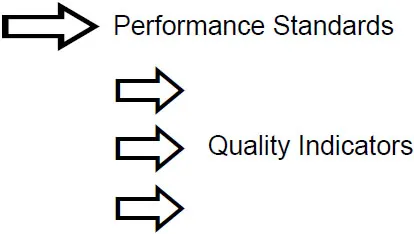
The expectations for teacher performance are defined using a two-tiered approach (Figure 1.1).
Figure 1.1. Model for Teacher Performance Standards and Quality Indicators
Source: Adapted from J.H. Stronge’s Goals and Roles Evaluation Model. It is used here with permission from the author.
Performance standards are the major units (i.e., major job responsibilities) of the teacher’s job, whereas quality indicators are the specific, observable, measurable aspects of these major job responsibilities. Performance standards and quality indicators will be explained, in turn.
Suggested Teacher Performance Standards
Performance standards are the job responsibilities or duties performed by a teacher. Consequently, the performance standards represent the major job responsibilities that a teacher fulfills. The performance standards form the basis for the development of job descriptions and, thus, should also form the basis for a job evaluation. Additionally, the teacher performance standards are intended to provide specification of role expectations. In other words, they provide clarity on the precise nature of the key aspects of the teacher’s job. Figure 1.2 is a set of suggested teacher performance standards.
Figure 1.2. Suggested Teacher Performance Standards
Suggested Teacher Performance Standards
1. Professional Knowledge
The teacher demonstrates an understanding of the curriculum, subject content, and the developmental needs of students by providing relevant learning experiences.
2. Data-Driven Planning
The teacher’s planning uses appropriate curricula, instructional strategies, and resources to address the needs of all students.
3. Instructional Delivery
The teacher promotes student learning by addressing individual learning differences and by using effective instructional strategies.
4. Assessment of Learning
The teacher systematically gathers, analyzes, and uses data to measure student progress, guide instruction, and provide timely feedback.
5. Learning Environment
The teacher provides a well-managed, safe, student-centered environment that is academically challenging and respectful.
6. Communication and Advocacy
The teacher communicates effectively with students, school personnel, families, and the community.
7. Professionalism
The teacher maintains a professional demeanor, participates in professional growth opportunities, and contributes to the profession.
8. Student Progress
The work of the teacher results in acceptable, measurable progress based on established standards.
Alignment of Teacher Performance Standards with Qualities of Effective Teachers
The eight teacher performance standards described in Figure 1.2 form the foundation for the teacher performance assessment system detailed throughout Evaluating What Good Teachers Do. In fact, until the key work of the teacher—the teacher performance standards—are understood and agreed upon, all other aspects of a comprehensive evaluation system are superfluous. We observe and collect other relevant evidence, not in the abstract, but based on a given set of performance expectations—the performance standards. Furthermore, we evaluate based on how well a teacher’s performance matches the prescribed work; again, the performance standards.
If the selection of a teacher’s performance standards is so fundamentally important to the overall assessment of the teacher’s work, then it is incumbent that these standards have a solid grounding in the research of what makes teachers effective.
Chapters 2 through 9 explore the research base upon which each of the eight respective teacher performance standards is grounded.
What Are Quality Indicators and How Are They Used?
Overview of Quality Indicators
The assumption upon which a system of teacher performance standards is built is that teachers—regardless of what their particular assignments might be—are far more alike than they are different. Nonetheless, although the use of a common set of instructional performance standards tends to work very well for most teachers, preK-12, the actual work of a high school teacher, for example, a chemistry teacher, differs markedly from that of a fourth grade teacher. Likewise, the role of a chemistry teacher is different from those of other high school teachers, for example, a Spanish teacher or a biology teacher. Practically speaking, however, it would be virtually impossible to create and implement a teacher evaluation system with se...
Table of contents
- Cover
- Title page
- Copyright page
- Contents
- Acknowledgments
- About the Author
- Preface
- Part I Performance Standards for Teachers
- 1 How to Assess Teacher Quality
- 2 Professional Knowledge
- 3 Data-Driven Planning
- 4 Instructional Delivery
- 5 Assessment for Learning
- 6 Learning Environment
- 7 Communication and Advocacy
- 8 Professionalism
- 9 Student Progress
- 10 Concluding Thoughts on Evaluating Teacher Effectiveness
- Part II Tools You Can Use
- Teacher Performance Standards
- Informal Classroom Observation Form
- Formal Classroom Observation Form
- Want to Know More?
- References
Trusted by 375,005 students
Access to over 1.5 million titles for a fair monthly price.
Study more efficiently using our study tools.
Frequently asked questions
Yes, you can cancel anytime from the Subscription tab in your account settings on the Perlego website. Your subscription will stay active until the end of your current billing period. Learn how to cancel your subscription
No, books cannot be downloaded as external files, such as PDFs, for use outside of Perlego. However, you can download books within the Perlego app for offline reading on mobile or tablet. Learn how to download books offline
Perlego offers two plans: Essential and Complete
- Essential is ideal for learners and professionals who enjoy exploring a wide range of subjects. Access the Essential Library with 800,000+ trusted titles and best-sellers across business, personal growth, and the humanities. Includes unlimited reading time and Standard Read Aloud voice.
- Complete: Perfect for advanced learners and researchers needing full, unrestricted access. Unlock 1.5M+ books across hundreds of subjects, including academic and specialized titles. The Complete Plan also includes advanced features like Premium Read Aloud and Research Assistant.
We are an online textbook subscription service, where you can get access to an entire online library for less than the price of a single book per month. With over 1.5 million books across 990+ topics, we’ve got you covered! Learn about our mission
Look out for the read-aloud symbol on your next book to see if you can listen to it. The read-aloud tool reads text aloud for you, highlighting the text as it is being read. You can pause it, speed it up and slow it down. Learn more about Read Aloud
Yes! You can use the Perlego app on both iOS and Android devices to read anytime, anywhere — even offline. Perfect for commutes or when you’re on the go.
Please note we cannot support devices running on iOS 13 and Android 7 or earlier. Learn more about using the app
Please note we cannot support devices running on iOS 13 and Android 7 or earlier. Learn more about using the app
Yes, you can access Evaluating What Good Teachers Do by James Stronge in PDF and/or ePUB format, as well as other popular books in Education & Education General. We have over 1.5 million books available in our catalogue for you to explore.