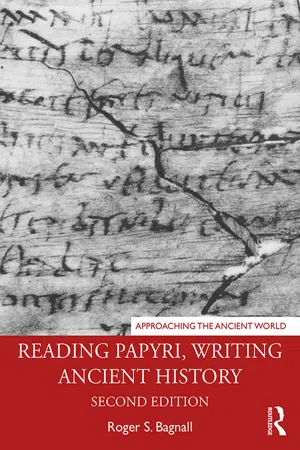
Reading Papyri, Writing Ancient History
eBook - ePub

Reading Papyri, Writing Ancient History

  1. 128 pages
  2. English
  3. ePUB (mobile friendly)
  4. Available on iOS & Android
eBook - ePub

Reading Papyri, Writing Ancient History

About this book

Since its first publication in 1995, Reading Papyri, Writing Ancient History has proved to be an invaluable resource for students of the ancient world looking to integrate papyrological evidence into their research. In the quarter century since its publication, changes in the research environment have affected papyrology like other fields. Although the core philological methods of the field remain in place, the field has increasingly embraced languages other than Greek and Latin, with considerable impact on the Hellenistic and Late Antique periods. Digital tools have increased the ease and speed of access, with profound effects on research choices, and digital imaging and materiality studies have brought questions about the physical form of written materials to the fore.

In this fully revised new edition, Bagnall adds to the previous analysis a portrait of how the use of papyri for historical research has developed during recent decades. Updated with the latest research and insights from the author, the volume guides historians in how to use these scattered and often badly damaged documents, and to interpret them in order to create a full and diverse picture of ancient society and culture.

This second edition of Reading Papyri, Writing Ancient History continues to offer students and researchers of the ancient world a critical resource in navigating how to use these ancient texts in their research.

Frequently asked questions

Yes, you can cancel anytime from the Subscription tab in your account settings on the Perlego website. Your subscription will stay active until the end of your current billing period. Learn how to cancel your subscription.
No, books cannot be downloaded as external files, such as PDFs, for use outside of Perlego. However, you can download books within the Perlego app for offline reading on mobile or tablet. Learn more here.
Perlego offers two plans: Essential and Complete
  • Essential is ideal for learners and professionals who enjoy exploring a wide range of subjects. Access the Essential Library with 800,000+ trusted titles and best-sellers across business, personal growth, and the humanities. Includes unlimited reading time and Standard Read Aloud voice.
  • Complete: Perfect for advanced learners and researchers needing full, unrestricted access. Unlock 1.4M+ books across hundreds of subjects, including academic and specialized titles. The Complete Plan also includes advanced features like Premium Read Aloud and Research Assistant.
Both plans are available with monthly, semester, or annual billing cycles.
We are an online textbook subscription service, where you can get access to an entire online library for less than the price of a single book per month. With over 1 million books across 1000+ topics, we’ve got you covered! Learn more here.
Look out for the read-aloud symbol on your next book to see if you can listen to it. The read-aloud tool reads text aloud for you, highlighting the text as it is being read. You can pause it, speed it up and slow it down. Learn more here.
Yes! You can use the Perlego app on both iOS or Android devices to read anytime, anywhere — even offline. Perfect for commutes or when you’re on the go.
Please note we cannot support devices running on iOS 13 and Android 7 or earlier. Learn more about using the app.
Yes, you can access Reading Papyri, Writing Ancient History by Roger S. Bagnall in PDF and/or ePUB format, as well as other popular books in History & Ancient History. We have over one million books available in our catalogue for you to explore.

Information

Publisher
Routledge
Year
2019
Print ISBN
9780815379928
eBook ISBN
9781351214568

Table of contents

  1. Cover
  2. Half Title
  3. Series Page
  4. Title Page
  5. Copyright Page
  6. Table of Contents
  7. List of figures
  8. Preface to the second edition, 2019
  9. Preface to the first edition, 1995
  10. Introduction
  11. 1. The culture of papyrus
  12. 2. Ancient and modern choices in documentation
  13. 3. Particular and general
  14. 4. Time and place
  15. 5. Quantification
  16. 6. Asking questions
  17. 7. The digital revolution
  18. 8. Continuity and renewal
  19. References
  20. General bibliography
  21. Index