eBook - ePub
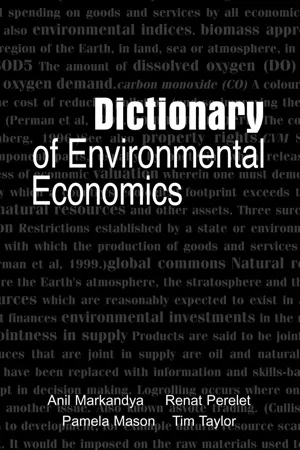
Dictionary of Environmental Economics
- 208 pages
- English
- ePUB (mobile friendly)
- Available on iOS & Android
eBook - ePub
Dictionary of Environmental Economics
About this book
A comprehensive dictionary of environmental economics, compiled by leading academics in the field. Each expression or phrase is explained clearly in non-technical language, with references given to its use in the growing literature on the subject area. From abatement to zonal travel cost method (ZTCM), there are over 1000 cross-referenced entries covering topics such as: environmental instruments for policy-making, techniques applied in environmental and natural resource economics, major issues in environmental economics and environmental management, economics of sustainable development, natural resource accounting, and international environmental agreements. As well as providing incisive answers to questions such as 'What is natural capital?' or 'when are crowding diseconomies important?', the dictionary includes a list of commonly used acronyms and abbreviations, and a complete bibliography detailing the major texts in the field is provided.
Information
Aa
abatement A decrease in either the level or the intensity of a nuisance, such as pollution or congestion, or the act of decreasing or eliminating a nuisance. Pollution abatement in industry, for example, may occur in response to regulation, consumer demand for cleaner processes, or the diffusion of less pollution-intensive technology. See also abatement cost; marginal abatement cost; marginal damage; efficient level of pollution.
abatement cost The cost incurred when reducing (in intensity or absolute level) a nuisance such as pollution or congestion. The cost per unit of abatement usually increases as the level of the nuisance approaches zero. See also marginal abatement cost; marginal damage; efficient level of pollution.
absolute scarcity In contrast to relative scarcity of a resource, which implies that demand exceeds supply over a given period of time (and which can apply to any number of resources – man-made capital, natural capital, renewable and non-renewable resources), absolute scarcity implies that ultimately the supply of the resource is fixed. Thus, absolute scarcity can occur only with exhaustible resources such as fossil fuels. See also scarcity.
absorptive capacity Also known as assimilative capacity. The ability of the environment to assimilate waste products from the economy. Limits to this capacity may be determined locally, regionally or globally. To the extent that waste emissions exceed the absorptive capacity of the environment, pollutants accumulate and damage results. See also safe minimum standards (SMS); precautionary principle (PP).
acceptability principle The principle that simple and transparent economic instruments are easily internalized by the existing market and institutional system. (Turner, Pearce and Bateman, 1994.)
acceptable effluent Acceptable effluent is defined as the effluent discharge that results in the efficient level of pollution, both in the short and long run. The efficient level of pollution is the load that minimizes the sum of abatement costs plus the environmental damage costs.
accommodating technocentrism A less extreme position than cornucopian technocentrism, accommodating technocentrism maintains that free markets have beneficial effects on the environment only if individuals think and act in an environmentally friendly way. Green consumers, investors, citizens and employees are therefore powerful agents for a green economy. From this perspective, although the market has an important role to play, some environmental limits (eg life support functions, maintenance and waste assimilation capacity maintenance) must be strictly adhered to (and development activities forgone) if the broader goals of sustainable development are to be met. (Turner, Pearce and Bateman, 1994.)
acid deposition One of the sources of soil acidification. It involves the atmospheric deposition of sulphur dioxide (SO2), nitrogen oxides (NOx) and ammonia (NH3). Acid wet and dry deposition has effects on water, soil and forests. (Stanners and Bourdeau, 1995.) See also acid rain.
acid rain Atmospheric stocks of sulphur dioxide (SO2) and nitrous oxide (N2O) accumulate primarily from coal and heavy-oil-fired power generation. As a result, acid rain occurs through two principal processes. In dry deposition, particulate matter is physically deposited, subsequently taking acidic form in conjunction with surface water. The term ‘acid rain’ is therefore something of a misnomer, as it is not necessarily associated with rain at all. Wet deposition is characterized by acidic substances, particularly sulphuric and nitric acids, being formed in the atmosphere, and subsequently being deposited through rain precipitation or simply movements of moist air. (Perman et al, 1999.) See also acid deposition.
acoustic quality A measure of noise that takes into account pitch and tone, and compares this against standards. The findings of many studies undertaken in European countries on the effects of noise point out that, to ensure a desirable level of indoor comfort, the outdoor noise level in daytime should not exceed an energy mean sound level (Leq) of 65dB(A) (OECD, 1991). The maximum acceptable levels are exceeded in most cities, affecting between 10 and 20 per cent of inhabitants in Western Europe and up to 50 per cent in some cases in Central and Eastern Europe. (Stanners and Bourdeau, 1995.) See also annoyance costing approach; dB(A) costing approach; noise pollution, valuation of.
action programmes European environmental policy has been developed through the medium of action programmes. These documents establish a proposed action plan for environmental developments over a period of time, usually about five years. They form the basis for policy development in the environmental arena. (Malcolm, 1994.)
activities implemented jointly See joint implementation.
acute toxicity This is present when a short-term exposure to a substance produces a detrimental effect on the exposed organisms. (Tietenberg, 1992a.) See also chronic toxicity.
adaptation Adaptation refers to changes in ecological, social or economic systems in response to changes in conditions. This term is often applied when discussing climate change issues and includes changes in processes, practices and structures in order to moderate damages or to yield benefits from potential opportunities arising from climate change.
There are two reasons why adaptation is important to climate change strategies. The first is that estimating the impacts of climate change requires estimates of the extent to which adaptation will reduce the net damage. The second is that adaptation policy strategies should be developed to minimize the risks arising from climate change. Adaptation is needed as a policy strategy since, even with reductions in greenhouse gas emissions, climate change is expected. For example, climate change is expected to lead to a sea-level rise resulting in erosion, flooding and saltwater intrusion in coastal areas. Adaptation here could include the building of sea defences, and will significantly reduce the costs of climate change. It is important that adaptation to climate change be built into coastal zone management. Another type of adaptation is the development of crop species that are more tolerant to climatic variations.
Adaptation policy includes three approaches to managing global change:
1 blocking, or preventing, unfavourable impacts of such change on any valuable resources;
2 adjusting or correcting environmental policy to prevent, or make up for, welfare losses resulting from global environmental change; and
3 anticipatory adjustment to strengthen the social systems to lessen losses from uncontrolled environmental change.
In contrast to adaptation policy, a mitigation policy consists of measures that reduce, check or delay unwanted effects of global change. (Jepma and Munasinghe, 1998; IPCC, 1996a.)
adaptive expectation Expectation of the value of an economic parameter, such as a price, derived by extrapolating the value of the parameter in the recent past. This would imply that to predict the price of a commodity next year an adjustment would have to be made to the previous year’s price to account for recent trends. This method will tend to under- or overestimate a variable, because it does not take account of information other than past values that may help to predict future values. In the environmental sphere, predictions of future prices of resources will be systematically wrong if based on such expectations. (Bannock, Baxter and Davis, 1991.) See also rational expectation; static expectation.
adaptive management ‘Sustainable management practices for ecosystems and species that are responsive to uncertainties and ecological fluctuations, as well as being reversible and flexible.’ (Barbier et al, 1994.)
adaptive policy See adaptation.
additionality In the context of North–South resource flows, the addition of new resources to those flows, as opposed to the repackaging of existing flows, which have now been re-labelled as ‘green’. An example would be assistance for global environmental problems which has been provided without reducing official aid for other purposes.
adjoint method See climate change impact assessment – adjoint method.
adjusted income This is a measure of poverty. In contrast to market income, which is the actual amount of money earnt by an individual or household, adjusted income includes cash transfers and in-kind transfers, thus providing a more realistic measure of living standards, particularly for low-income households.
administrative charges A type of economic instrument. Administrative charges are intended mainly to finance direct regulatory measures, such as the licensing and control activities of environmental authorities. The aim is to lay part of the financial burdens on polluters instead of the general public. In general, administrative charges are acceptable to firms when kept relatively low; otherwise they may compromise relationships between authorities and firms (OECD, 1989a). These charges will be environmentally effective if the revenue improves the performance of the environmental authorities. In practice, they rarely operate in this way, since the revenues are not added to the budget of the authorities involved, but to a general budget. In a few cases, administrative charges such as for the registration of harmful products (chemicals or pesticides) are intended as a disincentive to their use as well as to raise funds. (OECD, 1989a.)
aesthetic externalities Visual externalities that include damage to buildings or unsightly developments, in particular near historic monuments or wilderness areas. See also aesthetic, historical and cultural resources valuation.
aesthetic, historical and cultural resources valuation Negative impacts on sites of particular historical or cultural significance sometimes result from infrastructure construction projects. The loss of scenic resources as the result of a road-building scheme is one example. Such losses are an important consideration when attempting to gain the support of those living in the vicinity of a proposed development area.
It is difficult to quantify the economic value of lost aesthetic, historical or cultural resources. One technique that may be applied is the contingent valuation method (CVM). However, for aesthetic resources it is common to use the hedonic pricing method since, relying as it does on actual consumer behaviour for data, it is thought to produce more reliable results. See also valuation.
affluence This term is generally used in relation to financial income or wealth. Some environmentalists measure affluence as the per capita material capital stock, that is, the physical resources (eg cars, rooms in a house) available for use. The impact, or throughput of natural resources, caused by affluence is determined by the material flows required to supply and maintain this mater...
Table of contents
- Cover Page
- Half Title page
- Title Page
- Copyright Page
- Contents
- Figures
- List of Acronyms and Abbreviations
- Preface
- Acknowledgements
- Aa
- Bb
- Cc
- Dd
- Ee
- Ff
- Gg
- Hh
- Ii
- Jj
- Kk
- Ll
- Mm
- Nn
- Oo
- Pp
- Rr
- Ss
- Tt
- Uu
- Vv
- Ww
- Zz
- References
Trusted by 375,005 students
Access to over 1.5 million titles for a fair monthly price.
Study more efficiently using our study tools.
Frequently asked questions
Yes, you can cancel anytime from the Subscription tab in your account settings on the Perlego website. Your subscription will stay active until the end of your current billing period. Learn how to cancel your subscription
No, books cannot be downloaded as external files, such as PDFs, for use outside of Perlego. However, you can download books within the Perlego app for offline reading on mobile or tablet. Learn how to download books offline
Perlego offers two plans: Essential and Complete
- Essential is ideal for learners and professionals who enjoy exploring a wide range of subjects. Access the Essential Library with 800,000+ trusted titles and best-sellers across business, personal growth, and the humanities. Includes unlimited reading time and Standard Read Aloud voice.
- Complete: Perfect for advanced learners and researchers needing full, unrestricted access. Unlock 1.5M+ books across hundreds of subjects, including academic and specialized titles. The Complete Plan also includes advanced features like Premium Read Aloud and Research Assistant.
We are an online textbook subscription service, where you can get access to an entire online library for less than the price of a single book per month. With over 1.5 million books across 990+ topics, we’ve got you covered! Learn about our mission
Look out for the read-aloud symbol on your next book to see if you can listen to it. The read-aloud tool reads text aloud for you, highlighting the text as it is being read. You can pause it, speed it up and slow it down. Learn more about Read Aloud
Yes! You can use the Perlego app on both iOS and Android devices to read anytime, anywhere — even offline. Perfect for commutes or when you’re on the go.
Please note we cannot support devices running on iOS 13 and Android 7 or earlier. Learn more about using the app
Please note we cannot support devices running on iOS 13 and Android 7 or earlier. Learn more about using the app
Yes, you can access Dictionary of Environmental Economics by Anil Markandya,Renat Perelet,Pamela Mason,Tim Taylor in PDF and/or ePUB format, as well as other popular books in Economia & Business generale. We have over 1.5 million books available in our catalogue for you to explore.