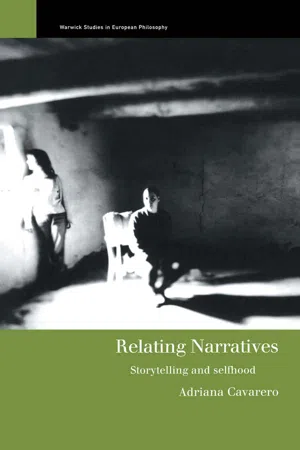
Relating Narratives is a major new work by the philosopher and feminist thinker Adriana Cavarero. First published in Italian to widespread acclaim, Relating Narratives is a fascinating and challenging new account of the relationship between selfhood and narration.
Drawing a diverse array of thinkers from both the philosophical and the literary tradition, from Sophocles and Homer to Hannah Arendt, Karen Blixen, Walter Benjamin and Borges, Adriana Cadarero's theory of the `narratable self' shows how narrative models in philosophy and literature can open new ways of thinking about formation of human identities. By showing how each human being has a unique story that can be told about them, Adriana Cavarero inaugurates an important shift in thinking about subjectivity and identity which relies not upon categorical or discursive norms, but rather seeks to account for `who' each one of us uniquely is.
- 184 pages
- English
- ePUB (mobile friendly)
- Available on iOS & Android
eBook - ePub
About this book
Information
Part I HEROES
1 THE STORY OF OEDIPUS
DOI: 10.4324/9781315824574-3
The mythological Sphinx will rise, and Oedipus will suddenly find himself facing her: confronted with her question, to which he wisely responds, but without realizing that this response of his would do no good for anyone, without realizing that his knowledge was only good for something general — ‘Man,’ he responded, as we know — when the point was to know himself, he himself, in the hiddenness of his being. He was indeed hidden — until, totally defenseless, he was exposed into the world — just born, barely awake.Maria Zambano, Chiari del Bosco
‘Now, Oedipus great and glorious, we seek your help again. Find some deliverance for us by any way that god or man can show,’ says the Priest in Oedipus the King.1 He has solved the riddle of the Sphinx, freeing Thebes. He answered the monster's question regarding which animal walks first with four legs, then with two, and finally with three: ‘Man.’ Oedipus knows, therefore, ‘what’ man is. The knowledge that he shares with the monstrous riddler consists in a definition of the universal.
It goes without saying that there is a correspondence between Oedipus' response and the form of Platonic discourse. What is ‘the just,’ the ‘beautiful,’ the ‘good’ and, of course, ‘what is man?’ are, for Plato, the genuine questions of the universal, which solicit a definition in response.2 It is, in short, the very form of philosophy. Might we therefore say that, faced with the Sphinx, Oedipus reveals himself to be a philosopher? It would seem so. His knowledge says that: man is an animal that as a child walks on four legs, as an adult on two, and in old age — leaning against a cane — on three. Certainly, the scarcity of the enunciation can, at first sight, astonish us if compared with the famous Aristotelian formula that defines man as a rational and political animal — showing itself in this way to be decidedly in keeping with the speculative tones of philosophical language. Then again, Plato himself, in one of his most enjoyable exercises on the art of definition, defines man as a two-footed animal, featherless and without horns.3 The joke is obvious, but the structure of the discourse is the same. Philosophy asks after man as a universal. (For this reason, we will now write Man, so that the upper-case carries the weight of universality.) The definition, which functions as a necessary response to this question, can be more or less refined, and is almost always inadequate or even wrong, but the correct approach to the problem, its epistemic form, does not change.
Oedipus' response — evidently in keeping with the philosophical school of the Theban monster — is nevertheless the right one. The fearful creature annihilates itself: Thebes is freed from the monster. In exchange, Oedipus will have the throne and the Queen Iocasta. Looking closely, with respect to the Platonic canon, the Sphinx has, however, composed a philosophical discourse in reverse. First came the definition in the interrogative form — then its object, as a response. Thus, the logic of the riddle, which always goes backwards from the interrogative definition to the discovery of what it meant, imposes itself. This is a logic, which, on the other hand, is rather dreadful since the answer is in any case linked with an effect of death. The challenge, of course, is deadly: as is typical of ancient Greece, ‘the riddle flows from the cruelty of a god, from malevolence towards men.’4 Either Oedipus or the Sphinx must die; he to be devoured by the monster, she to be cast into the abyss. No one gets out alive from the ancient game that stages the extraordinary ‘contrast between the banality, in the form and the content, of these riddles and the tragedy of their outcome.’5 It is the secret of her knowledge of Man that keeps the monster alive. The one who reveals this secret is saved, but we begin to suspect that he risks living with this monstrous knowledge.
Indeed, the definition itself is not the fearful or deadly side of the formula. The Thebans knew this harmless definition, which speaks of the number of legs, by heart. What decides who lives and who dies is, rather, the response, the definiendum — namely, Man. The Sphinx obviously knows this already: her knowledge is complete. By guessing the answer and putting it together with the question, Oedipus takes possession of that knowledge. And yet, in this transition from the secret of the monster to the human word, the deadly effect is not lost. It would therefore seem that there is something constitutively monstrous about the knowledge of Man. It is almost as though it is the attribution of universality itself that makes a monster of Man. The legacy of the Sphinx is burdensome. Philosophy in Thebes, despite the relief of the city, seems to be born under a bad omen.
Perhaps the riddle is to blame — what with its reversed logic and its lethal effect. Indeed, normally philosophers neither make riddles nor put themselves at risk in the deadly game of the riddle. Rather, philosophers quickly and peacefully determine what it is about the universal Man that should be questioned regarding ‘reality,’ and they then proceed to the answer by means of a definition. In this way, having unwisely accepted the crucial aspect of the monstrous, philosophers shift the problem on to the ‘definition.’ And yet the definition, rather than being a problem — as the Sphinx understood all too well, evidenced by the banal tone of her riddle — is nothing but child's play, a game of variously assemblable formulas (after all, even old Plato had fun with such formulas!).
The true mark of the monster lies, rather, in Man, as Oedipus had the occasion to learn. ‘Man’ is a universal that applies to everyone precisely because it is no one. It disincarnates itself from the living singularity of each one, while claiming to substantiate it. It is at once masculine and neuter, a hybrid creature generated by thought, a fantastic universal produced by the mind. It is invisible and intangible, while nevertheless declaring itself to be the only thing ‘sayable’ in true discourse. It lives on its noetic status, even though it never leaves behind any life-story, and impedes language with the many philosophic progeny of its abstract conception.
If the Sphinx's riddle concealed a philosophical monster, then it seems that Oedipus has had the chance to glimpse its face.
A famous vase-painting shows Oedipus facing the Sphinx, in the act of solving the riddle. He does not speak, he points at himself with his finger. The answer is not verbal and does not name Man, but rather consists in the tacit word ‘I/me.’ The situation is truly paradoxical. At a time when he has yet to learn who he himself is, Oedipus recognizes himself in the definition of Man. In the discovery of the object of this definition, he indicates himself. More than simply being a paradox, this seems once again to be the monster's umpteenth cruel game; since it is precisely the extent to which Oedipus does not know who he is, that he can identify himself in the Man that concerns the definition. Philosophers themselves — servants of the universal — are the ones who teach us that the knowledge of Man requires that the particularity of each one, the uniqueness of human existence, be unknowable.6 Knowledge of the universal, which excludes embodied uniqueness from its epistemology, attains its maximum perfection by presupposing the absence of such a uniqueness. What Man is can be known and defined, as Aristotle assures us; who Socrates is, instead, eludes the parameters of knowledge as science, it eludes the truth of the episteme.
In this way we can understand more exactly how the monster's last lethal game works. Since Oedipus does not know at all who he is; or, rather, he believes that he knows, but is mistaken — there, where the universal stakes its claim to reality by neglecting ‘uniqueness’ — he is already in a vulnerable position.
The deadly alternative of the challenge, between the Sphinx and Oedipus, is therefore also a deadly alternative between abstract Man and concrete uniqueness. In the sentence, ‘I, Man,’ it is the reality of the T that dies. The ancient painting is a tremendous warning.
Thus, it seems to follow that, faced with the Sphinx and the philosophical strength of the riddle, Oedipus does not yet know who he himself is. Within the context of the Sophoclean play, all the same, the situation is rather complex, since, on the other hand, Sophocles, the Athenian public and, obviously, we too, know very well who Oedipus is. Indeed, we know who he is in detail. The play presupposes a knowledge of the mythos; that is, a detailed knowledge of the tale, which, from time immemorial, has recounted the entire story of Oedipus. The story is therefore known by all, except for the protagonists on stage. The theatrical play consists in bringing the plot of events back to the ambiguity that sustains them and thus renders them narratable by the protagonists themselves. In this way, duplicate narrations intersect: the internal, ambiguous one of the actors, and the external, omniscient one of the myth, which comprehends the first and puts it to work. The myth is capable of narrating at once — and this is its power — the ‘true’ story of Oedipus, the story of who he is, and the false story that leads him to be ignorant of ‘who’ he is. It is, moreover, this ignorance that allows the two stories to emerge from the same act. The death of Laius, at the fatal crossroads, is at once the murder of a stranger and a parricide. The union with locasta is both a legitimate marriage, and an act of incest. What governs the double narration — the ambiguous duplication that makes Oedipus an enigmatic mask of duplicity — is his birth, the truth of which he is ignorant, and whose truth the myth knows.7
This birth ends up being decisive in more than one sense. As a driving force of the plot, it is loaded first of all by a prophesied parricide that determines the protagonists' exchange of identity. The myth is well known. Oedipus is born of locasta under a prophecy that destines him to slay Laius, his father. Oedipus, however, escapes the infanticidal command of his parent — a good man took pity on him and took him to Corinth, where Polybus raised him as if he were his son. The story is familiar. Oedipus kills his father, believing him to be a stranger, and, not knowing her to be his mother, marries Iocasta. That Oedipus is ignorant of who he is, because he is ignorant of his birth, is therefore part of the story. Only by knowing his birth can he know his story.
Indeed, within the scene of Oedipus the King, it is precisely the enigma of this birth which catches up with him, making him discover who he is. He does not come across the truth of his birth by accident — like many protagonists of modern novels — but rather looks for it. The spread of the plague, the new evil that afflicts Thebes after the horror of the Sphinx, gives him the chance. The oracle says that the plague is the effect of the ancient unpunished guilt of the murderer of Laius who, remaining unknown, contaminates the city with his presence. So, who better than Oedipus, King of Thebes — who already solved the riddle of the Sphinx — to track down the guilty party and free Thebes once more from the curse? Thus, Oedipus sets about looking into the identity of the unknown; that is, the identity, unknown to him, of himself.
Being the subject and object of the investigation — as though the philosophical guise fit him like a glove — Oedipus therefore seems to unknowingly obey the Delphic command, so dear to the philosopher: gnothi se autori (‘know thy self’). For now, we will not follow this train of thought. Here philosophy does not matter; on the contrary, we will go in the opposite direction. In the ‘know yourself,’ of Oedipus, it is indeed his unrepeatable identity that is found, and not, as with Socrates, a principle of universal value: the famous ‘knowledge of not knowing.’ Furthermore, Oedipus does not embark on any introspective journey into the interior of his self, but rather comes to know his identity from the outside, through the story that others tell him. While Oedipus may have been a philosopher in front of the Sphinx, now he is no longer one. The philosophical undertaking concluded with the monster. For Oedipus, the adventure of the narration has just begun.
As we know, this is an adventure with an unhappy outcome. From the narration of another, Oedipus comes to know of his true birth, and thus his true story: an awful story that makes him incestuous and parricidal. Yet, however awful the outcome of such a narration may be, the drama of the Sophoclean scene is nonetheless rather simple. Oedipus does not know who he is because he is ignorant of his birth. Therefore, only the story of his birth can reveal the story of which he is the protagonist. For Oedipus, in other words, knowing himself means knowing his birth, because that is where his story began. That this story is unfortunate, like the birth from which it begins, is of course part of the tragedy; but this does not affect the truth of a general principle. The story of one's life always begins where that person's life begins. We are not speaking of Man in his disembodied and universal substance, but rather of a particular man, a unique being who bears the name of Oedipus. Since he exists, he was born of a mother. The uniqueness of his identity, his daimon, has its origin in the event of this birth. Oedipus has no doubts regarding this:
She is my mother; my sisters are the Seasons;My rising and my falling march with theirs.Born thus, I ask to be no other manThan that I am, and will know wh...
Table of contents
- Cover Page
- Half-Title Page
- Title Page
- Copyright Page
- Table of Contents
- Translator's Introduction
- Translator's Note
- A Stork for an Introduction
- PART I Heroes
- PART II Women
- PART III Lovers
- PART IV Narrators
- Index
Trusted by 375,005 students
Access to over 1.5 million titles for a fair monthly price.
Study more efficiently using our study tools.
Frequently asked questions
Yes, you can cancel anytime from the Subscription tab in your account settings on the Perlego website. Your subscription will stay active until the end of your current billing period. Learn how to cancel your subscription
No, books cannot be downloaded as external files, such as PDFs, for use outside of Perlego. However, you can download books within the Perlego app for offline reading on mobile or tablet. Learn how to download books offline
Perlego offers two plans: Essential and Complete
- Essential is ideal for learners and professionals who enjoy exploring a wide range of subjects. Access the Essential Library with 800,000+ trusted titles and best-sellers across business, personal growth, and the humanities. Includes unlimited reading time and Standard Read Aloud voice.
- Complete: Perfect for advanced learners and researchers needing full, unrestricted access. Unlock 1.5M+ books across hundreds of subjects, including academic and specialized titles. The Complete Plan also includes advanced features like Premium Read Aloud and Research Assistant.
We are an online textbook subscription service, where you can get access to an entire online library for less than the price of a single book per month. With over 1.5 million books across 990+ topics, we’ve got you covered! Learn about our mission
Look out for the read-aloud symbol on your next book to see if you can listen to it. The read-aloud tool reads text aloud for you, highlighting the text as it is being read. You can pause it, speed it up and slow it down. Learn more about Read Aloud
Yes! You can use the Perlego app on both iOS and Android devices to read anytime, anywhere — even offline. Perfect for commutes or when you’re on the go.
Please note we cannot support devices running on iOS 13 and Android 7 or earlier. Learn more about using the app
Please note we cannot support devices running on iOS 13 and Android 7 or earlier. Learn more about using the app
Yes, you can access Relating Narratives by Adriana Cavarero in PDF and/or ePUB format, as well as other popular books in Philosophy & Feminist Literary Criticism. We have over 1.5 million books available in our catalogue for you to explore.