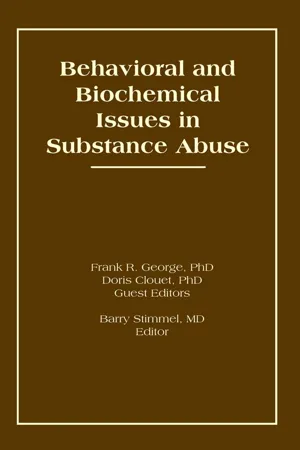
This excellent book is a concise yet thorough examination of the important and emerging field of the study of biological risk factors in drug abuse. Historically, drug abuse research has concentrated on the contributions of environmental and behavioral factors as the major influences on addiction. The revelatory studies in this volume examine the genetic contributions to drug taking behavior through the use of animal models, cellular experiments and human clinical studies. Behavioral and Biochemical Issues in Substance Abuse provides for the first time in one volume, up-to-date, easily digested reviews of topics concerning biological and genetic factors in drug abuse. Medical researchers in all areas of alcoholism and drug abuse, researchers in pharmacology, psychology, psychiatry and neuroscience, and clinicians interested in biological approaches to alcoholism and drug abuse problems will benefit greatly from this valuable resource. Authoritative contributors clearly demonstrate the capability of genetic factors to modulate the reinforcing or rewarding effects of drugs, thereby altering their addictive potential. In addition to gaining comprehension of the biological factors affecting addiction, a greater understanding of genetics related to drug abuse will enable future research to control biological factors, leading to more accurate studies of behavioral and environmental influences on drug and alcohol abuse.
eBook - ePub
Behavioral and Biochemical Issues in Substance Abuse
- 260 pages
- English
- ePUB (mobile friendly)
- Available on iOS & Android
eBook - ePub
Behavioral and Biochemical Issues in Substance Abuse
About this book
Information
Genetic Determinants of Susceptibility to the Rewarding and Other Behavioral Actions of Cocaine
SUMMARY: The role of genotype as a determinant of biologically based inter-individual differences in vulnerability to substance abuse has received little systematic investigation except in the case of alcohol. This report describes the use of an animal model, the inbred mouse, to identify and to characterize variants with inherently altered susceptibilities to the rewarding and other behavioral actions of cocaine. Among a battery of nine inbred strains chosen solely for their genetic diversity, genetic polymorphisms commonly occurred which altered the potency and/or efficacy of cocaine to induce conditioned place preference, oral self-administration, motor activity activation, seizures and lethality. These changes in cocaine sensitivity generally were of a behavior-specific and pharmacodynamic nature. One strain, DBA/21, found to be markedly hyporesponsive to the rewarding action of cocaine, also was hyporesponsive to the rewarding effects of amphetamine, etonitazene, phencyclidine, caffeine and procaine. We speculate that this strain has an inherent generalized appetitive defect. The frequent occurrence and large magnitude of inherent phenotypic changes in cocaine responsiveness which we have identified among inbred mouse strains now permits an analytical genetic study of processes underlying cocaine-mediated reinforcement.
INTRODUCTION
Anecdotal evidence and a limited number of controlled studies suggest that considerable inter-individual heterogeneity exists in the subjective effects, dependency risk, time course of dependency development and severity of the toxic effects associated with the use of psychomotor stimulants in man.1–3 The mechanistic bases for these variations in responsiveness are only suspected at present. In view of the difficulty in controlling the large number of variables which impact on the human drug response phenotype, identification of genetic factors which influence vulnerability to cocaine or amphetamine dependence in man is expected to be a complex process at best. To undertake a systematic and comprehensive study of the influence of genotype on vulnerability to stimulant dependence, we chose to initiate these studies in an animal model in which genotype, environment and drug experience could be rigorously controlled. This paper describes our approach to identifying and characterizing variants with inherently altered responsiveness to cocaine. We have divided this presentation into three parts for clarity: (1) an overview of some pertinent general pharmacological issues; (2) a brief description of the characteristics of our model system, the genetically inbred mouse; (3) a summary of our current research findings.
1. General Considerations Pertinent to the Behavioral Pharmacogenetics of Psychomotor Stimulants
Significant inter-individual heterogeneity in the effects of a pharmacological agent is often found to occur in man and animals. For a given dose of a compound, some individuals may exhibit reduced effects (hypo-responsiveness) compared to the majority of the population (normo-responsiveness). Other individuals may exhibit exaggerated effects beyond those which occur in most individuals (hyper-responsiveness). The distribution of individuals among these three classes of responsiveness may or may not approximate a normal distribution. The outliers at the extremes of the response continuum are of special interest from both a conceptual and a practical point of view. These outliers may provide new insights into innate and environmental mechanisms which impact on susceptibility to one or more effects of a particular compound. In the case of licit substances, the occurrence of such outlying populations defines the frequency of individuals who may not benefit from the desirable properties of a medication or who are at increased risk for deleterious effects such as overdosing or undesirable side effects at the usual therapeutic doses. For illicit compounds, such a distribution might reflect differences in relative dependence liability, risk of psychiatric consequences, specific toxic effects, etc.
For a given drug-induced effect, be it physiological or behavioral, the action of the compound is usually dosage dependent and has a characteristic maximal effect. Heterogeneity in pharmacological responsiveness among individuals can reflect changes in the dose response curve. Changes in potency of the agent will result in either greater or lesser doses of the compound being required to elicit the same final effect. Changes in the relative efficacy of the compound also can occur. In this latter situation the final magnitude of the induced effect is significantly greater or smaller regardless of dose. Efficacy and potency changes may occur together or independently. Finally, a third general type of alteration in response, the occurrence of a qualitatively distinct effect of the drug, may occur in some individuals.
The acute as well as the chronic effects of drug administration reflect the complex interaction of innate factors, pharmacological factors and environmental factors. Innate factors include pharmacokinetic alterations (such as intrinsically reduced/increased rates of drug catabolism), pharmacodynamic alterations (such as changes in number of receptors for a specific neurotransmitter in one brain region) and biologically determined set point or endogenous rate for a type of behavior (e.g., intrinsic mood state, high/low basal activity rate, etc.). Innate factors may be inherited. Alternatively, such factors may be intrinsic to the individual yet not genetically transmitted. Pharmacological factors include issues such as route of administration, specific attributes of particular compounds and their analogs (e.g., half-life, toxic or behaviorally active metabolites, etc.) and previous history of drug exposure. Environmental factors also may influence the response to a drug in many ways. These changes may include altering its rate of catabolism or its biodistribution, modifying the capacity of the organism to respond at the neurochemical level (e.g., neurotransmitter depletion) and restructuring the options for expression of a drug response in the case of behavioral effects. Both interactions with the inanimate milieu and social interactions may be significant. Thus, individual differences in responsiveness to a pharmacological agent, such as cocaine, are likely to arise from very complicated interactions between factors intrinsic to the individual, pharmacological factors and environmental factors.
Such complexity, coupled with reticence of individuals to admit illicit drug use, probably masks the role of genetic determinants as risk factors in dependence vulnerability and in the expression of toxicity following exposure to psychomotor stimulants and other controlled substances in man. Precedent for the possibility that inherited traits may alter the relative susceptibility of an individual to the rewarding effects of cocaine or other illicit substances is based on a substantial body of evidence that the reinforcing effects of ethanol are influenced by inherited factors.4,5 Hereditary predisposition to a broad spectrum of disease entities associated with abnormal behavior and/or abnormal function of the central nervous system is now well recognized.7 The fraction of individuals becoming dependent on cocaine among all those individuals who have experimented with this euphoriant may include individuals who are inherently biologically vulnerable to its rewarding effects.
The processes believed to intervene between the acute, drug-induced activation of the reward response and the subsequent development of dependence following chronic drug exposure are themselves complex. As indicated in Figure 1, acute hedonic responses are experienced in the milieu of other drug-induced behavioral and physiological effects. Opposing processes which serve to negatively regulate the net response to euphoria may be as significant as the rewarding actions of the drug.8 Polymorphic genes existing in the population may influence any one or more than one of these response traits. An array of variants with altered susceptibility to the acute rewarding effects of cocaine, as well as to chronic responses should be anticipated. Each of these might possess a somewhat distinctive phenotype depending upon the monospecific or pleiotropic actions of the variant genes. This consideration and the large fraction of the mammalian genetic repertoire uniquely devoted to the development, maintenance and function of the nervous system (30–40% of the genome, an estimated 30,000 to 40,000 genes in man)6 make intuitively unlikely the existence of only one, single specific genotypic change which uniquely confers sensitivity or resistance to the acute hedonic actions of cocaine or dependence development following chronic use. From this viewpoint, it is necessary to define precisely the specific goals of a genetic investigation focusing on the issue of genetic vulnerability to cocaine-medi...
Table of contents
- Cover
- Half Title
- Title Page
- Copyright Page
- Table of Contents
- About the Editors
- Editorial: Behavioral and Biochemical Genetic Issues in Substance Abuse
- Genetic Selections for Nicotine and Cocaine Sensitivity in Mice
- Where Are the mu Receptors That Mediate Opioid Analgesia? An Autoradiographic Study in the HAR and LAR Selection Lines
- Behavioral and Neurochemical Studies in Diazepam-Sensitive and -Resistant Mice
- Animal Models for the Study of Alcoholism: Utility of Selected Lines
- Use of Recombinant Inbred Strains to Assess Vulnerability to Drug Abuse at the Genetic Level
- The Use of Recombinant Inbred Strains to Study Mechanisms of Drug Action
- Progress Towards the Development of Animal Models of Smoking-Related Behaviors
- Is There a Common Biological Basis for Reinforcement from Alcohol and Other Drugs?
- Genetic Determinants of Susceptibility to the Rewarding and Other Behavioral Actions of Cocaine
- Issues Surrounding the Assessment of the Genetic Determinants of Drugs as Reinforcing Stimuli
- Establishment of Drug Discrimination and Drug Reinforcement in Different Animal Strains: Some Methodological Issues
- Biochemical Genetic Differences in Vulnerability to Drug Effects: Is Statistically Significant Always Physiologically Important and Vice Versa?
- Genetic Influences in Human Substance Abuse
- Methodological Issues in Genetic Studies of Human Substance Abuse
- The Use of Nonneuronal Cells as an In Vitro Model System for Studying the Genetic Component of Cellular Response to Opiates and Other Drugs of Abuse
- Selective Guide to Current Reference Sources on Topics Discussed in this Volume
Trusted by 375,005 students
Access to over 1.5 million titles for a fair monthly price.
Study more efficiently using our study tools.
Frequently asked questions
Yes, you can cancel anytime from the Subscription tab in your account settings on the Perlego website. Your subscription will stay active until the end of your current billing period. Learn how to cancel your subscription
No, books cannot be downloaded as external files, such as PDFs, for use outside of Perlego. However, you can download books within the Perlego app for offline reading on mobile or tablet. Learn how to download books offline
Perlego offers two plans: Essential and Complete
- Essential is ideal for learners and professionals who enjoy exploring a wide range of subjects. Access the Essential Library with 800,000+ trusted titles and best-sellers across business, personal growth, and the humanities. Includes unlimited reading time and Standard Read Aloud voice.
- Complete: Perfect for advanced learners and researchers needing full, unrestricted access. Unlock 1.5M+ books across hundreds of subjects, including academic and specialized titles. The Complete Plan also includes advanced features like Premium Read Aloud and Research Assistant.
We are an online textbook subscription service, where you can get access to an entire online library for less than the price of a single book per month. With over 1.5 million books across 990+ topics, we’ve got you covered! Learn about our mission
Look out for the read-aloud symbol on your next book to see if you can listen to it. The read-aloud tool reads text aloud for you, highlighting the text as it is being read. You can pause it, speed it up and slow it down. Learn more about Read Aloud
Yes! You can use the Perlego app on both iOS and Android devices to read anytime, anywhere — even offline. Perfect for commutes or when you’re on the go.
Please note we cannot support devices running on iOS 13 and Android 7 or earlier. Learn more about using the app
Please note we cannot support devices running on iOS 13 and Android 7 or earlier. Learn more about using the app
Yes, you can access Behavioral and Biochemical Issues in Substance Abuse by Doris Clouet,Frank R George,Barry Stimmel in PDF and/or ePUB format, as well as other popular books in Psychology & Genetics in Medicine. We have over 1.5 million books available in our catalogue for you to explore.