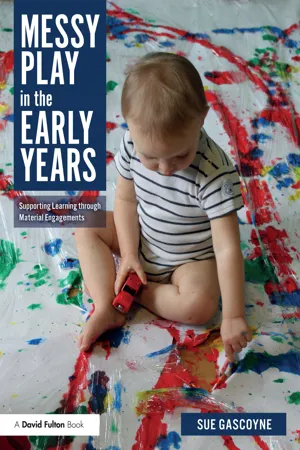
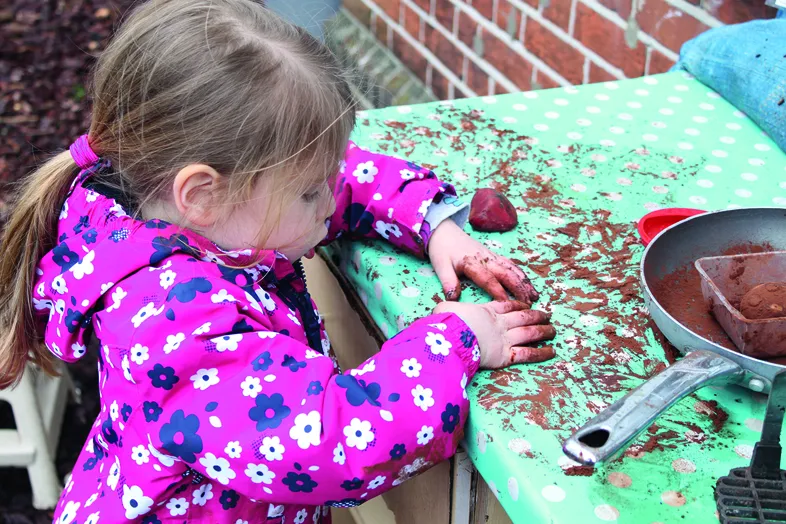
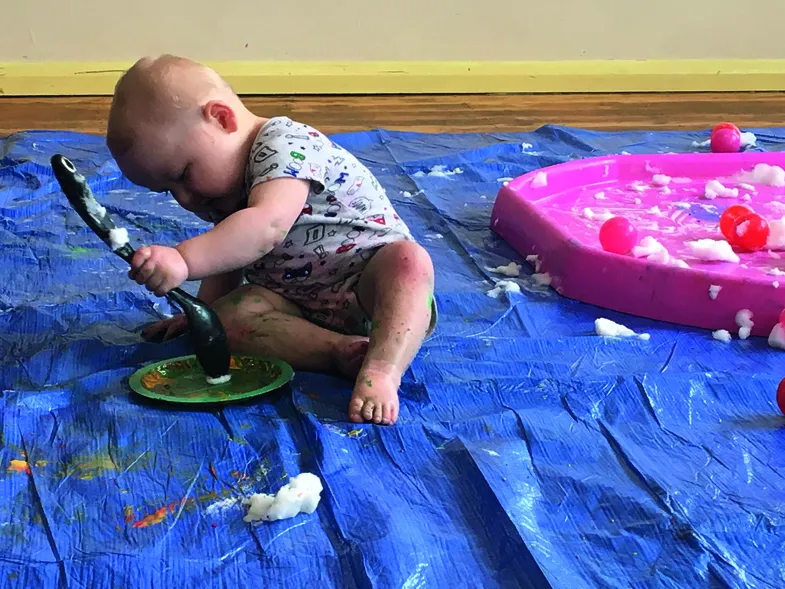
Combining a rich theoretical foundation with practical tips, advice and case studies, Messy Play in the Early Years provides an informative and practical exploration of the unique qualities, characteristics and learning possibilities of messy play.
Packed with valuable insights from research and theory, along with practitioner's experiences, this accessible book will bolster readers' understanding and appreciation of messy play and demonstrate how a range of material engagements can enhance young children's development and learning. Exploring an array of resources and a broad spectrum of approaches, including adult-and child-led inquiry, chapters consider how the specific sensory qualities of materials encourage problem-solving, scientific thinking, creativity, self-regulation and self-expression as children discover and make sense of new phenomena. With examples of international practice and reflective questions throughout, the book highlights a variety of approaches to meeting differing time, space and budgetary needs, simplifies preparation and planning, and empowers practitioners and children to understand and use messy play effectively.
An essential guidebook to supporting an engaging and rewarding journey into messy play, Messy Play in the Early Years will be an invaluable resource for early years students, practitioners and parents looking to understand and enhance children's learning possibilities.
Most practitioners instinctively know that messy play is good, even if it fills some with dread or can only be tolerated if ‘not in my home!’ Love it or hate it, ‘material engagements’1 are a key ingredient of the early years landscape and this book aims to increase understanding and provide confidence in the true learning and development value of messy play.
My own interest in messy play started fourteen years ago when my daughter was a toddler. I’d given her cooked couscous to play with only to be interrupted by a work call. The resulting mess, smeared gunge over the kitchen floor, table and chairs, taught me a valuable lesson about attentive parenting, not to mention appropriate equipment, as those fabric chairs were never the same again! Even then, exhausted from clearing up the aftermath and having galvanised a phobia of messy play in my husband, I knew that my daughter’s explorations had been worthwhile, despite the mess!
Since then I have shared a journey of discovery of messy play with my own children and an array of families, practitioners and children in childcare and therapeutic settings. As my adventure has progressed I have found myself returning time and again to the uniquely special qualities of messy play and my mission to understand the what, why and how of this revered and reviled play, so that we can better appreciate and support children’s interactions. In this book I hope to shine a torch on those very questions, taking the reader on a journey of discovery about messy play.
Messy play myths
We’ll start by exploring and, hopefully dispelling, some common myths so we can illuminate what messy play is, and what it is not.
Myth 1 – ‘Messy play is really messy’
When we think of messy play we tend to picture super-messy resources like mud and gloop.2 Although messy play encounters like my couscous misadventure can undoubtedly be untidy, this is not their purpose, but rather a product of children’s material engagements, thinking and need for immersion (Chapter 2). As will be evident when we focus on the spectrum of materials in Chapter 4, messy play resources can be classified according to their wet, dry or sticky texture and composition, each of which will impact upon the specific qualities of the resources being explored and how they are used.
Stretched budgets and a desire to look afresh at messy play have informed the emphasis upon low- and no-cost natural resources and early years staples in this book. While specialist messy play materials have a limited presence, most things are capable of being used for messy play, making resources infinitely varied and limited only by the imagination.
Myth 2 – ‘Messy play is just for very young children’
While a focus on the youngest children is welcome and we know from countless reports just how important quality early years experiences are to children’s life potential, that doesn’t mean that older children can’t benefit too:
I remember one time we started mud-sliding down a small hill after a particularly heavy rainstorm and a group of 8-to-11-year olds all joined in. This was an inner-city adventure playground with no provision for wellies or wet weather gear so [we] were all in ordinary clothes. About twenty children and staff took part and they had completely covered backsides and legs. One 15-year-old, ‘Tommy’, spent his time teasing the children who were covered in mud…. He stood alone watching the other younger children (and me) sliding down the hill, occasionally grunting insults at us. [When] someone shouted that tuckshop was open…. every child ran as fast as they could into the building and queued-up. Tommy didn’t follow. About 10 minutes later the door to the project was flung open and Tommy walked in. He was so covered in mud you could barely see clothing and face. The smile on his face could be seen though. He had waited until everyone else had gone inside and then repeatedly slid down the hill on his front!
(Ben Kingston-Hughes, 2018)
As we shall discover in Chapter 2, some older children may have missed out on valuable opportunities to experience the world in a sensory and whole-bodied way in their formative years. For these children, accessing paint or another media through an intermediary brush will never be as satisfying as smearing and squelching it in their hands. Only once they have enjoyed experiencing it in an active, sensory and embodied way (Jennings, 2011), will they discover, as if a young child ‘What is this material like?’, can they start to explore ‘What can I do with it?’ and ‘What can it become?’.
In Chapter 5 I introduce the value of material engagements for increasing children’s and adults’ mindfulness. But the value of material engagements doesn’t end there. No matter how playful we are as adults, we can always benefit from an injection of awe, wonder and curiosity. The surprising qualities of messy play (explored in Chapter 3) challenge our assumptions, reminding us of what it’s like to experience the world as a ‘sensory being’ (Grace, 2018). Unencumbered by worries, we’re able to enjoy the sheer sensory experience in the moment. For some adults, messy play brings with it those rare moments of freedom and release that come from being playful.
International festivals such as Thailand’s New Year Songkran festival revel in this sensory freedom, as young and old wield buckets and water guns and you can expect to be soaked for days on end! If you’ve partaken in Spain’s La Tomatina festival with its people and buildings caked in plum tomatoes, or India’s dazzling Holi Festival, where for one day only, adults throw handfuls of vibrant paint on anyone and everyone who happens to pass by, then it’s easy to be struck by their similarities to messy play. The resulting scene of swirling colours or tomato pulp has more than a nod to messy engagements and adult participants get a taste of the thrill and liberation of material encounters!
Reflection
Try to experience immersion in a messy encounter, be it being buried in sand on the beach, getting soaked through in the rain, body-sliding in mud or cocooning yourself in shredded paper or leaves. Savour the moment and notice any heightened sensory awareness or emotions.
Myth 3 – ‘Messy play is noisy, energetic and just good fun’
Messy play can be exciting and fun, providing endless possibilities, but it can also be enriching and satisfying, captivating and incredibly calming. These two extremes were evident in a survey of 35 practitioners (Gascoyne, 2018a), which identified sensory stimulation; fun; and calming and soothing (as well as communication and self-expression) as the most commonly cited benefits of messy play. Some children may find messy play encounters frustrating, others repulsive yet strangely compelling. For a child with sensory processing difficulties, touching certain substances may make finger play with gloop the antithesis of fun. As we shall discover on our journey through the landscape of messy play, experiences are infinitely varied, shaped by:
■ the messy play materials,
■ individual child and context,
■ physical and emotional environment,
■ the adult’s approach and
■ quality of adult/child relationship.
So, to pigeon-hole messy play as ‘just good fun’ would be to miss out on its potential to deliver so much more. With an artificial split sometimes suggested between real learning and play, it’s worth emphasising that just because children find messy play fun, it doesn’t mean they won’t distil learning. Indeed, messy play effortlessly delivers a wealth of cross-curricular learning opportunities, rooted in real discoveries, as will become apparent throughout this book. It was even reputedly a forbidden pursuit in at least one serial killer’s childhood3 – a chilling indicator perhaps of its wider benefits.
Myth 4 – ‘Messy Play is all about the end product’
With some books suggesting the creation of animals and pictures as legitimate messy play outcomes, you’d be forgiven for thinking that an end product is a natural conclusion. In fact, it was this focus on making something that was a key motivator for writing this book and offering an alternative approach! Definitions of messy play are limited but Duffy (2007) suggests that it should be about the process rather than an end product and this is something with which I wholeheartedly agree. An adult-initiated activity such as exploring paint with the objective of creating a picture is not messy play. However, the emergence of an end product doesn’t rule out messy play. Agency is key. If the child chooses to create a product from, during or as a natural extension to, their material explorations then this is a valid outcome. The subtle differences are helpfully illuminated in the following three examples:
■Cheesy puff – An 8-year-old was exploring a mixture of sand and dried couscous (I’d learnt my lesson about using cooked couscous!). She added a maize packing ‘peanut’ to the mix and frustration quickly turned to delight as she discovered that the sandy mixture had stuck to its exterior so that it resembled a well-known cheesy snack!
■Butterfly print – A 7-year-old experimented with adding different-coloured paint to a box, using their hands to spread, splat and smear the paint over its insides. When he had finished he firmly planted his hands on a piece of A4 paper, squishing and moving them to remove the excess paint. He then folded the sodden paper in half, carefully opening to reveal a butterfly-like print. He got several pieces of paper to make prints of the design, each one getting slightly fainter. Exclaiming what ‘a beautiful butterfly’ he marvelled at these with evident satisfaction.
■Make a sparkly snowman – ‘Stretch the snow gak4 into snowman shapes … Decorate with … buttons and pipe cleaners. Photograph the snowmen and use the photos for Christmas cards’ (Featherstone, 2016: 34).
Our understanding of messy play will shape a multitude of factors, from what we provide and how, to the quality of children’s experience.
Reflection
Discuss each of these snapshots of play and compare against Duffy’s (2007) definition of messy play provided on page 7. Decide which represents m...
Table of contents
Cover
Half Title
Title Page
Copyright Page
Dedication
Table of Contents
Acknowledgements
List of figures and tables
1 Introducing messy play and material engagements
2 Messy play and its theoretical roots
3 Investigating and quantifying messy play
4 Patterns in messy play use
5 Planning enabling messy play environments
6 Creating enabling environments for messy play
7 Material encounters and inquiry-based learning
8 Agency and messy play
9 Misadventure or mess adventures?
References
Index
Trusted by 375,005 students
Access to over 1.5 million titles for a fair monthly price.
Study more efficiently using our study tools.
Frequently asked questions
Yes, you can cancel anytime from the Subscription tab in your account settings on the Perlego website. Your subscription will stay active until the end of your current billing period. Learn how to cancel your subscription
No, books cannot be downloaded as external files, such as PDFs, for use outside of Perlego. However, you can download books within the Perlego app for offline reading on mobile or tablet. Learn how to download books offline
Perlego offers two plans: Essential and Complete
Essential is ideal for learners and professionals who enjoy exploring a wide range of subjects. Access the Essential Library with 800,000+ trusted titles and best-sellers across business, personal growth, and the humanities. Includes unlimited reading time and Standard Read Aloud voice.
Complete: Perfect for advanced learners and researchers needing full, unrestricted access. Unlock 1.5M+ books across hundreds of subjects, including academic and specialized titles. The Complete Plan also includes advanced features like Premium Read Aloud and Research Assistant.
Both plans are available with monthly, semester, or annual billing cycles.
We are an online textbook subscription service, where you can get access to an entire online library for less than the price of a single book per month. With over 1.5 million books across 990+ topics, we’ve got you covered! Learn about our mission
Look out for the read-aloud symbol on your next book to see if you can listen to it. The read-aloud tool reads text aloud for you, highlighting the text as it is being read. You can pause it, speed it up and slow it down. Learn more about Read Aloud
Yes! You can use the Perlego app on both iOS and Android devices to read anytime, anywhere — even offline. Perfect for commutes or when you’re on the go. Please note we cannot support devices running on iOS 13 and Android 7 or earlier. Learn more about using the app
Yes, you can access Messy Play in the Early Years by Sue Gascoyne in PDF and/or ePUB format, as well as other popular books in Education & Early Childhood Education. We have over 1.5 million books available in our catalogue for you to explore.