![]()
Part 1
Understanding anxiety
![]()
1 What is anxiety?
What do we mean by anxiety?
Psychologists consider anxiety to be an emotion closely related to fear. Fear is one of the five basic emotions along with sadness, happiness, anger and disgust. There is no single definition of anxiety, but some that the authors have found helpful are highlighted below:
Anxiety is sometimes described as fear, worry, unease and nervousness. Some researchers make a distinction between fear and anxiety. Fear is usually considered to have a clear object; for example, a fierce, snarling dog invokes a ‘fight or flight’ response, either staying to fight or leaving to escape danger, with the response disappearing once the threat has passed. Worry has a specific object which may or may not be real/present. Anxiety is often less specific, we may not know why we feel anxious, and it may persist over time.
Everybody has worries but anxiety becomes a problem when the fear or anxiety is:
out of proportion to the situation or age-inappropriate (see Chapter 3)
persisting for six months or longer
interfering with the ability to function normally.
The Diagnostic and Statistical Manual of Mental Disorders – 5th Edition (DSM 5) separates anxiety disorders into three separate categories:
Problem anxiety will manifest in different forms, vary in intensity and duration and may include feelings of powerlessness and panic. Children may suffer a distressing level of anxiety without reaching the criteria for a diagnosis.
This book is intended to address childhood anxiety within the DSM 5 criteria for anxiety disorders. It does not address the other two categories of obsessive compulsive disorders or trauma and stressor-related disorders in great depth. Parents who are particularly concerned about a child and believe they may require specialist help should seek advice from a qualified medical practitioner.
What is anxiety?
Anxiety is a normal emotion which has evolved over time to keep us safe. The part of our brain that deals with emotions was present in our very early beginnings. When we lived in caves and were in danger from many physical threats, anxiety evolved to alert us to danger. As our brains have developed over time, the thinking part of our brain has become much bigger and stronger. However, these two parts of the brain do not always balance comfortably together. Sometimes emotions ‘take over’ from thinking. If we are in danger we don’t stop and think about what to do, as this would take too much time. Without thinking, we react to the danger as quickly as possible to keep ourselves safe.
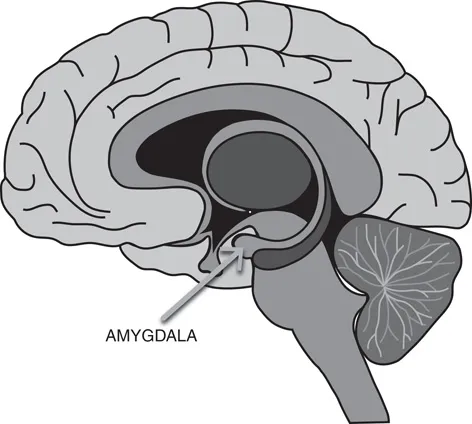
The emotional part of the brain sits deep in the middle of the brain and is called the amygdala. The thinking part of the brain is the outside part and is called the cortex.
FIGURE 1.1 The brain
All our responses are made up of four elements; feelings, thoughts, behaviour and bodily reactions (physiology). These elements interact and affect each other.
Excessive anxiety is characterised by:
Thinking – negative thoughts, with a tendency to notice possible threats too easily and to interpret situations negatively
Feelings - frightened, fearful, out of control
Behaviour – avoidance and rituals (safety and comfort behaviours)
Physiology – extreme physical reactions which can lead to more fear.
Many anxious children overestimate the danger involved in a situation and underestimate their ability to cope. This leads to behaviours, thoughts and physiology which reinforce the fear. It is easy to get into a cycle where anxiety and fear lead to more anxiety and fear.
It is not possible to eradicate anxiety altogether, and neither would we want to as we need it to keep us safe. However, we can learn better ways to manage difficult feelings, challenge negative thoughts, and develop plans to make us feel that we can attempt things more easily.
It is possible that anxiety will be manifested in alternative emotional responses. It is not unusual, for example, for anger outbursts to be caused by extreme anxiety and a feeling of a lack of control. From an evolutionary perspective anger and anxiety are both responses to threat which alert us to danger, not just to our physical beings but also to our inner selves. Sadness, tearfulness and depression may also be seen as a manifestation of anxiety. These emotions can therefore appear together and/or alongside each other. We often learn behaviours to express our emotions that are acceptable within the family. Parents may need to explore these options when their child is showing intense emotions.
What causes anxiety?
The causes of anxiety are complex. Generally, researchers agree that a combination of environmental and individual factors affect the probability of developing anxiety disorders:
Genetic make-up
Studies looking at parents of anxious children and children of anxious parents have found that anxiety does seem to run in families. A person with severe anxiety is likely to have a parent or other family member with similar difficulties.
It is likely that there are two factors at play in this familial predisposition. First, there is an over-sensitive biological reaction to stress, triggering a fight/flight response when it is not necessary, and a general tendency to a high level of emotional arousal (Barlow, 2002). Second, there is a tendency to interpret ambiguous events as potentially dangerous (Eley et al, 2008).
However, it is important to remember that genetic vulnerability does not necessarily lead to anxiety difficulties. This will only happen when it is triggered by life events.
Environmental factors
Four childhood experiences have been identified as potentially contributing to the likelihood of developing high levels of anxiety:
Trauma and stressful events; for example, bullying, teasing, parental conflict, sexual or physical abuse, death of a parent (Stein, 2008)
Parenting style; for example, over protective, sending out a signal that the world is a dangerous place, not allowing children to cope independently with difficulties (Hudson and Rapee, 2009)
Attachment style; for example, inconsistent and unpredictable parenting leading to anxious/resistant attachment (Warren et al, 1997)
Learning from others (Gerul and Rapee, 2002).
Again, we must be clear that none of these necessarily leads to anxiety problems; they can contribute in some instances.
Short-term triggering causes
Children and young people can feel anxious about:
people
animals, birds, insects
others’ behaviour, opinions; bullying, for example
places
specific situations, such as tests and field trips.
Types of anxiety
The DSM 5 recognises a...